
Free asset inventory template
Free asset inventory template (PDF). Track every asset by ID, location, holder, condition and status. Download and start today.
Updated 4 June 2026
How to use: download the PDF, print or complete digitally on any device.
- PDF format, ready to print or fill on screen
- Use as-is or customise to suit your operation
- Go digital in MapTrack for photos, reminders and audit trails
Download free PDF template
Use in MapTrack →



Trusted by teams across Australia and New Zealand
We respect your privacy. Unsubscribe anytime.
Or set it up in MapTrack
- Fill it in on a phone, attach photos to any check
- Automatic reports and audit trails
- Upload the PDF and MapTrack drafts the form for you
Free 30-day trial. No credit card. Personal email accepted.
Don't just download it - use it live. Start a free workspace, upload this asset inventory template and MapTrack drafts it as a form your crew can run from a phone.

Co-Founder & Commercial Director
Key takeaways
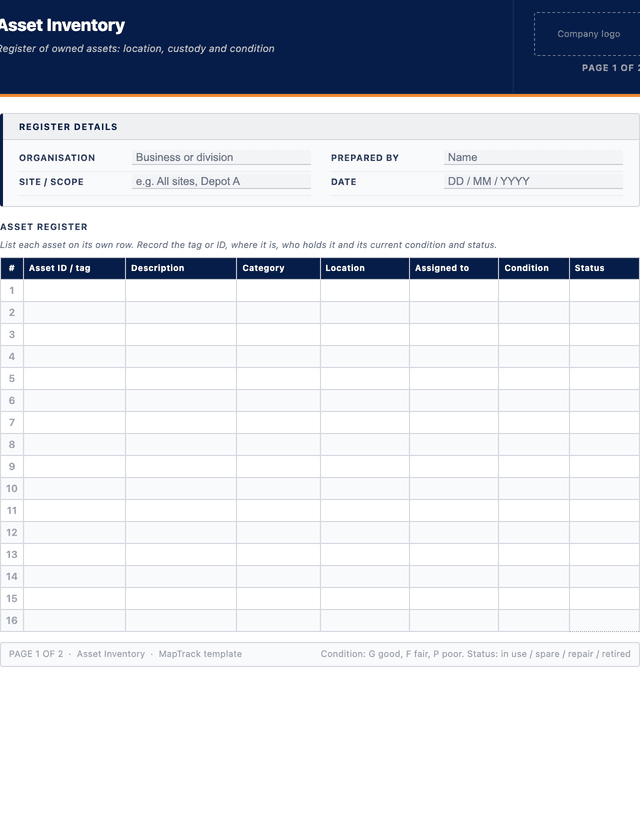
- The MapTrack asset inventory template has 7 columns and room for 28 entries. Columns: Asset ID / tag, Description, Category, Location, Assigned to, Condition, Status.
- An asset inventory lists every asset you own with its tag, location, current holder, condition and status, so nothing is lost or double-counted.
- Operational inventory answers where an asset is and who has it; a fixed asset register answers what it is worth for accounting. Keep both.
- ISO 55001 and the WHS Regulations 2011 expect organisations to know and control the plant they hold; an accurate inventory is the starting point.
- Reconcile the inventory with a physical stocktake at least annually; QR or barcode labels make the count far faster and more accurate.
Enter your email below to download this asset inventory template as a ready-to-use PDF.
Used by construction, mining and field service teams











What is an asset inventory template?
An asset inventory template is a structured register used to record every physical asset an organisation owns or controls in one place. For each asset it captures a unique ID or tag, a description, the category, where the asset is located, who currently holds it, its condition and its status (in use, spare, in for repair or retired). Unlike a stocktake count sheet, which simply tallies how many of an item exist, an asset inventory tracks individual assets and their custody so you always know what you have and where it is.
Asset inventories are used across construction, mining, manufacturing, facilities and trades wherever tools, plant and equipment move between people, vehicles and sites. Without one, organisations lose assets, buy duplicates of items they already own and fail audits because they cannot account for what they hold. In MapTrack, this inventory becomes a live register: each asset carries a QR or barcode label, check-in and check-out updates the holder automatically, and condition and location are captured on a phone in the field. Australian guidance under ISO 55001 and the record-keeping expectations of the WHS Regulations 2011 both assume an organisation can identify and locate the plant and equipment it is responsible for.
Learn more about asset tracking in MapTrack.
Benefits of using this asset inventory template
- Single source of truth: every asset recorded in one register so teams stop guessing what the business owns and where it sits.
- Loss prevention: knowing the current holder and location of each asset makes theft and misplacement obvious quickly.
- Less duplicate spend: a visible inventory stops crews buying tools and equipment the business already owns.
- Faster audits: an up-to-date inventory gives auditors and insurers a clear, accountable list of assets on demand.
- Condition visibility: recording condition and status flags items needing repair or replacement before they fail in the field.
- Stocktake ready: a structured register reconciles cleanly against a physical count, especially when assets are QR or barcode tagged.
- Better decisions: location and utilisation patterns reveal where to redeploy idle assets instead of hiring or buying more.
Benefits of digitising forms in MapTrack
When you move your asset registers from paper to MapTrack, you get:
- Field users can easily scan a QR code to complete a form on mobile. Unlimited users.
- Email the right people when a form is submitted, with an automation you set up.
- File every completed form against the asset, location or person it covers.
- Download any completed form as a PDF, with failed answers listed at the top.
- Fill in forms offline; they upload when the device is back online.
- Build conditional logic (show or hide questions based on answers).
- Take pictures or attach photos. Not possible with a paper-based form.
- Electronic signatures.
- Edit forms later without reprinting.
- Set who can view, fill in or edit forms with user roles.
- Upload a paper form (PDF, Word, Excel or a photo) and MapTrack's AI builds a digital version for you to check.
- Keep one asset register with each asset's location, condition and custody history.
- Schedule calibration and record certification and warranty expiry dates against each asset.
- See each asset's value over time in the Asset Depreciation report.
Book a demo to see how MapTrack handles asset registers.
Try MapTrack free for 30 days
Full access to every feature. No credit card required. Per-asset pricing so you scale as your fleet grows.
- No credit card required
- 30 days free trial
- Cancel anytime
1-2 days/week saved
“Bloody amazing! We used to spend 1-2 days a week tracking and managing our generators alone.”

Steve McAllister
Asset Coordinator, Saunders International
What to include in an asset inventory template
This asset inventory template covers 10 key areas:
- Register details: organisation, prepared by, site or scope covered, and the date of the inventory.
- Asset ID or tag: a unique identifier or barcode/QR tag number for each asset.
- Description: a clear name for the asset, including make and model where relevant.
- Category: asset type or group (for example tools, plant, IT, vehicles) for filtering and reporting.
- Location: the site, vehicle, store or area where the asset is currently held.
- Assigned to: the person, crew or cost centre responsible for the asset right now.
- Condition: a simple rating (good, fair, poor) reflecting current serviceability.
- Status: in use, spare, in for repair or retired, so availability is clear at a glance.
- Value: optional current or replacement value to support insurance and budgeting.
- Notes: defects, accessories, warranty or any action required.
How to use this asset inventory template
- Define the scope and set up the register columns before you start counting.: Decide which sites, categories and asset types the inventory will cover, then confirm the columns you need such as ID, location, holder, condition and status. Agreeing the scope first prevents gaps and double-counting later.
- Give every asset a unique ID or tag and label it physically.: Assign a unique identifier to each asset and attach a durable barcode or QR label where possible. Physical tags remove ambiguity between similar items and make future stocktakes far quicker and more accurate.
- Walk each location and record every asset you find against the register.: Move systematically through each site, vehicle and store, scanning or writing down each asset with its description, category, current location and the person or crew holding it. Record condition and status as you go.
- Capture condition, status and any defects for each asset.: Rate the condition of each asset and set its status to in use, spare, in for repair or retired. Note any defects, missing accessories or actions required so follow-up work can be scheduled rather than forgotten.
- Reconcile the count against existing records and investigate discrepancies.: Compare the completed inventory with purchase records, the previous inventory or your asset register. Investigate missing or unexpected items, correct the register and record any write-offs or transfers so the data stays trustworthy.
- Store the inventory, set a review date and keep it current as assets move.: Save the completed inventory as your baseline, schedule the next review at least annually, and update the register whenever assets are bought, transferred, repaired or disposed of. A static inventory drifts out of date within months.
In MapTrack, you can manage your full asset register digitally. Each submission is stored as a timestamped PDF against the asset record.
Get the free templateEnter your email above to download the full asset inventory template as a PDF.Back to download formHow often should you complete this asset register?
Complete a full asset inventory at least once a year, and reconcile it with a physical stocktake before annual audits or insurance renewals. Update the register continuously as assets are bought, transferred between sites or people, sent for repair or disposed of. High-value or high-loss categories such as power tools and portable plant benefit from more frequent spot checks, for example quarterly. In MapTrack, the register updates in real time as assets are scanned in and out, so the inventory never goes stale between formal counts.
Frequently asked questions
Applicable regulatory standards
This template is a starting point. Check the current requirements that apply to your equipment, work and location. The template alone does not establish compliance.
- ISO 55001 - Asset Management Systems (establishing control over the assets an organisation holds)
- WHS Regulations 2011, Chapter 5 - Plant and Structures (records of plant an organisation is responsible for)
- ISO 55000 - Asset Management (overview and principles of managing physical assets)
Asset inventory template preview
The numbers behind this asset inventory template
Every figure below is sourced and dated, so you can quote it in a toolbox talk, a budget case or a board paper without having to chase the original report.
Embed this free template on your website
Run an industry blog, trade association site, or training resource? Drop a preview of this free asset inventory template straight into your page. The snippet is self-contained, needs no scripts, and links readers back to the full free template.
<div style="max-width:480px;font-family:system-ui,-apple-system,'Segoe UI',Roboto,sans-serif;border:1px solid #E5E7EB;border-radius:12px;padding:20px;background:#ffffff;">
  <p style="font-size:12px;font-weight:700;letter-spacing:0.05em;text-transform:uppercase;color:#071D49;margin:0;">Free template</p>
  <p style="font-size:18px;font-weight:700;color:#071D49;margin:6px 0 0;">Asset inventory template</p>
  <ul style="margin:12px 0 0;padding-left:18px;color:#374151;font-size:14px;line-height:1.6;">
    <li style="margin:4px 0;">Register details: organisation, prepared by, site or scope covered, and the date of the inventory.</li>
    <li style="margin:4px 0;">Asset ID or tag: a unique identifier or barcode/QR tag number for each asset.</li>
    <li style="margin:4px 0;">Description: a clear name for the asset, including make and model where relevant.</li>
    <li style="margin:4px 0;">Category: asset type or group (for example tools, plant, IT, vehicles) for filtering and reporting.</li>
    <li style="margin:4px 0;">Location: the site, vehicle, store or area where the asset is currently held.</li>
    <li style="margin:4px 0;">Assigned to: the person, crew or cost centre responsible for the asset right now.</li>
  </ul>
  <p style="font-size:13px;color:#6B7280;margin:14px 0 0;padding-top:12px;border-top:1px solid #E5E7EB;">Free <a href="https://www.maptrack.com/templates/asset-inventory-template" style="color:#071D49;font-weight:600;text-decoration:none;">Asset inventory template</a> by MapTrack</p>
</div>Free to reuse, including commercially. This template is published under a Creative Commons Attribution 4.0 licence. Copy it, adapt it, put it on your own site or in your own docs. All we ask is that you credit MapTrack with a link back to this page. The snippet above already includes that credit, so if you use it as-is you’re covered.
Cite this template
Writing about this topic? You’re welcome to quote this checklist. Here’s the wording to use so your readers can find the original.
The MapTrack asset inventory template has 7 columns and room for 28 entries.
- Short attribution
- MapTrack Asset inventory template, https://www.maptrack.com/templates/asset-inventory-template
- Reference list
- MapTrack. (2026). Asset inventory template [Checklist template]. Retrieved from https://www.maptrack.com/templates/asset-inventory-template
Free to reuse with credit under a Creative Commons Attribution 4.0 licence. If you’d rather link straight to it, the page is https://www.maptrack.com/templates/asset-inventory-template.
Need to manage your full asset register digitally?
Register every asset in MapTrack, attach digital forms, and get a complete history of every inspection, service and compliance record.