
Free template · PDF
Free site induction checklist
Free site induction checklist for Australian workplaces (PDF-ready). Covers PPE, emergency procedures, hazards, muster points and sign-on. Download now.
Loading PDF page...
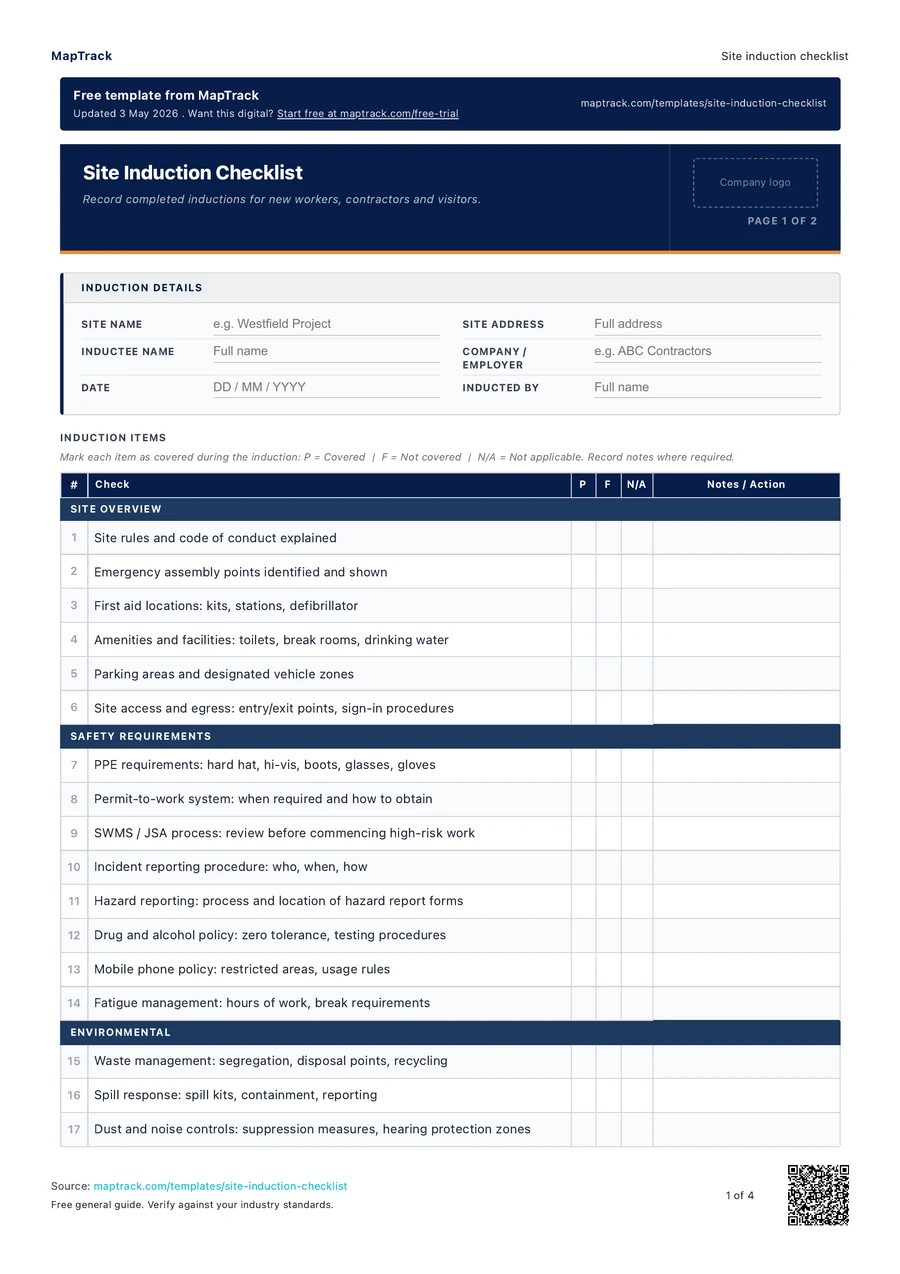


Read the form fields
28 checks · 5 sections · Sign-off
28 checks
The fields in the printable form, in a view that fits your screen.
- Site name
- Site address
- Inductee name
- Company / employer
- Date
- Inducted by
Site Overview
Safety Requirements
Environmental
Emergency Procedures
Site-Specific Hazards
Declaration
I declare that I have completed the site induction and understand the safety requirements, emergency procedures and site rules. I agree to comply with all site safety requirements and to report any hazards or unsafe conditions immediately. I understand that failure to comply with site rules may result in removal from site.
Inductee Sign-off
Signature · Print name · Date & time
Site Supervisor Sign-off
Signature · Print name · Date
The MapTrack site induction checklist contains 28 checks across 5 sections.

Make this form your own
Add your fields and logo. Give your team a form they can use on site.
Free 30-day trial. No credit card. Work email needed.
Customise & use this form now for free



“MapTrack beat them all in every aspect.”
 Vincent Stone · HSEQ Advisor, Concept Tanks
After signup: customise the template, then save and publish it for your team.
General guidance only. Check the form against your equipment manual, site procedures and local requirements before using it.
Key takeaways
- The MapTrack site induction checklist contains 28 checks across 5 sections. Sections covered: Site Overview, Safety Requirements, Environmental, Emergency Procedures, Site-Specific Hazards.
- Site overview: project name, site address, principal contractor, site manager contact details.
- PPE requirements: mandatory PPE for the site (hard hat, hi-vis, safety boots, eye protection, hearing protection, gloves, etc.) and any task-specific PPE.
- Emergency procedures: evacuation routes, assembly/muster points, emergency contact numbers, how to raise the alarm.
What is a site induction checklist?
A site induction (sometimes called a workplace induction or safety orientation) is a formal process where workers are briefed on the hazards, rules and emergency procedures specific to a worksite before they begin work. It is a legal requirement under Australian WHS legislation and is considered one of the most important risk controls a PCBU can put in place.
The purpose is simple: make sure every person on site knows the risks, knows the rules, and knows what to do in an emergency. Site inductions are required by Safe Work Australia's model WHS regulations and are enforced by state and territory regulators (SafeWork NSW, WorkSafe Victoria, Workplace Health and Safety Queensland, etc.).
A well-run induction covers site-specific hazards, emergency evacuation routes, muster points, first aid locations, PPE requirements, permit-to-work systems, traffic management, restricted areas, incident reporting procedures and a sign-on acknowledgement confirming the worker has understood the information.
Learn more about compliance and inspections in MapTrack.
Choose the format that fits your team
Download the PDF
Use the original printable form for a paper workflow. Check it against your equipment and site procedure before the job.
Keep completed copies in your own record system and arrange any follow-up through your normal process.
Download free PDFCustomise a form in MapTrack
Start a free trial, adjust the digital form to your workflow, then save and publish it for your team to use.
Your account uses the digital template. Sample answers on this page and completed PDF records aren't imported automatically.
Customise & use this form now for freeFree 30-day trial. No credit card. Work email needed.
Benefits of using this site induction checklist
- Consistency: every worker gets the same information, regardless of who delivers the induction. Nothing gets missed.
- Legal compliance: a completed checklist demonstrates that the PCBU has met their duty to provide information, training and instruction under the WHS Act.
- Audit trail: signed induction records provide evidence for regulators, insurers and principal contractors during audits or incident investigations.
- Reduces incidents: workers who understand site hazards and procedures before starting work are less likely to be involved in safety incidents.
- Faster onboarding: a structured checklist speeds up the induction process, getting workers productive sooner without cutting corners on safety.
- Accountability: the sign-on acknowledgement confirms the worker has received and understood the induction, creating a clear record of responsibility.
What to include in a site induction checklist
- Site overview: project name, site address, principal contractor, site manager contact details.
- PPE requirements: mandatory PPE for the site (hard hat, hi-vis, safety boots, eye protection, hearing protection, gloves, etc.) and any task-specific PPE.
- Emergency procedures: evacuation routes, assembly/muster points, emergency contact numbers, how to raise the alarm.
- Site hazards: key hazards specific to the site (e.g. overhead work, excavations, live services, asbestos, mobile plant, confined spaces, working at height).
- Muster points: location of emergency assembly areas with a simple site map or description.
- First aid locations: where first aid kits, defibrillators and trained first aiders are located.
- Incident reporting: how to report injuries, near misses and hazards, who to report to, and required timeframes.
- Permits and high-risk work: permit-to-work requirements, hot work permits, confined space entry, working at height permits.
- Traffic management: site speed limits, pedestrian walkways, exclusion zones, reversing procedures.
- Environmental controls: waste management, spill response, dust and noise controls.
- Sign-on acknowledgement: worker name, employer/company, date, signature confirming they have received and understood the induction.
How to use this site induction checklist
Prepare materials and review site-specific content before the induction session.
Gather the induction checklist, current site map, emergency procedure summary, PPE requirements list and any site-specific safety documentation such as SWMS registers or permit requirements. Verify all information reflects current site conditions, active hazards and up-to-date emergency contacts.
Deliver the briefing covering all checklist sections with the inductee.
Walk the worker through each section of the checklist in sequence. Explain the site layout, key hazards, emergency procedures, muster points, first aid locations, incident reporting requirements and PPE obligations. Use plain language, avoid jargon and allow time for questions throughout.
Conduct a physical site walkthrough to reinforce the briefing content.
Where practical, take the worker on a guided walkthrough of the site. Point out emergency exits, muster points, first aid stations, exclusion zones, traffic management routes and any active hazards. A physical walkthrough is significantly more effective than a classroom-only briefing.
Confirm the worker understands the key safety requirements and emergency procedures.
Ask the worker to confirm they understand the key points covered during the induction. Some organisations use short verbal checks or written quizzes to verify comprehension, particularly for high-risk sites. Address any gaps before proceeding to sign-on.
Complete the sign-on acknowledgement and file the induction record.
Have the worker print their name, record their employer or company, and sign the acknowledgement section confirming they have received and understood the induction. File the completed record in the project safety file for audit, regulatory and incident investigation purposes.
How often should you complete this checklist?
A site induction must be completed before any worker, visitor, subcontractor or delivery driver enters the worksite for the first time. The induction is a one-off process for each individual, but the induction content itself should be reviewed and updated whenever site conditions change significantly. Common triggers for updating the induction include new hazards being introduced, changes to emergency procedures or muster points, new legislation or codes of practice taking effect, a significant incident or near miss on site, changes to traffic management or site layout, and introduction of new plant or high-risk activities.
As a minimum, most organisations review their induction content at least every 12 months, even if no specific trigger has occurred. Workers who return to a site after an extended absence, typically more than three months, should be re-inducted to ensure they are aware of any changes. On large construction projects, the principal contractor often requires re-induction at major project milestones or when the site transitions between construction phases. Under AS/NZS ISO 45001:2018 Clause 7.3, the organisation must ensure workers are aware of relevant hazards, risks and controls, which supports the case for periodic re-induction rather than relying on a single orientation.
Make this form your own
From your template to your team.
Start with this template, adjust it for your equipment and site, then save and publish the digital form for your team.
- 01
Start your free trial
Use your work email to create your MapTrack account.
- 02
Customise, save and publish
Adjust the template fields and branding for your site.
- 03
Complete it on the job
Record checks, add photos and export a branded PDF.
Keep working offline
Load the form before you lose reception. Complete it offline and sync when you're back online.
Scan the asset. Open its form.
Use an asset's QR code to find and complete the forms that belong to it.
Show what you found
Capture photos and attach files so the next person has the details they need.
Take a branded PDF with you
Download completed forms as PDF reports with your company logo.
The trial uses a digital template. Completed paper records aren't imported automatically.
Frequently asked questions
Practical answers about the form, record keeping and using MapTrack.
A site induction checklist is a structured form used to ensure every worker entering a site has been informed of the key hazards, safety rules, emergency procedures and site-specific requirements before starting work. It typically covers PPE requirements, muster points, first aid locations, incident reporting procedures and a sign-on acknowledgement. The checklist provides a documented record that the induction was delivered and understood.
Link to this answerUnder the model Work Health and Safety (WHS) Act, a Person Conducting a Business or Undertaking (PCBU) must ensure that all workers, visitors and subcontractors who enter a workplace are given appropriate information, training and instruction. This means site inductions are required for new employees, labour hire workers, subcontractors, delivery drivers who enter the work area, visitors and anyone returning after a long absence or when conditions have changed significantly.
Link to this answerA thorough site induction should cover: site-specific hazards and risks, emergency procedures and evacuation routes, muster point locations, first aid facilities and personnel, PPE requirements, incident and near-miss reporting procedures, permit-to-work requirements, speed limits and traffic management, restricted areas, environmental controls and a sign-on acknowledgement confirming the worker has understood the information provided.
Link to this answerSite inductions should be reviewed and updated whenever there is a significant change to the site, such as new hazards, different work activities, changes to emergency procedures, new legislation or after an incident or near miss. As a minimum, most organisations review their induction content annually. Workers may also need to be re-inducted when they return after a long absence or when they move to a different area of the same site.
Link to this answerA site induction is a one-off orientation delivered before a worker first enters a site. It covers broad site rules, hazards, emergency procedures and general safety requirements. A toolbox talk is a short, regular safety briefing (often daily or weekly) focused on a specific topic relevant to the work being done that day, such as working at height, manual handling or heat stress. Both are important, but they serve different purposes. Inductions set the baseline; toolbox talks reinforce and update.
Link to this answerYes. Download and use this site induction checklist for free. It downloads as a ready-to-print PDF. No MapTrack account is required. If you later want digital inductions with QR code sign-on, automatic record keeping and compliance dashboards across all your sites, MapTrack can help. Book a demo to see how it works.
Link to this answerApplicable regulatory standards
This form is a starting point. Check the current requirements that apply to your equipment, work and location. The form alone does not establish compliance.
- Work Health and Safety Act 2011 (Cth) - Section 19 (duty to provide information, training, instruction and supervision)
- WHS Regulations 2011 - Part 3.2 (general workplace management)
- Safe Work Australia - Code of Practice: Construction work
- AS/NZS ISO 45001:2018 - Occupational health and safety management systems, Clause 7.2 (competence) and Clause 7.3 (awareness)
- Model Codes of Practice (Safe Work Australia)
- Model WHS Regulations (Safe Work Australia)
- Model Work Health and Safety Act (Safe Work Australia)
- ISO 45001:2018, Occupational health and safety management systems (ISO catalogue)
MapTrack publishes this template. The linked authorities publish their own guidance; they haven't endorsed this form.
The numbers behind this site induction checklist
Every figure below is sourced and dated, so you can quote it in a toolbox talk, a budget case or a board paper without having to chase the original report.
Cite this template
Writing about this topic? You’re welcome to quote this checklist. Here’s the wording to use so your readers can find the original.
The MapTrack site induction checklist contains 28 checks across 5 sections.
- Short attribution
- MapTrack Site induction checklist, https://www.maptrack.com/templates/site-induction-checklist
- Reference list
- MapTrack. (2026). Site induction checklist [Checklist template]. Retrieved from https://www.maptrack.com/templates/site-induction-checklist
Free to reuse with credit under a Creative Commons Attribution 4.0 licence. If you’d rather link straight to it, the page is https://www.maptrack.com/templates/site-induction-checklist.
Embed this free template on your website
Run an industry blog, trade association site, or training resource? Drop a preview of this free site induction checklist straight into your page. The snippet is self-contained, needs no scripts, and links readers back to the full free template.
<div style="max-width:480px;font-family:system-ui,-apple-system,'Segoe UI',Roboto,sans-serif;border:1px solid #E5E7EB;border-radius:12px;padding:20px;background:#ffffff;">
  <p style="font-size:12px;font-weight:700;letter-spacing:0.05em;text-transform:uppercase;color:#071D49;margin:0;">Free template</p>
  <p style="font-size:18px;font-weight:700;color:#071D49;margin:6px 0 0;">Site induction checklist</p>
  <ul style="margin:12px 0 0;padding-left:18px;color:#374151;font-size:14px;line-height:1.6;">
    <li style="margin:4px 0;">Site overview: project name, site address, principal contractor, site manager contact details.</li>
    <li style="margin:4px 0;">PPE requirements: mandatory PPE for the site (hard hat, hi-vis, safety boots, eye protection, hearing protection, gloves, etc.) and any task-specific PPE.</li>
    <li style="margin:4px 0;">Emergency procedures: evacuation routes, assembly/muster points, emergency contact numbers, how to raise the alarm.</li>
    <li style="margin:4px 0;">Site hazards: key hazards specific to the site (e.g. overhead work, excavations, live services, asbestos, mobile plant, confined spaces, working at height).</li>
    <li style="margin:4px 0;">Muster points: location of emergency assembly areas with a simple site map or description.</li>
    <li style="margin:4px 0;">First aid locations: where first aid kits, defibrillators and trained first aiders are located.</li>
  </ul>
  <p style="font-size:13px;color:#6B7280;margin:14px 0 0;padding-top:12px;border-top:1px solid #E5E7EB;">Free <a href="https://www.maptrack.com/templates/site-induction-checklist" style="color:#071D49;font-weight:600;text-decoration:none;">Site induction checklist</a> by MapTrack</p>
</div>Free to reuse, including commercially. This template is published under a Creative Commons Attribution 4.0 licence. Copy it, adapt it, put it on your own site or in your own docs. All we ask is that you credit MapTrack with a link back to this page. The snippet above already includes that credit, so if you use it as-is you’re covered.
About the author

Co-Founder & Commercial Director
Jarrod has spent over a decade in technology consulting and asset management, including roles at Accenture (mining and heavy industry) and CGI as an Asset Management Consultant. He co-founded MapTrack and built and scaled its original platform, then rebuilt it with Lachlan and Alex from thousands of customer conversations and 300+ user research sessions with field teams. His consulting background gives him deep insight into the operational and compliance challenges facing asset-intensive Australian businesses.
View LinkedIn profile →Ready for your next job?
Keep the PDF handy, or customise the digital form for your team.