
Free template · PDF
Free driver handbook template
Free driver handbook template (PDF-ready). Driver responsibilities, licensing, vehicle care, fatigue, incidents, fuel cards, infringements and COR.
Loading PDF page...
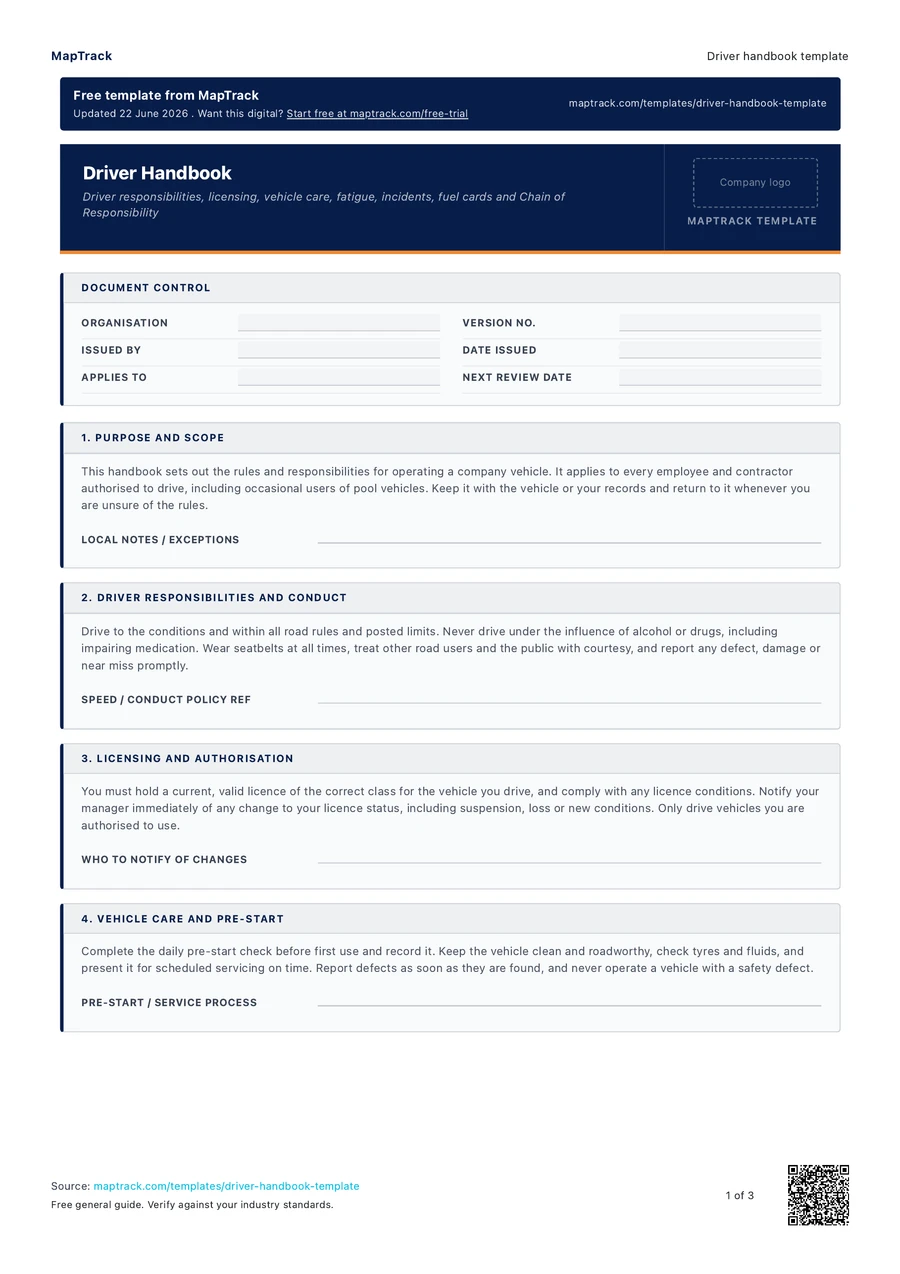


Read the form fields
Driver responsibilities, licensing, vehicle care, fatigue, incidents, fuel cards and Chain of Responsibility
11 sections
The fields in the printable form, in a view that fits your screen.
Document control
- Organisation
- Version no.
- Issued by
- Date issued
- Applies to
- Next review date
1. Purpose and scope
- Local notes / exceptions
2. Driver responsibilities and conduct
- Speed / conduct policy ref
3. Licensing and authorisation
- Who to notify of changes
4. Vehicle care and pre-start
- Pre-start / service process
5. Fatigue management
- Work / rest expectations
6. Mobile phones and distraction
- Device / hands free policy
7. Incidents, accidents and breakdowns
- Emergency / report contacts
- Roadside assistance no.
8. Fuel cards and expenses
- Authorised use / limits
9. Infringements and demerit points
- Reporting / consequences
10. Chain of Responsibility
- COR contact / escalation
Driver acknowledgement (I have received, read and understood this handbook)
Signature · Print name · Licence no. · Date
Issued by (fleet manager / supervisor)
Signature · Print name · Role · Date

Co-Founder & Commercial Director
Make this form your own
Add your fields and logo. Give your team a form they can use on site.
Free 30-day trial. No credit card. Work email needed.
Upload & use this form now for free



“MapTrack beat them all in every aspect.”
 Vincent Stone · HSEQ Advisor, Concept Tanks
After signup: upload this PDF, check the form MapTrack drafts, then save and publish it for your team.
General guidance only. Check the form against your equipment manual, site procedures and local requirements before using it.
Key takeaways
- A driver handbook is a standing reference setting out the rules, responsibilities and procedures for driving a company vehicle.
- A signed acknowledgement gives the handbook its value as duty of care and Chain of Responsibility evidence.
- Core sections cover licensing, vehicle care, fatigue, distraction, incidents, fuel cards and infringements.
- The handbook is the content; a driver induction checklist is the proof each driver was taken through it.
- Review at least annually and reissue with fresh acknowledgements whenever the law or policy changes.
What is a driver handbook template?
A driver handbook is the reference document a fleet gives every driver that sets out the rules, responsibilities and procedures for operating a company vehicle. It is not a checklist to be filled in once, it is a standing guide the driver keeps and returns to. A complete handbook covers who it applies to, the driver responsibilities and code of conduct, licensing and authorisation requirements, day to day vehicle care and pre-start checks, fatigue management, mobile phone and distraction rules, what to do after an incident or breakdown, fuel card use, how infringements and demerit points are handled, and the fleet position on Chain of Responsibility. It turns scattered verbal expectations into one written standard that every driver has read and signed.
For any organisation that puts staff on the road, the handbook is a core part of the safety system, not an administrative nicety. The Work Health and Safety Act makes managing road risk part of the employer duty of care, and for heavy vehicles the Chain of Responsibility extends legal duties to everyone who influences how the vehicle is driven, loaded and scheduled. A handbook that clearly states the rules, that drivers have acknowledged in writing, is practical evidence that the organisation told its drivers what was expected and gave them the information to comply. Paired with an induction record, it also forms the baseline every refresher and toolbox talk builds on, so standards do not drift as the fleet grows.
Learn more about GPS and fleet tracking in MapTrack.
Choose the format that fits your team
Download the PDF
Use the original printable form for a paper workflow. Check it against your equipment and site procedure before the job.
Keep completed copies in your own record system and arrange any follow-up through your normal process.
Download free PDFCustomise a form in MapTrack
Start a free trial, upload this PDF and MapTrack drafts the form. Adjust it to your workflow, then save and publish it for your team to use.
Sample answers on this page and completed PDF records aren't imported automatically.
Upload & use this form now for freeFree 30-day trial. No credit card. Work email needed.
Benefits of using this driver handbook template
- One clear standard: a single written handbook replaces scattered verbal rules so every driver works to the same expectations from day one.
- Duty of care evidence: an acknowledged handbook shows the organisation informed drivers of the rules, supporting the WHS primary duty and Chain of Responsibility.
- Fewer incidents: clear rules on speed, fatigue, distraction and vehicle care reduce the behaviours behind most preventable fleet crashes.
- Faster onboarding: a new driver can read one document and understand licensing, fuel cards, incidents and care instead of learning by trial and error.
- Consistent enforcement: a written policy on infringements, demerit points and misuse means consequences are applied evenly rather than case by case.
- Lower running costs: rules on fuel card use, tyre care and reporting defects early protect the vehicles and contain avoidable fleet spend.
What to include in a driver handbook template
- Purpose and scope: who the handbook applies to and the driver acknowledgement to be signed
- Driver responsibilities and code of conduct, including speed, alcohol and drug rules
- Licensing and authorisation: licence class, currency, notifying changes and authorised use
- Vehicle care: pre-start checks, cleanliness, tyres, servicing and reporting defects
- Fatigue management: work and rest expectations, and heavy vehicle fatigue duties where relevant
- Mobile phone and distraction policy, including hands free and device mounting rules
- Incident, accident and breakdown procedure: what to do, who to call and what to record
- Fuel cards and expenses: authorised use, PIN security, receipts and prohibited purchases
- Infringements and demerit points: who pays, reporting obligations and the consequences policy
- Chain of Responsibility: the duties drivers share for roadworthiness, loading and speed
How to use this driver handbook template
Set the scope and ground rules
Define who the handbook covers, from full time drivers to anyone who occasionally drives a pool vehicle, and state the non negotiable rules up front such as licence currency, the alcohol and drug position and authorised use of vehicles.
Document the day to day expectations
Write the practical sections a driver uses most: pre-start checks, vehicle care and cleanliness, fatigue and rest expectations, the distraction and mobile phone policy, and fuel card use. Keep the language plain so the rules are easy to follow on the road.
Define the incident and breakdown procedure
Set out exactly what a driver does after a crash, near miss or breakdown: secure the scene, who to call, what details and photos to capture, and when to complete an incident or damage report. Clear steps under stress are what make the record usable later.
Cover infringements, demerits and Chain of Responsibility
State who is responsible for fines and demerit points, the obligation to report them, and the consequences for serious or repeated breaches. Explain the Chain of Responsibility duties drivers share so heavy vehicle obligations are understood, not assumed.
Issue, acknowledge and keep current
Give the handbook to every driver at induction, have them sign an acknowledgement, and file it. Review the handbook at least annually and whenever the law or fleet policy changes, then reissue and re-acknowledge so the signed version always matches current practice.
How often should you complete this guide?
Issue the driver handbook to every new driver at induction and have them sign an acknowledgement before they are authorised to drive. The signed acknowledgement is the part that gives the handbook its evidentiary value, so it should be captured for every driver, not just the first intake.
Review the handbook at least once a year, and immediately whenever road transport law, fatigue rules or your own fleet policy change. After any material update, reissue it and collect fresh acknowledgements so the version on file always reflects current rules. Reinforce the key sections through toolbox talks and refreshers rather than relying on a single read at induction.
Make this form your own
From your template to your team.
Upload this PDF and MapTrack drafts the form. Adjust it for your equipment and site, then save and publish the digital form for your team.
- 01
Start your free trial
Use your work email to create your MapTrack account.
- 02
Customise, save and publish
Adjust the template fields and branding for your site.
- 03
Complete it on the job
Record checks, add photos and export a branded PDF.
Keep working offline
Load the form before you lose reception. Complete it offline and sync when you're back online.
Scan the asset. Open its form.
Use an asset's QR code to find and complete the forms that belong to it.
Show what you found
Capture photos and attach files so the next person has the details they need.
Take a branded PDF with you
Download completed forms as PDF reports with your company logo.
Completed paper records aren't imported automatically.
Frequently asked questions
Practical answers about the form, record keeping and using MapTrack.
No single law mandates a document called a driver handbook, but the obligations behind it are legal. The Work Health and Safety Act requires employers to manage risks to workers, which includes road risk, and the Heavy Vehicle National Law imposes Chain of Responsibility duties on everyone who influences how a heavy vehicle is driven and loaded. A handbook is the practical way to meet those duties: it documents the rules, and a signed acknowledgement shows drivers were informed. Without it, demonstrating that you communicated expectations becomes much harder after an incident.
Link to this answerA driver handbook is a reference document the driver keeps and returns to, setting out the standing rules, responsibilities and procedures. A driver induction checklist is a one time record confirming that a specific driver completed each onboarding step, such as having their licence verified and acknowledging the policies. The handbook is the content; the induction checklist is the proof a driver was taken through it. You use them together: the handbook informs, and the signed checklist records that the induction actually happened.
Link to this answerIn Australia the registered operator first receives camera-detected infringements, then must nominate the responsible driver so the fine and any demerit points transfer to that person. A driver handbook should state this clearly: that drivers are responsible for offences they commit, must report any infringement promptly, and that the organisation will nominate them. Setting this out in writing avoids disputes, keeps demerit points with the right licence, and supports a fair, consistent consequences policy across the fleet.
Link to this answerReview it at least annually and whenever something material changes, such as a road rule update, a change to heavy vehicle fatigue requirements, or a revision of your own fleet policy. After a significant update, reissue the handbook and collect new acknowledgements so the signed copy on file matches current practice. Treating the handbook as a living document, rather than a one off issued years ago, is what keeps it both useful to drivers and credible as evidence of your safety system.
Link to this answerYes, it is completely free. It downloads as a PDF you can keep or print for your drivers. You do not need a MapTrack account. If you want to move beyond paper, MapTrack keeps driver records, vehicle history, inductions and acknowledgements together, so you can see at a glance which drivers are current and which vehicles are due, rather than chasing signed forms. Start free or book a demo to see how.
Link to this answerApplicable regulatory standards
This form is a starting point. Check the current requirements that apply to your equipment, work and location. The form alone does not establish compliance.
- Work Health and Safety Act 2011, worker duties and the employer primary duty of care
- Heavy Vehicle National Law (HVNL) and the Chain of Responsibility
- National Heavy Vehicle Regulator (NHVR) fatigue management requirements
- Australian Road Rules and state and territory road transport legislation
- Model Work Health and Safety Act (Safe Work Australia)
- Heavy Vehicle National Law and Regulations (NHVR)
MapTrack publishes this template. The linked authorities publish their own guidance; they haven't endorsed this form.
The numbers behind this driver handbook template
Every figure below is sourced and dated, so you can quote it in a toolbox talk, a budget case or a board paper without having to chase the original report.
Cite this template
Writing about this topic? You’re welcome to quote this checklist. Here’s the wording to use so your readers can find the original.
- Short attribution
- MapTrack Driver handbook template, https://www.maptrack.com/templates/driver-handbook-template
- Reference list
- MapTrack. (2026). Driver handbook template [Checklist template]. Retrieved from https://www.maptrack.com/templates/driver-handbook-template
Free to reuse with credit under a Creative Commons Attribution 4.0 licence. If you’d rather link straight to it, the page is https://www.maptrack.com/templates/driver-handbook-template.
Embed this free template on your website
Run an industry blog, trade association site, or training resource? Drop a preview of this free driver handbook template straight into your page. The snippet is self-contained, needs no scripts, and links readers back to the full free template.
<div style="max-width:480px;font-family:system-ui,-apple-system,'Segoe UI',Roboto,sans-serif;border:1px solid #E5E7EB;border-radius:12px;padding:20px;background:#ffffff;">
  <p style="font-size:12px;font-weight:700;letter-spacing:0.05em;text-transform:uppercase;color:#071D49;margin:0;">Free template</p>
  <p style="font-size:18px;font-weight:700;color:#071D49;margin:6px 0 0;">Driver handbook template</p>
  <ul style="margin:12px 0 0;padding-left:18px;color:#374151;font-size:14px;line-height:1.6;">
    <li style="margin:4px 0;">Purpose and scope: who the handbook applies to and the driver acknowledgement to be signed</li>
    <li style="margin:4px 0;">Driver responsibilities and code of conduct, including speed, alcohol and drug rules</li>
    <li style="margin:4px 0;">Licensing and authorisation: licence class, currency, notifying changes and authorised use</li>
    <li style="margin:4px 0;">Vehicle care: pre-start checks, cleanliness, tyres, servicing and reporting defects</li>
    <li style="margin:4px 0;">Fatigue management: work and rest expectations, and heavy vehicle fatigue duties where relevant</li>
    <li style="margin:4px 0;">Mobile phone and distraction policy, including hands free and device mounting rules</li>
  </ul>
  <p style="font-size:13px;color:#6B7280;margin:14px 0 0;padding-top:12px;border-top:1px solid #E5E7EB;">Free <a href="https://www.maptrack.com/templates/driver-handbook-template" style="color:#071D49;font-weight:600;text-decoration:none;">Driver handbook template</a> by MapTrack</p>
</div>Free to reuse, including commercially. This template is published under a Creative Commons Attribution 4.0 licence. Copy it, adapt it, put it on your own site or in your own docs. All we ask is that you credit MapTrack with a link back to this page. The snippet above already includes that credit, so if you use it as-is you’re covered.
About the author

Co-Founder & Commercial Director
Jarrod has spent over a decade in technology consulting and asset management, including roles at Accenture (mining and heavy industry) and CGI as an Asset Management Consultant. He co-founded MapTrack and built and scaled its original platform, then rebuilt it with Lachlan and Alex from thousands of customer conversations and 300+ user research sessions with field teams. His consulting background gives him deep insight into the operational and compliance challenges facing asset-intensive Australian businesses.
View LinkedIn profile →Ready for your next job?
Keep the PDF handy, or upload it to MapTrack and turn it into a digital form for your team.