
Free template · PDF
Free drill rig inspection checklist
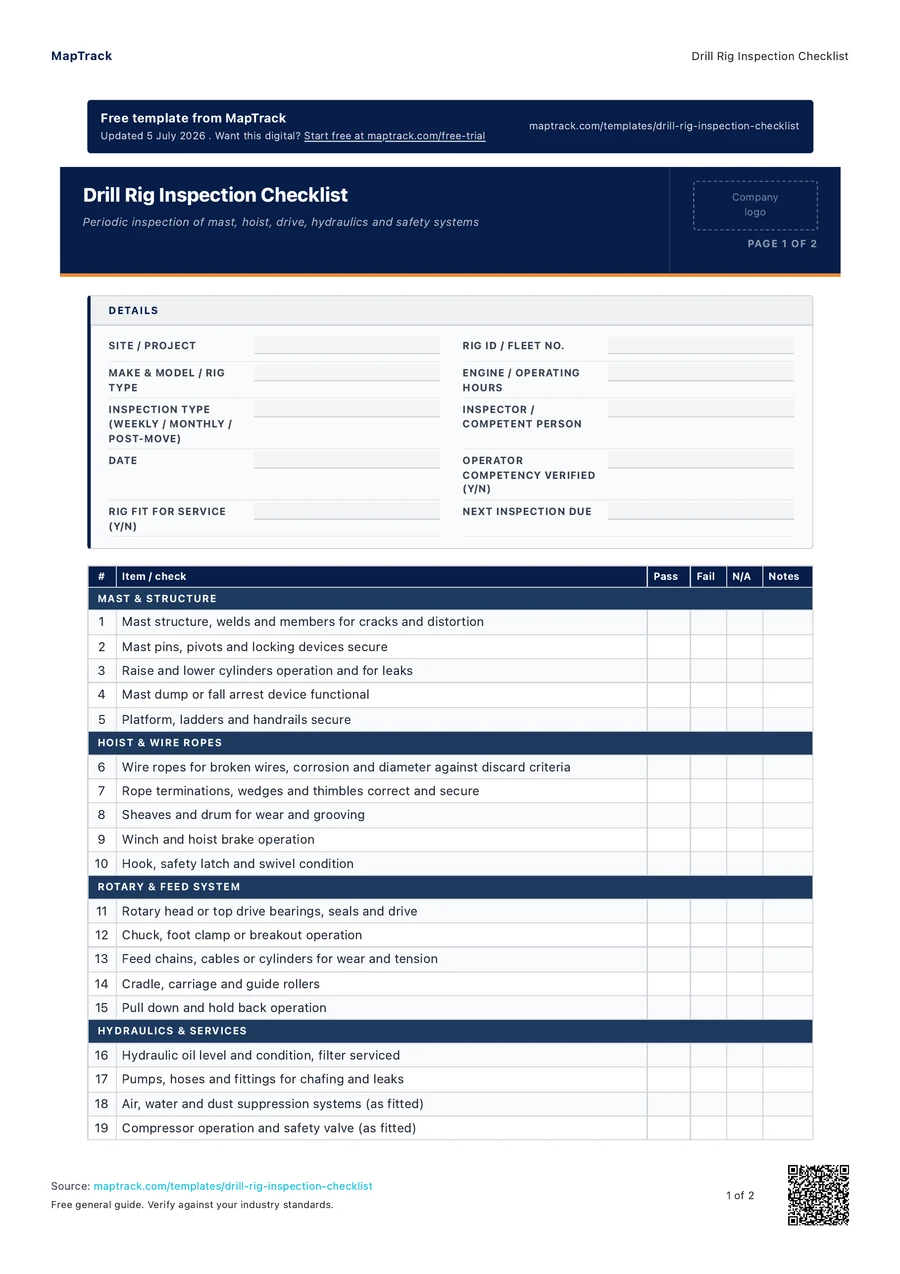
Free drill rig inspection checklist (PDF-ready). Periodic checks of mast, hoist, rotary head, hydraulics, guarding and emergency stops on drilling rigs.
Loading PDF page...

Read the form fields
25 checks · 5 sections · Sign-off
25 checks
The fields in the printable form, in a view that fits your screen.
- Site / project
- Rig ID / fleet no.
- Make & model / rig type
- Engine / operating hours
- Inspection type (weekly / monthly / post-move)
- Inspector / competent person
- Date
- Operator competency verified (Y/N)
- Rig fit for service (Y/N)
- Next inspection due
MAST & STRUCTURE
HOIST & WIRE ROPES
ROTARY & FEED SYSTEM
HYDRAULICS & SERVICES
GUARDING & SAFETY
Declaration & Sign-Off
I confirm that all items have been inspected/completed as indicated above. Any defects or concerns have been noted and reported.
Completed By
Printed name · Signature · Date
Reviewed / Approved By
Printed name · Signature · Date
The MapTrack drill rig inspection checklist contains 25 checks across 5 sections.

Co-Founder & Commercial Director
Make this form your own
Add your fields and logo. Give your team a form they can use on site.
Free 30-day trial. No credit card. Work email needed.
Upload & use this form now for free



“MapTrack beat them all in every aspect.”
 Vincent Stone · HSEQ Advisor, Concept Tanks
After signup: upload this PDF, check the form MapTrack drafts, then save and publish it for your team.
General guidance only. Check the form against your equipment manual, site procedures and local requirements before using it.
Key takeaways
- The MapTrack drill rig inspection checklist contains 25 checks across 5 sections. Sections covered: MAST & STRUCTURE, HOIST & WIRE ROPES, ROTARY & FEED SYSTEM, HYDRAULICS & SERVICES, GUARDING & SAFETY.
- Rig ID or fleet number, make, model, type and current engine or operating hours
- Mast: structure, welds, pins, raise and lower cylinders and locking devices
- Hoist and wire ropes: rope condition, terminations, sheaves and drum
What is a drill rig inspection checklist?
A drill rig inspection checklist is a periodic inspection sheet that guides a competent person through every safety critical and wear prone system on a drilling rig, whether it is a track mounted blast hole rig, a diamond core rig, a water bore rig or an auger rig. It covers the mast and its raise and lower mechanism, the hoist and wire ropes, the rotary head or top drive, the feed and pull down system, the hydraulics and hoses, the guarding around rotating parts, the emergency stops and the operator controls. It is a scheduled inspection completed above the daily pre-start, meant to catch wear, cracking, hydraulic leaks and guarding faults before they become a failure or an injury.
Drilling rigs carry a high injury potential because they combine rotating strings, high pressure hydraulics, suspended masts and lifting operations, often in remote locations where help is far away. A consistent inspection checklist turns rig safety into a measurable routine, gives the driller and the maintenance team a shared record of condition, and demonstrates the plant maintenance and guarding duties set out in the model Work Health and Safety (WHS) Regulations (mirrored in each state and territory except Victoria, which uses the OHS Regulations 2017 (Vic)). Recorded against each rig, the completed inspections build the history that planned maintenance, component change out and repair versus replace decisions rely on, in line with the asset management discipline of ISO 55001:2024.
Learn more about maintenance and work orders in MapTrack.
Choose the format that fits your team
Download the PDF
Use the original printable form for a paper workflow. Check it against your equipment and site procedure before the job.
Keep completed copies in your own record system and arrange any follow-up through your normal process.
Download free PDFCustomise a form in MapTrack
Start a free trial, upload this PDF and MapTrack drafts the form. Adjust it to your workflow, then save and publish it for your team to use.
Sample answers on this page and completed PDF records aren't imported automatically.
Upload & use this form now for freeFree 30-day trial. No credit card. Work email needed.
Benefits of using this drill rig inspection checklist
- Injury prevention: guarding, emergency stops and rotating parts are checked before a fault can catch or injure the crew.
- Less downtime: catching wire rope wear, hydraulic leaks and cracked structure early stops a rig failing in a remote hole.
- Complete rig history: every signed inspection adds to the record that component change out and warranty claims depend on.
- Shared condition picture: the driller and the fitter work from one dated record instead of relying on memory and word of mouth.
- Accountability: a named inspector and date against each inspection means every interval has a clear owner and paper trail.
- Audit evidence: a consistent, dated inspection trail is objective proof of a controlled plant inspection process for WHS reviews.
What to include in a drill rig inspection checklist
- Rig ID or fleet number, make, model, type and current engine or operating hours
- Mast: structure, welds, pins, raise and lower cylinders and locking devices
- Hoist and wire ropes: rope condition, terminations, sheaves and drum
- Rotary head or top drive: bearings, seals, chuck or breakout, drive condition
- Feed system: chains, cables, cylinders, cradle and pull down operation
- Hydraulics: pumps, hoses, fittings, oil level, condition and leaks
- Guarding: rotating parts guards, exclusion zones and interlocks
- Emergency stops, remote stops and controls tested and functional
- Air, dust suppression, water and compressor systems (as fitted)
- Defects found, parts fitted, competency of operator and next inspection due
How to use this drill rig inspection checklist
Isolate the rig and make it safe
Park on stable level ground, lower the mast, set outriggers or tracks, shut down and isolate energy sources, and follow lockout and tagout so the rig cannot start or move while the inspector is working on it.
Inspect the mast and lifting components
Check the mast structure, welds and pins for cracks and wear, the raise and lower cylinders and locking devices, and inspect the wire ropes and terminations for broken wires, corrosion and correct fit against the discard criteria.
Check the drive, feed and hydraulic systems
Inspect the rotary head or top drive, the feed chains or cables, and the hydraulic pumps, hoses and fittings for wear and leaks. Run the systems where safe and listen and watch for abnormal noise, movement or pressure loss.
Test guarding and emergency stops
Confirm all guards over rotating parts are fitted and secure, exclusion zones are marked, and every emergency stop and remote stop actually shuts the machine down when pressed. Any failed safety device takes the rig out of service until fixed.
Record defects and sign off
Note every fault with enough detail for the next person, raise work orders for items not fixed on the spot, confirm the operator holds the right competency, then sign the inspection off and set the date the next inspection falls due.
How often should you complete this form?
Run this inspection on a periodic schedule, commonly weekly or monthly for a working rig plus after any major component change, incident or transport between sites. Wire ropes, guarding and emergency stops are checked more frequently because they are safety critical, and the manufacturer schedule sets the interval for deeper mechanical inspections.
This periodic inspection sits above the operator's daily pre-start, which confirms the rig is safe to run that shift. Track completed inspections against each rig so wear trends are visible, overdue inspections are chased, and the maintenance team can plan component change out before a failure rather than after one.
Make this form your own
From your template to your team.
Upload this PDF and MapTrack drafts the form. Adjust it for your equipment and site, then save and publish the digital form for your team.
- 01
Start your free trial
Use your work email to create your MapTrack account.
- 02
Customise, save and publish
Adjust the template fields and branding for your site.
- 03
Complete it on the job
Record checks, add photos and export a branded PDF.
Keep working offline
Load the form before you lose reception. Complete it offline and sync when you're back online.
Scan the asset. Open its form.
Use an asset's QR code to find and complete the forms that belong to it.
Show what you found
Capture photos and attach files so the next person has the details they need.
Take a branded PDF with you
Download completed forms as PDF reports with your company logo.
Completed paper records aren't imported automatically.
Frequently asked questions
Practical answers about the form, record keeping and using MapTrack.
The model Work Health and Safety (WHS) Regulations (regulation 213 on maintenance of plant, plus the guarding duties, as enacted in each state and territory except Victoria, which has the OHS Regulations 2017 (Vic)) require that plant is maintained and inspected so it stays safe to use, that guarding is in place around dangerous parts, and that only competent people operate and inspect it. For a drill rig that means scheduled inspection of the mast, ropes, rotary head, guarding and emergency stops, keeping the records, and removing the rig from service when a defect makes it unsafe. A dated, signed inspection checklist is strong evidence those duties are being met.
Link to this answerThe daily pre-start is a quick operator check that the rig is safe to run that shift, covering fluids, guards, controls and obvious damage. The periodic inspection is a deeper, scheduled check by a competent person of the mast structure, wire ropes, feed and drive systems and safety devices, looking for wear and cracking that build up over time. You need both: the pre-start catches day to day faults, the periodic inspection catches developing failures.
Link to this answerRun a periodic inspection weekly or monthly for a rig in regular use, and always after a major component change, an incident or transport between sites. Safety critical items such as wire ropes, guarding and emergency stops warrant more frequent checks, while the deeper mechanical inspection interval follows the manufacturer schedule. Setting the next inspection due date on completion stops intervals slipping on a busy drilling program.
Link to this answerThe rig should be taken out of service immediately and tagged out until the fault is repaired and re inspected. Wire ropes have documented discard criteria for broken wires, corrosion and reduction in diameter, and any rope that meets a discard criterion must be replaced, not run to failure. A failed emergency stop is a critical safety fault because it removes the last line of defence, so it is never acceptable to keep drilling with it.
Link to this answerYes, it is completely free. It downloads as a ready-to-print PDF. You do not need a MapTrack account. If you want to move beyond paper, MapTrack schedules inspections against each rig, tracks defects, parts and downtime, and keeps the full inspection and maintenance history in one place. Start a free trial or book a demo to see how.
Link to this answerApplicable regulatory standards
This form is a starting point. Check the current requirements that apply to your equipment, work and location. The form alone does not establish compliance.
- Model Work Health and Safety (WHS) Act and Regulations, as enacted in each state and territory (in Victoria, the Occupational Health and Safety Act 2004 (Vic) and OHS Regulations 2017 (Vic))
- Model WHS Regulations, regulation 213 (maintenance of plant) and the plant guarding duties (Chapter 5, Plant and structures)
- AS/NZS 4024 Safety of machinery series - guarding, interlocks and emergency stops (e.g. AS/NZS 4024.1601:2014, guards and guarding)
- ISO 55001:2024 Asset management - Asset management systems - Requirements (controlled maintenance records and asset history)
- Manufacturer (OEM) inspection and maintenance schedule for the specific rig
- Model WHS Regulations (Safe Work Australia)
- ISO 55001:2024, Asset management system requirements (ISO catalogue)
- AS 4024 series, Safety of machinery (Standards Australia listing)
MapTrack publishes this template. The linked authorities publish their own guidance; they haven't endorsed this form.
The numbers behind this drill rig inspection checklist
Every figure below is sourced and dated, so you can quote it in a toolbox talk, a budget case or a board paper without having to chase the original report.
Cite this template
Writing about this topic? You’re welcome to quote this checklist. Here’s the wording to use so your readers can find the original.
The MapTrack drill rig inspection checklist contains 25 checks across 5 sections.
- Short attribution
- MapTrack Drill Rig Inspection Checklist, https://www.maptrack.com/templates/drill-rig-inspection-checklist
- Reference list
- MapTrack. (2026). Drill Rig Inspection Checklist [Checklist template]. Retrieved from https://www.maptrack.com/templates/drill-rig-inspection-checklist
Free to reuse with credit under a Creative Commons Attribution 4.0 licence. If you’d rather link straight to it, the page is https://www.maptrack.com/templates/drill-rig-inspection-checklist.
Embed this free template on your website
Run an industry blog, trade association site, or training resource? Drop a preview of this free drill rig inspection checklist straight into your page. The snippet is self-contained, needs no scripts, and links readers back to the full free template.
<div style="max-width:480px;font-family:system-ui,-apple-system,'Segoe UI',Roboto,sans-serif;border:1px solid #E5E7EB;border-radius:12px;padding:20px;background:#ffffff;">
  <p style="font-size:12px;font-weight:700;letter-spacing:0.05em;text-transform:uppercase;color:#071D49;margin:0;">Free template</p>
  <p style="font-size:18px;font-weight:700;color:#071D49;margin:6px 0 0;">Drill Rig Inspection Checklist</p>
  <ul style="margin:12px 0 0;padding-left:18px;color:#374151;font-size:14px;line-height:1.6;">
    <li style="margin:4px 0;">Rig ID or fleet number, make, model, type and current engine or operating hours</li>
    <li style="margin:4px 0;">Mast: structure, welds, pins, raise and lower cylinders and locking devices</li>
    <li style="margin:4px 0;">Hoist and wire ropes: rope condition, terminations, sheaves and drum</li>
    <li style="margin:4px 0;">Rotary head or top drive: bearings, seals, chuck or breakout, drive condition</li>
    <li style="margin:4px 0;">Feed system: chains, cables, cylinders, cradle and pull down operation</li>
    <li style="margin:4px 0;">Hydraulics: pumps, hoses, fittings, oil level, condition and leaks</li>
  </ul>
  <p style="font-size:13px;color:#6B7280;margin:14px 0 0;padding-top:12px;border-top:1px solid #E5E7EB;">Free <a href="https://www.maptrack.com/templates/drill-rig-inspection-checklist" style="color:#071D49;font-weight:600;text-decoration:none;">Drill Rig Inspection Checklist</a> by MapTrack</p>
</div>Free to reuse, including commercially. This template is published under a Creative Commons Attribution 4.0 licence. Copy it, adapt it, put it on your own site or in your own docs. All we ask is that you credit MapTrack with a link back to this page. The snippet above already includes that credit, so if you use it as-is you’re covered.
About the author

Co-Founder & Commercial Director
Jarrod has spent over a decade in technology consulting and asset management, including roles at Accenture (mining and heavy industry) and CGI as an Asset Management Consultant. He co-founded MapTrack and built and scaled its original platform, then rebuilt it with Lachlan and Alex from thousands of customer conversations and 300+ user research sessions with field teams. His consulting background gives him deep insight into the operational and compliance challenges facing asset-intensive Australian businesses.
View LinkedIn profile →Ready for your next job?
Keep the PDF handy, or upload it to MapTrack and turn it into a digital form for your team.