
Free concrete pump inspection checklist
Free concrete pump inspection checklist (PDF-ready). Inspect boom and line pumps: hopper, pipeline, boom, outriggers, hydraulics and safety devices.
Updated 5 July 2026
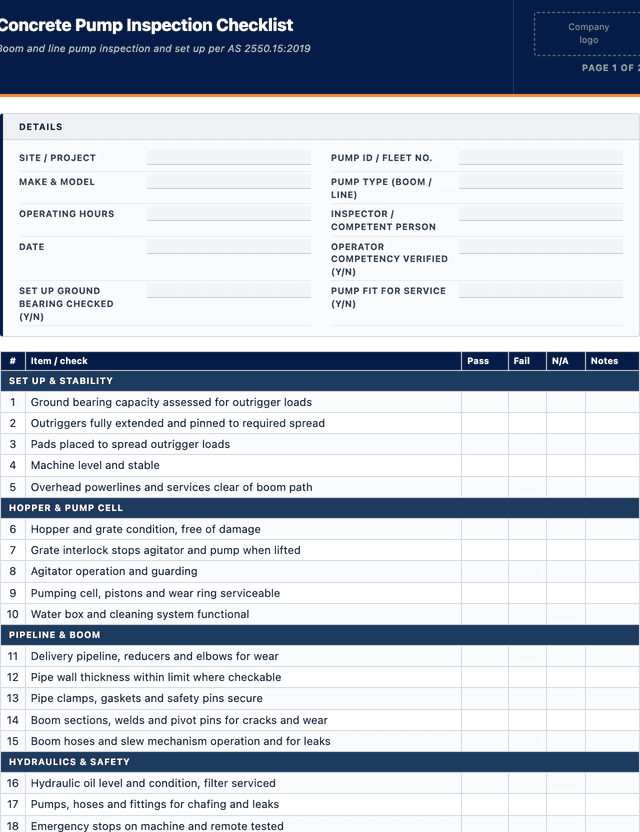
Concrete Pump Inspection Checklist
Boom and line pump inspection and set up per AS 2550.15:2019
SET UP & STABILITY
HOPPER & PUMP CELL
PIPELINE & BOOM
HYDRAULICS & SAFETY
How to use: download the PDF, print or complete digitally on any device.
- PDF format, ready to print or fill on screen
- Use as-is or customise to suit your operation
- Go digital in MapTrack for photos, reminders and audit trails
Download free PDF template
Use in MapTrack →



Trusted by teams across Australia and New Zealand
We respect your privacy. Unsubscribe anytime.
Or set it up in MapTrack
- Fill it in on a phone, attach photos to any check
- Automatic reports and audit trails
- Upload the PDF and MapTrack drafts the form for you
Free 30-day trial. No credit card. Personal email accepted.
Don't just download it - use it live. Start a free workspace, upload this concrete pump inspection checklist and MapTrack drafts it as a form your crew can run from a phone.

Co-Founder & Commercial Director
Key takeaways
- The MapTrack concrete pump inspection checklist contains 21 checks across 4 sections. Sections covered: SET UP & STABILITY, HOPPER & PUMP CELL, PIPELINE & BOOM, HYDRAULICS & SAFETY.
Enter your email below to download this concrete pump inspection checklist as a ready-to-use PDF.
Used by construction, mining and field service teams











What is a concrete pump inspection checklist?
A concrete pump inspection checklist is an inspection sheet that guides a competent person through every safety critical and wear prone system on a boom or line concrete pump before and during use on a placement job. It covers the hopper, grate and agitator, the pumping cell and hydraulic drive, the delivery pipeline and clamps, the placing boom and its slewing and outrigger system, the hydraulics and hoses, and the safety devices including the hopper grate interlock and emergency stops. It is used above the daily pre-start to confirm the pump is set up correctly and safe to place concrete, because a burst line, an unlatched grate or an unstable set up can cause serious injury.
Concrete placing equipment is high risk plant: it runs at high hydraulic and line pressures, swings a heavy boom over people and structures, and must be set up on outriggers that can punch through soft ground if the bearing capacity is wrong. AS 2550.15:2019, the standard for the safe use of concrete placing equipment (design counterpart AS 1418.15), sets out inspection, set up and operating requirements, and the model Work Health and Safety (WHS) Regulations (mirrored in each state and territory except Victoria, which uses the OHS Regulations 2017 (Vic)) require the pump to be maintained and inspected so it stays safe to use. A consistent inspection checklist, recorded against the machine, turns that into a measurable routine and builds the history that planned maintenance and component change out rely on under ISO 55001:2024.
Learn more about maintenance and work orders in MapTrack.
Benefits of using this concrete pump inspection checklist
- Injury prevention: the grate interlock, line clamps and emergency stops are confirmed before pressure is ever put on the line.
- Safe set up: outrigger spread, ground bearing and boom clearance are checked so the pump cannot tip or foul services.
- Less downtime: catching worn pipeline, hoses and pump cell parts early stops a burst or blockage part way through a pour.
- Complete pump history: every signed inspection adds to the record that pipeline wear tracking and component change out depend on.
- Accountability: a named inspector and date against each inspection means every set up and interval has a clear owner.
- Audit evidence: a dated inspection trail against AS 2550.15:2019 is objective proof of a controlled inspection process for WHS reviews.
Benefits of digitising forms in MapTrack
When you move from paper or static PDFs to digital forms in MapTrack, you get:
- Field users can easily scan a QR code to complete a form on mobile. Unlimited users.
- Email the right people when a form is submitted, with an automation you set up.
- File every completed form against the asset, location or person it covers.
- Download any completed form as a PDF, with failed answers listed at the top.
- Fill in forms offline; they upload when the device is back online.
- Build conditional logic (show or hide questions based on answers).
- Take pictures or attach photos. Not possible with a paper-based form.
- Electronic signatures.
- Edit forms later without reprinting.
- Set who can view, fill in or edit forms with user roles.
- Upload a paper form (PDF, Word, Excel or a photo) and MapTrack's AI builds a digital version for you to check.
- Raise a work order from a submitted form with an automation you set up.
- Track service intervals by hours, kilometres or calendar date in one place.
- Attach supplier invoices and parts receipts to each maintenance record.
Book a demo to see how MapTrack handles forms.
Try MapTrack free for 30 days
Full access to every feature. No credit card required. Per-asset pricing so you scale as your fleet grows.
- No credit card required
- 30 days free trial
- Cancel anytime
1-2 days/week saved
“Bloody amazing! We used to spend 1-2 days a week tracking and managing our generators alone.”

Steve McAllister
Asset Coordinator, Saunders International
What to include in a concrete pump inspection checklist
This concrete pump inspection checklist covers 10 key areas:
- Pump ID or fleet number, make, model, type (boom or line) and operating hours
- Hopper, grate, grate interlock and agitator condition and operation
- Pumping cell, pistons, wear ring and hydraulic drive
- Delivery pipeline, reducers, elbows and wall thickness where checkable
- Pipe clamps, gaskets and safety pins or clips secure
- Placing boom sections, pins, hoses and slew operation
- Outriggers, pads, ground bearing and level set up
- Hydraulics: pumps, hoses, fittings, oil level and leaks
- Emergency stops, remote control and hopper grate cut out tested
- Defects found, competency of operator, set up sign off and next inspection due
How to use this concrete pump inspection checklist
- Check the machine and set up location: Before setting up, confirm the ground can take the outrigger loads, there are no overhead powerlines or services in the boom path, and the pump is level. A poor set up is the leading cause of concrete pump tip overs, so this comes before any pumping check.
- Deploy outriggers and inspect the boom: Fully extend and pin the outriggers to the required spread, place pads to spread the load, then inspect the boom sections, pins, hoses and slew mechanism for wear, cracking and leaks before the boom is raised over people or structures.
- Inspect the hopper, cell and pipeline: Check the hopper, grate and agitator, confirm the pumping cell and wear parts are serviceable, and inspect the delivery pipeline, elbows, clamps and gaskets for wear and correct fit. Worn line and a loose clamp are common causes of a dangerous line burst.
- Test safety devices before pressure: Confirm the hopper grate interlock stops the agitator and pump when the grate is lifted, and test every emergency stop and the remote control. No concrete goes down the line until the grate cut out and stops are proven to work.
- Record defects and sign off the set up: Note every fault, raise work orders for items not fixed on the spot, confirm the operator holds the right competency, then sign off that the pump and its set up are safe to place concrete and record when the next inspection falls due.
In MapTrack, you can schedule and track maintenance digitally, by date or meter reading. Each submission is stored as a timestamped PDF against the asset record.
Get the free templateEnter your email above to download the full concrete pump inspection checklist as a PDF.Back to download formHow often should you complete this form?
Inspect the pump and its set up before every placement job, because the ground conditions, boom path and pipeline configuration change from site to site. A deeper periodic inspection of the pump cell, boom pins and hydraulics follows the manufacturer schedule and the requirements of AS 2550.15:2019, typically at set hour intervals plus after any incident or major repair.
Pipeline and cell wear are progressive and pressure related, so wall thickness on delivery pipe and the condition of clamps and gaskets warrant more frequent checks on high volume operations. Record inspections against each pump so wear trends are visible and pipeline or wear parts can be changed out before a burst rather than after one.
Frequently asked questions
Applicable regulatory standards
This template is a starting point. Check the current requirements that apply to your equipment, work and location. The template alone does not establish compliance.
- Model Work Health and Safety (WHS) Act and Regulations, as enacted in each state and territory (in Victoria, the Occupational Health and Safety Act 2004 (Vic) and OHS Regulations 2017 (Vic))
- Model WHS Regulations, regulation 213 (maintenance of plant so it stays safe and without risk to health)
- AS 2550.15:2019 Cranes, hoists and winches - Safe use, Part 15: Concrete placing equipment
- AS 1418.15 Cranes, hoists and winches - Concrete placing equipment (design counterpart to AS 2550.15)
- ISO 55001:2024 Asset management - Asset management systems - Requirements (controlled maintenance records and asset history)
Concrete Pump Inspection Checklist preview
The numbers behind this concrete pump inspection checklist
Every figure below is sourced and dated, so you can quote it in a toolbox talk, a budget case or a board paper without having to chase the original report.
Embed this free template on your website
Run an industry blog, trade association site, or training resource? Drop a preview of this free concrete pump inspection checklist straight into your page. The snippet is self-contained, needs no scripts, and links readers back to the full free template.
<div style="max-width:480px;font-family:system-ui,-apple-system,'Segoe UI',Roboto,sans-serif;border:1px solid #E5E7EB;border-radius:12px;padding:20px;background:#ffffff;">
  <p style="font-size:12px;font-weight:700;letter-spacing:0.05em;text-transform:uppercase;color:#071D49;margin:0;">Free template</p>
  <p style="font-size:18px;font-weight:700;color:#071D49;margin:6px 0 0;">Concrete Pump Inspection Checklist</p>
  <ul style="margin:12px 0 0;padding-left:18px;color:#374151;font-size:14px;line-height:1.6;">
    <li style="margin:4px 0;">Pump ID or fleet number, make, model, type (boom or line) and operating hours</li>
    <li style="margin:4px 0;">Hopper, grate, grate interlock and agitator condition and operation</li>
    <li style="margin:4px 0;">Pumping cell, pistons, wear ring and hydraulic drive</li>
    <li style="margin:4px 0;">Delivery pipeline, reducers, elbows and wall thickness where checkable</li>
    <li style="margin:4px 0;">Pipe clamps, gaskets and safety pins or clips secure</li>
    <li style="margin:4px 0;">Placing boom sections, pins, hoses and slew operation</li>
  </ul>
  <p style="font-size:13px;color:#6B7280;margin:14px 0 0;padding-top:12px;border-top:1px solid #E5E7EB;">Free <a href="https://www.maptrack.com/templates/concrete-pump-inspection-checklist" style="color:#071D49;font-weight:600;text-decoration:none;">Concrete Pump Inspection Checklist</a> by MapTrack</p>
</div>Free to reuse, including commercially. This template is published under a Creative Commons Attribution 4.0 licence. Copy it, adapt it, put it on your own site or in your own docs. All we ask is that you credit MapTrack with a link back to this page. The snippet above already includes that credit, so if you use it as-is you’re covered.
Cite this template
Writing about this topic? You’re welcome to quote this checklist. Here’s the wording to use so your readers can find the original.
The MapTrack concrete pump inspection checklist contains 21 checks across 4 sections.
- Short attribution
- MapTrack Concrete Pump Inspection Checklist, https://www.maptrack.com/templates/concrete-pump-inspection-checklist
- Reference list
- MapTrack. (2026). Concrete Pump Inspection Checklist [Checklist template]. Retrieved from https://www.maptrack.com/templates/concrete-pump-inspection-checklist
Free to reuse with credit under a Creative Commons Attribution 4.0 licence. If you’d rather link straight to it, the page is https://www.maptrack.com/templates/concrete-pump-inspection-checklist.
Need to schedule and track maintenance digitally, by date or meter reading?
Register every asset in MapTrack, attach digital forms, and get a complete history of every inspection, service and compliance record.
Maintenance and work orders · All templates · Pricing · Book a demo