
Free digital scale calibration log template
Free digital scale calibration log covering zero, linearity, eccentric and repeatability tests per AS 1284, NMI and OIML R76 for trade and lab use.
Updated 25 May 2026
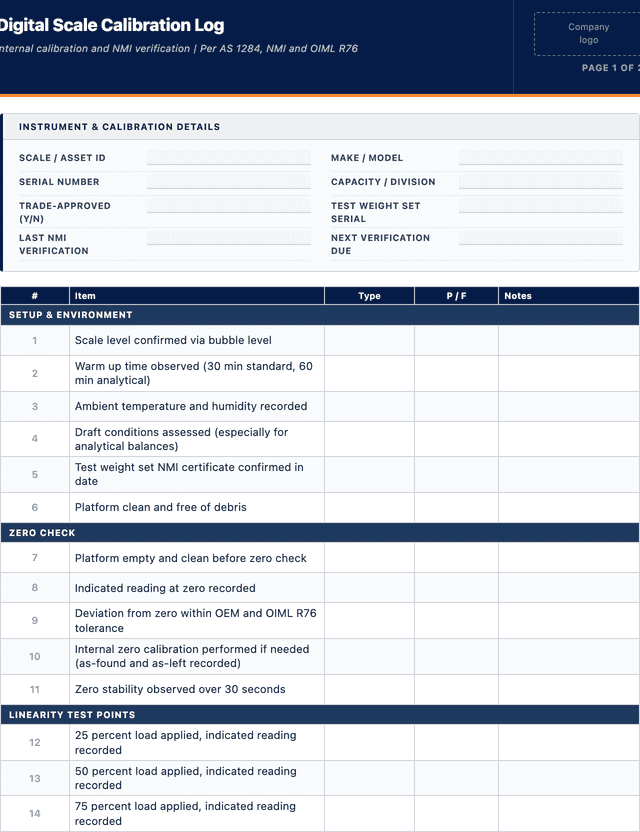
Digital Scale Calibration Log
Internal calibration and NMI verification | Per AS 1284, NMI and OIML R76
Setup & environment
Zero check
Linearity test points
Off-centre load test
Repeatability test
Certification & records
How to use: download the PDF, print or complete digitally on any device.
- PDF format, ready to print or fill on screen
- Use as-is or customise to suit your operation
- Go digital in MapTrack for photos, reminders and audit trails
Download free PDF template
Use in MapTrack →



Trusted by teams across Australia and New Zealand
We respect your privacy. Unsubscribe anytime.
Or set it up in MapTrack
- Fill it in on a phone, attach photos to any check
- Automatic reports and audit trails
- Upload the PDF and MapTrack drafts the form for you
Free 30-day trial. No credit card. Personal email accepted.
Don't just download it - use it live. Start a free workspace, upload this digital scale calibration log template and MapTrack drafts it as a form your crew can run from a phone.

Co-Founder & Commercial Director
Key takeaways
- The MapTrack digital scale calibration log template contains 33 checks across 6 sections. Sections covered: Setup & environment, Zero check, Linearity test points, Off-centre load test, Repeatability test, Certification & records.
Enter your email below to download this digital scale calibration log template as a ready-to-use PDF.
Used by construction, mining and field service teams










What is a digital scale calibration log template?
A digital scale calibration log is a two-part record used to manage weighing instruments across food and beverage, pharmaceutical, retail, manufacturing and healthcare environments. The first part is a routine internal calibration log, completed at the frequency set by the site quality programme using certified M1, M2 or M3 test weights traceable to the National Measurement Institute, capturing a zero check, a linearity test at 25, 50, 75 and 100 percent of scale capacity, an eccentric (off-centre) loading test at the four cardinal corners of the platform and a repeatability test using a single weight read ten consecutive times to confirm the indicated value sits within the OIML R76 class III tolerance band for trade-approved scales or the tighter band published by the manufacturer for analytical balances. The second part is a trade-measurement verification record, completed by an NMI-licensed servicing licensee for any scale used in a trade transaction in Australia.
Digital scales used in retail trade, food production, pharmacy dispensing, batching plant operation and laboratory analytical work are subject to a layered regulatory framework. The Trade Measurement Act 1960 and the National Measurement Act 1960 require that any scale used in a buying or selling transaction is verified by an NMI-licensed servicing licensee and re-verified at intervals set by the National Measurement Institute. AS 1284 series sets the Australian Standard for weighing instruments, OIML R76 defines the international class III accuracy band that most trade-approved instruments meet, and Food Standard 3.2.1 sets the food safety programme requirements that drive weighing accuracy in food production, including allergen control and label declaration accuracy. For pharmaceutical and analytical balances the GMP framework and the relevant pharmacopoeia drive a stricter regime with daily or pre-use checks. A documented calibration log is the evidence chain that allows a weight on a label, a batch dose or a clinical reading to be defended in front of an NMI inspector, a state trade-measurement officer, an FSANZ auditor or a TGA inspector. Without these records, the indicated weight is not legally defensible.
Learn more about compliance and inspections in MapTrack.
Benefits of using this digital scale calibration log template
- Trade-measurement defensibility: documented internal calibrations and current NMI verification stamps protect a retailer or food producer from short-weight prosecutions under the Trade Measurement Act 1960
- Class III tolerance evidence: capturing linearity readings at 25, 50, 75 and 100 percent capacity proves the scale meets OIML R76 class III tolerance at every point a customer transaction might occur
- Eccentric loading verification: the four-corner test catches uneven platform loading errors that would otherwise cause systematic under or over-weighing depending on where the operator places the load
- Repeatability assurance: ten consecutive readings of the same weight reveal mechanical or electronic instability that affects analytical balances and high-accuracy industrial scales
- Food safety programme support: documented weighing accuracy underpins allergen control, recipe dosing and label declaration accuracy required by Food Standard 3.2.1
- Audit-ready evidence: a stamped, dated calibration log satisfies NMI, FSANZ, TGA and ISO 9001 expectations across food, pharmaceutical, retail and laboratory environments
- Test weight traceability: recording the test weight set serial number, class and last NMI calibration date confirms that the reference used was itself within tolerance and traceable
- Drift detection: a trend of as-found readings over multiple internal calibrations reveals slow drift from load-cell fatigue, environmental contamination or platform damage before it becomes a customer-facing failure
Benefits of digitising forms in MapTrack
When you digitise digital scale calibration logs in MapTrack, you get:
- Field users can easily scan a QR code to complete a form on mobile. Unlimited users.
- Email the right people when a form is submitted, with an automation you set up.
- File every completed form against the asset, location or person it covers.
- Download any completed form as a PDF, with failed answers listed at the top.
- Fill in forms offline; they upload when the device is back online.
- Build conditional logic (show or hide questions based on answers).
- Take pictures or attach photos. Not possible with a paper-based form.
- Electronic signatures.
- Edit forms later without reprinting.
- Set who can view, fill in or edit forms with user roles.
- Upload a paper form (PDF, Word, Excel or a photo) and MapTrack's AI builds a digital version for you to check.
- Assign audits and send reminder emails to the people doing them.
- Keep every audit, inspection and sign-off against the asset or site it covers.
- Track corrective actions as work orders from finding to close-out, with each change in the activity log.
Book a demo to see how MapTrack handles digital scale calibration logs.
Try MapTrack free for 30 days
Full access to every feature. No credit card required. Per-asset pricing so you scale as your fleet grows.
- No credit card required
- 30 days free trial
- Cancel anytime
1-2 days/week saved
“Bloody amazing! We used to spend 1-2 days a week tracking and managing our generators alone.”

Steve McAllister
Asset Coordinator, Saunders International
What to include in a digital scale calibration log template
This digital scale calibration log template covers 13 key areas:
- Scale details: make and model, serial number, asset or ID number, capacity, division (resolution), trade-approved status, OIML class (typically III), last NMI verification date and current verification stamp number
- Test weight set: serial number, class (M1, M2 or M3), individual weight values, last NMI calibration date and certificate number for the reference standards used in the internal calibration
- Zero check log: date, time, technician name, indicated reading at empty platform, deviation from zero and pass or fail against the OEM and OIML R76 tolerance
- Linearity test at 25, 50, 75 and 100 percent capacity: target weight applied, indicated reading, deviation, OIML R76 class III tolerance limit and pass or fail
- Eccentric (off-centre) loading test: indicated reading at front, rear, left and right of the platform with a representative weight (typically one-third capacity), deviation and pass or fail
- Repeatability test: ten consecutive readings of a single weight, maximum deviation between readings and pass or fail against the OEM repeatability specification
- Environmental conditions: ambient temperature, humidity, draft conditions and platform level (bubble level) recorded against the calibration
- NMI verification record: trade-measurement servicing licensee name, licence number, verification date, current stamp and next verification due date
- Sign-off: technician declaration and signature confirming the calibration has been performed correctly and the scale is fit for service
- Defect record: any failed test point with the action taken (adjustment, load-cell replacement, return to manufacturer, removal from trade use)
- Linked records: reference to the batches, transactions or laboratory analyses that the scale supported during the calibration period
- Storage and installation: platform level confirmation, vibration isolation status (for analytical balances) and any environmental controls active
- Adjustment record: as-found and as-left readings if internal span adjustment was performed during the calibration session
How to use this digital scale calibration log template
- 1. Prepare the workspace: confirm the scale is level using the bubble level, switch the unit on and allow at least 30 minutes warm up time (longer for analytical balances), record ambient temperature, humidity and any draft conditions and confirm the test weight set NMI certificate is in date
- 2. Verify the test weight reference: select the test weight set appropriate for the scale capacity and class (M1 for analytical, M2 or M3 for trade and industrial), confirm the serial number and last NMI calibration date and cross-reference each individual weight value to the certificate before use
- 3. Conduct the zero check: with the platform empty and clean, observe the indicated reading at zero, record the value on the log and confirm the deviation sits within the OEM and OIML R76 tolerance for the scale class, if the zero is off, perform an internal zero calibration and record both the as-found and as-left readings
- 4. Conduct the linearity test: apply the test weights to reach 25 percent of scale capacity centred on the platform, record the indicated reading and deviation, repeat at 50 percent, 75 percent and 100 percent capacity, confirming each point sits within the OIML R76 class III tolerance band (typically plus or minus 0.5 division for the lower load range and plus or minus 1.0 division for higher load ranges)
- 5. Conduct the eccentric (off-centre) loading test: place a single representative weight (typically one-third capacity) at the front edge of the platform, record the indicated reading, repeat at the rear edge, left edge and right edge of the platform, confirming each reading is within tolerance of the centred reading
- 6. Conduct the repeatability test: place a single weight on the platform, record the indicated reading, remove the weight and re-zero, place the same weight back and record the second reading, repeat ten times in total and confirm the maximum deviation between readings sits within the OEM repeatability specification
- 7. Take action on any failure: if any test point fails, mark the scale out of trade use, perform internal span adjustment per the OEM procedure if available and within scope, recheck the failed test points and if still out of tolerance return the scale to the NMI-licensed servicing licensee for investigation
- 8. Schedule the next internal calibration: per the site quality programme cadence (typically daily for analytical balances, weekly or monthly for trade scales, per-batch for high-criticality industrial scales) and set the date in the asset register against the scale
- 9. Close the record: sign the calibration log against the technician name and trade-measurement licence number if applicable, attach the test weight certificate, file the record against the scale asset and update the verification due date
In MapTrack, you can automate compliance tracking and audit trails. Each submission is stored as a timestamped PDF against the asset record.
Get the free templateEnter your email above to download the full digital scale calibration log template as a PDF.Back to download formHow often should you complete this calibration log?
Internal calibration frequency depends on the scale class and the application risk. Trade-approved scales in retail, butcher, deli and fresh produce environments are typically internally calibrated weekly or monthly by site staff and re-verified annually by an NMI-licensed servicing licensee. Industrial batching scales handling high-criticality recipes are internally calibrated per batch or per shift by the operator, with a fuller calibration completed monthly by the maintenance technician. Laboratory analytical balances are internally calibrated daily, often before each use, and re-verified annually by a NATA-accredited laboratory. Healthcare clinical scales are internally calibrated monthly and re-verified annually. NMI trade-measurement verification for any scale used in a buying or selling transaction is mandatory and the re-verification interval is set by the National Measurement Institute (typically annually or biennially depending on the scale type). Re-calibrate out of cycle whenever a scale is moved, dropped, overloaded or fails a routine zero check. Always follow the most stringent requirement from the manufacturer, the site quality programme, the NMI verification interval and any sector-specific regulator (FSANZ, TGA, NATA).
Frequently asked questions
Applicable regulatory standards
This template is a starting point. Check the current requirements that apply to your equipment, work and location. The template alone does not establish compliance.
- AS 1284 (Weighing instruments)
- National Measurement Act 1960 and Trade Measurement Act 1960
- OIML R76 (Non-automatic weighing instruments class III)
- Food Standard 3.2.1 (Food Safety Programs)
- National Measurement Institute (NMI) verification requirements
Digital Scale Calibration Log Template preview
The numbers behind this digital scale calibration log template
Every figure below is sourced and dated, so you can quote it in a toolbox talk, a budget case or a board paper without having to chase the original report.
Embed this free template on your website
Run an industry blog, trade association site, or training resource? Drop a preview of this free digital scale calibration log template straight into your page. The snippet is self-contained, needs no scripts, and links readers back to the full free template.
<div style="max-width:480px;font-family:system-ui,-apple-system,'Segoe UI',Roboto,sans-serif;border:1px solid #E5E7EB;border-radius:12px;padding:20px;background:#ffffff;">
  <p style="font-size:12px;font-weight:700;letter-spacing:0.05em;text-transform:uppercase;color:#071D49;margin:0;">Free template</p>
  <p style="font-size:18px;font-weight:700;color:#071D49;margin:6px 0 0;">Digital Scale Calibration Log Template</p>
  <ul style="margin:12px 0 0;padding-left:18px;color:#374151;font-size:14px;line-height:1.6;">
    <li style="margin:4px 0;">Scale details: make and model, serial number, asset or ID number, capacity, division (resolution), trade-approved status, OIML class (typically III), last NMI verification date and current verification stamp number</li>
    <li style="margin:4px 0;">Test weight set: serial number, class (M1, M2 or M3), individual weight values, last NMI calibration date and certificate number for the reference standards used in the internal calibration</li>
    <li style="margin:4px 0;">Zero check log: date, time, technician name, indicated reading at empty platform, deviation from zero and pass or fail against the OEM and OIML R76 tolerance</li>
    <li style="margin:4px 0;">Linearity test at 25, 50, 75 and 100 percent capacity: target weight applied, indicated reading, deviation, OIML R76 class III tolerance limit and pass or fail</li>
    <li style="margin:4px 0;">Eccentric (off-centre) loading test: indicated reading at front, rear, left and right of the platform with a representative weight (typically one-third capacity), deviation and pass or fail</li>
    <li style="margin:4px 0;">Repeatability test: ten consecutive readings of a single weight, maximum deviation between readings and pass or fail against the OEM repeatability specification</li>
  </ul>
  <p style="font-size:13px;color:#6B7280;margin:14px 0 0;padding-top:12px;border-top:1px solid #E5E7EB;">Free <a href="https://www.maptrack.com/templates/digital-scale-calibration-log" style="color:#071D49;font-weight:600;text-decoration:none;">Digital Scale Calibration Log Template</a> by MapTrack</p>
</div>Free to reuse, including commercially. This template is published under a Creative Commons Attribution 4.0 licence. Copy it, adapt it, put it on your own site or in your own docs. All we ask is that you credit MapTrack with a link back to this page. The snippet above already includes that credit, so if you use it as-is you’re covered.
Cite this template
Writing about this topic? You’re welcome to quote this checklist. Here’s the wording to use so your readers can find the original.
The MapTrack digital scale calibration log template contains 33 checks across 6 sections.
- Short attribution
- MapTrack Digital Scale Calibration Log Template, https://www.maptrack.com/templates/digital-scale-calibration-log
- Reference list
- MapTrack. (2026). Digital Scale Calibration Log Template [Checklist template]. Retrieved from https://www.maptrack.com/templates/digital-scale-calibration-log
Free to reuse with credit under a Creative Commons Attribution 4.0 licence. If you’d rather link straight to it, the page is https://www.maptrack.com/templates/digital-scale-calibration-log.
Need to automate compliance tracking and audit trails?
Register every digital scale in MapTrack, attach digital forms, and get a complete history of every inspection, service and compliance record.
Compliance and inspections · All templates · Pricing · Book a demo