
Free anemometer calibration log template
Free anemometer calibration log covering low, mid and high velocity, direction and span linearity per AS HB 9 and AS ISO/IEC 17025.
Updated 25 May 2026
Anemometer Calibration Log Template
Calibration log | Per AS ISO/IEC 17025, AS HB 9 and ASHRAE 111
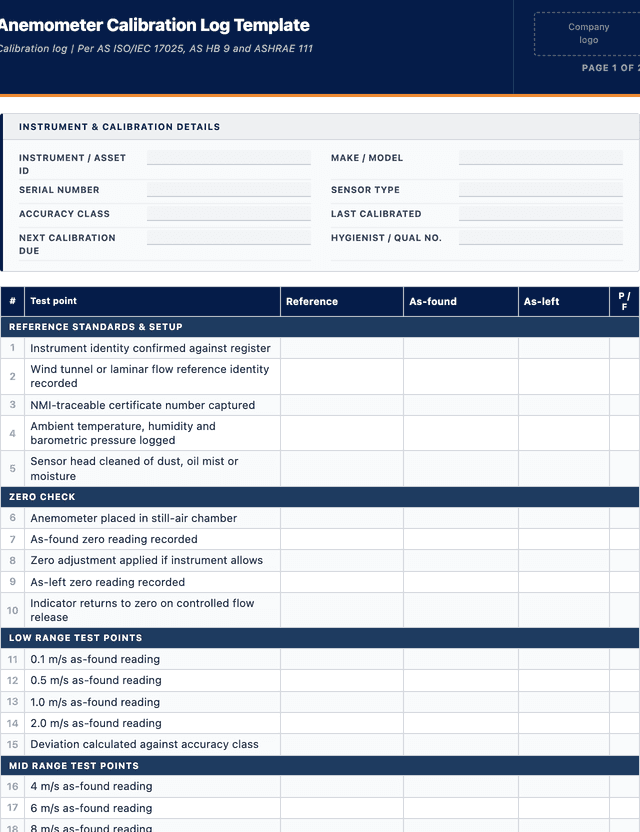
Reference standards & setup
Zero check
Low range test points
Mid range test points
High range test points
Direction, linearity & labelling
How to use: download the PDF, print or complete digitally on any device.
- PDF format, ready to print or fill on screen
- Use as-is or customise to suit your operation
- Go digital in MapTrack for photos, reminders and audit trails
Download free PDF template
Use in MapTrack →



Trusted by teams across Australia and New Zealand
We respect your privacy. Unsubscribe anytime.
Or set it up in MapTrack
- Fill it in on a phone, attach photos to any check
- Automatic reports and audit trails
- Upload the PDF and MapTrack drafts the form for you
Free 30-day trial. No credit card. Personal email accepted.
Don't just download it - use it live. Start a free workspace, upload this anemometer calibration log template and MapTrack drafts it as a form your crew can run from a phone.

Co-Founder & Commercial Director
Key takeaways
- The MapTrack anemometer calibration log template contains 30 checks across 6 sections. Sections covered: Reference standards & setup, Zero check, Low range test points, Mid range test points, High range test points, Direction, linearity & labelling.
Enter your email below to download this anemometer calibration log template as a ready-to-use PDF.
Used by construction, mining and field service teams










What is an anemometer calibration log template?
An anemometer calibration log is a formal record used to document the periodic calibration of a cup, vane, hot-wire or ultrasonic anemometer against a traceable wind-tunnel reference. The log captures the instrument identity, the wind tunnel or laminar flow reference used, the anemometer sensor type, the rated velocity range and the as-found and as-left readings at each calibration point across the working envelope. Standard practice covers a zero offset check at still air, low-velocity calibration at 0.1 to 2 metres per second for occupational hygiene and HVAC face velocity duty, mid-range calibration at 2 to 10 metres per second for general ventilation and weather monitoring, and high-velocity calibration at 10 to 30 metres per second for mine ventilation, weather station and wind farm duty. Direction calibration and span linearity round out the procedure for vane and ultrasonic instruments where azimuth response matters.
From a regulatory angle, anemometer calibration sits inside a framework that occupational hygienists, HVAC commissioning engineers and ventilation engineers rely on for defensible measurement. AS ISO/IEC 17025 sets the international competence standard for the calibration laboratory or in-house procedure that issues the certificate, with traceability through the National Measurement Institute. AS HB 9 covers occupational hygiene measurement practice in Australia, which prescribes the use of calibrated anemometers for personal sampling, LEV face velocity surveys and indoor air quality assessment. Australian Industrial Hygiene Association guidelines reinforce the calibration interval for hygiene instruments, and ASHRAE 111 covers HVAC system testing and balancing measurement, including anemometer accuracy class. In mine ventilation, state mining safety regulators and the relevant MDG guidelines require anemometer readings used for primary airflow surveys to be backed by a current calibration certificate. A documented calibration log is the artefact auditors, hygienists and mines inspectors will look for first when they question the integrity of a velocity reading.
Learn more about compliance and inspections in MapTrack.
Benefits of using this anemometer calibration log template
- Hygiene measurement assurance: documented calibration confirms anemometer readings are accurate before they are used for personal sampling, LEV face velocity surveys or indoor air quality
- HVAC commissioning evidence: ASHRAE 111 and the testing and balancing chain require anemometers to be calibrated against a wind tunnel reference before design verification
- Mine ventilation compliance: state mining safety regulators require anemometer readings on primary airflow surveys to be backed by a current NMI-traceable calibration certificate
- Detect sensor drift early: trended as-found readings across low, mid and high velocity reveal gradual drift before the anemometer falls outside its accuracy class
- Direction response verification: rotating the anemometer through 360 degrees in the wind tunnel flags vane stiction, bearing wear and ultrasonic transducer drift
- Identify damaged instruments: repeated zero offset, span failures or low-velocity errors flag anemometers dropped, exposed to dust, oil mist or moisture, or stored contaminated
- Sensor-type discipline: separate calibration records for cup, vane, hot-wire and ultrasonic instruments force the right calibration to be applied to the right sensor type
- Due diligence record: in the event of a hygiene investigation or mine ventilation incident, a stamped log demonstrates the anemometer was verified at survey time
Benefits of digitising forms in MapTrack
When you digitise anemometer calibration logs in MapTrack, you get:
- Field users can easily scan a QR code to complete a form on mobile. Unlimited users.
- Email the right people when a form is submitted, with an automation you set up.
- File every completed form against the asset, location or person it covers.
- Download any completed form as a PDF, with failed answers listed at the top.
- Fill in forms offline; they upload when the device is back online.
- Build conditional logic (show or hide questions based on answers).
- Take pictures or attach photos. Not possible with a paper-based form.
- Electronic signatures.
- Edit forms later without reprinting.
- Set who can view, fill in or edit forms with user roles.
- Upload a paper form (PDF, Word, Excel or a photo) and MapTrack's AI builds a digital version for you to check.
- Assign audits and send reminder emails to the people doing them.
- Keep every audit, inspection and sign-off against the asset or site it covers.
- Track corrective actions as work orders from finding to close-out, with each change in the activity log.
Book a demo to see how MapTrack handles anemometer calibration logs.
Try MapTrack free for 30 days
Full access to every feature. No credit card required. Per-asset pricing so you scale as your fleet grows.
- No credit card required
- 30 days free trial
- Cancel anytime
1-2 days/week saved
“Bloody amazing! We used to spend 1-2 days a week tracking and managing our generators alone.”

Steve McAllister
Asset Coordinator, Saunders International
What to include in an anemometer calibration log template
This anemometer calibration log template covers 11 key areas:
- Instrument details: make, model, serial number, asset/ID number, sensor type (cup, vane, hot-wire or ultrasonic), rated velocity range, accuracy class and probe length
- Reference standard details: wind tunnel or laminar flow reference make, model, serial number and NMI-traceable certificate number, four times better than the anemometer accuracy class
- Environmental conditions: ambient temperature, relative humidity, barometric pressure and reference stabilisation time recorded against the calibration event for air-density correction
- Zero offset check: as-found still-air reading recorded with the anemometer protected from any draught, with the indicator returning to zero after airflow is released
- Low-velocity calibration: as-found and as-left readings at 0.1, 0.5, 1.0 and 2.0 metres per second for hygiene and HVAC face velocity duty, with deviation calculated
- Mid-range calibration: as-found and as-left readings at 4, 6, 8 and 10 metres per second for general ventilation and weather monitoring duty, with deviation calculated
- High-velocity calibration: as-found and as-left readings at 15, 20, 25 and 30 metres per second for mine ventilation, weather station and wind farm duty
- Direction calibration: for vane and ultrasonic anemometers, as-found and as-left azimuth readings at 0, 90, 180 and 270 degrees against the wind tunnel reference direction
- Span linearity: regression of the as-found readings against the reference values across the working envelope to flag non-linear sensor response on a single sweep
- Sensor-type sign-off: confirmation that the calibration procedure matches the sensor type, with a note where the anemometer has been moved between application categories
- Technician identity and sign-off: occupational hygienist, HVAC technician or ventilation engineer name, qualification number, calibration date and signature confirming the anemometer is fit for service
How to use this anemometer calibration log template
- 1. Record the instrument details: fill in make, model, serial number, sensor type, rated velocity range and accuracy class at the top of page 1, cross-reference against the hygiene or commissioning instrument register to confirm the anemometer identity before any test airflow is applied
- 2. Record the reference standard: capture make, model, serial number and NMI-traceable certificate number of the wind tunnel or laminar flow reference, confirm the reference accuracy is at least four times better than the anemometer accuracy class and that the reference certificate is current
- 3. Stabilise the anemometer: allow the anemometer to sit at the calibration room ambient temperature for at least 30 minutes before testing, log the ambient temperature, relative humidity and barometric pressure, and verify the sensor head is clean and free of dust, oil mist or moisture
- 4. Run the zero offset check: with the anemometer protected from any draught in the still-air chamber, record the as-found indicator reading, confirm the zero offset is within the accuracy class and adjust the zero if the instrument allows it
- 5. Run the low-velocity sweep: position the anemometer in the wind tunnel at 0.1, 0.5, 1.0 and 2.0 metres per second in turn, record the as-found indicator reading at each test point and calculate deviation against the accuracy class for pass or fail
- 6. Run the mid-range sweep: increase the wind tunnel velocity to 4, 6, 8 and 10 metres per second in turn, record the as-found indicator reading at each test point and calculate deviation against the accuracy class
- 7. Run the high-velocity sweep: increase the wind tunnel velocity to 15, 20, 25 and 30 metres per second in turn, record the as-found indicator reading at each test point and calculate deviation against the accuracy class for mine ventilation, weather station or wind farm duty
- 8. Run the direction calibration: for vane and ultrasonic anemometers, rotate the instrument through 0, 90, 180 and 270 degrees in the wind tunnel reference flow, record the as-found azimuth reading at each direction and flag vane stiction or transducer drift
- 9. Close the record: stamp the calibration sheet with the technician name and qualification number, set the next calibration due date based on the application interval, attach a calibration sticker to the anemometer body and load the certificate against the asset in MapTrack
In MapTrack, you can automate compliance tracking and audit trails. Each submission is stored as a timestamped PDF against the asset record.
Get the free templateEnter your email above to download the full anemometer calibration log template as a PDF.Back to download formHow often should you complete this calibration log?
Anemometer calibration intervals are driven by the application category, the sensor type and the accuracy class required. For occupational hygiene face velocity surveys and indoor air quality assessment under AS HB 9, the typical interval is 12 months from the previous calibration sticker, with hot-wire instruments often calibrated every 6 months because the heated sensor is sensitive to dust and oil mist contamination. For HVAC commissioning and testing and balancing work under ASHRAE 111, the interval is also 12 months. For mine ventilation surveys feeding into the primary airflow circuit, state mining safety regulators typically require 12 months but tighten the interval to 6 months for cup and vane instruments exposed to dust-heavy environments. Outside the scheduled cadence, an anemometer must also be calibrated immediately after a suspected impact event, exposure to oil mist or moisture, extended storage, or any change in sensor type or probe length that affects the wind-tunnel response.
Frequently asked questions
Applicable regulatory standards
This template is a starting point. Check the current requirements that apply to your equipment, work and location. The template alone does not establish compliance.
- AS ISO/IEC 17025 (Calibration laboratory competence)
- AS HB 9 (Occupational hygiene measurement)
- Australian Industrial Hygiene Association guidelines
- ASHRAE 111 (HVAC system testing and balancing)
- NMI traceability (National Measurement Institute)
Anemometer Calibration Log Template preview
The numbers behind this anemometer calibration log template
Every figure below is sourced and dated, so you can quote it in a toolbox talk, a budget case or a board paper without having to chase the original report.
Embed this free template on your website
Run an industry blog, trade association site, or training resource? Drop a preview of this free anemometer calibration log template straight into your page. The snippet is self-contained, needs no scripts, and links readers back to the full free template.
<div style="max-width:480px;font-family:system-ui,-apple-system,'Segoe UI',Roboto,sans-serif;border:1px solid #E5E7EB;border-radius:12px;padding:20px;background:#ffffff;">
  <p style="font-size:12px;font-weight:700;letter-spacing:0.05em;text-transform:uppercase;color:#071D49;margin:0;">Free template</p>
  <p style="font-size:18px;font-weight:700;color:#071D49;margin:6px 0 0;">Anemometer Calibration Log Template</p>
  <ul style="margin:12px 0 0;padding-left:18px;color:#374151;font-size:14px;line-height:1.6;">
    <li style="margin:4px 0;">Instrument details: make, model, serial number, asset/ID number, sensor type (cup, vane, hot-wire or ultrasonic), rated velocity range, accuracy class and probe length</li>
    <li style="margin:4px 0;">Reference standard details: wind tunnel or laminar flow reference make, model, serial number and NMI-traceable certificate number, four times better than the anemometer accuracy class</li>
    <li style="margin:4px 0;">Environmental conditions: ambient temperature, relative humidity, barometric pressure and reference stabilisation time recorded against the calibration event for air-density correction</li>
    <li style="margin:4px 0;">Zero offset check: as-found still-air reading recorded with the anemometer protected from any draught, with the indicator returning to zero after airflow is released</li>
    <li style="margin:4px 0;">Low-velocity calibration: as-found and as-left readings at 0.1, 0.5, 1.0 and 2.0 metres per second for hygiene and HVAC face velocity duty, with deviation calculated</li>
    <li style="margin:4px 0;">Mid-range calibration: as-found and as-left readings at 4, 6, 8 and 10 metres per second for general ventilation and weather monitoring duty, with deviation calculated</li>
  </ul>
  <p style="font-size:13px;color:#6B7280;margin:14px 0 0;padding-top:12px;border-top:1px solid #E5E7EB;">Free <a href="https://www.maptrack.com/templates/anemometer-calibration-log" style="color:#071D49;font-weight:600;text-decoration:none;">Anemometer Calibration Log Template</a> by MapTrack</p>
</div>Free to reuse, including commercially. This template is published under a Creative Commons Attribution 4.0 licence. Copy it, adapt it, put it on your own site or in your own docs. All we ask is that you credit MapTrack with a link back to this page. The snippet above already includes that credit, so if you use it as-is you’re covered.
Cite this template
Writing about this topic? You’re welcome to quote this checklist. Here’s the wording to use so your readers can find the original.
The MapTrack anemometer calibration log template contains 30 checks across 6 sections.
- Short attribution
- MapTrack Anemometer Calibration Log Template, https://www.maptrack.com/templates/anemometer-calibration-log
- Reference list
- MapTrack. (2026). Anemometer Calibration Log Template [Checklist template]. Retrieved from https://www.maptrack.com/templates/anemometer-calibration-log
Free to reuse with credit under a Creative Commons Attribution 4.0 licence. If you’d rather link straight to it, the page is https://www.maptrack.com/templates/anemometer-calibration-log.
Need to automate compliance tracking and audit trails?
Register every anemometer in MapTrack, attach digital forms, and get a complete history of every inspection, service and compliance record.
Compliance and inspections · All templates · Pricing · Book a demo