
Free asset tag and labelling register
Free asset tag template (PDF). Design a barcode or QR numbering scheme and map every tag number to its asset. Download free.
Updated 4 June 2026
Asset Tag and Labelling Register
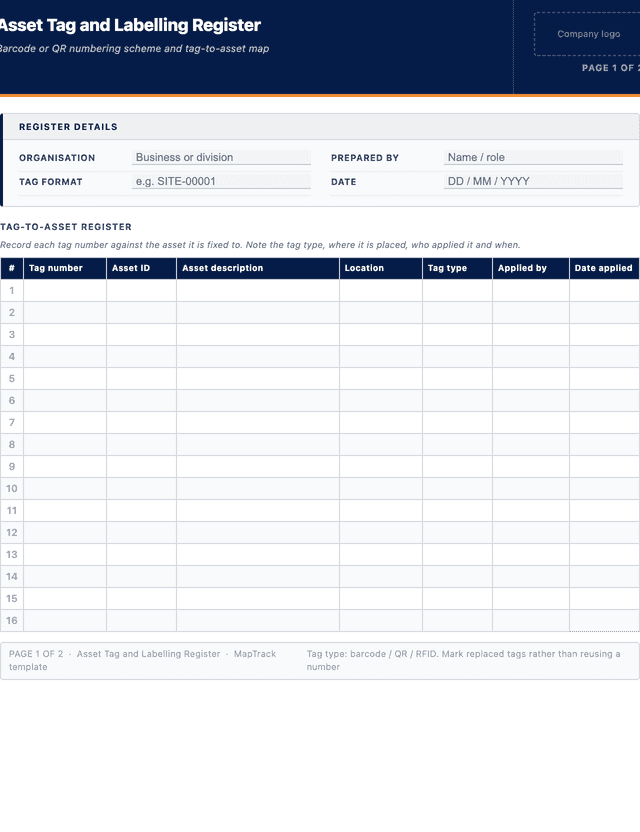
Record each tag number against the asset it is fixed to. Note the tag type, where it is placed, who applied it and when.
| # | Tag number | Asset ID | Asset description | Location | Tag type | Applied by | Date applied |
|---|---|---|---|---|---|---|---|
| e.g. | EXC-102 | EXC-102 | Excavator - 8 tonne | Depot A | EXC-102 | - | 12/03/2024 |
| 1 | |||||||
| 2 | |||||||
| 3 | |||||||
| 4 | |||||||
| 5 |
The PDF includes all 28 numbered rows, ready to print or fill on screen.
Prepared by
Signature
Print name
Date
Asset / store manager
Signature
Print name
Date
How to use: download the PDF, print or complete digitally on any device.
- PDF format, ready to print or fill on screen
- Use as-is or customise to suit your operation
- Go digital in MapTrack for photos, reminders and audit trails
Two ways to use it
Use in MapTrack →Use it digitally instead
Unlimited usersUpload this PDF and MapTrack drafts the form for you.




- Scan the asset’s QR tag with any phone
- Submitted forms can trigger alerts
- Photos on fails, audit-ready records
- Export responses, PDF reports with your logo
Free trial. No credit card needed.
Trusted by teams across Australia and New Zealand
We respect your privacy. Unsubscribe anytime.
These templates are free general guides provided as-is. They do not constitute legal, safety or compliance advice. You are responsible for ensuring any form meets your specific workplace obligations, industry standards and applicable regulations.
Don't just download it - use it live. Start a free workspace, upload this asset tag and labelling register and MapTrack drafts it as a form your crew can run from a phone.

Co-Founder & Commercial Director
Key takeaways
- The MapTrack asset tag and labelling register has 7 columns and room for 28 entries. Columns: Tag number, Asset ID, Asset description, Location, Tag type, Applied by, Date applied.
- An asset tag register defines your barcode or QR numbering scheme and maps each tag number to the asset it is fixed to.
- A consistent tag format with a site or category prefix keeps numbers unique and readable as you scale across multiple locations.
- Recording the tag type, the date applied and who applied it gives an audit trail and flags tags that need re-labelling.
- The register is the bridge from paper to scanning: once every asset is tagged, a phone scan can pull up its full record.
Enter your email below to download this asset tag and labelling register as a ready-to-use PDF.
Used by construction, mining and field service teams










What is an asset tag and labelling register?
An asset tag and labelling register is a structured record of an organisation tagging scheme and the map between each tag and the asset it identifies. It has two jobs. First, it documents the numbering scheme: the tag format, the prefixes used for sites, categories or asset classes, the tag technology (barcode, QR or RFID) and how new numbers are issued, so identifiers stay unique and consistent. Second, it records the tag-to-asset map: for each tag number, the asset it is fixed to, the asset description, the location, the tag type, the date applied and who applied it.
A clear tagging scheme is the foundation of any scan-based asset system, because the label is what links a physical item to its record. Construction, facilities, manufacturing and IT teams use this register when rolling out barcode or QR labels so the numbering does not become a tangle of duplicates and one-off formats, and so a replacement tag can be reissued without losing history. In MapTrack, each asset carries a QR or barcode label that a phone scans to open its full record, including custody, condition and service history, so a well-designed tag scheme set up here flows straight into live tracking. A consistent identification approach also supports the asset information requirements of ISO 55001 by ensuring each asset is uniquely and durably identified.
Learn more about asset tracking in MapTrack.
Benefits of using this asset tag and labelling register
- Unique identification: a documented numbering scheme keeps every tag number unique, so two assets are never confused or double-counted.
- Scalable scheme: site, category or class prefixes mean the format still works as you add locations and thousands more assets over time.
- Faster scanning: once each asset is tagged and mapped here, a phone scan opens the asset record instead of someone keying in an ID.
- Re-labelling control: recording tag type and date applied flags worn or damaged labels for replacement before they become unreadable.
- Clean rollout: a planned tag register prevents the common mess of duplicate numbers and one-off formats that derails a tagging project.
- Audit trail: knowing who applied each tag and when supports stocktakes, reconciliations and the reissue of a lost or replaced label.
- Consistent reporting: a single scheme across sites lets you filter and report by prefix, so asset data rolls up cleanly by location or category.
Benefits of digitising forms in MapTrack
When you move your asset registers from paper to MapTrack, you get:
- Field users can easily scan a QR code to complete a form on mobile. Unlimited users.
- Email the right people when a form is submitted, with an automation you set up.
- File every completed form against the asset, location or person it covers.
- Download any completed form as a PDF, with failed answers listed at the top.
- Fill in forms offline; they upload when the device is back online.
- Build conditional logic (show or hide questions based on answers).
- Take pictures or attach photos. Not possible with a paper-based form.
- Electronic signatures.
- Edit forms later without reprinting.
- Set who can view, fill in or edit forms with user roles.
- Upload a paper form (PDF, Word, Excel or a photo) and MapTrack's AI builds a digital version for you to check.
- Keep one asset register with each asset's location, condition and custody history.
- Schedule calibration and record certification and warranty expiry dates against each asset.
- See each asset's value over time in the Asset Depreciation report.
Book a demo to see how MapTrack handles asset registers.
Try MapTrack free for 30 days
Full access to every feature. No credit card required. Per-asset pricing so you scale as your fleet grows.
- No credit card required
- 30 days free trial
- Cancel anytime
1-2 days/week saved
“Bloody amazing! We used to spend 1-2 days a week tracking and managing our generators alone.”

Steve McAllister
Asset Coordinator, Saunders International
What to include in an asset tag and labelling register
This asset tag and labelling register covers 11 key areas:
- Scheme details: organisation, prepared by, the sites or categories covered, and the date.
- Tag format: the structure of the tag number, for example a prefix plus a sequential number.
- Prefix key: the codes used for each site, category or asset class.
- Tag technology: whether tags are barcode, QR or RFID and the label material or size.
- Tag number: the unique identifier printed or encoded on each label.
- Asset ID: the internal asset or fleet number the tag corresponds to, where they differ.
- Asset description: a clear name for the asset the tag is fixed to.
- Location: the site, area or vehicle where the tagged asset is held.
- Tag type and placement: the label type and where on the asset it is fixed.
- Applied by and date: who attached the tag and when, for the audit trail.
- Status and notes: active, replaced or retired, plus any re-label or damage note.
How to use this asset tag and labelling register
- Design the numbering scheme and prefixes before printing any labels.: Decide the tag format, for example a two or three letter site or category prefix followed by a sequential number, and document how new numbers are issued. A scheme agreed up front keeps identifiers unique and readable and prevents the duplicate, one-off formats that derail rollouts.
- Choose the tag technology and label material to suit the environment.: Select barcode, QR or RFID and a label material that survives the conditions, such as weatherproof or metal-mount labels for outdoor plant. Recording the technology and material here means replacements match and tags stay scannable through the asset life.
- Allocate a tag number to each asset and record the map.: Work through the asset base assigning the next number from the scheme to each item, and record the tag number against the asset ID, description and location. This tag-to-asset map is the core of the register and the link a scan relies on to find the right record.
- Apply the physical label and record who applied it and when.: Fix the label in a consistent, visible and durable position on each asset, then record the tag type, placement, who applied it and the date. The audit trail lets you reissue a replacement tag later without losing the history tied to the original number.
- Verify each tag scans and links to the correct asset record.: Scan a sample of applied tags to confirm they read cleanly and resolve to the intended asset, and check that no number has been issued twice. Fixing read errors and duplicates now avoids confusion during stocktakes and day-to-day scanning later.
- Store the register, manage reissues and keep the scheme current.: Save the register as the source of truth for the scheme, and update it whenever a tag is replaced, an asset is retired or a new site prefix is added. Mark replaced tags rather than deleting them so the history of each asset identifier remains intact.
In MapTrack, you can manage your full asset register digitally. Each submission is stored as a timestamped PDF against the asset record.
Get the free templateEnter your email above to download the full asset tag and labelling register as a PDF.Back to download formHow often should you complete this asset register?
Set up the tag register at the start of a labelling rollout, then maintain it continuously. Add a row whenever a new asset is tagged, and update the status whenever a label is replaced or an asset is retired. Review the scheme whenever you add a site or asset category so the prefix structure still holds, and re-scan a sample of tags during each stocktake to catch worn or unreadable labels. In MapTrack, the tag scheme set up here flows into live tracking, where each scanned QR or barcode opens the asset record, so the register and the field stay in step.
Frequently asked questions
Applicable regulatory standards
This template is a starting point. Check the current requirements that apply to your equipment, work and location. The template alone does not establish compliance.
- ISO 55001 - Asset Management Systems (unique and durable identification of assets in the asset register)
- ISO/IEC 15459 - Unique identifiers (principles for unique identification of items and assets)
- ISO 55000 - Asset Management (overview and principles, including reliable asset information)
Check the current source
Asset tag and labelling register preview
The numbers behind this asset tag and labelling register
Every figure below is sourced and dated, so you can quote it in a toolbox talk, a budget case or a board paper without having to chase the original report.
Embed this free template on your website
Run an industry blog, trade association site, or training resource? Drop a preview of this free asset tag and labelling register straight into your page. The snippet is self-contained, needs no scripts, and links readers back to the full free template.
<div style="max-width:480px;font-family:system-ui,-apple-system,'Segoe UI',Roboto,sans-serif;border:1px solid #E5E7EB;border-radius:12px;padding:20px;background:#ffffff;">
  <p style="font-size:12px;font-weight:700;letter-spacing:0.05em;text-transform:uppercase;color:#071D49;margin:0;">Free template</p>
  <p style="font-size:18px;font-weight:700;color:#071D49;margin:6px 0 0;">Asset tag and labelling register</p>
  <ul style="margin:12px 0 0;padding-left:18px;color:#374151;font-size:14px;line-height:1.6;">
    <li style="margin:4px 0;">Scheme details: organisation, prepared by, the sites or categories covered, and the date.</li>
    <li style="margin:4px 0;">Tag format: the structure of the tag number, for example a prefix plus a sequential number.</li>
    <li style="margin:4px 0;">Prefix key: the codes used for each site, category or asset class.</li>
    <li style="margin:4px 0;">Tag technology: whether tags are barcode, QR or RFID and the label material or size.</li>
    <li style="margin:4px 0;">Tag number: the unique identifier printed or encoded on each label.</li>
    <li style="margin:4px 0;">Asset ID: the internal asset or fleet number the tag corresponds to, where they differ.</li>
  </ul>
  <p style="font-size:13px;color:#6B7280;margin:14px 0 0;padding-top:12px;border-top:1px solid #E5E7EB;">Free <a href="https://www.maptrack.com/templates/asset-tag-register-template" style="color:#071D49;font-weight:600;text-decoration:none;">Asset tag and labelling register</a> by MapTrack</p>
</div>Free to reuse, including commercially. This template is published under a Creative Commons Attribution 4.0 licence. Copy it, adapt it, put it on your own site or in your own docs. All we ask is that you credit MapTrack with a link back to this page. The snippet above already includes that credit, so if you use it as-is you’re covered.
Cite this template
Writing about this topic? You’re welcome to quote this checklist. Here’s the wording to use so your readers can find the original.
The MapTrack asset tag and labelling register has 7 columns and room for 28 entries.
- Short attribution
- MapTrack Asset tag and labelling register, https://www.maptrack.com/templates/asset-tag-register-template
- Reference list
- MapTrack. (2026). Asset tag and labelling register [Checklist template]. Retrieved from https://www.maptrack.com/templates/asset-tag-register-template
Free to reuse with credit under a Creative Commons Attribution 4.0 licence. If you’d rather link straight to it, the page is https://www.maptrack.com/templates/asset-tag-register-template.
Need to manage your full asset register digitally?
Register every asset in MapTrack, attach digital forms, and get a complete history of every inspection, service and compliance record.