
Free asset audit compliance checklist
Free asset audit compliance checklist (PDF-ready). Verify register accuracy, labelling, documentation and ISO 55001 requirements. Digitise with MapTrack.
Updated 2 May 2026
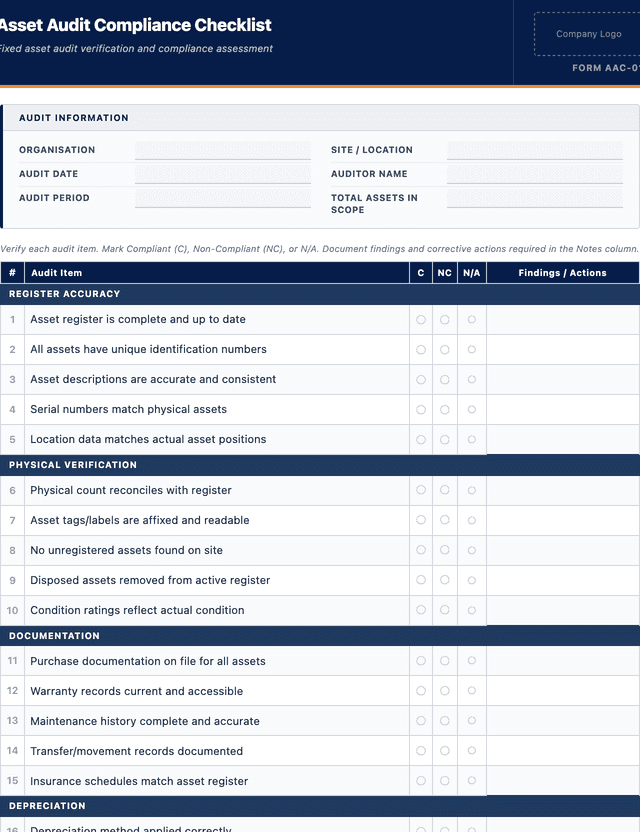
Asset Audit Compliance Checklist
Fixed asset audit verification and compliance assessment
Register Accuracy
Physical Verification
Documentation
Depreciation
Compliance
Auditor
Name
Signature
Date
Management Acknowledgement
Name
Signature
Date
How to use: download the PDF, print or complete digitally on any device.
- PDF format, ready to print or fill on screen
- Use as-is or customise to suit your operation
- Go digital in MapTrack for photos, reminders and audit trails
Two ways to use it
Use in MapTrack →Use it digitally instead
Unlimited usersThese same 25 checks, already built.




- Scan the asset’s QR tag with any phone
- Submitted forms can trigger alerts
- Photos on fails, audit-ready records
- Export responses, PDF reports with your logo
Free trial. No credit card needed.
Trusted by teams across Australia and New Zealand
We respect your privacy. Unsubscribe anytime.
These templates are free general guides provided as-is. They do not constitute legal, safety or compliance advice. You are responsible for ensuring any form meets your specific workplace obligations, industry standards and applicable regulations.
Don't just download it - use it live. Start a free workspace with this asset audit compliance checklist already built, so your crew can run it from a phone.

Co-Founder & Commercial Director
Key takeaways
- The MapTrack asset audit compliance checklist contains 25 checks across 5 sections. Sections covered: Register Accuracy, Physical Verification, Documentation, Depreciation, Compliance.
Enter your email below to download this asset audit compliance checklist as a ready-to-use PDF.
Used by construction, mining and field service teams









What is an asset audit compliance checklist?
An asset audit compliance checklist is a structured document used to verify that an organisation asset management programme meets the requirements of applicable standards, policies and regulations. Unlike a physical asset stocktake (which verifies assets exist at their registered location), a compliance audit assesses the processes, documentation, controls and governance surrounding asset management. The checklist covers asset register completeness, labelling and identification, acquisition and disposal procedures, maintenance records, depreciation accuracy, insurance coverage, risk management and reporting.
ISO 55001:2024 (Asset management, Management systems) provides the framework for a compliant asset management system. For Australian public sector organisations, the Australian Accounting Standards (AASB 116 Property, Plant and Equipment) require accurate asset records for financial reporting. Government agencies must also comply with the Financial Management and Accountability Act or equivalent state legislation. The WHS Act 2011 requires that plant and equipment is maintained and inspected, which requires an accurate asset management system. A compliance audit identifies gaps in the asset management programme before they become audit findings, regulatory breaches or financial statement qualifications.
Learn more about asset tracking in MapTrack.
Benefits of using this asset audit compliance checklist
- Standards compliance: verifies the asset management programme meets ISO 55001 requirements.
- Financial accuracy: confirms depreciation schedules, valuations and write-offs are based on accurate asset data.
- Process improvement: identifies gaps in acquisition, transfer, maintenance and disposal processes.
- Audit preparation: addresses non-conformances before external auditors, regulators or accreditation bodies conduct their reviews.
- Risk reduction: confirms insurance coverage is current, maintenance records are complete and risk registers are updated.
- Governance assurance: documents that asset management policies and delegations are being followed.
Benefits of digitising forms in MapTrack
When you move your checklists from paper to MapTrack, you get:
- Field users can easily scan a QR code to complete a form on mobile. Unlimited users.
- Email the right people when a form is submitted, with an automation you set up.
- File every completed form against the asset, location or person it covers.
- Download any completed form as a PDF, with failed answers listed at the top.
- Fill in forms offline; they upload when the device is back online.
- Build conditional logic (show or hide questions based on answers).
- Take pictures or attach photos. Not possible with a paper-based form.
- Electronic signatures.
- Edit forms later without reprinting.
- Set who can view, fill in or edit forms with user roles.
- Upload a paper form (PDF, Word, Excel or a photo) and MapTrack's AI builds a digital version for you to check.
- Keep one asset register with each asset's location, condition and custody history.
- Schedule calibration and record certification and warranty expiry dates against each asset.
- See each asset's value over time in the Asset Depreciation report.
Book a demo to see how MapTrack handles checklists.
Try MapTrack free for 30 days
Full access to every feature. No credit card required. Per-asset pricing so you scale as your fleet grows.
- No credit card required
- 30 days free trial
- Cancel anytime
1-2 days/week saved
“Bloody amazing! We used to spend 1-2 days a week tracking and managing our generators alone.”

Steve McAllister
Asset Coordinator, Saunders International
What to include in an asset audit compliance checklist
This asset audit compliance checklist covers 12 key areas:
- Audit scope: organisation or business unit, asset classes covered, audit date, auditor name and qualifications.
- Asset register: register is complete and current, all assets have unique IDs, location and custodian fields are populated.
- Asset identification: physical labels or tags match register entries, labelling method is consistent and durable.
- Acquisition process: purchase orders reference asset register entries, capitalisation thresholds followed, commissioning checklists completed.
- Maintenance records: scheduled maintenance is planned and tracked, maintenance history is recorded against each asset.
- Depreciation and valuation: useful life estimates are reviewed periodically, depreciation method is appropriate, revaluations conducted per schedule.
- Disposal process: disposals follow the documented procedure, approvals are recorded, register is updated, environmental compliance confirmed.
- Insurance: asset schedule provided to insurer is current, coverage levels reflect replacement cost, claims process documented.
- Transfer process: transfers between locations or departments are documented, register updated, transfer forms filed.
- Risk management: critical assets identified, risk assessments current, contingency plans in place for high-risk assets.
- Reporting: asset management reports are produced and reviewed by management at required intervals.
- Sign-off: auditor signature, asset manager response to findings, date, next audit scheduled.
How to use this asset audit compliance checklist
- Define the audit scope and gather reference documents: Confirm the asset classes, locations and processes to be audited. Obtain the asset management policy, procedure documents, asset register, maintenance records, insurance schedule and previous audit reports. Prepare the audit checklist with criteria aligned to ISO 55001 clauses and organisational policy requirements.
- Review asset register completeness and accuracy: Check that the asset register includes all asset classes within scope, every asset has a unique identifier, and key fields (location, custodian, acquisition date, cost, useful life, condition) are populated. Select a sample of register entries and verify them against physical assets to confirm the register reflects reality.
- Audit acquisition, transfer and disposal processes: Review recent acquisitions to confirm purchase orders reference asset register entries and capitalisation thresholds are applied correctly. Check transfer forms for recent asset movements. Review disposal records to confirm approvals, environmental compliance and register updates were completed.
- Review maintenance records, depreciation and insurance: Verify that scheduled maintenance is planned and tracked for each asset. Check that depreciation calculations are based on current useful life estimates and appropriate methods. Confirm the insurance schedule matches the current asset register and coverage levels reflect replacement costs.
- Document findings, assign corrective actions and schedule follow-up: Record all findings as conformances, observations or non-conformances. Assign corrective actions for non-conformances with responsible persons, target dates and evidence requirements. Present findings to the asset manager. Schedule a follow-up audit to verify corrective actions have been implemented.
In MapTrack, you can manage your full asset register digitally. Each submission is stored as a timestamped PDF against the asset record.
Get the free templateEnter your email above to download the full asset audit compliance checklist as a PDF.Back to download formHow often should you complete this checklist?
Asset audit compliance reviews should be conducted annually for organisations with significant asset portfolios. ISO 55001 certified organisations must conduct internal audits at planned intervals per Clause 9.2. Government agencies may have legislated audit frequencies. Interim reviews should be triggered by significant events such as organisational restructure, system migration, major acquisition or disposal programme, or findings from external auditors. The first compliance audit after implementing a new asset management system should occur within six months.
Frequently asked questions
Applicable regulatory standards
This template is a starting point. Check the current requirements that apply to your equipment, work and location. The template alone does not establish compliance.
- ISO 55001:2024, Clause 9.2 - Internal audit
- AASB 116 - Property, Plant and Equipment
Check the current source
Asset audit compliance checklist preview
The numbers behind this asset audit compliance checklist
Every figure below is sourced and dated, so you can quote it in a toolbox talk, a budget case or a board paper without having to chase the original report.
Embed this free template on your website
Run an industry blog, trade association site, or training resource? Drop a preview of this free asset audit compliance checklist straight into your page. The snippet is self-contained, needs no scripts, and links readers back to the full free template.
<div style="max-width:480px;font-family:system-ui,-apple-system,'Segoe UI',Roboto,sans-serif;border:1px solid #E5E7EB;border-radius:12px;padding:20px;background:#ffffff;">
  <p style="font-size:12px;font-weight:700;letter-spacing:0.05em;text-transform:uppercase;color:#071D49;margin:0;">Free template</p>
  <p style="font-size:18px;font-weight:700;color:#071D49;margin:6px 0 0;">Asset audit compliance checklist</p>
  <ul style="margin:12px 0 0;padding-left:18px;color:#374151;font-size:14px;line-height:1.6;">
    <li style="margin:4px 0;">Audit scope: organisation or business unit, asset classes covered, audit date, auditor name and qualifications.</li>
    <li style="margin:4px 0;">Asset register: register is complete and current, all assets have unique IDs, location and custodian fields are populated.</li>
    <li style="margin:4px 0;">Asset identification: physical labels or tags match register entries, labelling method is consistent and durable.</li>
    <li style="margin:4px 0;">Acquisition process: purchase orders reference asset register entries, capitalisation thresholds followed, commissioning checklists completed.</li>
    <li style="margin:4px 0;">Maintenance records: scheduled maintenance is planned and tracked, maintenance history is recorded against each asset.</li>
    <li style="margin:4px 0;">Depreciation and valuation: useful life estimates are reviewed periodically, depreciation method is appropriate, revaluations conducted per schedule.</li>
  </ul>
  <p style="font-size:13px;color:#6B7280;margin:14px 0 0;padding-top:12px;border-top:1px solid #E5E7EB;">Free <a href="https://www.maptrack.com/templates/asset-audit-compliance-checklist" style="color:#071D49;font-weight:600;text-decoration:none;">Asset audit compliance checklist</a> by MapTrack</p>
</div>Free to reuse, including commercially. This template is published under a Creative Commons Attribution 4.0 licence. Copy it, adapt it, put it on your own site or in your own docs. All we ask is that you credit MapTrack with a link back to this page. The snippet above already includes that credit, so if you use it as-is you’re covered.
Cite this template
Writing about this topic? You’re welcome to quote this checklist. Here’s the wording to use so your readers can find the original.
The MapTrack asset audit compliance checklist contains 25 checks across 5 sections.
- Short attribution
- MapTrack Asset audit compliance checklist, https://www.maptrack.com/templates/asset-audit-compliance-checklist
- Reference list
- MapTrack. (2026). Asset audit compliance checklist [Checklist template]. Retrieved from https://www.maptrack.com/templates/asset-audit-compliance-checklist
Free to reuse with credit under a Creative Commons Attribution 4.0 licence. If you’d rather link straight to it, the page is https://www.maptrack.com/templates/asset-audit-compliance-checklist.
Need to manage your full asset register digitally?
Register every asset in MapTrack, attach digital forms, and get a complete history of every inspection, service and compliance record.