
Free template · PDF
Free 5 whys analysis template
Free 5 Whys template (PDF). State the problem, ask why five times to reach the root cause, then assign countermeasures and verify. Download free.
Loading PDF page...
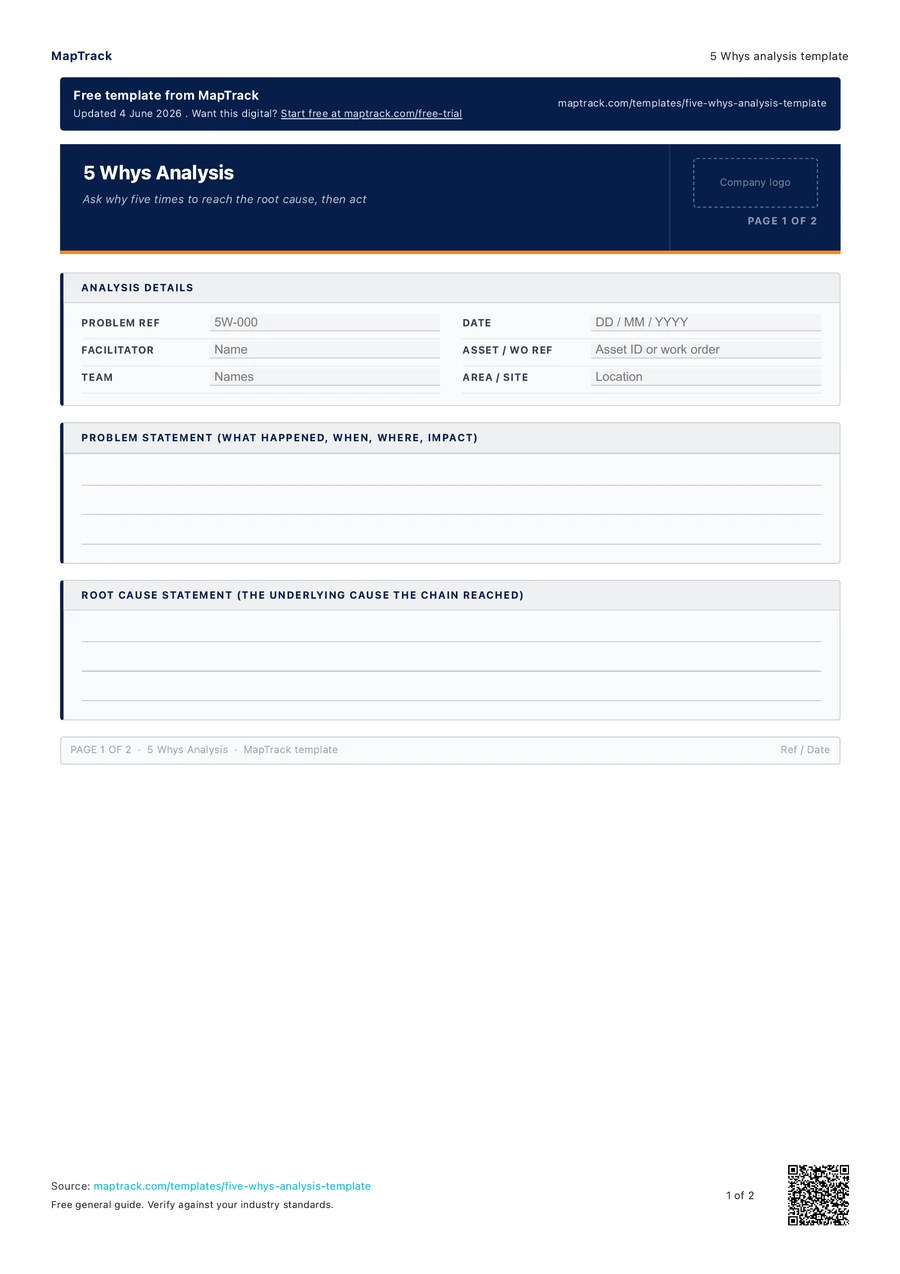

Read the form fields
Ask why five times to reach the root cause, then act
6 sections
The fields in the printable form, in a view that fits your screen.
Analysis Details
- Problem ref
- Date
- Facilitator
- Asset / WO ref
- Team
- Area / site
Problem statement (what happened, when, where, impact)
Root cause statement (the underlying cause the chain reached)
5 Whys Chain
Ask why the problem occurred, then ask why of each answer in turn. Record the evidence for each level. Stop when you reach a cause you can control; go further if you have not.
| Level | Ask: why? | Answer / cause | Evidence that confirms it |
|---|---|---|---|
| Blank field | Blank field | Blank field | Blank field |
| Blank field | Blank field | Blank field | Blank field |
Countermeasures and Verification
For each confirmed root cause, record the countermeasure, the owner, the due date and how effectiveness will be verified.
| Countermeasure | Owner | Due | Verified (date / result) |
|---|---|---|---|
| Blank field | Blank field | Blank field | Blank field |
| Blank field | Blank field | Blank field | Blank field |
Verification
I confirm this 5 Whys analysis is based on evidence available at the time, that the root cause stated reflects the chain recorded above, and that the countermeasures listed have been assigned with owners and due dates.
Facilitator
Signature · Print name · Date
Reviewed by / manager
Signature · Print name · Date
The MapTrack 5 whys analysis template has 4 columns and room for 6 entries.

Make this form your own
Add your fields and logo. Give your team a form they can use on site.
Free 30-day trial. No credit card. Work email needed.
Upload & use this form now for free



“MapTrack beat them all in every aspect.”
 Vincent Stone · HSEQ Advisor, Concept Tanks
After signup: upload this PDF, check the form MapTrack drafts, then save and publish it for your team.
General guidance only. Check the form against your equipment manual, site procedures and local requirements before using it.
Key takeaways
- The MapTrack 5 whys analysis template has 4 columns and room for 6 entries. Columns: Level, Ask: why?, Answer / cause, Evidence that confirms it.
- The 5 Whys is a single-method root cause tool: ask why repeatedly, usually five times, until you reach a cause you can fix rather than a symptom.
- It suits one clear problem with a single causal chain; use a fishbone or full RCA when several independent causes are likely.
- Each answer must be evidence-based, not a guess. A weak link early in the chain leads the whole analysis to the wrong root cause.
- Every confirmed root cause needs a countermeasure with an owner and a due date, then verification that the problem has not recurred.
What is a 5 whys analysis template?
A 5 Whys analysis template is a simple, structured worksheet for finding the root cause of a problem by asking why it happened, then asking why of each answer in turn, typically five times, until the chain reaches a cause that can be acted on rather than another symptom. For each level it captures the question, the evidence-based answer and how that answer was confirmed, ending in a root cause statement and one or more countermeasures with owners and due dates. It deliberately follows a single causal chain, which makes it fast to run and easy to read.
The method came out of the Toyota Production System, where Sakichi Toyoda used repeated why questions to get past the obvious fault to the underlying condition. Maintenance, quality and operations teams in manufacturing, mining and construction use it for breakdowns, defects, near misses and recurring nuisance faults, because it forces the conversation past blame and toward the system that allowed the failure. In MapTrack, a 5 Whys worksheet can be attached to the work order or incident it relates to, so the analysis and its countermeasures stay with the asset history. It is a recognised analytical technique under the corrective action requirements of ISO 9001, clause 10.2.
Learn more about maintenance and work orders in MapTrack.
Choose the format that fits your team
Download the PDF
Use the original printable form for a paper workflow. Check it against your equipment and site procedure before the job.
Keep completed copies in your own record system and arrange any follow-up through your normal process.
Download free PDFCustomise a form in MapTrack
Start a free trial, upload this PDF and MapTrack drafts the form. Adjust it to your workflow, then save and publish it for your team to use.
Sample answers on this page and completed PDF records aren't imported automatically.
Upload & use this form now for freeFree 30-day trial. No credit card. Work email needed.
Benefits of using this 5 whys analysis template
- Fast to run: a small team can complete a focused 5 Whys in minutes, so it suits the daily problems that never justify a full investigation.
- Gets past symptoms: asking why repeatedly moves the team from the visible fault to the system condition that actually needs fixing.
- Reduces blame: the chain points at procedures, controls and design rather than the last person to touch the equipment, which keeps the analysis honest.
- Evidence discipline: recording how each answer was confirmed stops the chain becoming a string of assumptions that lead to the wrong root cause.
- Clear countermeasures: tying the root cause to a named owner and a due date turns the analysis into action rather than a filed form.
- Easy to read: a one-page linear chain is simple for a supervisor or auditor to follow and to challenge, unlike a dense narrative report.
- Feeds bigger tools: a completed 5 Whys plugs straight into a fishbone, an A3 or a formal RCA when the problem turns out to be more complex.
What to include in a 5 whys analysis template
- Header details: reference number, problem title, date, facilitator, team members and the work order or incident this analysis relates to.
- Problem statement: a factual, quantified description of what happened, when, where and the impact (downtime hours, units rejected, cost).
- Why 1: the first answer to why the problem occurred, with the evidence that confirms it.
- Why 2: why that first cause occurred, again supported by evidence rather than opinion.
- Why 3: the next level down the causal chain, confirming the link to the level above.
- Why 4: the next answer, checking whether the chain has reached a system or process condition.
- Why 5: the final why, or earlier if a true root cause is reached sooner, or further if it is not.
- Root cause statement: a concise statement of the underlying cause the chain has reached, distinguished from contributing factors.
- Countermeasures: the actions that eliminate the root cause, each with a responsible person and a due date.
- Verification: how and when effectiveness will be checked, and confirmation the problem has not recurred.
How to use this 5 whys analysis template
Write a clear, factual problem statement before asking any why.
Describe exactly what happened, where, when and the size of the impact, using numbers such as downtime hours or rejected units. A vague problem statement sends the whole chain in the wrong direction, so agree the wording with the team before you start.
Ask why the problem occurred and record the first answer with its evidence.
Capture the most direct cause of the stated problem and note how you know it is true, for example a meter reading, a photograph or a maintenance record. Resist jumping straight to a favourite theory; the first why should be the immediate, verifiable cause.
Ask why of that answer, and keep going down the chain.
Treat each answer as a new problem and ask why it happened, confirming each link with evidence. Continue for about five levels, but stop when you reach a cause you can actually control and go further if you have not, since five is a guide and not a rule.
Test the chain by reading it back from the root cause upward.
Start at the deepest answer and say therefore at each step back up to the problem. If the logic holds in that direction, the chain is sound; if a step does not follow, you have a gap or a missing branch that needs more evidence before you continue.
State the root cause and write countermeasures that eliminate it.
Phrase the root cause as a system or process condition, not as individual error, then define actions that remove it. Give each countermeasure a named owner and a due date so the analysis converts into work that someone is accountable for completing.
Verify effectiveness after a set period and close the analysis.
Agree how you will confirm the fix worked, such as no recurrence over the next 30 to 90 days or a measurable drop in the failure, then review it on that date. Record the outcome and sign off, escalating to a fuller RCA if the problem returns.
How often should you complete this root cause?
Run a 5 Whys whenever a problem is worth understanding but does not warrant a full team investigation: an equipment breakdown, a recurring nuisance fault, a defect, a near miss or a customer complaint. Use it immediately while the evidence and the people involved are still available, because detail is lost within days. Reserve a broader fishbone or formal RCA for high-consequence events or problems with several likely causes. In MapTrack, you can attach the completed worksheet to the related work order, so the root cause and its countermeasures stay visible against that asset the next time it fails.
Make this form your own
From your template to your team.
Upload this PDF and MapTrack drafts the form. Adjust it for your equipment and site, then save and publish the digital form for your team.
- 01
Start your free trial
Use your work email to create your MapTrack account.
- 02
Customise, save and publish
Adjust the template fields and branding for your site.
- 03
Complete it on the job
Record checks, add photos and export a branded PDF.
Keep working offline
Load the form before you lose reception. Complete it offline and sync when you're back online.
Scan the asset. Open its form.
Use an asset's QR code to find and complete the forms that belong to it.
Show what you found
Capture photos and attach files so the next person has the details they need.
Take a branded PDF with you
Download completed forms as PDF reports with your company logo.
Completed paper records aren't imported automatically.
Frequently asked questions
Practical answers about the form, record keeping and using MapTrack.
A 5 Whys analysis template is a one-page worksheet for finding the root cause of a problem by asking why it happened and then asking why of each answer in turn, usually five times. It records the problem statement, each why and its supporting evidence, the root cause the chain reaches, and the countermeasures with owners and due dates. It is a fast, single-method tool best suited to one clear problem with a single causal chain.
Link to this answerThe 5 Whys follows one causal chain, asking why down a single line until it reaches the root cause, which makes it quick and easy to read. A fishbone diagram is divergent: it spreads potential causes across categories such as methods, machines, materials and manpower before the team narrows in. Use the 5 Whys when the problem looks like it has a single cause, and a fishbone when several independent factors may be involved, or use the 5 Whys to drill into a branch the fishbone surfaced.
Link to this answerISO 9001 clause 10.2 covers nonconformity and corrective action, which the standard defines as action to eliminate the cause of a nonconformity and to prevent recurrence. ISO 45001:2018 clause 10.2 requires an organisation to determine the causes of a nonconformity or incident before acting, and the 5 Whys is a recognised technique for finding those causes. For minor issues it can stand alone, but for serious or complex events auditors generally expect a fuller investigation with timeline and evidence. The WHS Act 2011 duty to prevent recurrence is also better met by a documented method than by an undocumented conversation.
Link to this answerNo. Five is a rule of thumb, not a requirement. The point is to keep asking why until you reach a cause you can actually control, which is often a system or process condition rather than a person. Sometimes the root cause appears at the third why, and sometimes you need seven. Stopping too early leaves you fixing a symptom; pushing past the real root cause drifts into causes you cannot influence. Let the evidence, not the number, decide when to stop.
Link to this answerYes. Download and use this 5 Whys analysis template for free: it downloads as a PDF you can print to fill in by hand during a toolbox talk. No account is required. If you would rather keep each analysis attached to the work order or asset it relates to, with countermeasures tracked to completion, MapTrack can do that. Book a demo to see how the root cause stays with the asset history.
Link to this answerApplicable regulatory standards
This form is a starting point. Check the current requirements that apply to your equipment, work and location. The form alone does not establish compliance.
- ISO 9001, clause 10.2 - Nonconformity and corrective action (root cause analysis as part of corrective action)
- ISO 45001:2018, clause 10.2 - Incident, nonconformity and corrective action (investigation of underlying causes)
- WHS Act 2011, section 19 - Primary duty of care (investigating incidents to prevent recurrence)
- Model Work Health and Safety Act (Safe Work Australia)
- ISO 9001:2026, Quality management systems requirements (ISO catalogue)
- ISO 45001:2018, Occupational health and safety management systems (ISO catalogue)
MapTrack publishes this template. The linked authorities publish their own guidance; they haven't endorsed this form.
The numbers behind this 5 whys analysis template
Every figure below is sourced and dated, so you can quote it in a toolbox talk, a budget case or a board paper without having to chase the original report.
Cite this template
Writing about this topic? You’re welcome to quote this checklist. Here’s the wording to use so your readers can find the original.
The MapTrack 5 whys analysis template has 4 columns and room for 6 entries.
- Short attribution
- MapTrack 5 Whys analysis template, https://www.maptrack.com/templates/five-whys-analysis-template
- Reference list
- MapTrack. (2026). 5 Whys analysis template [Checklist template]. Retrieved from https://www.maptrack.com/templates/five-whys-analysis-template
Free to reuse with credit under a Creative Commons Attribution 4.0 licence. If you’d rather link straight to it, the page is https://www.maptrack.com/templates/five-whys-analysis-template.
Embed this free template on your website
Run an industry blog, trade association site, or training resource? Drop a preview of this free 5 whys analysis template straight into your page. The snippet is self-contained, needs no scripts, and links readers back to the full free template.
<div style="max-width:480px;font-family:system-ui,-apple-system,'Segoe UI',Roboto,sans-serif;border:1px solid #E5E7EB;border-radius:12px;padding:20px;background:#ffffff;">
  <p style="font-size:12px;font-weight:700;letter-spacing:0.05em;text-transform:uppercase;color:#071D49;margin:0;">Free template</p>
  <p style="font-size:18px;font-weight:700;color:#071D49;margin:6px 0 0;">5 Whys analysis template</p>
  <ul style="margin:12px 0 0;padding-left:18px;color:#374151;font-size:14px;line-height:1.6;">
    <li style="margin:4px 0;">Header details: reference number, problem title, date, facilitator, team members and the work order or incident this analysis relates to.</li>
    <li style="margin:4px 0;">Problem statement: a factual, quantified description of what happened, when, where and the impact (downtime hours, units rejected, cost).</li>
    <li style="margin:4px 0;">Why 1: the first answer to why the problem occurred, with the evidence that confirms it.</li>
    <li style="margin:4px 0;">Why 2: why that first cause occurred, again supported by evidence rather than opinion.</li>
    <li style="margin:4px 0;">Why 3: the next level down the causal chain, confirming the link to the level above.</li>
    <li style="margin:4px 0;">Why 4: the next answer, checking whether the chain has reached a system or process condition.</li>
  </ul>
  <p style="font-size:13px;color:#6B7280;margin:14px 0 0;padding-top:12px;border-top:1px solid #E5E7EB;">Free <a href="https://www.maptrack.com/templates/five-whys-analysis-template" style="color:#071D49;font-weight:600;text-decoration:none;">5 Whys analysis template</a> by MapTrack</p>
</div>Free to reuse, including commercially. This template is published under a Creative Commons Attribution 4.0 licence. Copy it, adapt it, put it on your own site or in your own docs. All we ask is that you credit MapTrack with a link back to this page. The snippet above already includes that credit, so if you use it as-is you’re covered.
About the author

Co-Founder & Commercial Director
Jarrod has spent over a decade in technology consulting and asset management, including roles at Accenture (mining and heavy industry) and CGI as an Asset Management Consultant. He co-founded MapTrack and built and scaled its original platform, then rebuilt it with Lachlan and Alex from thousands of customer conversations and 300+ user research sessions with field teams. His consulting background gives him deep insight into the operational and compliance challenges facing asset-intensive Australian businesses.
View LinkedIn profile →Ready for your next job?
Keep the PDF handy, or upload it to MapTrack and turn it into a digital form for your team.