
Free A3 problem solving template
Free A3 problem solving template (PDF). Background, current state, target, root cause, countermeasures, plan and follow-up on one page. Download free.
Updated 28 Sept 2026
A3 Problem Solving
One-page problem solving: plan, do, check, act
| # | Countermeasure / action | Owner | Due | Resources / status |
|---|---|---|---|---|
| e.g. | 1 | S. Carter | 10/09/2026 | - |
| 1 | ||||
| 2 | ||||
| 3 | ||||
| 4 | ||||
| 5 |
The PDF includes all 6 numbered rows, ready to print or fill on screen.
Owner
Signature
Print name
Date
Sponsor / manager
Signature
Print name
Date
How to use: download the PDF, print or complete digitally on any device.
- PDF format, ready to print or fill on screen
- Use as-is or customise to suit your operation
- Go digital in MapTrack for photos, reminders and audit trails
Two ways to use it
Use in MapTrack →Use it digitally instead
Unlimited usersUpload this PDF and MapTrack drafts the form for you.




- Scan the asset’s QR tag with any phone
- Submitted forms can trigger alerts
- Photos on fails, audit-ready records
- Export responses, PDF reports with your logo
Free trial. No credit card needed.
Trusted by teams across Australia and New Zealand
We respect your privacy. Unsubscribe anytime.
These templates are free general guides provided as-is. They do not constitute legal, safety or compliance advice. You are responsible for ensuring any form meets your specific workplace obligations, industry standards and applicable regulations.
Don't just download it - use it live. Start a free workspace, upload this A3 problem solving template and MapTrack drafts it as a form your crew can run from a phone.

Co-Founder & Commercial Director
Key takeaways
- The MapTrack A3 problem solving template has 4 columns and room for 6 entries. Columns: Countermeasure / action, Owner, Due, Resources / status.
- An A3 tells the whole story of a problem on a single page, from background and current state to root cause, countermeasures, plan and follow-up.
- It is built on the PDCA cycle: the left side plans (problem and analysis), the right side does, checks and acts (countermeasures, plan, follow-up).
- The A3 is a structured container, not a single method; its analysis box usually holds a 5 Whys or fishbone, not a separate document.
- A measurable target and a follow-up section are what separate an A3 from a one-off report; the gap to target drives the whole sheet.
Enter your email below to download this A3 problem solving template as a ready-to-use PDF.
Used by construction, mining and field service teams










What is an A3 problem solving template?
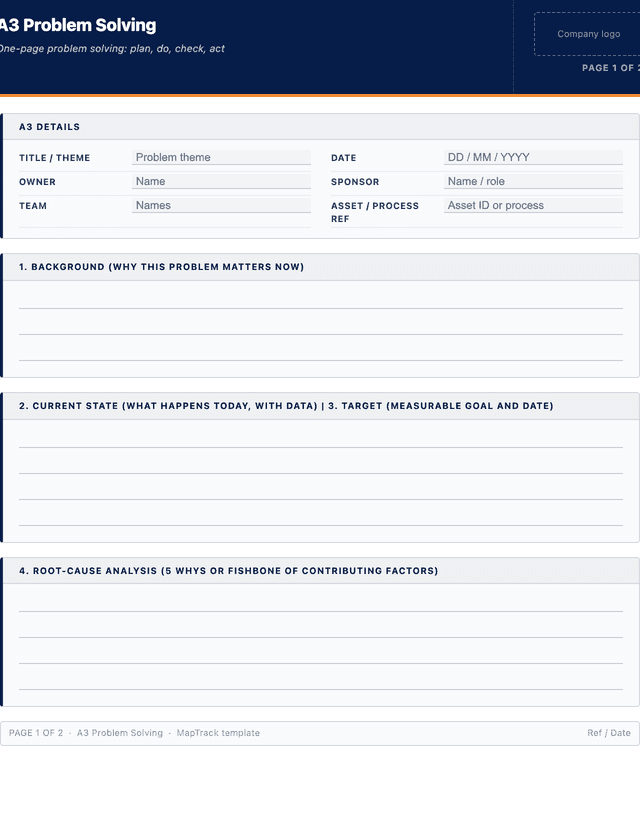
An A3 problem solving template is a single-page worksheet, named after the A3 paper size, that walks a problem from first description through to verified result in a fixed left-to-right structure. It captures the background, the current state with data, a measurable target or goal, the root-cause analysis, the proposed countermeasures, an implementation plan with owners and dates, and a follow-up section that checks whether the target was met. Keeping it to one page forces the author to separate what matters from the noise and to tell a clear story that others can follow and challenge.
The A3 grew out of Toyota and lean practice, where it doubles as a problem-solving tool and a way to coach people through structured thinking. Maintenance, reliability, quality and operations teams in manufacturing, mining and facilities use it for recurring failures, chronic losses and improvement projects that need more rigour than a quick fix but should still fit on one sheet. Its structure follows the Plan, Do, Check, Act cycle, and the root-cause box usually contains a 5 Whys or a fishbone rather than a separate document. In MapTrack, a completed A3 can be linked to the asset or work order it improves, so the analysis and the follow-up result sit alongside that equipment history. It aligns with the corrective action and improvement requirements of ISO 9001:2015, clauses 10.2 and 10.3.
Learn more about maintenance and work orders in MapTrack.
Benefits of using this A3 problem solving template
- One-page discipline: fitting the whole story on a single sheet forces the author to keep only what matters, which makes the logic easy to review and approve.
- Tells a complete story: background, current state, target, analysis, countermeasures, plan and follow-up sit together, so a reader sees the full reasoning at a glance.
- Built on PDCA: the structure mirrors plan, do, check and act, so the team works through the problem in the right order instead of jumping to solutions.
- Target driven: a measurable goal and the gap to it anchor the whole sheet, keeping countermeasures aimed at the result rather than at activity.
- Coaches thinking: working through an A3 teaches structured problem solving, so it builds capability in the team as well as fixing the immediate problem.
- Closes the loop: the follow-up section checks whether the target was actually met, which turns an improvement plan into a verified outcome rather than a hope.
- Holds other methods: the analysis box carries a 5 Whys or fishbone, so the A3 organises detailed root-cause work without duplicating it.
Benefits of digitising forms in MapTrack
When you move your root causes from paper to MapTrack, you get:
- Field users can easily scan a QR code to complete a form on mobile. Unlimited users.
- Email the right people when a form is submitted, with an automation you set up.
- File every completed form against the asset, location or person it covers.
- Download any completed form as a PDF, with failed answers listed at the top.
- Fill in forms offline; they upload when the device is back online.
- Build conditional logic (show or hide questions based on answers).
- Take pictures or attach photos. Not possible with a paper-based form.
- Electronic signatures.
- Edit forms later without reprinting.
- Set who can view, fill in or edit forms with user roles.
- Upload a paper form (PDF, Word, Excel or a photo) and MapTrack's AI builds a digital version for you to check.
- Raise a work order from a submitted form with an automation you set up.
- Track service intervals by hours, kilometres or calendar date in one place.
- Attach supplier invoices and parts receipts to each maintenance record.
Book a demo to see how MapTrack handles root causes.
Try MapTrack free for 30 days
Full access to every feature. No credit card required. Per-asset pricing so you scale as your fleet grows.
- No credit card required
- 30 days free trial
- Cancel anytime
1-2 days/week saved
“Bloody amazing! We used to spend 1-2 days a week tracking and managing our generators alone.”

Steve McAllister
Asset Coordinator, Saunders International
What to include in an A3 problem solving template
This A3 problem solving template covers 9 key areas:
- Header details: title, owner, team, sponsor, date and the asset, work order or process the A3 addresses.
- Background: why this problem matters now, its context and the business or safety reason for working on it.
- Current state: what is happening today, described with data such as downtime, defect rate or cost, often with a simple chart.
- Target or goal: the measurable result to achieve and by when, expressed as the gap to close from the current state.
- Root-cause analysis: the analysis of why the gap exists, typically a 5 Whys chain or a fishbone of contributing factors.
- Countermeasures: the proposed actions that address each confirmed root cause, not just the symptoms.
- Implementation plan: each action with a responsible person, a due date and the resources required.
- Follow-up and results: how effectiveness will be measured, the date of the check, the result against target and any further action.
- Approvals: sign-off by the owner and the sponsor or accountable manager.
How to use this A3 problem solving template
- Set the background and write a focused problem theme.: Explain why this problem is worth solving now and the context around it, then give the A3 a clear theme or title. This frames the sheet for everyone who reads it and stops the work drifting into unrelated issues that belong on a different A3.
- Describe the current state with data, not impressions.: Capture what is actually happening today using measurements such as downtime hours, defect counts or cost over a period, and add a simple chart if it helps. A factual current state is the baseline you will judge the countermeasures against, so avoid opinion and round numbers.
- Set a measurable target and define the gap to close.: State the result you want and the date for it, for example halving a fault over a quarter, so the gap between current state and target is explicit. The size of that gap tells the team how ambitious the countermeasures need to be and keeps everyone aimed at the same outcome.
- Analyse the root cause inside the analysis box.: Work out why the gap exists using a 5 Whys chain or a fishbone, and record the analysis directly in the A3 rather than in a separate file. Confirm each cause with evidence so the countermeasures attack the real condition and not a convenient symptom that leaves the problem in place.
- Develop countermeasures and an implementation plan.: For each confirmed root cause, define the action that removes it, then list those actions with an owner, a due date and any resources needed. A countermeasure without a name and a date beside it rarely happens, so make accountability explicit on the right-hand side of the sheet.
- Follow up against the target and act on the result.: On the agreed date, compare the measured result with the target and record it in the follow-up section. If the gap is closed, standardise the change and share it; if not, return to the analysis, adjust the countermeasures and set the next review before the A3 is signed off.
In MapTrack, you can schedule and track maintenance digitally, by date or meter reading. Each submission is stored as a timestamped PDF against the asset record.
Get the free templateEnter your email above to download the full A3 problem solving template as a PDF.Back to download formHow often should you complete this root cause?
Open an A3 when a problem needs more structure than a quick fix but should still fit on one page: a recurring failure, a chronic loss, a quality issue or an improvement project with a clear target. It is event-driven rather than scheduled, but the follow-up section makes it a living document over the days or weeks it takes to verify the result, so review it at each agreed check date until the target is met or the approach is changed. In MapTrack, you can link the A3 to the asset or work order it improves, so the analysis and the verified result stay with that equipment history.
Frequently asked questions
Applicable regulatory standards
This template is a starting point. Check the current requirements that apply to your equipment, work and location. The template alone does not establish compliance.
- ISO 9001, clause 10.2 - Nonconformity and corrective action (determining causes and acting on them)
- ISO 9001:2026, clause 10.1 - Continual improvement (structured improvement of performance)
- ISO 45001:2018, clause 10.2 - Incident, nonconformity and corrective action (investigation and corrective action)
A3 problem solving template preview
The numbers behind this A3 problem solving template
Every figure below is sourced and dated, so you can quote it in a toolbox talk, a budget case or a board paper without having to chase the original report.
Embed this free template on your website
Run an industry blog, trade association site, or training resource? Drop a preview of this free A3 problem solving template straight into your page. The snippet is self-contained, needs no scripts, and links readers back to the full free template.
<div style="max-width:480px;font-family:system-ui,-apple-system,'Segoe UI',Roboto,sans-serif;border:1px solid #E5E7EB;border-radius:12px;padding:20px;background:#ffffff;">
  <p style="font-size:12px;font-weight:700;letter-spacing:0.05em;text-transform:uppercase;color:#071D49;margin:0;">Free template</p>
  <p style="font-size:18px;font-weight:700;color:#071D49;margin:6px 0 0;">A3 problem solving template</p>
  <ul style="margin:12px 0 0;padding-left:18px;color:#374151;font-size:14px;line-height:1.6;">
    <li style="margin:4px 0;">Header details: title, owner, team, sponsor, date and the asset, work order or process the A3 addresses.</li>
    <li style="margin:4px 0;">Background: why this problem matters now, its context and the business or safety reason for working on it.</li>
    <li style="margin:4px 0;">Current state: what is happening today, described with data such as downtime, defect rate or cost, often with a simple chart.</li>
    <li style="margin:4px 0;">Target or goal: the measurable result to achieve and by when, expressed as the gap to close from the current state.</li>
    <li style="margin:4px 0;">Root-cause analysis: the analysis of why the gap exists, typically a 5 Whys chain or a fishbone of contributing factors.</li>
    <li style="margin:4px 0;">Countermeasures: the proposed actions that address each confirmed root cause, not just the symptoms.</li>
  </ul>
  <p style="font-size:13px;color:#6B7280;margin:14px 0 0;padding-top:12px;border-top:1px solid #E5E7EB;">Free <a href="https://www.maptrack.com/templates/a3-problem-solving-template" style="color:#071D49;font-weight:600;text-decoration:none;">A3 problem solving template</a> by MapTrack</p>
</div>Free to reuse, including commercially. This template is published under a Creative Commons Attribution 4.0 licence. Copy it, adapt it, put it on your own site or in your own docs. All we ask is that you credit MapTrack with a link back to this page. The snippet above already includes that credit, so if you use it as-is you’re covered.
Cite this template
Writing about this topic? You’re welcome to quote this checklist. Here’s the wording to use so your readers can find the original.
The MapTrack A3 problem solving template has 4 columns and room for 6 entries.
- Short attribution
- MapTrack A3 problem solving template, https://www.maptrack.com/templates/a3-problem-solving-template
- Reference list
- MapTrack. (2026). A3 problem solving template [Checklist template]. Retrieved from https://www.maptrack.com/templates/a3-problem-solving-template
Free to reuse with credit under a Creative Commons Attribution 4.0 licence. If you’d rather link straight to it, the page is https://www.maptrack.com/templates/a3-problem-solving-template.
Need to schedule and track maintenance digitally, by date or meter reading?
Register every asset in MapTrack, attach digital forms, and get a complete history of every inspection, service and compliance record.
Maintenance and work orders · All templates · Pricing · Book a demo