
Free maintenance schedule template
Free maintenance schedule template (PDF and editable Excel). Plan recurring tasks for each asset across daily, weekly, monthly, quarterly and annual intervals. Download free.
Updated 12 Aug 2026
Maintenance Schedule
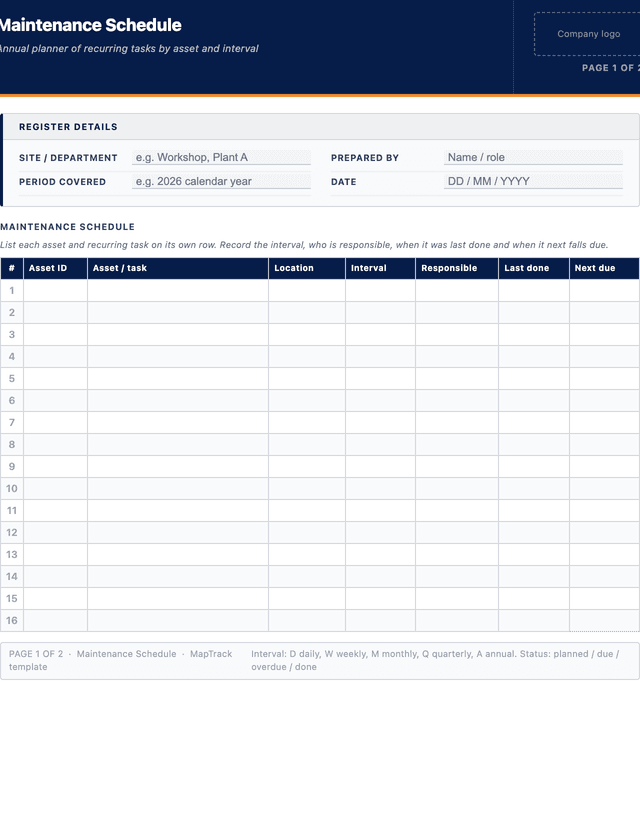
List each asset and recurring task on its own row. Record the interval, who is responsible, when it was last done and when it next falls due.
| # | Asset ID | Asset / task | Location | Interval | Responsible | Last done | Next due |
|---|---|---|---|---|---|---|---|
| e.g. | EXC-102 | - | Depot A | - | S. Carter | - | 10/09/2026 |
| 1 | |||||||
| 2 | |||||||
| 3 | |||||||
| 4 | |||||||
| 5 |
The PDF includes all 28 numbered rows, ready to print or fill on screen.
Completed by
Signature
Print name
Date
Reviewed by
Signature
Print name
Date
How to use: download the PDF, print or complete digitally on any device.
- PDF format, ready to print or fill on screen
- Use as-is or customise to suit your operation
- Go digital in MapTrack for photos, reminders and audit trails
Download formats
- Maintenance schedule template PDF
PDF: Print-ready planning grid: each asset mapped against its recurring tasks, interval, owner and next due date.
- Maintenance schedule template XLSX
XLSX: Editable Excel workbook with the same grid, ready to re-sort by asset, interval or owner as the schedule changes.
Two ways to use it
Use in MapTrack →Use it digitally instead
Unlimited usersUpload this PDF and MapTrack drafts the form for you.




- Scan the asset’s QR tag with any phone
- Submitted forms can trigger alerts
- Photos on fails, audit-ready records
- Export responses, PDF reports with your logo
Free trial. No credit card needed.
Trusted by teams across Australia and New Zealand
We respect your privacy. Unsubscribe anytime.
These templates are free general guides provided as-is. They do not constitute legal, safety or compliance advice. You are responsible for ensuring any form meets your specific workplace obligations, industry standards and applicable regulations.
Don't just download it - use it live. Start a free workspace, upload this maintenance schedule template and MapTrack drafts it as a form your crew can run from a phone.

Co-Founder & Commercial Director
Key takeaways
- The MapTrack maintenance schedule template has 7 columns and room for 28 entries. Columns: Asset ID, Asset / task, Location, Interval, Responsible, Last done, Next due.
- A maintenance schedule is a calendar planner that maps each asset against recurring tasks at daily, weekly, monthly, quarterly and annual intervals.
- It answers when each task is due and who owns it; a checklist is the task list for a single service, and a plan is the strategy behind both.
- Download it as a PDF, or as an editable Excel (XLSX) workbook you can re-sort as intervals and owners change.
- Building the schedule from manufacturer service intervals and the WHS Regulations 2011 prevents overdue services and missed statutory inspections.
- Review the schedule against what was actually completed each month; rolling overdue tasks forward quietly is how PM compliance slips.
Enter your email below to download this maintenance schedule template as a ready-to-use PDF.
Used by construction, mining and field service teams











What is a maintenance schedule template?
A maintenance schedule template is a planning grid that maps every asset against the recurring maintenance tasks it needs and the interval each task falls due, such as daily, weekly, monthly, quarterly and annual. Instead of describing the steps of one service, it lays out the whole forward calendar at a glance: which asset needs what, how often, who is responsible and when it is next due. It is the document a maintenance planner or workshop supervisor uses to see the coming month or year of planned work in one view and to confirm nothing has slipped past its interval.
Maintenance schedules are used across construction, mining, manufacturing, facilities and fleet wherever planned maintenance has to be coordinated across many assets and competing site priorities. Without one, servicing becomes reactive and items quietly run past their interval until they fail. A schedule is distinct from a preventive maintenance checklist, which lists the tasks inside a single service, and from a maintenance plan, which sets the strategy behind the work. In MapTrack, this static grid becomes a live schedule: each asset carries its own service intervals, due dates are calculated from calendar or meter readings, and a reminder is raised automatically when work falls due. The WHS Regulations 2011, Chapter 5 require plant to be maintained so it does not create a risk, and a documented schedule is the practical evidence that maintenance is planned rather than left to chance.
Learn more about maintenance and work orders in MapTrack.
Benefits of using this maintenance schedule template
- Forward visibility: the whole month or year of planned tasks across every asset sits in one grid, so nothing runs silently past its interval.
- Balanced workload: seeing daily, weekly and monthly tasks together lets a planner level the work across the team instead of clustering services.
- Fewer breakdowns: servicing assets on interval rather than after failure cuts unplanned downtime and the cost of emergency repairs on site.
- Compliance evidence: a documented schedule shows a regulator or auditor that plant maintenance is planned to manufacturer and WHS expectations.
- Clear ownership: naming the responsible person against each recurring task removes the assumption that someone else has it covered.
- Easier handover: a single schedule lets a relieving supervisor or new planner pick up the maintenance calendar without losing continuity.
- Drives the spares list: knowing what is due when lets the store hold the right parts ahead of each service instead of chasing them on the day.
Benefits of digitising forms in MapTrack
When you move your schedules from paper to MapTrack, you get:
- Field users can easily scan a QR code to complete a form on mobile. Unlimited users.
- Email the right people when a form is submitted, with an automation you set up.
- File every completed form against the asset, location or person it covers.
- Download any completed form as a PDF, with failed answers listed at the top.
- Fill in forms offline; they upload when the device is back online.
- Build conditional logic (show or hide questions based on answers).
- Take pictures or attach photos. Not possible with a paper-based form.
- Electronic signatures.
- Edit forms later without reprinting.
- Set who can view, fill in or edit forms with user roles.
- Upload a paper form (PDF, Word, Excel or a photo) and MapTrack's AI builds a digital version for you to check.
- Raise a work order from a submitted form with an automation you set up.
- Track service intervals by hours, kilometres or calendar date in one place.
- Attach supplier invoices and parts receipts to each maintenance record.
Book a demo to see how MapTrack handles schedules.
Try MapTrack free for 30 days
Full access to every feature. No credit card required. Per-asset pricing so you scale as your fleet grows.
- No credit card required
- 30 days free trial
- Cancel anytime
1-2 days/week saved
“Bloody amazing! We used to spend 1-2 days a week tracking and managing our generators alone.”

Steve McAllister
Asset Coordinator, Saunders International
What to include in a maintenance schedule template
This maintenance schedule template covers 10 key areas:
- Schedule details: site or department, prepared by, the period the schedule covers and the date issued.
- Asset ID and description: the tag or fleet number and a clear name for each asset on the schedule.
- Asset location or system: where the asset sits or the functional area it belongs to, for filtering and routing.
- Maintenance task: the recurring activity, for example service, inspection, lubrication, calibration or statutory check.
- Frequency or interval: daily, weekly, monthly, quarterly or annual, or the meter interval such as every 250 hours.
- Responsible person or trade: who owns the task, whether an operator, fitter, electrician or external contractor.
- Last completed: the date or meter reading of the last time the task was done.
- Next due: the calculated date or meter reading when the task next falls due.
- Status: planned, due, overdue or completed for the current period.
- Notes: parts required, isolation needs, permit requirements or any dependency on shutdowns.
How to use this maintenance schedule template
- List every asset in scope and the recurring tasks each one needs.: Decide whether the schedule covers a site, a department or a fleet, then list each asset with the maintenance tasks it requires. Draw the tasks from the manufacturer service manual, statutory inspection requirements and your own operational experience so nothing is missed.
- Assign an interval to each task and record the last completed date.: Set each task to a calendar interval such as weekly, monthly or annual, or to a meter interval such as every 250 hours, then record when it was last done. The interval and the last completed date are what let you calculate the next due date for every line.
- Calculate the next due date and lay the tasks out across the planner grid.: Work out the next due date for each task from its interval and last completed date, then place it in the schedule so the coming month or year is visible at a glance. Spread services so they do not all land in the same week and overload the team.
- Name a responsible person and confirm parts and access for each task.: Assign each recurring task to an operator, trade or contractor so ownership is explicit. Note the parts the store must hold, any isolation or permit needs and whether the task depends on a planned shutdown, so the work is not blocked on the day it falls due.
- Issue the schedule and update status as tasks are completed.: Share the schedule with the team and the store, then mark each task planned, due, overdue or completed as the period progresses. Updating status as work is done is what keeps the schedule honest and shows real preventive maintenance compliance.
- Review monthly, close out overdue work and roll the schedule forward.: At the end of each period, compare planned against completed tasks, investigate anything overdue rather than quietly rolling it forward, and update next due dates. A schedule that is never reconciled against actual work drifts out of date and stops being trusted.
In MapTrack, you can schedule and track maintenance digitally, by date or meter reading. Each submission is stored as a timestamped PDF against the asset record.
Get the free templateEnter your email above to download the full maintenance schedule template as a PDF.Back to download formHow often should you complete this schedule?
Use the maintenance schedule continuously: it is a live planning document, not a once-a-year exercise. Review it weekly to confirm the coming tasks are resourced and parts are on hand, and reconcile planned against completed work at least monthly so overdue items are caught early rather than rolled forward. Rebuild or revise the schedule whenever assets are added, retired or moved, or when manufacturer service intervals change. In MapTrack, due dates recalculate automatically from calendar dates and meter readings, so the schedule stays current without manual re-entry between reviews.
Frequently asked questions
Applicable regulatory standards
This template is a starting point. Check the current requirements that apply to your equipment, work and location. The template alone does not establish compliance.
- WHS Regulations 2011, Chapter 5 - Plant and Structures (duty to maintain plant so it does not create a risk)
- ISO 55001 - Asset Management Systems (planned, systematic management of maintenance activity)
- AS ISO 55001 - Asset management (Australian adoption of the asset management system standard)
Maintenance schedule template preview
The numbers behind this maintenance schedule template
Every figure below is sourced and dated, so you can quote it in a toolbox talk, a budget case or a board paper without having to chase the original report.
Embed this free template on your website
Run an industry blog, trade association site, or training resource? Drop a preview of this free maintenance schedule template straight into your page. The snippet is self-contained, needs no scripts, and links readers back to the full free template.
<div style="max-width:480px;font-family:system-ui,-apple-system,'Segoe UI',Roboto,sans-serif;border:1px solid #E5E7EB;border-radius:12px;padding:20px;background:#ffffff;">
  <p style="font-size:12px;font-weight:700;letter-spacing:0.05em;text-transform:uppercase;color:#071D49;margin:0;">Free template</p>
  <p style="font-size:18px;font-weight:700;color:#071D49;margin:6px 0 0;">Maintenance schedule template</p>
  <ul style="margin:12px 0 0;padding-left:18px;color:#374151;font-size:14px;line-height:1.6;">
    <li style="margin:4px 0;">Schedule details: site or department, prepared by, the period the schedule covers and the date issued.</li>
    <li style="margin:4px 0;">Asset ID and description: the tag or fleet number and a clear name for each asset on the schedule.</li>
    <li style="margin:4px 0;">Asset location or system: where the asset sits or the functional area it belongs to, for filtering and routing.</li>
    <li style="margin:4px 0;">Maintenance task: the recurring activity, for example service, inspection, lubrication, calibration or statutory check.</li>
    <li style="margin:4px 0;">Frequency or interval: daily, weekly, monthly, quarterly or annual, or the meter interval such as every 250 hours.</li>
    <li style="margin:4px 0;">Responsible person or trade: who owns the task, whether an operator, fitter, electrician or external contractor.</li>
  </ul>
  <p style="font-size:13px;color:#6B7280;margin:14px 0 0;padding-top:12px;border-top:1px solid #E5E7EB;">Free <a href="https://www.maptrack.com/templates/maintenance-schedule-template" style="color:#071D49;font-weight:600;text-decoration:none;">Maintenance schedule template</a> by MapTrack</p>
</div>Free to reuse, including commercially. This template is published under a Creative Commons Attribution 4.0 licence. Copy it, adapt it, put it on your own site or in your own docs. All we ask is that you credit MapTrack with a link back to this page. The snippet above already includes that credit, so if you use it as-is you’re covered.
Cite this template
Writing about this topic? You’re welcome to quote this checklist. Here’s the wording to use so your readers can find the original.
The MapTrack maintenance schedule template has 7 columns and room for 28 entries.
- Short attribution
- MapTrack Maintenance schedule template, https://www.maptrack.com/templates/maintenance-schedule-template
- Reference list
- MapTrack. (2026). Maintenance schedule template [Checklist template]. Retrieved from https://www.maptrack.com/templates/maintenance-schedule-template
Free to reuse with credit under a Creative Commons Attribution 4.0 licence. If you’d rather link straight to it, the page is https://www.maptrack.com/templates/maintenance-schedule-template.
Need to schedule and track maintenance digitally, by date or meter reading?
Register every asset in MapTrack, attach digital forms, and get a complete history of every inspection, service and compliance record.
Maintenance and work orders · All templates · Pricing · Book a demo