
Free maintenance plan template
Free maintenance plan template (PDF). Set asset criticality, maintenance approach, spares, resourcing and KPIs across your asset base. Download free.
Updated 4 June 2026
How to use: download the PDF, print or complete digitally on any device.
- PDF format, ready to print or fill on screen
- Use as-is or customise to suit your operation
- Go digital in MapTrack for photos, reminders and audit trails
Download free PDF template
Use in MapTrack →



Trusted by teams across Australia and New Zealand
We respect your privacy. Unsubscribe anytime.
Or set it up in MapTrack
- Fill it in on a phone, attach photos to any check
- Automatic reports and audit trails
- Upload the PDF and MapTrack drafts the form for you
Free 30-day trial. No credit card. Personal email accepted.
Don't just download it - use it live. Start a free workspace, upload this maintenance plan template and MapTrack drafts it as a form your crew can run from a phone.

Co-Founder & Commercial Director
Key takeaways
- The MapTrack maintenance plan template has 6 columns and room for 12 entries. Columns: Asset / class, Criticality, Approach, Key tasks, Interval, Critical spares.
- A maintenance plan decides, per asset, how it will be maintained: preventive, predictive or run-to-failure, based on its criticality and failure consequence.
- It sits between the high-level strategy and the day-to-day schedule: the plan defines the work, the schedule decides when it happens.
- Rank assets by criticality first; spending the same effort on low-consequence assets as on critical plant is the most common planning mistake.
- Set the KPIs you will measure, such as PM compliance, reactive ratio and MTBF, so the plan can be reviewed against results, not opinion.
Enter your email below to download this maintenance plan template as a ready-to-use PDF.
Used by construction, mining and field service teams











What is a maintenance plan template?
A maintenance plan template is a program document that sets out, for each asset or asset class, how it will be maintained: its criticality, the maintenance approach applied to it (preventive, predictive or run-to-failure), the specific tasks and intervals, the spare parts strategy, the resourcing needed and the KPIs the work will be measured against. It is the document that translates a high-level maintenance strategy into concrete, asset-by-asset decisions about what work is done and why, before any of it is loaded onto a calendar.
Maintenance planners, reliability engineers and asset managers use a maintenance plan to make sure effort is matched to consequence: critical plant gets a planned or condition-based regime, while low-consequence assets may justifiably be run to failure. The plan is distinct from a maintenance schedule, which is the operational calendar of when each task falls due, and from a maintenance strategy, which is the leadership-level direction and budget for the whole function. In MapTrack, the decisions captured in the plan become live maintenance regimes against each asset, with tasks, intervals and meter triggers configured so the plan drives the actual work. ISO 55001 sets out a systematic approach to deciding and documenting how assets are managed across their life, and a written maintenance plan is the practical expression of that for the maintenance function.
Learn more about maintenance and work orders in MapTrack.
Benefits of using this maintenance plan template
- Effort matched to risk: ranking assets by criticality first directs planned and predictive work to the plant where failure actually hurts.
- Defensible approach: recording why each asset is preventive, predictive or run-to-failure replaces ad-hoc servicing with decisions you can stand behind.
- Clear scope of work: defining the tasks and intervals per asset gives the schedule and the technicians an unambiguous instruction set to work from.
- Spares aligned to plan: deciding the critical-spares holding against the maintenance approach reduces both stockouts and dead stock on the shelf.
- Resourcing clarity: stating the labour, skills and contractor support each asset class needs lets the plan be costed and staffed honestly.
- Measurable outcomes: naming the KPIs and targets up front turns the plan review into a scorecard rather than a debate about opinion.
- Continuity and audit: a documented plan survives staff turnover and gives auditors clear evidence of how maintenance decisions were made.
Benefits of digitising forms in MapTrack
When you move your plans from paper to MapTrack, you get:
- Field users can easily scan a QR code to complete a form on mobile. Unlimited users.
- Email the right people when a form is submitted, with an automation you set up.
- File every completed form against the asset, location or person it covers.
- Download any completed form as a PDF, with failed answers listed at the top.
- Fill in forms offline; they upload when the device is back online.
- Build conditional logic (show or hide questions based on answers).
- Take pictures or attach photos. Not possible with a paper-based form.
- Electronic signatures.
- Edit forms later without reprinting.
- Set who can view, fill in or edit forms with user roles.
- Upload a paper form (PDF, Word, Excel or a photo) and MapTrack's AI builds a digital version for you to check.
- Raise a work order from a submitted form with an automation you set up.
- Track service intervals by hours, kilometres or calendar date in one place.
- Attach supplier invoices and parts receipts to each maintenance record.
Book a demo to see how MapTrack handles plans.
Try MapTrack free for 30 days
Full access to every feature. No credit card required. Per-asset pricing so you scale as your fleet grows.
- No credit card required
- 30 days free trial
- Cancel anytime
1-2 days/week saved
“Bloody amazing! We used to spend 1-2 days a week tracking and managing our generators alone.”

Steve McAllister
Asset Coordinator, Saunders International
What to include in a maintenance plan template
This maintenance plan template covers 10 key areas:
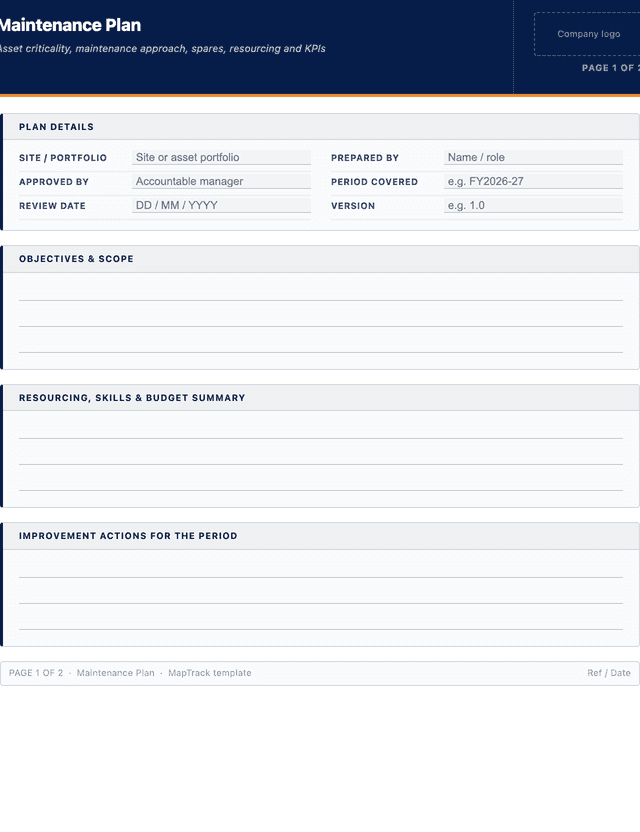
- Plan details: site or asset portfolio, prepared by, approver, the period the plan covers and the review date.
- Objectives and scope: what the plan is trying to achieve and which assets or asset classes it covers.
- Asset register and criticality: each asset or class ranked by criticality based on safety, production and cost consequence of failure.
- Maintenance approach per asset: preventive, predictive, condition-based or run-to-failure, with the reason for each choice.
- Maintenance tasks and intervals: the recurring tasks and the calendar or meter interval applied to each asset class.
- Spare parts strategy: critical spares to hold, min and max levels and lead times against the chosen approach.
- Resourcing and skills: in-house labour, trades, contractors and any competencies or licences required.
- KPIs and targets: the measures such as PM compliance, reactive ratio, MTBF, MTTR and schedule attainment, with target ranges.
- Budget summary: indicative labour, parts and contractor cost for the planned regime.
- Improvement actions: planned changes such as adding condition monitoring or moving an asset class off run-to-failure.
How to use this maintenance plan template
- Define the objectives and scope of the plan before any asset detail.: State what the plan is meant to achieve, for example a target reactive ratio or uptime, and list the assets or asset classes it covers. Agreeing the scope and objectives first keeps the rest of the plan focused on outcomes rather than becoming an undifferentiated task list.
- Rank every asset by criticality using safety, production and cost consequence.: Score each asset or class on the consequence of its failure across safety, production loss and repair cost, then rank them. This criticality ranking is the backbone of the plan because it decides where planned and predictive effort is justified and where run-to-failure is acceptable.
- Choose a maintenance approach for each asset and record why.: Assign preventive, predictive, condition-based or run-to-failure to each asset class and write down the reasoning. Critical, predictable-wear assets suit time or condition-based work, while low-consequence assets with random failure modes may justifiably be run to failure to avoid wasted effort.
- Define the tasks, intervals, spares and resourcing for each approach.: For each asset class, list the recurring tasks and their calendar or meter intervals, the critical spares to hold with min and max levels, and the labour, skills and contractors required. This is the detail the schedule and the store will draw from to execute the plan.
- Set the KPIs, targets and budget the plan will be measured against.: Choose the headline measures such as PM compliance, reactive ratio, MTBF and schedule attainment, set realistic target ranges, and summarise the indicative labour, parts and contractor cost. Defining these up front lets the plan be reviewed objectively against results later.
- Approve the plan, then review and revise it against actual performance.: Have the plan signed off by the accountable manager, load the decisions into your scheduling system, then review it at least annually against the KPIs. Adjust criticality, approach and spares where the failure data shows the original assumptions were wrong.
In MapTrack, you can schedule and track maintenance digitally, by date or meter reading. Each submission is stored as a timestamped PDF against the asset record.
Get the free templateEnter your email above to download the full maintenance plan template as a PDF.Back to download formHow often should you complete this plan?
Develop the maintenance plan once for the asset base, then treat it as a living document reviewed at least annually and whenever the asset portfolio changes materially. Revisit an asset's criticality and maintenance approach when its failure history, production role or repair cost shifts, and update the spares and resourcing detail as part of that review. In MapTrack, the regimes defined in the plan run live against each asset, so the failure and completion data needed to test and refine the plan is captured automatically rather than reconstructed at review time.
Frequently asked questions
Applicable regulatory standards
This template is a starting point. Check the current requirements that apply to your equipment, work and location. The template alone does not establish compliance.
- ISO 55001 - Asset Management Systems (systematic planning of how assets are managed across their life)
- WHS Regulations 2011, Chapter 5 - Plant and Structures (duty to maintain plant so it does not create a risk)
- AS IEC 60300.3.11 - Reliability centred maintenance (guidance on selecting maintenance tasks by failure consequence)
Maintenance plan template preview
The numbers behind this maintenance plan template
Every figure below is sourced and dated, so you can quote it in a toolbox talk, a budget case or a board paper without having to chase the original report.
Embed this free template on your website
Run an industry blog, trade association site, or training resource? Drop a preview of this free maintenance plan template straight into your page. The snippet is self-contained, needs no scripts, and links readers back to the full free template.
<div style="max-width:480px;font-family:system-ui,-apple-system,'Segoe UI',Roboto,sans-serif;border:1px solid #E5E7EB;border-radius:12px;padding:20px;background:#ffffff;">
  <p style="font-size:12px;font-weight:700;letter-spacing:0.05em;text-transform:uppercase;color:#071D49;margin:0;">Free template</p>
  <p style="font-size:18px;font-weight:700;color:#071D49;margin:6px 0 0;">Maintenance plan template</p>
  <ul style="margin:12px 0 0;padding-left:18px;color:#374151;font-size:14px;line-height:1.6;">
    <li style="margin:4px 0;">Plan details: site or asset portfolio, prepared by, approver, the period the plan covers and the review date.</li>
    <li style="margin:4px 0;">Objectives and scope: what the plan is trying to achieve and which assets or asset classes it covers.</li>
    <li style="margin:4px 0;">Asset register and criticality: each asset or class ranked by criticality based on safety, production and cost consequence of failure.</li>
    <li style="margin:4px 0;">Maintenance approach per asset: preventive, predictive, condition-based or run-to-failure, with the reason for each choice.</li>
    <li style="margin:4px 0;">Maintenance tasks and intervals: the recurring tasks and the calendar or meter interval applied to each asset class.</li>
    <li style="margin:4px 0;">Spare parts strategy: critical spares to hold, min and max levels and lead times against the chosen approach.</li>
  </ul>
  <p style="font-size:13px;color:#6B7280;margin:14px 0 0;padding-top:12px;border-top:1px solid #E5E7EB;">Free <a href="https://www.maptrack.com/templates/maintenance-plan-template" style="color:#071D49;font-weight:600;text-decoration:none;">Maintenance plan template</a> by MapTrack</p>
</div>Free to reuse, including commercially. This template is published under a Creative Commons Attribution 4.0 licence. Copy it, adapt it, put it on your own site or in your own docs. All we ask is that you credit MapTrack with a link back to this page. The snippet above already includes that credit, so if you use it as-is you’re covered.
Cite this template
Writing about this topic? You’re welcome to quote this checklist. Here’s the wording to use so your readers can find the original.
The MapTrack maintenance plan template has 6 columns and room for 12 entries.
- Short attribution
- MapTrack Maintenance plan template, https://www.maptrack.com/templates/maintenance-plan-template
- Reference list
- MapTrack. (2026). Maintenance plan template [Checklist template]. Retrieved from https://www.maptrack.com/templates/maintenance-plan-template
Free to reuse with credit under a Creative Commons Attribution 4.0 licence. If you’d rather link straight to it, the page is https://www.maptrack.com/templates/maintenance-plan-template.
Need to schedule and track maintenance digitally, by date or meter reading?
Register every asset in MapTrack, attach digital forms, and get a complete history of every inspection, service and compliance record.
Maintenance and work orders · All templates · Pricing · Book a demo