
Free template · PDF
Free maintenance strategy planning template
Free annual maintenance strategy planning template (PDF-ready). Reactive, preventive, predictive and condition-based mix per asset class. ISO 55001 aligned.
Loading PDF page...
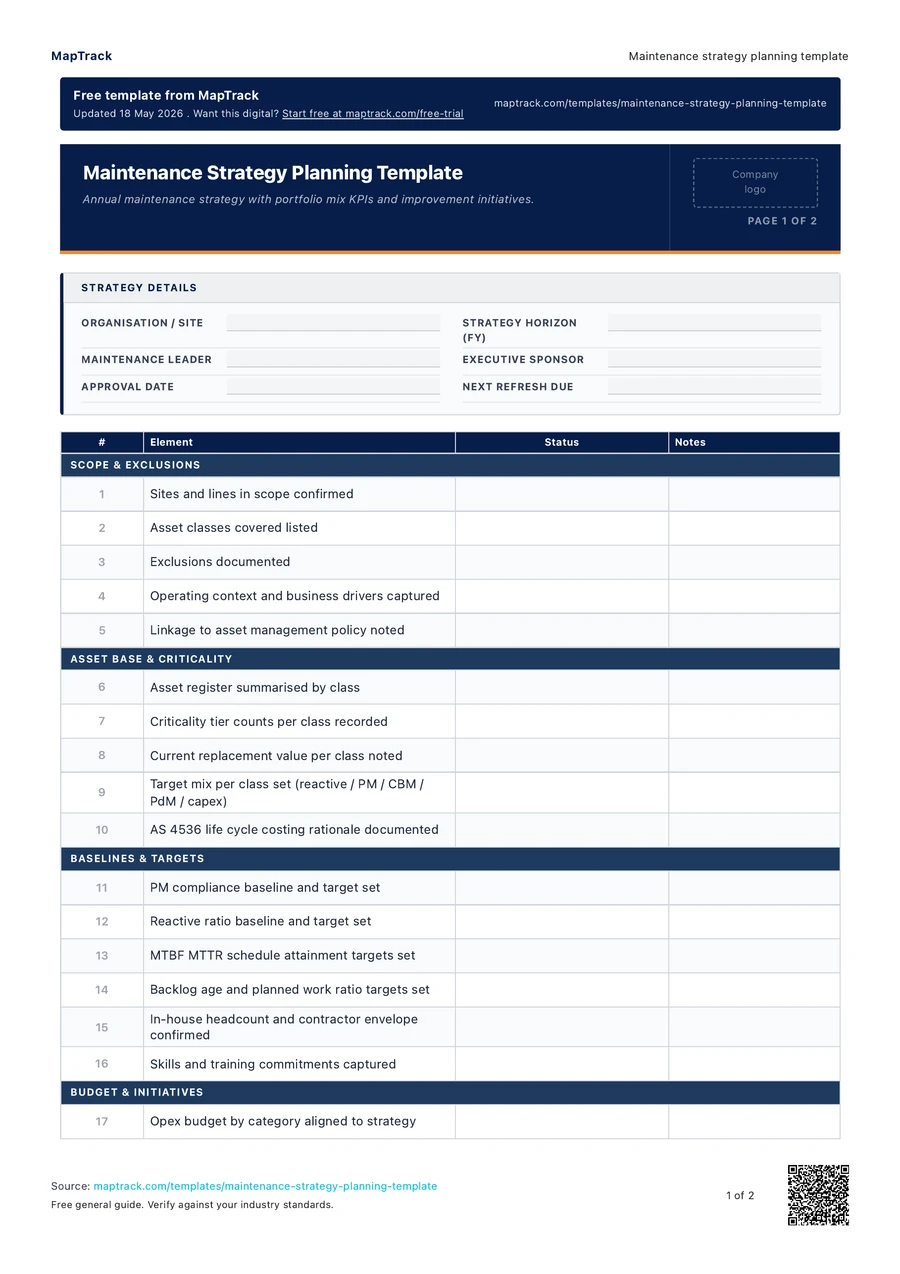

Read the form fields
23 checks · 4 sections · Sign-off
23 checks
The fields in the printable form, in a view that fits your screen.
- Organisation / site
- Strategy horizon (FY)
- Maintenance leader
- Executive sponsor
- Approval date
- Next refresh due
Scope & exclusions
Asset base & criticality
Baselines & targets
Budget & initiatives
Declaration & Sign-Off
I confirm that all items have been inspected/completed as indicated above. Any defects or concerns have been noted and reported.
Completed By
Printed name · Signature · Date
Reviewed / Approved By
Printed name · Signature · Date
The MapTrack maintenance strategy planning template contains 23 checks across 4 sections.

Co-Founder & Commercial Director
Make this form your own
Add your fields and logo. Give your team a form they can use on site.
Free 30-day trial. No credit card. Work email needed.
Upload & use this form now for free



“MapTrack beat them all in every aspect.”
 Vincent Stone · HSEQ Advisor, Concept Tanks
After signup: upload this PDF, check the form MapTrack drafts, then save and publish it for your team.
General guidance only. Check the form against your equipment manual, site procedures and local requirements before using it.
Key takeaways
- The MapTrack maintenance strategy planning template contains 23 checks across 4 sections. Sections covered: Scope & exclusions, Asset base & criticality, Baselines & targets, Budget & initiatives.
- Strategy scope and horizon: the sites, lines, asset classes and exclusions covered by this strategy, the 12 month horizon and the named executive sponsor and maintenance leader accountable for delivery.
- Operating context: business priorities for the year, regulatory drivers, customer commitments, capex and divestment plans, headcount changes and any organisational restructure that affects maintenance delivery.
- Asset class portfolio: the asset register summarised by class (rotating plant, fixed plant, mobile fleet, structures, instrumentation, IT and OT), with criticality tier counts and current replacement value per class.
What is a maintenance strategy planning template?
A maintenance strategy planning template is a 12 month leadership planning document a maintenance director, asset manager or operations leader uses to set the overall direction of the maintenance function across an asset portfolio for the next 12 months. It sits one level above the work order schedule and one level below the asset management policy. The strategy decides, for every asset class on site, what mix of reactive, time-based preventive, condition-based and predictive work will be applied, what KPIs the function will be measured on, what budget envelope is being committed, what headcount and skills mix is being deployed, and what improvement initiatives are being funded against the year. ISO 55001 clause 6.2.2 calls this the strategic asset management plan input for the maintenance function, and AS 4536 (Life cycle costing An application guide) underpins the financial case behind the strategic mix.
The strategy is distinct from a reliability programme plan (which is the deep methodology document for one or two asset classes anchored against SAE JA1011) and from a preventive maintenance schedule (which is the operational calendar of recurring tasks). The strategy is the broader, leadership-level document that decides why the team is doing the mix of work it is doing and what business outcomes that mix is meant to deliver. SMRP (Society for Maintenance and Reliability Professionals) best practice and the EN 13306 maintenance taxonomy describe the strategic choices: pure reactive, time-based PM, condition-based monitoring (CBM), predictive maintenance (PdM), TPM, RCM and the hybrid programmes most asset-heavy organisations actually run. A typical mature portfolio mix sits around 10 to 20 percent reactive, 40 to 55 percent planned PM, 20 to 35 percent condition-based or predictive and 5 to 10 percent capital renewal. A documented strategy with that mix decided per asset class, KPIs set, budget aligned and improvement initiatives sequenced is the document executives sign off on, the document finance attaches the budget to and the document the team uses to defend resourcing decisions through the year.
Learn more about maintenance and work orders in MapTrack.
Choose the format that fits your team
Download the PDF
Use the original printable form for a paper workflow. Check it against your equipment and site procedure before the job.
Keep completed copies in your own record system and arrange any follow-up through your normal process.
Download free PDFCustomise a form in MapTrack
Start a free trial, upload this PDF and MapTrack drafts the form. Adjust it to your workflow, then save and publish it for your team to use.
Sample answers on this page and completed PDF records aren't imported automatically.
Upload & use this form now for freeFree 30-day trial. No credit card. Work email needed.
Benefits of using this maintenance strategy planning template
- Strategic direction: a documented annual maintenance strategy gives the executive sponsor a single signed plan covering scope, mix of work, budget envelope, KPIs and improvement initiatives across every asset class on site.
- Defensible mix of work: deciding the reactive / preventive / predictive / condition-based ratio per asset class up front and grounding it in AS 4536 life cycle costing replaces the ad-hoc spend pattern that erodes maintenance credibility with finance.
- Budget alignment: a strategy that explicitly costs labour, parts, contractors, capex and improvement initiatives lets finance approve the maintenance budget against committed outcomes rather than against last year plus inflation.
- KPI clarity: defining headline KPIs (PM compliance, reactive ratio, MTBF, MTTR, schedule attainment, planned work ratio, backlog age) and target ranges up front turns the year-end review from a debate into a scorecard.
- ISO 55001 compliance: the documented strategy satisfies clause 6.2.2 strategic asset management planning, clause 7.5 documented information and clause 9.1 monitoring requirements expected by asset management auditors.
- Improvement sequencing: ranking the year's improvement initiatives (CMMS roll-out, condition monitoring expansion, RCM-lite on Class A, planner role uplift) inside the strategy prevents two or three competing programmes running at half effort across the same team.
What to include in a maintenance strategy planning template
- Strategy scope and horizon: the sites, lines, asset classes and exclusions covered by this strategy, the 12 month horizon and the named executive sponsor and maintenance leader accountable for delivery.
- Operating context: business priorities for the year, regulatory drivers, customer commitments, capex and divestment plans, headcount changes and any organisational restructure that affects maintenance delivery.
- Asset class portfolio: the asset register summarised by class (rotating plant, fixed plant, mobile fleet, structures, instrumentation, IT and OT), with criticality tier counts and current replacement value per class.
- Strategic mix of work: the planned mix of reactive, time-based preventive, condition-based, predictive and capital renewal work for each asset class with rationale grounded in AS 4536 life cycle costing and SMRP guidance.
- KPI framework and targets: the headline KPIs the function will be measured on (PM compliance, reactive ratio, schedule attainment, MTBF, MTTR, planned work ratio, backlog age, safety leading indicators) with current baseline and 12 month target.
- Resource and skills plan: in-house headcount by trade and role, contractor envelope, planned recruitment, training and certification commitments and any specialist contract resource needed for shutdowns.
- Budget and capex envelope: opex by category (labour, overtime, parts, contractors, software, training, contingency) and capex by asset class with the approved threshold for in-year drawdown.
- Improvement initiatives portfolio: the prioritised list of improvement projects for the year (CMMS roll-out, condition monitoring expansion, RCM-lite pilots, planner role uplift, mobile inspections, BIM tie-in) with owner, milestones and KPI linkage.
- Risk and assumption register: the strategic risks to delivery (talent attrition, supply chain disruption, OEM exit, regulatory change, capex deferral) with mitigation owner and the documented assumptions the budget rests on.
- Governance and review cadence: monthly KPI scorecard, quarterly steering committee, annual strategy refresh and the executive sponsor sign-off page that turns the strategy into a controlled commitment.
How to use this maintenance strategy planning template
Set scope, horizon and executive sponsor
confirm the sites, lines and asset classes covered, agree the 12 month horizon and named executive sponsor with the operations director and asset manager, document the linkage to the broader asset management policy and reliability programme plan so the strategy fits inside the wider system rather than competing with it.
Baseline the portfolio and current state
pull the asset register and criticality matrix, summarise assets by class with current replacement value, KPI baselines from the last 12 months (PM compliance, reactive ratio, MTBF, MTTR, schedule attainment, backlog age) and the current mix of reactive, preventive, predictive and condition-based work to give the strategy an evidence-based starting point.
Choose the strategic mix per asset class using AS 4536 life cycle costing logic
for each asset class decide the target mix of reactive, time-based PM, condition-based, predictive and capital renewal work, weighting Class A and B critical assets toward PdM and CBM and Class C and D non-critical assets toward run-to-failure or minimal time-based PM, and document the rationale per class with the cost and risk trade-off.
Cost the strategy, set KPI targets and sequence improvement initiatives
build the bottom-up budget by category against the strategic mix, set the KPI target range for each headline metric, sequence the year's improvement initiatives so resourcing does not collide and document the risk and assumption register against each material commitment.
Approve, communicate and embed the governance cadence
walk the draft through with finance and operations leadership, secure executive sponsor sign-off on the strategy and budget, communicate the plan to the maintenance team and the wider business, schedule the monthly KPI scorecard, quarterly steering committee and annual refresh, then attach the document to the CMMS so it informs daily prioritisation rather than sitting on a shared drive.
How often should you complete this plan?
A maintenance strategy is built and signed off annually, aligned to the organisation fiscal year. Most Australian asset-heavy organisations operate on a July to June cycle so the strategy is drafted in March or April, reviewed with finance and operations leadership through April and May, signed by the executive sponsor in May or June and goes live on 1 July. The strategy is then reviewed at three cadences. Monthly KPI scorecards check whether the function is tracking against the plan. Quarterly steering committees review programme health and the improvement initiatives portfolio. The full strategy is refreshed annually with current asset register, KPI baselines and improvement programme outcomes. An out-of-cycle review is triggered by major incident, capex acceleration or deferral, organisational restructure, regulatory change or material movement in headline KPIs. MapTrack tracks KPI delivery against the strategy commitments and surfaces variance alerts so the next quarterly steering committee has the data it needs.
Make this form your own
From your template to your team.
Upload this PDF and MapTrack drafts the form. Adjust it for your equipment and site, then save and publish the digital form for your team.
- 01
Start your free trial
Use your work email to create your MapTrack account.
- 02
Customise, save and publish
Adjust the template fields and branding for your site.
- 03
Complete it on the job
Record checks, add photos and export a branded PDF.
Keep working offline
Load the form before you lose reception. Complete it offline and sync when you're back online.
Scan the asset. Open its form.
Use an asset's QR code to find and complete the forms that belong to it.
Show what you found
Capture photos and attach files so the next person has the details they need.
Take a branded PDF with you
Download completed forms as PDF reports with your company logo.
Completed paper records aren't imported automatically.
Frequently asked questions
Practical answers about the form, record keeping and using MapTrack.
A maintenance strategy is the annual leadership-level plan covering the whole maintenance function across every asset class on site, deciding the mix of reactive, preventive, predictive and condition-based work, the KPIs, the budget and the improvement initiatives. A reliability programme plan is a deeper methodology document for one or two critical asset classes anchored against SAE JA1011 RCM, defining how failure modes are analysed and tasks selected. The strategy sets direction across everything; the reliability programme plan executes RCM-lite or RCM on the priority assets the strategy has flagged as critical.
Link to this answerSMRP and EN 13306 benchmarks describe mature asset-heavy portfolios as around 10 to 20 percent reactive, 40 to 55 percent planned preventive, 20 to 35 percent condition-based or predictive and 5 to 10 percent capital renewal. Reactive ratios above 40 percent indicate an under-resourced or immature programme. Predictive ratios above 40 percent are usually only seen in instrumented continuous-process industries. The strategy sets the target mix per asset class rather than a single ratio across the whole portfolio because high-criticality assets warrant a different mix than low-criticality ones.
Link to this answerISO 55001:2024 clause 6.2.2 requires a strategic asset management plan that documents how the organisation will deliver the asset management objectives across the portfolio. The annual maintenance strategy is the most common artefact used to satisfy that clause for the maintenance function. Clause 7.5 requires documented information be controlled and clause 9.1 requires monitoring against the plan. AS 4536 (Life cycle costing An application guide) underpins the financial reasoning behind the strategic mix. Auditors typically expect to see the signed strategy, the KPI scorecard and evidence of monthly and quarterly review against it.
Link to this answerThe strategy commits the maintenance function to a specific mix of work, KPI targets and improvement initiatives for the year. The budget is the costed bottom-up build of labour, overtime, parts, contractors, software, training, contingency and capex that delivers that mix. Finance approves the budget against the strategy commitments rather than against last year plus inflation, which is why a defensible strategy walks alongside the maintenance budget template and ISO 55001 clause 6.2.2 documentation. Variance against budget through the year is reviewed in the quarterly steering committee and any reallocation flows back into the strategy update.
Link to this answerThe strategy is owned by the maintenance director or asset manager and signed off by the executive sponsor (typically the operations director). The build team usually includes the reliability engineer, the maintenance planner, the trades supervisors, the procurement lead, the finance business partner and the HSE manager. Operations leadership and any major capex project sponsor should review the draft because their inputs affect the workload assumptions. Final approval sits with the executive sponsor and the document then becomes a controlled record with revision number, prepared-by, approved-by and change history.
Link to this answerApplicable regulatory standards
This form is a starting point. Check the current requirements that apply to your equipment, work and location. The form alone does not establish compliance.
- ISO 55001:2024 (clause 6.2.2 strategic asset management planning)
- ISO 55002:2018 (guidance on strategic planning)
- AS 4536-1999 (Life cycle costing An application guide)
- EN 13306:2017 (Maintenance terminology)
- SMRP Best Practices 5th Edition (2017)
MapTrack publishes this template. The linked authorities publish their own guidance; they haven't endorsed this form.
The numbers behind this maintenance strategy planning template
Every figure below is sourced and dated, so you can quote it in a toolbox talk, a budget case or a board paper without having to chase the original report.
Cite this template
Writing about this topic? You’re welcome to quote this checklist. Here’s the wording to use so your readers can find the original.
The MapTrack maintenance strategy planning template contains 23 checks across 4 sections.
- Short attribution
- MapTrack Maintenance strategy planning template, https://www.maptrack.com/templates/maintenance-strategy-planning-template
- Reference list
- MapTrack. (2026). Maintenance strategy planning template [Checklist template]. Retrieved from https://www.maptrack.com/templates/maintenance-strategy-planning-template
Free to reuse with credit under a Creative Commons Attribution 4.0 licence. If you’d rather link straight to it, the page is https://www.maptrack.com/templates/maintenance-strategy-planning-template.
Embed this free template on your website
Run an industry blog, trade association site, or training resource? Drop a preview of this free maintenance strategy planning template straight into your page. The snippet is self-contained, needs no scripts, and links readers back to the full free template.
<div style="max-width:480px;font-family:system-ui,-apple-system,'Segoe UI',Roboto,sans-serif;border:1px solid #E5E7EB;border-radius:12px;padding:20px;background:#ffffff;">
  <p style="font-size:12px;font-weight:700;letter-spacing:0.05em;text-transform:uppercase;color:#071D49;margin:0;">Free template</p>
  <p style="font-size:18px;font-weight:700;color:#071D49;margin:6px 0 0;">Maintenance strategy planning template</p>
  <ul style="margin:12px 0 0;padding-left:18px;color:#374151;font-size:14px;line-height:1.6;">
    <li style="margin:4px 0;">Strategy scope and horizon: the sites, lines, asset classes and exclusions covered by this strategy, the 12 month horizon and the named executive sponsor and maintenance leader accountable for delivery.</li>
    <li style="margin:4px 0;">Operating context: business priorities for the year, regulatory drivers, customer commitments, capex and divestment plans, headcount changes and any organisational restructure that affects maintenance delivery.</li>
    <li style="margin:4px 0;">Asset class portfolio: the asset register summarised by class (rotating plant, fixed plant, mobile fleet, structures, instrumentation, IT and OT), with criticality tier counts and current replacement value per class.</li>
    <li style="margin:4px 0;">Strategic mix of work: the planned mix of reactive, time-based preventive, condition-based, predictive and capital renewal work for each asset class with rationale grounded in AS 4536 life cycle costing and SMRP guidance.</li>
    <li style="margin:4px 0;">KPI framework and targets: the headline KPIs the function will be measured on (PM compliance, reactive ratio, schedule attainment, MTBF, MTTR, planned work ratio, backlog age, safety leading indicators) with current baseline and 12 month target.</li>
    <li style="margin:4px 0;">Resource and skills plan: in-house headcount by trade and role, contractor envelope, planned recruitment, training and certification commitments and any specialist contract resource needed for shutdowns.</li>
  </ul>
  <p style="font-size:13px;color:#6B7280;margin:14px 0 0;padding-top:12px;border-top:1px solid #E5E7EB;">Free <a href="https://www.maptrack.com/templates/maintenance-strategy-planning-template" style="color:#071D49;font-weight:600;text-decoration:none;">Maintenance strategy planning template</a> by MapTrack</p>
</div>Free to reuse, including commercially. This template is published under a Creative Commons Attribution 4.0 licence. Copy it, adapt it, put it on your own site or in your own docs. All we ask is that you credit MapTrack with a link back to this page. The snippet above already includes that credit, so if you use it as-is you’re covered.
About the author

Co-Founder & Commercial Director
Jarrod has spent over a decade in technology consulting and asset management, including roles at Accenture (mining and heavy industry) and CGI as an Asset Management Consultant. He co-founded MapTrack and built and scaled its original platform, then rebuilt it with Lachlan and Alex from thousands of customer conversations and 300+ user research sessions with field teams. His consulting background gives him deep insight into the operational and compliance challenges facing asset-intensive Australian businesses.
View LinkedIn profile →Ready for your next job?
Keep the PDF handy, or upload it to MapTrack and turn it into a digital form for your team.