
Free template · PDF
Free BESS inspection checklist
Free battery energy storage system (BESS) inspection checklist (PDF-ready). Cells PCS HVAC fire and grid checks to IEC 62619 and NFPA 855. Download free.
Loading PDF page...

Read the form fields
29 checks · 5 sections · Sign-off
29 checks
The fields in the printable form, in a view that fits your screen.
- Project / site
- PCS make / model
- BESS capacity (MWh)
- Inspector / licence no.
- Inspection date
- Next quarterly due
Isolation & lockout
Battery racks & cells
Power conversion system
Transformer & switchgear
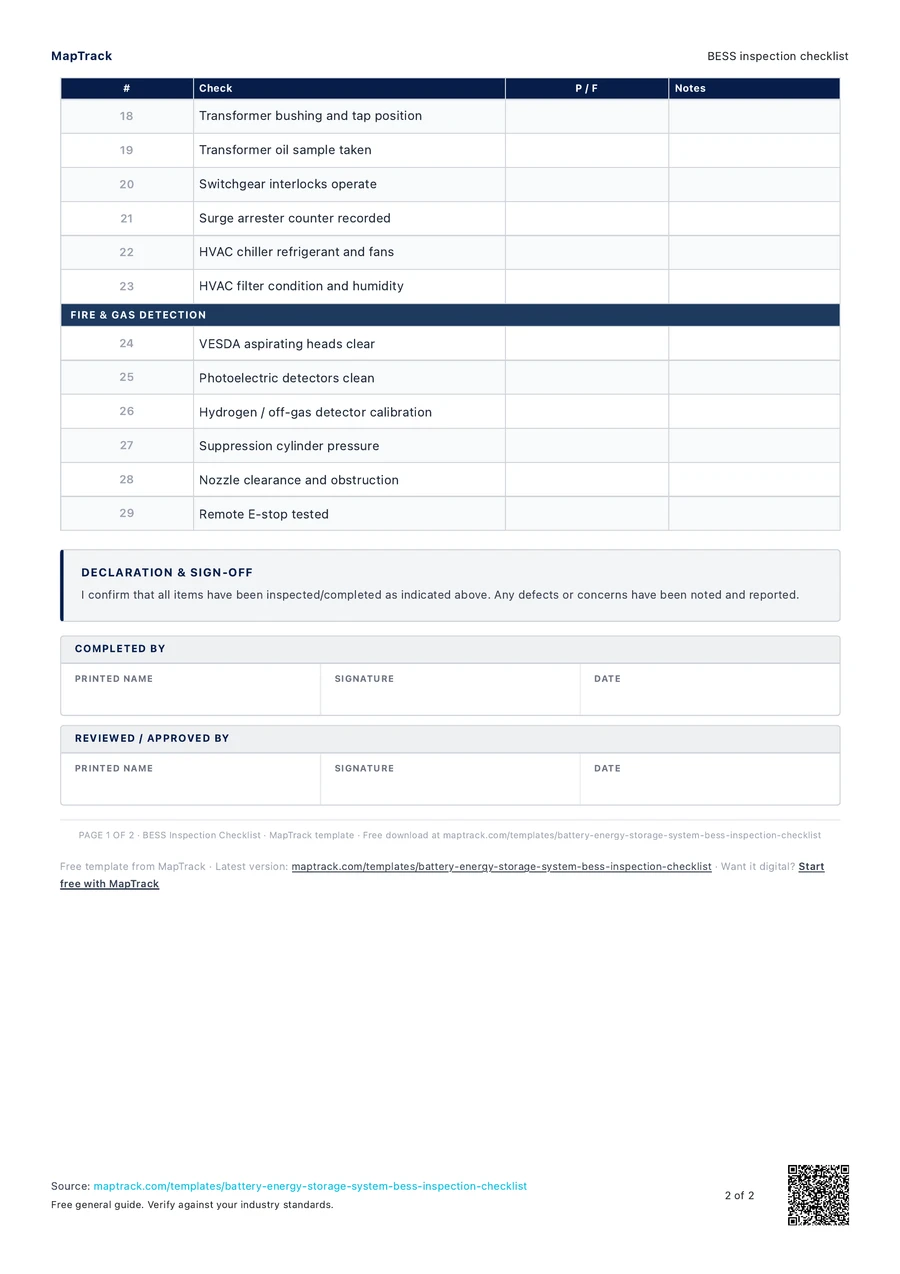
Fire & gas detection
Declaration & Sign-Off
I confirm that all items have been inspected/completed as indicated above. Any defects or concerns have been noted and reported.
Completed By
Printed name · Signature · Date
Reviewed / Approved By
Printed name · Signature · Date
The MapTrack BESS inspection checklist contains 29 checks across 5 sections.

Co-Founder & Commercial Director
Make this form your own
Add your fields and logo. Give your team a form they can use on site.
Free 30-day trial. No credit card. Work email needed.
Customise & use this form now for free

“MapTrack beat them all in every aspect.”
 Vincent Stone · HSEQ Advisor, Concept Tanks
After signup: customise the template, then save and publish it for your team.
General guidance only. Check the form against your equipment manual, site procedures and local requirements before using it.
Key takeaways
- The MapTrack BESS inspection checklist contains 29 checks across 5 sections. Sections covered: Isolation & lockout, Battery racks & cells, Power conversion system, Transformer & switchgear, Fire & gas detection.
- Site identification: project name PCS make and model BESS capacity (MWh) container count BMS firmware version commissioning date and inspector electrical licence number.
- Permit isolation and PPE: lockout-tagout of PCS and HVAC arc-flash PPE category insulating gloves rated for the DC bus voltage and gas-detector calibration.
- Battery modules and racks: visual inspection of cell venting bus-bar torque rack interconnect cables module humidity sensors and any electrolyte residue or swelling.
What is a BESS inspection checklist?
A BESS inspection is a structured condition and safety walk-down of a grid-scale or commercial battery energy storage system, covering the lithium-ion battery modules and racks, power conversion system (PCS) inverters, medium-voltage transformer and switchgear, station HVAC and thermal management, fire detection and suppression, gas detection, the battery management system (BMS) and the supervisory control and data acquisition (SCADA) interface. The inspection is the cadence at which commissioning engineers and grid-scale storage operators verify that the integrated electrochemical and electrical plant continues to operate within the limits set during energisation and within the standards expected by IEC 62619 (Industrial lithium-ion batteries), IEEE 1547 (Grid interconnection of distributed energy resources), NFPA 855 (Standard for the installation of stationary energy storage systems) and AS/NZS 5139 (Battery systems for power conversion equipment).
Unlike a switchboard maintenance check (which covers a single low-voltage cabinet) or a generator service (which is a rotating-machine procedure), a BESS inspection treats the site as a coupled chemistry, power-electronics and fire-safety system. The lithium chemistry imposes thermal runaway risk; the PCS imposes harmonic and protection settings risk; the HVAC and gas-detection systems are the engineered barriers that keep the chemistry within the safe operating envelope. The inspection is the routine that confirms each barrier is intact and the integration between them (BMS sees a thermal rise, PCS curtails charging, HVAC ramps up, fire detection arms) still behaves as designed. Operators use the signed checklist as audit evidence for the network service provider, the insurer and the fire authority, and as the data feed that drives the next scheduled outage, the next module rebalance and the next firmware release in the BMS and PCS.
Learn more about maintenance and work orders in MapTrack.
Choose the format that fits your team
Download the PDF
Use the original printable form for a paper workflow. Check it against your equipment and site procedure before the job.
Keep completed copies in your own record system and arrange any follow-up through your normal process.
Download free PDFCustomise a form in MapTrack
Start a free trial, adjust the digital form to your workflow, then save and publish it for your team to use.
Your account uses the digital template. Sample answers on this page and completed PDF records aren't imported automatically.
Customise & use this form now for freeFree 30-day trial. No credit card. Work email needed.
Benefits of using this BESS inspection checklist
- Thermal runaway prevention: walk-down of BMS thermal data HVAC airflow gas detection and suppression nozzles is the engineered barrier that catches a single-cell anomaly before it propagates across a rack.
- NFPA 855 compliance: the signed inspection record is the evidence the authority having jurisdiction requires for stationary energy storage permits including suppression spacing and clearance verification.
- Grid availability protection: PCS firmware protection settings harmonic filters and AS 4777.2 grid-connection verification keep the site dispatchable and prevent loss-of-mains tripping that erodes revenue.
- Capacity health visibility: capturing state-of-health and state-of-charge data at each inspection feeds the degradation model that predicts when modules need rebalancing or replacement.
- Insurance and warranty defence: insurers and OEM warranty providers expect documented quarterly inspections aligned to IEC 62619 and AS/NZS 5139 as a precondition for coverage on multi-million dollar assets.
- Fire authority readiness: confirming the suppression system gas detection emergency stop and operator training matches the building permit means the fire brigade and local authority can review evidence on demand.
What to include in a BESS inspection checklist
- Site identification: project name PCS make and model BESS capacity (MWh) container count BMS firmware version commissioning date and inspector electrical licence number.
- Permit isolation and PPE: lockout-tagout of PCS and HVAC arc-flash PPE category insulating gloves rated for the DC bus voltage and gas-detector calibration.
- Battery modules and racks: visual inspection of cell venting bus-bar torque rack interconnect cables module humidity sensors and any electrolyte residue or swelling.
- Battery management system: BMS communication health cell voltage spread state-of-health state-of-charge balance fault history and protection setpoint verification.
- Power conversion system (PCS): IGBT cooling DC link capacitor health firmware version protection setpoints AC contactor inspection and harmonic filter capacitor venting.
- Transformer and switchgear: MV transformer oil sample bushing condition tap-changer position switchgear interlocks earth fault relay and surge arrester counter.
- HVAC and thermal management: chiller refrigerant level fan airflow filter condition humidity setpoint and coolant pump operation.
- Fire detection gas and suppression: VESDA aspirating smoke head photoelectric detector hydrogen and electrolyte off-gas detector suppression cylinder pressure and nozzle clearance.
- SCADA and operator interface: SCADA fault log review remote stop test alarm escalation matrix communication channel health and operator training records.
- Sign-off: defect list severity escalation path owner target close-out date inspector signature and licence number.
How to use this BESS inspection checklist
Plan the visit and review SCADA and BMS data before site access
pull the last quarter of BMS cell voltage spread state-of-charge and state-of-health trends pull the PCS fault history and the HVAC and gas-detector event log agree the inspection scope with the asset owner and pre-stage arc-flash PPE insulating gloves and a calibrated gas detector.
Isolate the system and verify zero energy
stop the PCS from SCADA isolate the AC and DC sides apply lockout-tagout to the PCS HVAC and switchgear verify zero potential at the DC bus and AC terminals with a rated multimeter and post the permit at the entry point before entering any battery enclosure.
Inspect the battery modules racks and BMS
walk each rack visually checking for cell venting electrolyte residue bus-bar torque and rack interconnect cable condition open the BMS interface and confirm cell voltage spread balance state-of-health protection setpoints and fault history download the BMS log and oil sample any liquid-cooled coolant where fitted.
Inspect the PCS transformer switchgear and HVAC
open the PCS cabinet check IGBT cooling DC link capacitor venting AC contactor wear and harmonic filter capacitor condition verify firmware version and protection setpoints inspect the MV transformer bushings tap position oil sample and surge arrester switchgear interlocks and HVAC chiller refrigerant fan airflow filter condition and humidity setpoint.
Verify fire gas detection and suppression then close out
visually inspect VESDA aspirating heads photoelectric smoke detectors hydrogen and electrolyte off-gas detector calibration suppression cylinder pressure and nozzle clearance test the remote emergency stop and SCADA alarm escalation release lockout-tagout return the site to service and submit the signed checklist defect register and BMS PCS and HVAC log references.
How often should you complete this checklist?
BESS maintenance is best run on a tiered cadence aligned to the OEM service manual and to NFPA 855 chapter 9 maintenance and operation requirements. SCADA and BMS run continuously and trigger immediate intervention for cell or thermal alarms. Weekly remote checks of SCADA fault log alarm escalation and gas-detector status are completed from the control room. A quarterly inspection (this checklist) walks the site every three months to verify the BMS PCS HVAC and fire and gas systems against IEC 62619 IEEE 1547 NFPA 855 and AS/NZS 5139. A six-monthly inspection adds detailed protection setpoint verification PCS firmware audit and gas-detector recalibration. A full annual major service replaces consumables (HVAC filters suppression cylinders gas-detector sensors) recertifies the safety systems and performs a capacity test on a sample of racks. MapTrack quarterly time and SCADA-fault triggers automate the next inspection across every BESS asset in the portfolio.
Make this form your own
From your template to your team.
Start with this template, adjust it for your equipment and site, then save and publish the digital form for your team.
- 01
Start your free trial
Use your work email to create your MapTrack account.
- 02
Customise, save and publish
Adjust the template fields and branding for your site.
- 03
Complete it on the job
Record checks, add photos and export a branded PDF.
Keep working offline
Load the form before you lose reception. Complete it offline and sync when you're back online.
Scan the asset. Open its form.
Use an asset's QR code to find and complete the forms that belong to it.
Show what you found
Capture photos and attach files so the next person has the details they need.
Take a branded PDF with you
Download completed forms as PDF reports with your company logo.
The trial uses a digital template. Completed paper records aren't imported automatically.
Frequently asked questions
Practical answers about the form, record keeping and using MapTrack.
BESS installations fall under IEC 62619 (Industrial lithium-ion batteries safety requirements), AS/NZS 5139 (Electrical installations safety of battery systems for use with power conversion equipment), AS 4777.2 (Grid connection of energy systems via inverters), AS/NZS 3000 (Wiring rules), AS/NZS 3008 (Cable selection) and the network service provider grid connection agreement under IEEE 1547. NFPA 855 (Installation of stationary energy storage systems) is widely referenced for fire-safety design and inspection cadence. State electrical safety legislation and the Building Code of Australia (Volume One) apply to the enclosure and clearance requirements.
Link to this answerA switchboard maintenance check covers a single low-voltage cabinet (busbar torque thermography RCD operation insulation resistance). A BESS inspection covers a coupled chemistry power-electronics and fire-safety system: lithium battery modules and BMS power conversion system medium-voltage transformer station HVAC fire detection gas detection and suppression. The switchboard check verifies one electrical asset; the BESS inspection verifies the integration between chemistry electrical and engineered safety systems and the BMS PCS HVAC and fire suppression behave correctly when a single-cell anomaly occurs.
Link to this answerIEC 62619 and NFPA 855 expect the inspection to verify each engineered barrier against thermal runaway. The BMS must detect cell voltage spread and module temperature rise and disconnect the affected rack. The HVAC must maintain the battery enclosure within the OEM thermal envelope. Gas detection must monitor for hydrogen and electrolyte off-gas. The suppression system must be charged and clear of obstruction and the remote emergency stop must isolate the PCS in less than the contracted response time. The inspector confirms each barrier visually and tests the alarm escalation path through SCADA.
Link to this answerCompetence is set by AS/NZS 5139 clause 1.5 and the network service provider connection agreement. The inspector must hold a current electrical licence covering the relevant voltage class, OEM-specific BESS platform training for the PCS and BMS, BESS commissioning experience or supervision and arc-flash and DC system awareness training. NFPA 855 chapter 9 adds expectations on operator and emergency responder familiarity. Independent commissioning engineers grid-scale O&M contractors and OEM field service teams are the typical providers. The asset owner verifies competence against a documented competency matrix before site access.
Link to this answerDefects are recorded in the inspection register with severity (informational degrading immediate) the responsible asset owner contact and a target close-out date. An immediate severity defect (thermal runaway barrier failure suppression system fault gas-detector failure protection setpoint disabled) requires the affected rack or the site to be removed from service through SCADA until the defect is corrected. Degrading defects are scheduled into the next outage. Informational defects feed the trend record. The inspector signs the register and notifies the duty operator the asset owner the insurer and the network service provider where the defect affects grid availability or safety.
Link to this answerApplicable regulatory standards
This form is a starting point. Check the current requirements that apply to your equipment, work and location. The form alone does not establish compliance.
- IEC 62619 (Industrial lithium-ion batteries safety)
- IEEE 1547-2018 (Grid interconnection of distributed energy resources)
- NFPA 855-2023 (Stationary energy storage systems)
- AS/NZS 5139:2019 (Battery systems for power conversion)
- AS 4777.2:2020 (Grid connection via inverters)
MapTrack publishes this template. The linked authorities publish their own guidance; they haven't endorsed this form.
The numbers behind this BESS inspection checklist
Every figure below is sourced and dated, so you can quote it in a toolbox talk, a budget case or a board paper without having to chase the original report.
Cite this template
Writing about this topic? You’re welcome to quote this checklist. Here’s the wording to use so your readers can find the original.
The MapTrack BESS inspection checklist contains 29 checks across 5 sections.
- Short attribution
- MapTrack BESS inspection checklist, https://www.maptrack.com/templates/battery-energy-storage-system-bess-inspection-checklist
- Reference list
- MapTrack. (2026). BESS inspection checklist [Checklist template]. Retrieved from https://www.maptrack.com/templates/battery-energy-storage-system-bess-inspection-checklist
Free to reuse with credit under a Creative Commons Attribution 4.0 licence. If you’d rather link straight to it, the page is https://www.maptrack.com/templates/battery-energy-storage-system-bess-inspection-checklist.
Embed this free template on your website
Run an industry blog, trade association site, or training resource? Drop a preview of this free BESS inspection checklist straight into your page. The snippet is self-contained, needs no scripts, and links readers back to the full free template.
<div style="max-width:480px;font-family:system-ui,-apple-system,'Segoe UI',Roboto,sans-serif;border:1px solid #E5E7EB;border-radius:12px;padding:20px;background:#ffffff;">
  <p style="font-size:12px;font-weight:700;letter-spacing:0.05em;text-transform:uppercase;color:#071D49;margin:0;">Free template</p>
  <p style="font-size:18px;font-weight:700;color:#071D49;margin:6px 0 0;">BESS inspection checklist</p>
  <ul style="margin:12px 0 0;padding-left:18px;color:#374151;font-size:14px;line-height:1.6;">
    <li style="margin:4px 0;">Site identification: project name PCS make and model BESS capacity (MWh) container count BMS firmware version commissioning date and inspector electrical licence number.</li>
    <li style="margin:4px 0;">Permit isolation and PPE: lockout-tagout of PCS and HVAC arc-flash PPE category insulating gloves rated for the DC bus voltage and gas-detector calibration.</li>
    <li style="margin:4px 0;">Battery modules and racks: visual inspection of cell venting bus-bar torque rack interconnect cables module humidity sensors and any electrolyte residue or swelling.</li>
    <li style="margin:4px 0;">Battery management system: BMS communication health cell voltage spread state-of-health state-of-charge balance fault history and protection setpoint verification.</li>
    <li style="margin:4px 0;">Power conversion system (PCS): IGBT cooling DC link capacitor health firmware version protection setpoints AC contactor inspection and harmonic filter capacitor venting.</li>
    <li style="margin:4px 0;">Transformer and switchgear: MV transformer oil sample bushing condition tap-changer position switchgear interlocks earth fault relay and surge arrester counter.</li>
  </ul>
  <p style="font-size:13px;color:#6B7280;margin:14px 0 0;padding-top:12px;border-top:1px solid #E5E7EB;">Free <a href="https://www.maptrack.com/templates/battery-energy-storage-system-bess-inspection-checklist" style="color:#071D49;font-weight:600;text-decoration:none;">BESS inspection checklist</a> by MapTrack</p>
</div>Free to reuse, including commercially. This template is published under a Creative Commons Attribution 4.0 licence. Copy it, adapt it, put it on your own site or in your own docs. All we ask is that you credit MapTrack with a link back to this page. The snippet above already includes that credit, so if you use it as-is you’re covered.
About the author

Co-Founder & Commercial Director
Jarrod has spent over a decade in technology consulting and asset management, including roles at Accenture (mining and heavy industry) and CGI as an Asset Management Consultant. He co-founded MapTrack and built and scaled its original platform, then rebuilt it with Lachlan and Alex from thousands of customer conversations and 300+ user research sessions with field teams. His consulting background gives him deep insight into the operational and compliance challenges facing asset-intensive Australian businesses.
View LinkedIn profile →Ready for your next job?
Keep the PDF handy, or customise the digital form for your team.