
Free template · PDF
Free RCM reliability-centred maintenance worksheet template
Free RCM reliability-centred maintenance worksheet (PDF-ready). SAE JA1011 seven-question analysis per asset with FMEA, P-F intervals and task selection.
Loading PDF page...
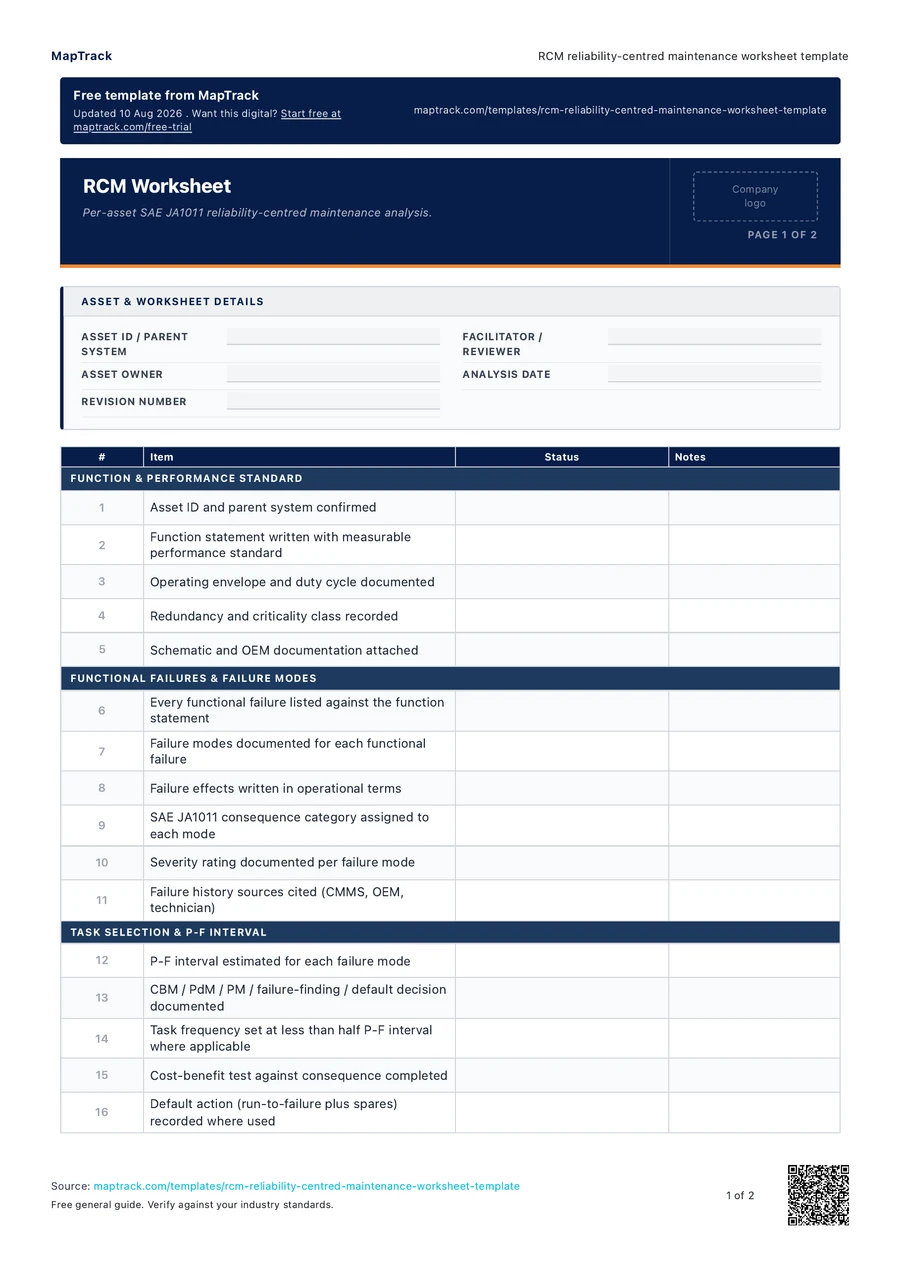

Read the form fields
21 checks · 4 sections · Sign-off
21 checks
The fields in the printable form, in a view that fits your screen.
- Asset ID / parent system
- Facilitator / reviewer
- Asset owner
- Analysis date
- Revision number
Function & performance standard
Functional failures & failure modes
Task selection & P-F interval
Task specification & CMMS load
Declaration & Sign-Off
I confirm that all items have been inspected/completed as indicated above. Any defects or concerns have been noted and reported.
Completed By
Printed name · Signature · Date
Reviewed / Approved By
Printed name · Signature · Date
The MapTrack RCM reliability-centred maintenance worksheet template contains 21 checks across 4 sections.

Co-Founder & Commercial Director
Make this form your own
Add your fields and logo. Give your team a form they can use on site.
Free 30-day trial. No credit card. Work email needed.
Upload & use this form now for free



“MapTrack beat them all in every aspect.”
 Vincent Stone · HSEQ Advisor, Concept Tanks
After signup: upload this PDF, check the form MapTrack drafts, then save and publish it for your team.
General guidance only. Check the form against your equipment manual, site procedures and local requirements before using it.
Key takeaways
- The MapTrack RCM reliability-centred maintenance worksheet template contains 21 checks across 4 sections. Sections covered: Function & performance standard, Functional failures & failure modes, Task selection & P-F interval, Task specification & CMMS load.
- Asset identification and operating context: asset ID, parent system, location, design and operating parameters, operating envelope, redundancy status and the functional standard the asset must deliver to remain available.
- Function statement: the primary and secondary functions of the asset written as a measurable performance standard (e.g. deliver 240 m3/h of cooling water at 4 bar between 5C and 30C ambient).
- Functional failures: the specific ways the asset can fail to meet the function statement (cannot start, delivers degraded flow, delivers contaminated water, fails to alarm on low flow).
What is an RCM reliability-centred maintenance worksheet template?
A reliability-centred maintenance worksheet is a per-asset analysis document used by a reliability engineer or cross-functional review team to step a single piece of equipment through the seven SAE JA1011 questions and decide, failure mode by failure mode, what proactive task (if any) should be performed. Each row of the worksheet captures one failure mode: the function it threatens, the functional failure that results, the failure mode (specific mechanism such as bearing fatigue, seal extrusion, sensor drift, control logic fault), the failure effects in operational terms, the consequence category (hidden, safety or environmental, operational, non-operational), the SAE JA1011 task-selection logic applied, and the resulting maintenance task with its frequency. The worksheet is the working evidence behind every preventive, predictive, failure-finding and run-to-failure decision on the asset, and it is the document an ISO 55001 auditor or insurance assessor will ask to see when a major failure occurs.
Unlike a reliability programme plan (which sets the strategy across an entire site and defines how the team will operate), an RCM worksheet is operational: one asset, one analysis, one set of conclusions. The methodology was first codified in the airline industry in the 1960s (Nowlan and Heap), formalised for general industry in SAE JA1011 (the standard) and SAE JA1012 (the guide), and is referenced in MIL-STD-3034 for naval applications. A rigorous worksheet typically covers 15 to 60 failure modes per asset and takes a facilitated team 8 to 16 hours to complete for a Class A asset. The output is a defensible task list grounded in the P-F curve (the interval between detectable potential failure and functional failure), the consequence category and the cost-benefit test required by JA1011. Mid-market operators rarely run full classical RCM on every asset; instead, they reserve worksheet-level depth for the 10 to 20 percent of assets that carry catastrophic safety, environmental or production risk, and use FMEA-light templates for the rest. Done well, the worksheet replaces opinion-based PM scoping with documented engineering judgement that survives auditor scrutiny.
Learn more about maintenance and work orders in MapTrack.
Choose the format that fits your team
Download the PDF
Use the original printable form for a paper workflow. Check it against your equipment and site procedure before the job.
Keep completed copies in your own record system and arrange any follow-up through your normal process.
Download free PDFCustomise a form in MapTrack
Start a free trial, upload this PDF and MapTrack drafts the form. Adjust it to your workflow, then save and publish it for your team to use.
Sample answers on this page and completed PDF records aren't imported automatically.
Upload & use this form now for freeFree 30-day trial. No credit card. Work email needed.
Benefits of using this RCM reliability-centred maintenance worksheet template
- Defensible task selection: every PM, PdM, failure-finding and run-to-failure decision is traceable through the SAE JA1011 seven-question logic, replacing opinion-driven PM scoping with documented engineering rationale.
- Cost-justified depth: full RCM is reserved for the few assets that genuinely warrant 8 to 16 hours of facilitated analysis, with FMEA-light or PM optimisation used for everything else to control programme cost.
- P-F interval discipline: forcing each failure mode into the P-F framework reveals where condition monitoring at half the P-F interval beats time-based PM, and where time-based PM is genuinely the right call.
- Insurance and ISO 55001 evidence: a signed worksheet per Class A asset is the document that auditors, OEMs and insurers request when a major failure triggers a warranty claim or root cause review.
- Capture of tribal knowledge: the facilitated review pulls failure history out of senior technician memory and into a controlled record before retirement, restructure or attrition removes the knowledge from the organisation.
- Foundation for capital decisions: a populated worksheet exposes which failure modes are dominant and informs whether the right investment is a PM change, a sensor retrofit, a design modification or full asset replacement.
What to include in an RCM reliability-centred maintenance worksheet template
- Asset identification and operating context: asset ID, parent system, location, design and operating parameters, operating envelope, redundancy status and the functional standard the asset must deliver to remain available.
- Function statement: the primary and secondary functions of the asset written as a measurable performance standard (e.g. deliver 240 m3/h of cooling water at 4 bar between 5C and 30C ambient).
- Functional failures: the specific ways the asset can fail to meet the function statement (cannot start, delivers degraded flow, delivers contaminated water, fails to alarm on low flow).
- Failure modes: the physical mechanisms that cause each functional failure (bearing fatigue, seal extrusion, impeller erosion, sensor drift, control logic fault, operator error, supply utility failure).
- Failure effects and evidence: a written description of what happens when the failure mode occurs, including symptoms operators will see, downstream consequences and how the team can verify the failure.
- Consequence category and rating: classification against the SAE JA1011 categories (hidden, safety and environmental, operational, non-operational) with a documented severity rating.
- P-F interval and task selection: the documented P-F interval for each failure mode, the task selected (CBM, PdM, PM, failure-finding, default action) and the frequency, with reference to the JA1011 decision tree.
- Task description and standard: the specific work to be performed (vibration reading at point A, oil sample on schedule X, ultrasonic thickness at gauge B) with acceptance criteria, sample frequency and the responsible role.
- Risk-priority outputs: the residual risk after the proposed task is implemented, plus any recommended design change, operator training or spare-parts strategy needed to support the task.
- Sign-off and revision control: facilitator, reviewer, asset owner and reliability engineer sign-off with revision number, revision date and the change log that records every update.
How to use this RCM reliability-centred maintenance worksheet template
Define the asset boundary and assemble the cross-functional team. The boundary determines what is in scope (pump and motor and coupling and instrumentation) versus what sits in the upstream or downstream system, and the team needs the senior operator, the senior technician, the planner, the reliability engineer and (for Class A assets) a process engineer in the room for 8 to 16 hours.
Write the function statement and identify every functional failure. The function statement is the measurable performance standard the asset must deliver, written in operational units (flow, pressure, temperature, availability, safety integrity level). Every way the asset can fail to meet that standard is a functional failure, and the team must brainstorm exhaustively because anything missed at this stage is missed by every downstream PM decision.
Identify and rate the failure modes that cause each functional failure. For every functional failure, the team lists the physical mechanisms that produce it, drawing on CMMS work order history, OEM failure-mode catalogues, technician experience and any FMEA or RCFA records from similar assets. Each failure mode is rated for consequence severity using the SAE JA1011 four-category framework and given a likelihood estimate based on data.
Estimate the P-F interval and apply the SAE JA1011 task-selection logic. For each failure mode the team estimates the P-F interval (the time between the first detectable indication of failure and functional failure). If the P-F interval is long and a detection technology exists, CBM or PdM is selected at less than half the P-F interval. If the P-F interval is short or no detection exists, time-based PM or failure-finding is selected. If no task is technically feasible and cost-justified, run-to-failure is the documented default with spares strategy.
Document the task, sign off the worksheet and load tasks into the CMMS. Each selected task is written with its specific scope, acceptance criteria, frequency, labour role, parts and tools list. The completed worksheet is signed off by the facilitator, the reliability engineer, the asset owner and the operations manager. The tasks are then loaded against the asset in the CMMS with the worksheet reference so that any future PM change can be traced back to the analysis.
How often should you complete this procedure?
An RCM worksheet is a living document, refreshed on a defined cadence and on event triggers, not redone from scratch every year. The initial analysis for a Class A asset typically takes 8 to 16 facilitated hours; subsequent reviews should take 2 to 4 hours when the data is well kept. Scheduled review cadence is typically every three to five years for Class A assets, every five years for Class B, and event-triggered only for lower classes. Mandatory event-based reviews are triggered by a major failure (any incident that meets the safety, environmental or production threshold defined in the programme charter), a design modification or capital upgrade, a change in operating context (duty cycle, ambient, redundancy, criticality), an OEM bulletin or recall, a regulatory change, or repeated PM compliance failures that suggest the original task selection was wrong. MapTrack attaches the worksheet revision to the asset record and surfaces the next review date alongside live PM compliance, MTBF and PdM finding-rate data.
Make this form your own
From your template to your team.
Upload this PDF and MapTrack drafts the form. Adjust it for your equipment and site, then save and publish the digital form for your team.
- 01
Start your free trial
Use your work email to create your MapTrack account.
- 02
Customise, save and publish
Adjust the template fields and branding for your site.
- 03
Complete it on the job
Record checks, add photos and export a branded PDF.
Keep working offline
Load the form before you lose reception. Complete it offline and sync when you're back online.
Scan the asset. Open its form.
Use an asset's QR code to find and complete the forms that belong to it.
Show what you found
Capture photos and attach files so the next person has the details they need.
Take a branded PDF with you
Download completed forms as PDF reports with your company logo.
Completed paper records aren't imported automatically.
Frequently asked questions
Practical answers about the form, record keeping and using MapTrack.
The worksheet is structured to satisfy the SAE JA1011 evaluation criteria: it captures the function statement, every functional failure, the failure modes that cause each functional failure, the failure effects, the consequence category, the proactive task selected per the JA1011 decision tree, and the default action when no proactive task is suitable. JA1011 compliance also requires the analysis to be performed by a competent, multi-disciplinary team and signed off, so the worksheet includes facilitator, reviewer and asset-owner signatures. SAE JA1012 provides the supporting guide, and ISO 55001 audit programmes typically accept a JA1011-aligned worksheet as sufficient evidence of structured task selection.
Link to this answerFMEA (failure mode and effects analysis, IEC 60812) identifies failure modes, their effects and the controls in place; FMECA adds a criticality calculation (severity x occurrence x detection or similar) producing a risk priority number. RCM uses an FMEA as one input but goes further: it applies the SAE JA1011 task-selection decision tree to every failure mode and prescribes the specific maintenance task. An FMEA documents risk; an RCM worksheet documents the maintenance response to that risk. Most mature programmes run FMEA across all assets and reserve a full RCM worksheet for the 10 to 20 percent of assets that genuinely warrant the deeper analysis.
Link to this answerThe P-F interval is the elapsed time between the first detectable indication that failure is starting (the potential failure point, P) and the moment functional failure occurs (F). To detect a failure reliably before it occurs, the inspection or condition-monitoring task must be scheduled at no more than half the P-F interval (the Nyquist principle applied to maintenance). For example, if vibration analysis can detect a bearing failure 12 weeks before it fails, the vibration route runs every 6 weeks. P-F intervals come from OEM data, CMMS failure history, vibration or oil analysis literature, and senior technician experience, and they must be documented in the worksheet.
Link to this answerReserve full classical RCM (the 8-16 hour facilitated worksheet with the SAE JA1011 seven questions) for assets that meet at least one of three criteria: a single failure can cause a fatality, a notifiable environmental release, or production loss exceeding the threshold defined in the programme charter (commonly $100,000+ per incident). For the next tier of assets use an FMEA-light approach: function, failure mode, effect, current control, proposed task in 1-2 hours. For Class C and D assets use OEM PM templates or run-to-failure. Most operators discover that 10 to 20 percent of the asset base genuinely warrants a worksheet at this depth.
Link to this answerSAE JA1011 requires the analysis to be carried out by a competent team representing the disciplines needed to understand the asset and its operating context. In practice this is the reliability engineer (facilitator), the senior maintenance technician with hands-on experience of the asset, the senior operator who runs the asset day to day, the planner who will load the tasks, and (for safety-critical or process assets) a process or design engineer and an HSE representative. For instrumented or safety-integrity-level rated assets, a functional safety engineer is also required. Single-author worksheets are not JA1011-compliant and rarely survive a credible audit.
Link to this answerISO 55001:2024 requires demonstrable, evidence-based decisions about how each asset is maintained to deliver the asset management objectives. A signed RCM worksheet per Class A asset provides the most direct line of evidence available: from the strategic asset management plan, to the criticality assessment, to the worksheet analysis, to the specific task in the CMMS, to the work order record. ISO 55002:2018 provides supporting guidance on linking risk-based decisions to maintenance task selection. Auditors typically sample a Class A asset and trace the audit chain end to end, so the worksheet revision control and sign-off must be intact.
Link to this answerApplicable regulatory standards
This form is a starting point. Check the current requirements that apply to your equipment, work and location. The form alone does not establish compliance.
- SAE JA1011:2009 (Evaluation Criteria for Reliability-Centred Maintenance Processes)
- SAE JA1012:2011 (A Guide to the Reliability-Centred Maintenance Standard)
- IEC 60812:2018 (Failure modes and effects analysis FMEA and FMECA)
- MIL-STD-3034 (Reliability-Centred Maintenance Process)
- ISO 55001:2024 (Asset management - Management systems - Requirements)
MapTrack publishes this template. The linked authorities publish their own guidance; they haven't endorsed this form.
The numbers behind this RCM reliability-centred maintenance worksheet template
Every figure below is sourced and dated, so you can quote it in a toolbox talk, a budget case or a board paper without having to chase the original report.
Cite this template
Writing about this topic? You’re welcome to quote this checklist. Here’s the wording to use so your readers can find the original.
The MapTrack RCM reliability-centred maintenance worksheet template contains 21 checks across 4 sections.
- Short attribution
- MapTrack RCM reliability-centred maintenance worksheet template, https://www.maptrack.com/templates/rcm-reliability-centred-maintenance-worksheet-template
- Reference list
- MapTrack. (2026). RCM reliability-centred maintenance worksheet template [Checklist template]. Retrieved from https://www.maptrack.com/templates/rcm-reliability-centred-maintenance-worksheet-template
Free to reuse with credit under a Creative Commons Attribution 4.0 licence. If you’d rather link straight to it, the page is https://www.maptrack.com/templates/rcm-reliability-centred-maintenance-worksheet-template.
Embed this free template on your website
Run an industry blog, trade association site, or training resource? Drop a preview of this free RCM reliability-centred maintenance worksheet template straight into your page. The snippet is self-contained, needs no scripts, and links readers back to the full free template.
<div style="max-width:480px;font-family:system-ui,-apple-system,'Segoe UI',Roboto,sans-serif;border:1px solid #E5E7EB;border-radius:12px;padding:20px;background:#ffffff;">
  <p style="font-size:12px;font-weight:700;letter-spacing:0.05em;text-transform:uppercase;color:#071D49;margin:0;">Free template</p>
  <p style="font-size:18px;font-weight:700;color:#071D49;margin:6px 0 0;">RCM reliability-centred maintenance worksheet template</p>
  <ul style="margin:12px 0 0;padding-left:18px;color:#374151;font-size:14px;line-height:1.6;">
    <li style="margin:4px 0;">Asset identification and operating context: asset ID, parent system, location, design and operating parameters, operating envelope, redundancy status and the functional standard the asset must deliver to remain available.</li>
    <li style="margin:4px 0;">Function statement: the primary and secondary functions of the asset written as a measurable performance standard (e.g. deliver 240 m3/h of cooling water at 4 bar between 5C and 30C ambient).</li>
    <li style="margin:4px 0;">Functional failures: the specific ways the asset can fail to meet the function statement (cannot start, delivers degraded flow, delivers contaminated water, fails to alarm on low flow).</li>
    <li style="margin:4px 0;">Failure modes: the physical mechanisms that cause each functional failure (bearing fatigue, seal extrusion, impeller erosion, sensor drift, control logic fault, operator error, supply utility failure).</li>
    <li style="margin:4px 0;">Failure effects and evidence: a written description of what happens when the failure mode occurs, including symptoms operators will see, downstream consequences and how the team can verify the failure.</li>
    <li style="margin:4px 0;">Consequence category and rating: classification against the SAE JA1011 categories (hidden, safety and environmental, operational, non-operational) with a documented severity rating.</li>
  </ul>
  <p style="font-size:13px;color:#6B7280;margin:14px 0 0;padding-top:12px;border-top:1px solid #E5E7EB;">Free <a href="https://www.maptrack.com/templates/rcm-reliability-centred-maintenance-worksheet-template" style="color:#071D49;font-weight:600;text-decoration:none;">RCM reliability-centred maintenance worksheet template</a> by MapTrack</p>
</div>Free to reuse, including commercially. This template is published under a Creative Commons Attribution 4.0 licence. Copy it, adapt it, put it on your own site or in your own docs. All we ask is that you credit MapTrack with a link back to this page. The snippet above already includes that credit, so if you use it as-is you’re covered.
About the author

Co-Founder & Commercial Director
Jarrod has spent over a decade in technology consulting and asset management, including roles at Accenture (mining and heavy industry) and CGI as an Asset Management Consultant. He co-founded MapTrack and built and scaled its original platform, then rebuilt it with Lachlan and Alex from thousands of customer conversations and 300+ user research sessions with field teams. His consulting background gives him deep insight into the operational and compliance challenges facing asset-intensive Australian businesses.
View LinkedIn profile →Ready for your next job?
Keep the PDF handy, or upload it to MapTrack and turn it into a digital form for your team.