
Free LOTO procedure template
Free lockout tagout (LOTO) procedure template as PDF or Excel (XLSX). Covers isolation types, roles, group lockout, try-out and removal.
Updated 10 Aug 2026
LOTO Procedure Template
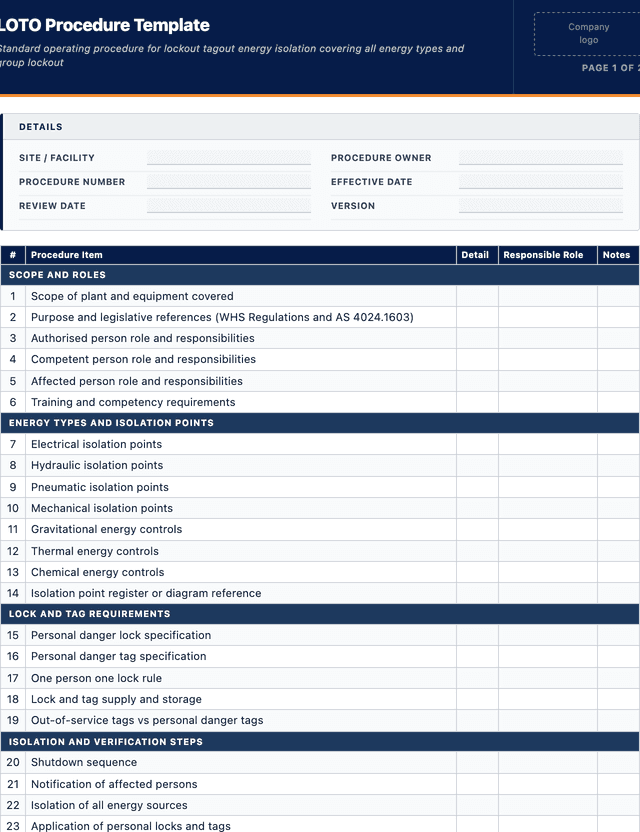
Standard operating procedure for lockout tagout energy isolation covering all energy types and group lockout
Scope and Roles
Energy Types and Isolation Points
Lock and Tag Requirements
Isolation and Verification Steps
Group Lockout and Removal
How to use: download the PDF, print or complete digitally on any device.
- PDF format, ready to print or fill on screen
- Use as-is or customise to suit your operation
- Go digital in MapTrack for photos, reminders and audit trails
Download formats
- LOTO procedure template PDF
PDF: Print-ready lockout tagout procedure covering isolation points, roles, group lockout, try-out and removal.
- LOTO procedure template XLSX
XLSX: Editable Excel workbook with the same isolation-point and step structure, ready to adapt per machine.
Two ways to use it
Use in MapTrack →Use it digitally instead
Unlimited usersThese same 32 checks, already built.




- Scan the asset’s QR tag with any phone
- Submitted forms can trigger alerts
- Photos on fails, audit-ready records
- Export responses, PDF reports with your logo
Free trial. No credit card needed.
Trusted by teams across Australia and New Zealand
We respect your privacy. Unsubscribe anytime.
These templates are free general guides provided as-is. They do not constitute legal, safety or compliance advice. You are responsible for ensuring any form meets your specific workplace obligations, industry standards and applicable regulations.
Don't just download it - use it live. Start a free workspace with this LOTO procedure template already built, so your crew can run it from a phone.

Co-Founder & Commercial Director
Key takeaways
- The MapTrack LOTO procedure template contains 32 checks across 5 sections. Sections covered: Scope and Roles, Energy Types and Isolation Points, Lock and Tag Requirements, Isolation and Verification Steps, Group Lockout and Removal.
Enter your email below to download this LOTO procedure template as a ready-to-use PDF.
Used by construction, mining and field service teams











What is a LOTO procedure template?
A lockout tagout (LOTO) procedure is a standard operating procedure that defines how energy sources are isolated and secured before maintenance or servicing work begins on plant and equipment. MapTrack helps operations teams manage LOTO procedures digitally so every isolation is recorded against the asset with full traceability. This overarching SOP is distinct from a per-job LOTO isolation checklist which is the field checklist completed for each specific isolation event. The procedure template defines the organisation-wide rules covering scope roles and responsibilities isolation types lock and tag requirements group isolation try-out verification and lock removal.
LOTO procedures are essential for preventing uncontrolled release of energy during maintenance. In Australia AS 4024.1603 (Control of hazardous energy - Lockout tagout and alternative methods) and the WHS Regulations set out requirements for isolation of plant. Failure to follow proper LOTO procedures is a leading cause of serious workplace injuries and fatalities in Australian industry. A well-documented LOTO procedure also addresses complex isolation scenarios such as multi-trade shutdowns where several work groups require simultaneous protection and long-duration isolations that span shift changes. The procedure should define how locks are transferred between shifts, how temporary de-isolation for testing is managed, and how the final re-energisation is authorised. Organisations that digitise their LOTO procedures can link each isolation event directly to the asset record, giving maintenance planners full visibility of isolation history, outstanding lock counts, and overdue removals.
Learn more about compliance and inspections in MapTrack.
Benefits of using this LOTO procedure template
- Injury prevention: a documented LOTO procedure ensures all energy sources are identified and isolated before any maintenance work begins
- Legal compliance: a written LOTO procedure demonstrates the PCBU has met their WHS Regulations and AS 4024.1603 obligations for energy isolation
- Consistency: every worker follows the same isolation process regardless of the type of energy source or complexity of the task
- Accountability: defined roles and responsibilities ensure everyone knows who authorises isolation who applies locks and who verifies zero energy
- Group lockout coverage: the procedure addresses multi-person and multi-trade isolation scenarios where several workers need protection simultaneously
- Audit trail: documented LOTO procedures with referenced checklists provide evidence for regulator enquiries and insurer audits
Benefits of digitising forms in MapTrack
When you move your procedures from paper to MapTrack, you get:
- Field users can easily scan a QR code to complete a form on mobile. Unlimited users.
- Email the right people when a form is submitted, with an automation you set up.
- File every completed form against the asset, location or person it covers.
- Download any completed form as a PDF, with failed answers listed at the top.
- Fill in forms offline; they upload when the device is back online.
- Build conditional logic (show or hide questions based on answers).
- Take pictures or attach photos. Not possible with a paper-based form.
- Electronic signatures.
- Edit forms later without reprinting.
- Set who can view, fill in or edit forms with user roles.
- Upload a paper form (PDF, Word, Excel or a photo) and MapTrack's AI builds a digital version for you to check.
- Email safety managers when a hazard report is submitted, with an automation you set up.
- Keep every hazard and incident report against the site it came from, with photos.
- Turn a hazard report into a corrective-action work order with its own review step.
Book a demo to see how MapTrack handles procedures.
Try MapTrack free for 30 days
Full access to every feature. No credit card required. Per-asset pricing so you scale as your fleet grows.
- No credit card required
- 30 days free trial
- Cancel anytime
1-2 days/week saved
“Bloody amazing! We used to spend 1-2 days a week tracking and managing our generators alone.”

Steve McAllister
Asset Coordinator, Saunders International
What to include in a LOTO procedure template
This LOTO procedure template covers 8 key areas:
- Scope and purpose: define which plant equipment and energy types the procedure covers and state its purpose in preventing uncontrolled energy release
- Roles and responsibilities: define the roles of the authorised person (who authorises isolation) the competent person (who performs isolation) and the affected person (who works on the isolated plant)
- Energy types: list all energy types covered including electrical hydraulic pneumatic mechanical gravitational thermal and chemical
- Lock and tag requirements: specify the types of locks and tags to be used personal lock requirements and the rule that each worker applies their own lock
- Isolation steps: describe the step-by-step process for isolating each energy type including shutdown sequence isolation point identification and lock application
- Try-out and verification: define the process for verifying zero energy after isolation is applied including try-start and testing with appropriate instruments
- Group isolation: describe the procedure for multi-person lockout including the use of a group lockout box or hasp and the requirement for each worker to apply their personal lock
- Lock removal and re-energisation: define the process for removing locks restoring energy and confirming the plant is safe to return to service
How to use this LOTO procedure template
- Identify all energy sources: conduct an energy source audit for each item of plant and document every electrical hydraulic pneumatic mechanical gravitational thermal and chemical energy source
- Define isolation points: for each energy source identify the specific isolation point (breaker valve bleed point block) and document it on an isolation point diagram or register
- Assign roles and responsibilities: define who is authorised to approve isolations who is competent to perform them and how affected persons are informed and protected
- Document the step-by-step procedure: write out the shutdown isolation lock application try-out and verification steps in sequence for the organisation
- Establish lock and tag standards: specify the types of personal danger locks tags and group lockout devices (hasps boxes) to be used and ensure adequate supply is available
- Train all affected personnel: ensure every worker who performs isolation supervises isolation or works on isolated plant is trained in the procedure and assessed as competent
- Review and update regularly: review the LOTO procedure at least annually after any incident involving isolation failure and whenever new plant or energy sources are introduced
In MapTrack, you can digitise safety inspections and compliance forms. Each submission is stored as a timestamped PDF against the asset record.
Get the free templateEnter your email above to download the full LOTO procedure template as a PDF.Back to download formHow often should you complete this procedure?
The LOTO procedure should be reviewed at least annually as part of the organisation's safety management system review cycle. It should also be reviewed immediately after any incident or near miss involving an isolation failure after the introduction of new plant or equipment and whenever there is a change in legislation or standards.
AS 4024.1603 requires that procedures for the control of hazardous energy are documented maintained and reviewed. The WHS Regulations require the PCBU to ensure that risks associated with plant are managed and that isolation procedures are followed. Regular review ensures the LOTO procedure remains current and effective as the workplace evolves.
Frequently asked questions
Applicable regulatory standards
This template is a starting point. Check the current requirements that apply to your equipment, work and location. The template alone does not establish compliance.
- AS/NZS 4024.1603 - Control of hazardous energy (Lockout/tagout)
- WHS Regulations - Chapter 5 Plant and structures
- OSHA 29 CFR 1910.147 - Control of hazardous energy
LOTO procedure template preview
The numbers behind this LOTO procedure template
Every figure below is sourced and dated, so you can quote it in a toolbox talk, a budget case or a board paper without having to chase the original report.
Embed this free template on your website
Run an industry blog, trade association site, or training resource? Drop a preview of this free LOTO procedure template straight into your page. The snippet is self-contained, needs no scripts, and links readers back to the full free template.
<div style="max-width:480px;font-family:system-ui,-apple-system,'Segoe UI',Roboto,sans-serif;border:1px solid #E5E7EB;border-radius:12px;padding:20px;background:#ffffff;">
  <p style="font-size:12px;font-weight:700;letter-spacing:0.05em;text-transform:uppercase;color:#071D49;margin:0;">Free template</p>
  <p style="font-size:18px;font-weight:700;color:#071D49;margin:6px 0 0;">LOTO procedure template</p>
  <ul style="margin:12px 0 0;padding-left:18px;color:#374151;font-size:14px;line-height:1.6;">
    <li style="margin:4px 0;">Scope and purpose: define which plant equipment and energy types the procedure covers and state its purpose in preventing uncontrolled energy release</li>
    <li style="margin:4px 0;">Roles and responsibilities: define the roles of the authorised person (who authorises isolation) the competent person (who performs isolation) and the affected person (who works on the isolated plant)</li>
    <li style="margin:4px 0;">Energy types: list all energy types covered including electrical hydraulic pneumatic mechanical gravitational thermal and chemical</li>
    <li style="margin:4px 0;">Lock and tag requirements: specify the types of locks and tags to be used personal lock requirements and the rule that each worker applies their own lock</li>
    <li style="margin:4px 0;">Isolation steps: describe the step-by-step process for isolating each energy type including shutdown sequence isolation point identification and lock application</li>
    <li style="margin:4px 0;">Try-out and verification: define the process for verifying zero energy after isolation is applied including try-start and testing with appropriate instruments</li>
  </ul>
  <p style="font-size:13px;color:#6B7280;margin:14px 0 0;padding-top:12px;border-top:1px solid #E5E7EB;">Free <a href="https://www.maptrack.com/templates/loto-procedure-template" style="color:#071D49;font-weight:600;text-decoration:none;">LOTO procedure template</a> by MapTrack</p>
</div>Free to reuse, including commercially. This template is published under a Creative Commons Attribution 4.0 licence. Copy it, adapt it, put it on your own site or in your own docs. All we ask is that you credit MapTrack with a link back to this page. The snippet above already includes that credit, so if you use it as-is you’re covered.
Cite this template
Writing about this topic? You’re welcome to quote this checklist. Here’s the wording to use so your readers can find the original.
The MapTrack LOTO procedure template contains 32 checks across 5 sections.
- Short attribution
- MapTrack LOTO procedure template, https://www.maptrack.com/templates/loto-procedure-template
- Reference list
- MapTrack. (2026). LOTO procedure template [Checklist template]. Retrieved from https://www.maptrack.com/templates/loto-procedure-template
Free to reuse with credit under a Creative Commons Attribution 4.0 licence. If you’d rather link straight to it, the page is https://www.maptrack.com/templates/loto-procedure-template.
Need to digitise safety inspections and compliance forms?
Register every asset in MapTrack, attach digital forms, and get a complete history of every inspection, service and compliance record.
Compliance and inspections · All templates · Pricing · Book a demo