
Free kaizen template
Free kaizen template (PDF-ready). Run a structured continuous improvement event: problem, current state, target, root cause, countermeasures and results.
Updated 28 Sept 2026
How to use: download the PDF, print or complete digitally on any device.
- PDF format, ready to print or fill on screen
- Use as-is or customise to suit your operation
- Go digital in MapTrack for photos, reminders and audit trails
Download free PDF template
Use in MapTrack →



Trusted by teams across Australia and New Zealand
We respect your privacy. Unsubscribe anytime.
Or set it up in MapTrack
- Fill it in on a phone, attach photos to any check
- Automatic reports and audit trails
- Upload the PDF and MapTrack drafts the form for you
Free 30-day trial. No credit card. Personal email accepted.
Don't just download it - use it live. Start a free workspace, upload this kaizen template and MapTrack drafts it as a form your crew can run from a phone.

Co-Founder & Commercial Director
Key takeaways
- A kaizen template moves a team from problem to verified, sustained result on one page.
- It is built on PDCA: plan, do, check, then act to standardise the gain.
- Current state and target metrics anchor every decision in data, not opinion.
- Root cause analysis stops the team fixing symptoms that let problems return.
- A completed sheet is solid evidence for ISO 9001:2015 Clause 10 continual improvement.
Enter your email below to download this kaizen template as a ready-to-use PDF.
Used by construction, mining and field service teams










What is a kaizen template?
A kaizen template is a one-page structure that guides a team through a focused continuous improvement event from problem to sustained result. It captures the theme and problem statement, the current state backed by data, the target or goal, the root cause analysis, the countermeasures chosen, the implementation plan, and the before versus after results. Built around the Plan-Do-Check-Act cycle, it keeps reasoning visible so the whole team can see how each decision links back to the measured problem.
Kaizen comes from the Toyota Production System and means change for the better through small, frequent improvements made by the people who do the work. This template turns that idea into a repeatable form that any frontline team can run in a short workshop or rapid event. It supports the continual improvement requirements of ISO 9001 Clause 10 by recording the opportunity, the action taken, the evidence of effect, and the new standard that holds the gain.
Learn more about maintenance and work orders in MapTrack.
Benefits of using this kaizen template
- Structured thinking: a single page walks the team from problem to verified result without gaps.
- Data discipline: forcing current state and target metrics removes opinion and anchors every decision.
- Faster events: a fixed agenda lets a rapid kaizen reach countermeasures within hours, not weeks.
- Root cause focus: a dedicated analysis box stops the team jumping straight to favourite solutions.
- Sustained gains: the standardise and sustain step locks the improvement into daily standard work.
- Audit evidence: the completed form documents continual improvement for ISO 9001 Clause 10 reviews.
Benefits of digitising forms in MapTrack
When you move your reports from paper to MapTrack, you get:
- Field users can easily scan a QR code to complete a form on mobile. Unlimited users.
- Email the right people when a form is submitted, with an automation you set up.
- File every completed form against the asset, location or person it covers.
- Download any completed form as a PDF, with failed answers listed at the top.
- Fill in forms offline; they upload when the device is back online.
- Build conditional logic (show or hide questions based on answers).
- Take pictures or attach photos. Not possible with a paper-based form.
- Electronic signatures.
- Edit forms later without reprinting.
- Set who can view, fill in or edit forms with user roles.
- Upload a paper form (PDF, Word, Excel or a photo) and MapTrack's AI builds a digital version for you to check.
- Raise a work order from a submitted form with an automation you set up.
- Track service intervals by hours, kilometres or calendar date in one place.
- Attach supplier invoices and parts receipts to each maintenance record.
Book a demo to see how MapTrack handles reports.
Try MapTrack free for 30 days
Full access to every feature. No credit card required. Per-asset pricing so you scale as your fleet grows.
- No credit card required
- 30 days free trial
- Cancel anytime
1-2 days/week saved
“Bloody amazing! We used to spend 1-2 days a week tracking and managing our generators alone.”

Steve McAllister
Asset Coordinator, Saunders International
What to include in a kaizen template
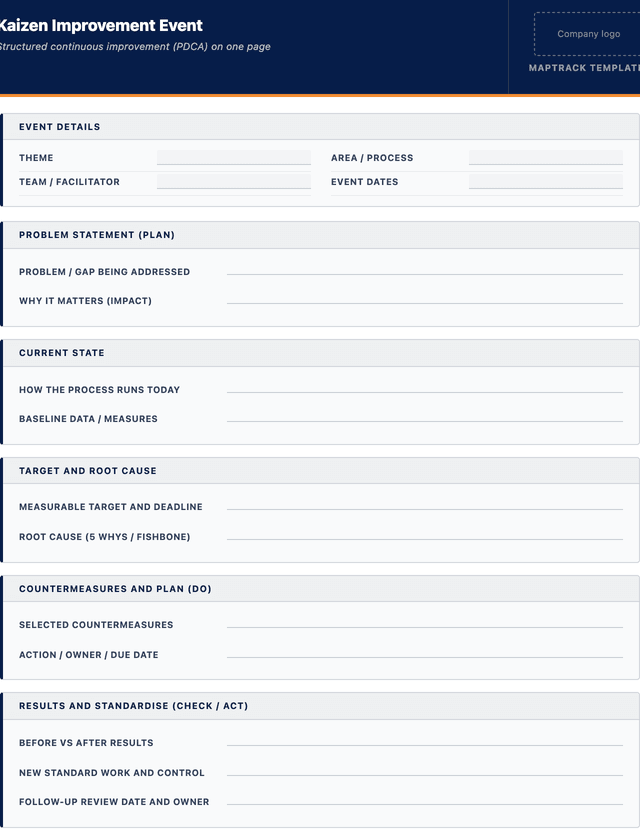
This kaizen template covers 9 key areas:
- Event details: theme, area or process, team members, facilitator, and event dates
- Problem statement: a clear, specific description of the gap or waste being addressed
- Current state: how the process runs today, mapped and measured with baseline data
- Target or goal: the measurable outcome the team commits to, with a deadline
- Root cause analysis: 5 Whys or fishbone work that traces the problem to its source
- Countermeasures: the improvement ideas selected to remove or reduce each root cause
- Implementation plan: actions, owners, and due dates for putting countermeasures in place
- Results: before versus after metrics showing the size and direction of the change
- Standardise and sustain: the new standard work, controls, and follow-up review date
How to use this kaizen template
- Plan the event and define the problem: Pick a focused theme tied to a real pain such as downtime, defects, or delay, then write a specific problem statement. Assemble the people who do the work and a facilitator, and agree the scope so the event stays small enough to finish.
- Map the current state with data: Go to where the work happens and document how the process actually runs today, not how it should run. Capture baseline measures such as cycle time, defect rate, or distance walked so the team has hard numbers to improve against later.
- Set the target and find root causes: Agree a measurable target and deadline that closes the gap to the ideal. Use 5 Whys or a fishbone diagram to dig past symptoms and reach the true root causes, because countermeasures aimed at symptoms rarely hold and the problem returns.
- Trial countermeasures and measure: Brainstorm improvement ideas against each root cause, then pick the highest impact and lowest effort ones to test. Implement the changes on a small scale during the event, observe what happens, and record the new measures to check whether the target moved.
- Standardise, sustain, and reflect: If the change worked, write it into standard work and add a control so it cannot quietly slip back. Compare before and after results, share the learning, set a follow-up review date, and start the next cycle on the remaining gap.
In MapTrack, you can schedule and track maintenance digitally, by date or meter reading. Each submission is stored as a timestamped PDF against the asset record.
Get the free templateEnter your email above to download the full kaizen template as a PDF.Back to download formHow often should you complete this report?
Kaizen is meant to be continuous rather than a once a year exercise, so the most powerful pattern is many small improvements run often by the people closest to the work. Many teams hold a structured kaizen event monthly or quarterly on a priority process, while encouraging daily point kaizen suggestions in between. The cadence matters less than the habit of always having an active improvement in flight.
Link the rhythm to your management review and ISO 9001 continual improvement loop so events are chosen from real performance data rather than at random. Run a fresh event whenever a metric drifts, a recurring problem surfaces, or a previous improvement needs deepening. After each event, revisit the standard at the follow-up date you set to confirm the gain has held before moving the team onto the next opportunity.
Frequently asked questions
Applicable regulatory standards
This template is a starting point. Check the current requirements that apply to your equipment, work and location. The template alone does not establish compliance.
- ISO 9001:2026 Clause 10 Improvement (including 10.1 continual improvement)
- PDCA / Deming cycle (Plan-Do-Check-Act)
- Toyota Production System / Lean kaizen (continuous improvement)
- A3 problem solving (structured PDCA on a single page)
Check the current source
Kaizen template preview
The numbers behind this kaizen template
Every figure below is sourced and dated, so you can quote it in a toolbox talk, a budget case or a board paper without having to chase the original report.
Embed this free template on your website
Run an industry blog, trade association site, or training resource? Drop a preview of this free kaizen template straight into your page. The snippet is self-contained, needs no scripts, and links readers back to the full free template.
<div style="max-width:480px;font-family:system-ui,-apple-system,'Segoe UI',Roboto,sans-serif;border:1px solid #E5E7EB;border-radius:12px;padding:20px;background:#ffffff;">
  <p style="font-size:12px;font-weight:700;letter-spacing:0.05em;text-transform:uppercase;color:#071D49;margin:0;">Free template</p>
  <p style="font-size:18px;font-weight:700;color:#071D49;margin:6px 0 0;">Kaizen template</p>
  <ul style="margin:12px 0 0;padding-left:18px;color:#374151;font-size:14px;line-height:1.6;">
    <li style="margin:4px 0;">Event details: theme, area or process, team members, facilitator, and event dates</li>
    <li style="margin:4px 0;">Problem statement: a clear, specific description of the gap or waste being addressed</li>
    <li style="margin:4px 0;">Current state: how the process runs today, mapped and measured with baseline data</li>
    <li style="margin:4px 0;">Target or goal: the measurable outcome the team commits to, with a deadline</li>
    <li style="margin:4px 0;">Root cause analysis: 5 Whys or fishbone work that traces the problem to its source</li>
    <li style="margin:4px 0;">Countermeasures: the improvement ideas selected to remove or reduce each root cause</li>
  </ul>
  <p style="font-size:13px;color:#6B7280;margin:14px 0 0;padding-top:12px;border-top:1px solid #E5E7EB;">Free <a href="https://www.maptrack.com/templates/kaizen-template" style="color:#071D49;font-weight:600;text-decoration:none;">Kaizen template</a> by MapTrack</p>
</div>Free to reuse, including commercially. This template is published under a Creative Commons Attribution 4.0 licence. Copy it, adapt it, put it on your own site or in your own docs. All we ask is that you credit MapTrack with a link back to this page. The snippet above already includes that credit, so if you use it as-is you’re covered.
Cite this template
Writing about this topic? You’re welcome to quote this checklist. Here’s the wording to use so your readers can find the original.
- Short attribution
- MapTrack Kaizen template, https://www.maptrack.com/templates/kaizen-template
- Reference list
- MapTrack. (2026). Kaizen template [Checklist template]. Retrieved from https://www.maptrack.com/templates/kaizen-template
Free to reuse with credit under a Creative Commons Attribution 4.0 licence. If you’d rather link straight to it, the page is https://www.maptrack.com/templates/kaizen-template.
Need to schedule and track maintenance digitally, by date or meter reading?
Register every asset in MapTrack, attach digital forms, and get a complete history of every inspection, service and compliance record.
Maintenance and work orders · All templates · Pricing · Book a demo