
Free workshop safety audit checklist
Free workshop safety audit checklist (PDF-ready). Covers housekeeping, machine guarding, electrical safety, fire exits, PPE and ventilation. Download free.
Updated 3 May 2026
Workshop Safety Audit Checklist
Weekly workshop and yard workplace health and safety audit
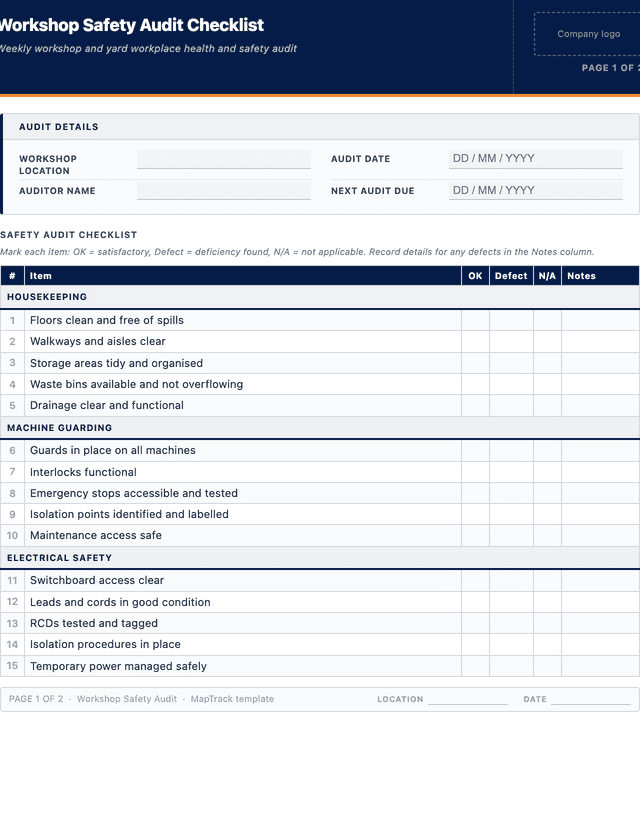
Housekeeping
Machine Guarding
Electrical Safety
Fire & Emergency
PPE & Ventilation
Chemical Storage
Auditor sign-off
Signature
Print name
Date
Workshop manager sign-off
Signature
Print name
Date
How to use: download the PDF, print or complete digitally on any device.
- PDF format, ready to print or fill on screen
- Use as-is or customise to suit your operation
- Go digital in MapTrack for photos, reminders and audit trails
Two ways to use it
Use in MapTrack →Use it digitally instead
Unlimited usersThese same 31 checks, already built.




- Scan the asset’s QR tag with any phone
- Submitted forms can trigger alerts
- Photos on fails, audit-ready records
- Export responses, PDF reports with your logo
Free trial. No credit card needed.
Trusted by teams across Australia and New Zealand
We respect your privacy. Unsubscribe anytime.
These templates are free general guides provided as-is. They do not constitute legal, safety or compliance advice. You are responsible for ensuring any form meets your specific workplace obligations, industry standards and applicable regulations.
Don't just download it - use it live. Start a free workspace with this workshop safety audit checklist already built, so your crew can run it from a phone.

Co-Founder & Commercial Director
Key takeaways
- The MapTrack workshop safety audit checklist contains 31 checks across 6 sections. Sections covered: Housekeeping, Machine Guarding, Electrical Safety, Fire & Emergency, PPE & Ventilation, Chemical Storage.
- Walks the workshop by zone: machine guarding, electrical, hot work, chemicals, housekeeping, PPE and emergency equipment, with a finding per item.
- Typical findings include missing guards, out-of-test tags, blocked exits and unlabelled containers.
- An audit finding without an owner and a date is an observation. The checklist assigns both at the point of finding.
- The model WHS Act primary duty of care covers the workshop, and periodic audits are how a PCBU shows the duty is being exercised.
Enter your email below to download this workshop safety audit checklist as a ready-to-use PDF.
Used by construction, mining and field service teams










What is a workshop safety audit checklist?
A workshop safety audit checklist is a structured form used to systematically inspect a workshop environment for safety hazards and regulatory compliance. It covers housekeeping, machine guarding, electrical safety, fire protection, PPE, ventilation, chemical storage and emergency preparedness. Workshops present a concentration of hazards, from moving machinery and sharp tools to electrical equipment and hazardous substances. Regular safety audits help identify risks before they cause injuries, ensure compliance with Australian WHS regulations and standards, and build a documented history of safety performance.
Workshops in industries such as construction, mining, manufacturing, transport and facilities management are subject to specific obligations under the WHS Act 2011 and supporting regulations. The PCBU must ensure, so far as is reasonably practicable, that the workplace is without risks to health and safety. AS/NZS 4024 sets requirements for machine guarding, emergency stops and interlocks, while AS/NZS 3760 governs testing and tagging of electrical equipment. A formal audit checklist ensures these requirements are verified consistently across every inspection, regardless of who conducts it. Over time, completed audit records reveal trends such as recurring guarding deficiencies, persistent housekeeping issues or ageing electrical infrastructure, allowing the organisation to prioritise capital investment and preventive maintenance where it will have the greatest safety impact.
Learn more about compliance and inspections in MapTrack.
Benefits of using this workshop safety audit checklist
- Hazard identification: systematically find risks across housekeeping, guarding, electrical, fire and chemical storage areas.
- WHS compliance: documented audits demonstrate compliance with Work Health and Safety regulations and Australian Standards.
- Injury prevention: address hazards before they cause injuries, reducing lost-time incidents and workers' compensation costs.
- Continuous improvement: track corrective actions over time and measure whether safety performance is improving.
- Worker engagement: involving workshop staff in audits builds safety awareness and encourages hazard reporting.
- Audit trail: maintain a verifiable record of safety inspections for regulators, insurers and incident investigations.
Benefits of digitising forms in MapTrack
When you move your checklists from paper to MapTrack, you get:
- Field users can easily scan a QR code to complete a form on mobile. Unlimited users.
- Email the right people when a form is submitted, with an automation you set up.
- File every completed form against the asset, location or person it covers.
- Download any completed form as a PDF, with failed answers listed at the top.
- Fill in forms offline; they upload when the device is back online.
- Build conditional logic (show or hide questions based on answers).
- Take pictures or attach photos. Not possible with a paper-based form.
- Electronic signatures.
- Edit forms later without reprinting.
- Set who can view, fill in or edit forms with user roles.
- Upload a paper form (PDF, Word, Excel or a photo) and MapTrack's AI builds a digital version for you to check.
- Email safety managers when a hazard report is submitted, with an automation you set up.
- Keep every hazard and incident report against the site it came from, with photos.
- Turn a hazard report into a corrective-action work order with its own review step.
Book a demo to see how MapTrack handles checklists.
Try MapTrack free for 30 days
Full access to every feature. No credit card required. Per-asset pricing so you scale as your fleet grows.
- No credit card required
- 30 days free trial
- Cancel anytime
1-2 days/week saved
“Bloody amazing! We used to spend 1-2 days a week tracking and managing our generators alone.”

Steve McAllister
Asset Coordinator, Saunders International
What to include in a workshop safety audit checklist
This workshop safety audit checklist covers 10 key areas:
- Workshop details: location, date, auditor name and role.
- Housekeeping: floors clear, walkways unobstructed, waste disposal, spill management, storage areas organised.
- Machine guarding: guards in place, emergency stops functional, lock-out/tag-out procedures, moving parts shielded.
- Electrical safety: leads and plugs in good condition, RCDs tested, switchboards accessible, test and tag current.
- Fire safety: exits clear and signed, extinguishers serviced and accessible, evacuation plan displayed.
- PPE: correct PPE available, in good condition, signage displayed, storage provided.
- Ventilation: extraction systems operating, welding fume capture, dust collection, air quality adequate.
- Chemical storage: SDS accessible, chemicals stored correctly, spill kits available, incompatibles separated.
- Corrective actions: non-conformances noted, responsible person, due date, priority.
- Sign-off: auditor and workshop manager.
How to use this workshop safety audit checklist
- Record the workshop location, date and auditor details.: Note the workshop name or building number, the street address or site reference, the date and time of the audit, and the full name and role of the auditor. If the workshop operates across multiple bays or zones, identify which areas are included in this audit. Recording these details ensures the report can be traced back to a specific inspection event, which is critical for trend analysis, regulatory reviews and incident investigations.
- Walk the workshop systematically, starting at the entrance and covering every area, including storage rooms, pits and mezzanine levels.: Begin at the main entrance and move through the workshop in a logical sequence so no area is missed. Include service pits, mezzanine levels, tool cribs, paint booths, welding bays, parts wash stations, battery charging areas and external laydown zones. Check overhead areas for unsecured items and underfoot for trip hazards, spills or damaged flooring. A consistent walk pattern each audit ensures repeatability and makes it easier to spot changes between inspections.
- Assess each category on the checklist (housekeeping, guarding, electrical, fire, PPE, ventilation, chemicals) and mark Compliant or Non-Compliant.: Work through every category methodically. For housekeeping, check floors, walkways, waste bins and storage racks. For machine guarding, confirm guards are in place on grinders, lathes, drill presses and saws, and test emergency stops. For electrical safety, verify test and tag labels are current per AS/NZS 3760, RCDs are tested and switchboard access is clear. For fire safety, confirm extinguishers are serviced, exits are unobstructed and evacuation plans are displayed. For PPE, check signage, availability and condition. For ventilation, confirm extraction systems are running and air quality is adequate. For chemicals, verify SDS accessibility, correct storage and spill kit readiness.
- For each non-conformance, record the issue, take a photo, assign a responsible person and set a due date for corrective action.: Describe the non-conformance clearly, noting the exact location and the specific requirement that is not met. Photograph the issue for evidence and attach it to the audit record. Assign a named responsible person who has the authority and resources to fix the issue, and agree on a realistic due date. Classify each finding by risk priority: high (immediate action required), medium (action within one week) or low (action within one month). Enter corrective actions into your tracking system so they are not lost after the audit.
- Review findings with the workshop manager and agree on priorities.: Walk through the completed checklist with the workshop manager or team leader on the same day as the audit. Discuss each non-conformance, agree on the priority and corrective action timeline, and confirm resource availability for repairs or improvements. This review builds ownership of the findings and ensures the workshop team understands what needs to change and by when. If any finding presents an immediate danger, escalate it for same-day resolution before workers continue in the area.
- Sign off the audit and distribute the report. Follow up on corrective actions by their due dates.: Both the auditor and the workshop manager sign and date the completed checklist. Distribute the report to the site safety manager, maintenance team and any other stakeholders. Upload the completed audit and supporting photos to MapTrack or your document management system. Set calendar reminders for each corrective action due date and follow up to confirm completion. Close out each action with evidence, such as a photo of the repaired guard or a test tag receipt. Review open actions at the next audit to track progress.
In MapTrack, you can digitise safety inspections and compliance forms. Each submission is stored as a timestamped PDF against the asset record.
Get the free templateEnter your email above to download the full workshop safety audit checklist as a PDF.Back to download formHow often should you complete this checklist?
Conduct a formal workshop safety audit at least monthly. Weekly informal walk-throughs are recommended for workshops with heavy machinery, welding, grinding or hazardous substances. Increase the audit frequency after any incident, near miss, change in layout, introduction of new equipment, or when new workers join the team. A comprehensive annual audit should cover all aspects of the workshop including infrastructure, ventilation systems and emergency equipment.
Under the WHS Act 2011 Section 19, the PCBU must ensure, so far as is reasonably practicable, that the workplace is without risks to health and safety. Regular audits are the primary mechanism for verifying this obligation is met on an ongoing basis. AS/NZS 3760 requires that portable electrical equipment in construction and demolition environments be tested every three months, and in workshop and manufacturing environments every six months. AS/NZS 4024 recommends periodic verification that machine guarding, interlocks and emergency stops remain functional. Maintaining a schedule of monthly formal audits, supplemented by weekly walk-throughs and an annual comprehensive review, provides a layered assurance framework that satisfies both regulatory expectations and insurer requirements.
Frequently asked questions
Applicable regulatory standards
This template is a starting point. Check the current requirements that apply to your equipment, work and location. The template alone does not establish compliance.
- Work Health and Safety Act 2011 (Cth) - Section 19 (primary duty of care)
- WHS Regulations 2011 - Part 3.2 (general workplace management)
- AS/NZS 4024 - Safety of Machinery (guarding, emergency stops, interlocks)
- AS/NZS 3760 - In-service safety inspection and testing of electrical equipment
Workshop safety audit checklist preview
The numbers behind this workshop safety audit checklist
Every figure below is sourced and dated, so you can quote it in a toolbox talk, a budget case or a board paper without having to chase the original report.
Embed this free template on your website
Run an industry blog, trade association site, or training resource? Drop a preview of this free workshop safety audit checklist straight into your page. The snippet is self-contained, needs no scripts, and links readers back to the full free template.
<div style="max-width:480px;font-family:system-ui,-apple-system,'Segoe UI',Roboto,sans-serif;border:1px solid #E5E7EB;border-radius:12px;padding:20px;background:#ffffff;">
  <p style="font-size:12px;font-weight:700;letter-spacing:0.05em;text-transform:uppercase;color:#071D49;margin:0;">Free template</p>
  <p style="font-size:18px;font-weight:700;color:#071D49;margin:6px 0 0;">Workshop safety audit checklist</p>
  <ul style="margin:12px 0 0;padding-left:18px;color:#374151;font-size:14px;line-height:1.6;">
    <li style="margin:4px 0;">Workshop details: location, date, auditor name and role.</li>
    <li style="margin:4px 0;">Housekeeping: floors clear, walkways unobstructed, waste disposal, spill management, storage areas organised.</li>
    <li style="margin:4px 0;">Machine guarding: guards in place, emergency stops functional, lock-out/tag-out procedures, moving parts shielded.</li>
    <li style="margin:4px 0;">Electrical safety: leads and plugs in good condition, RCDs tested, switchboards accessible, test and tag current.</li>
    <li style="margin:4px 0;">Fire safety: exits clear and signed, extinguishers serviced and accessible, evacuation plan displayed.</li>
    <li style="margin:4px 0;">PPE: correct PPE available, in good condition, signage displayed, storage provided.</li>
  </ul>
  <p style="font-size:13px;color:#6B7280;margin:14px 0 0;padding-top:12px;border-top:1px solid #E5E7EB;">Free <a href="https://www.maptrack.com/templates/workshop-safety-audit-checklist" style="color:#071D49;font-weight:600;text-decoration:none;">Workshop safety audit checklist</a> by MapTrack</p>
</div>Free to reuse, including commercially. This template is published under a Creative Commons Attribution 4.0 licence. Copy it, adapt it, put it on your own site or in your own docs. All we ask is that you credit MapTrack with a link back to this page. The snippet above already includes that credit, so if you use it as-is you’re covered.
Cite this template
Writing about this topic? You’re welcome to quote this checklist. Here’s the wording to use so your readers can find the original.
The MapTrack workshop safety audit checklist contains 31 checks across 6 sections.
- Short attribution
- MapTrack Workshop safety audit checklist, https://www.maptrack.com/templates/workshop-safety-audit-checklist
- Reference list
- MapTrack. (2026). Workshop safety audit checklist [Checklist template]. Retrieved from https://www.maptrack.com/templates/workshop-safety-audit-checklist
Free to reuse with credit under a Creative Commons Attribution 4.0 licence. If you’d rather link straight to it, the page is https://www.maptrack.com/templates/workshop-safety-audit-checklist.
Need to digitise safety inspections and compliance forms?
Register every asset in MapTrack, attach digital forms, and get a complete history of every inspection, service and compliance record.
Compliance and inspections · All templates · Pricing · Book a demo