
Free welding machine inspection checklist
Free welding machine inspection checklist (PDF-ready). Covers power cable, leads, wire feeder, gas system, earth clamp and torch. Download free.
Updated 2 Oct 2026
Welding Machine Inspection Checklist
Pre-use inspection record: complete before operating welding equipment
Power & Electrical
Welding Leads & Connections
Wire Feeder & Gas System
Torch / Electrode Holder
Safety Features
Work Area
Inspector Sign-off
Signature
Print name
Date & time
Supervisor Acknowledgement
Signature
Print name
Date
How to use: download the PDF, print or complete digitally on any device.
- PDF format, ready to print or fill on screen
- Use as-is or customise to suit your operation
- Go digital in MapTrack for photos, reminders and audit trails
Two ways to use it
Use in MapTrack →Use it digitally instead
Unlimited usersThese same 28 checks, already built.




- Scan the asset’s QR tag with any phone
- Submitted forms can trigger alerts
- Photos on fails, audit-ready records
- Export responses, PDF reports with your logo
Free trial. No credit card needed.
Trusted by teams across Australia and New Zealand
We respect your privacy. Unsubscribe anytime.
These templates are free general guides provided as-is. They do not constitute legal, safety or compliance advice. You are responsible for ensuring any form meets your specific workplace obligations, industry standards and applicable regulations.
Don't just download it - use it live. Start a free workspace with this welding machine inspection checklist already built, so your crew can run it from a phone.

Co-Founder & Commercial Director
Key takeaways
- The MapTrack welding machine inspection checklist contains 28 checks across 6 sections. Sections covered: Power & Electrical, Welding Leads & Connections, Wire Feeder & Gas System, Torch / Electrode Holder, Safety Features, Work Area.
- Covers the leads, connections, earth return, ventilation and duty cycle, so an electrical fault is found before the machine is energised on site.
- Common faults are damaged leads, loose terminals, a compromised earth return and blocked cooling vents, and all four are visible before a test is run.
- Inspect after transport, not only on a calendar. Welding plant is moved constantly, and lead damage happens in the truck rather than at the bench.
- Built to sit alongside in-service electrical testing rather than replace it: a visual inspection covers what a tester cannot see.
Enter your email below to download this welding machine inspection checklist as a ready-to-use PDF.
Used by construction, mining and field service teams











What is a welding machine inspection checklist?
A welding machine inspection is a systematic pre-use check of welding equipment to verify it is safe to operate. It covers the power supply and cables, welding leads and connections, wire feeder and gas system (for MIG and TIG), torch or electrode holder, earth clamp, and safety features such as duty cycle indicators and thermal overload protection. The inspection also confirms that the work area has adequate ventilation, that appropriate PPE is available, and that a fire extinguisher is within reach. Regular inspections help prevent electrical shock, burns, fire and toxic fume exposure, and a welding machine is plant, which regulation 213 of the WHS Regulations requires to be maintained and inspected by a competent person.
Welding presents a unique combination of hazards: high electrical currents, ultraviolet and infrared radiation, molten metal splatter, toxic fumes, fire risk from hot work, and compressed gas cylinders. A pre-use inspection catches the most common failure points, including damaged cables, loose earth connections, gas leaks and faulty safety devices, before the operator strikes an arc. This template covers MIG, TIG and stick (MMA) welding machines used on construction sites, in workshops and on maintenance tasks. AS 1674 (Safety in welding, brazing, cutting and allied processes) and AS/NZS 3000 (Wiring rules) set out safety requirements for welding equipment, including regular inspection of leads, earth connections and gas systems.
Learn more about compliance and inspections in MapTrack.
Benefits of using this welding machine inspection checklist
- Prevent electrical hazards: identify damaged cables, loose connections and faulty earth clamps before they cause shock or arc flash.
- Reduce fire risk: confirm fire extinguisher proximity, check for gas leaks and verify the work area is clear of combustibles.
- Extend equipment life: catch minor faults early before they escalate into costly repairs or machine failure.
- WHS records: a dated pre-use check of each machine, its leads, torch and gas system shows how the electrical and fire risks of welding plant are managed on site.
- Consistent quality: a well-maintained machine produces consistent welds, reducing rework and defects.
- Audit trail: completed checklists provide documented evidence for safety audits and incident investigations.
Benefits of digitising forms in MapTrack
When you digitise welder checklists in MapTrack, you get:
- Field users can easily scan a QR code to complete a form on mobile. Unlimited users.
- Email the right people when a form is submitted, with an automation you set up.
- File every completed form against the asset, location or person it covers.
- Download any completed form as a PDF, with failed answers listed at the top.
- Fill in forms offline; they upload when the device is back online.
- Build conditional logic (show or hide questions based on answers).
- Take pictures or attach photos. Not possible with a paper-based form.
- Electronic signatures.
- Edit forms later without reprinting.
- Set who can view, fill in or edit forms with user roles.
- Upload a paper form (PDF, Word, Excel or a photo) and MapTrack's AI builds a digital version for you to check.
- Email safety managers when a hazard report is submitted, with an automation you set up.
- Keep every hazard and incident report against the site it came from, with photos.
- Turn a hazard report into a corrective-action work order with its own review step.
Book a demo to see how MapTrack handles welder checklists.
Try MapTrack free for 30 days
Full access to every feature. No credit card required. Per-asset pricing so you scale as your fleet grows.
- No credit card required
- 30 days free trial
- Cancel anytime
1-2 days/week saved
“Bloody amazing! We used to spend 1-2 days a week tracking and managing our generators alone.”

Steve McAllister
Asset Coordinator, Saunders International
What to include in a welding machine inspection checklist
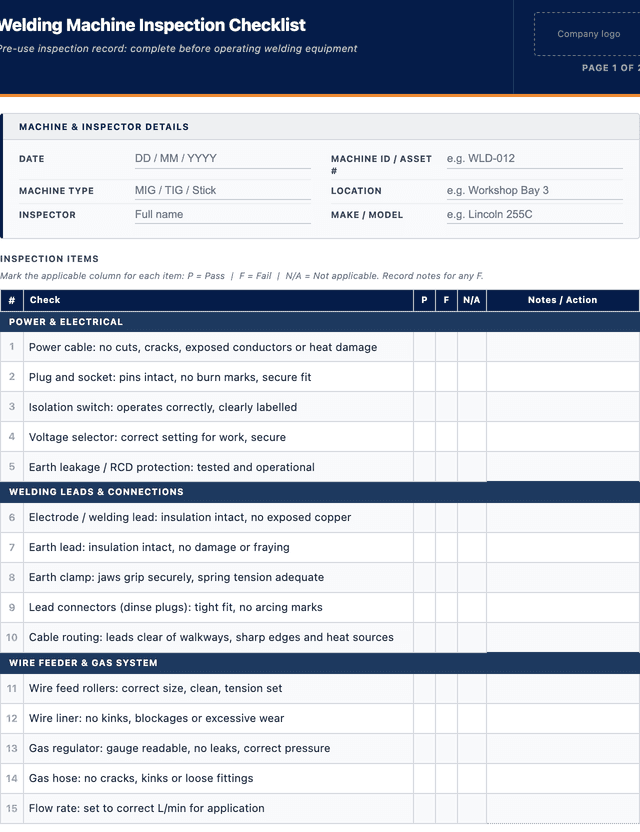
This welding machine inspection checklist covers 8 key areas:
- Machine details: date, machine ID, type (MIG/TIG/stick), location, inspector name.
- Power and electrical (P/F/N/A): power cable condition, plug and socket, isolation switch, voltage selector, earth leakage protection.
- Welding leads and connections: electrode lead condition, earth lead condition, earth clamp grip, lead connectors, cable routing.
- Wire feeder and gas system: wire feed rollers, liner condition, gas regulator, gas hose, flow rate setting.
- Torch/electrode holder: trigger or clamp operation, tip/nozzle condition, insulation, gas diffuser.
- Safety features: duty cycle indicator, thermal overload protection, ventilation fan, warning labels, test tag current.
- Work area: ventilation adequate, fire extinguisher within reach, PPE available, combustibles cleared.
- Declaration and signatures: inspector sign-off and supervisor acknowledgement.
How to use this welding machine inspection checklist
- Complete the machine details - date, machine ID, type (MIG/TIG/stick), location and inspector name.: Record the inspection date, the unique machine ID or asset number, the welding process type (MIG, TIG, stick/MMA or multi-process), the site or workshop location, and the name of the person performing the inspection. If the machine has a current test and tag label, note the tag number and next test due date. This information links the inspection record to the correct asset in your maintenance register.
- Inspect power and electrical items. Check the power cable, plug, isolation switch and earth leakage protection. Mark Pass, Fail or N/A for each item.: Run the full length of the power cable through your hands, checking for cuts, abrasion, heat damage, kinks and exposed conductors. Inspect the plug for cracked casing, bent or corroded pins and a secure cable grip. Confirm the isolation switch on the machine operates positively (on/off with clear engagement). Verify the earth leakage device (RCD) is fitted, test it using the test button, and confirm it trips and resets correctly. On construction sites, the machine must be connected through an RCD-protected supply per AS/NZS 3012.
- Check welding leads and connections. Inspect electrode lead, earth lead, earth clamp and connectors.: Inspect both the electrode (work) lead and the earth (return) lead for damage to the insulation, exposed copper, heat-damaged sections, and secure crimped or bolted connections at both ends. Check the earth clamp jaws for spring tension, clean contact surfaces and firm grip; a poor earth clamp connection causes arcing, heat build-up and potential fire. Verify that lead connectors (Dinse or cam-lock) are fully seated, undamaged and locked. Ensure leads are long enough for the task without needing joins or extensions unless rated for the current.
- Verify wire feeder and gas system (MIG/TIG). Check feed rollers, liner, gas regulator, hose and flow rate.: For MIG machines, inspect the feed rollers for wear and correct tension, check the liner for kinks or blockages (replace if bird-nesting occurs regularly), and confirm the wire spool is correctly loaded and tensioned. Check the gas regulator for damage, confirm the gauge reads correctly, and test for leaks at all fittings using soapy water or a gas leak detector. Inspect the gas hose for cracks, perishing and secure connections. Set the flow rate to the recommended level for the wire diameter and shielding gas type, typically 12 to 18 litres per minute for standard MIG welding.
- Inspect the torch or electrode holder. Check trigger/clamp operation, tip condition and insulation.: For MIG torches, check the trigger for smooth operation and positive on/off action, inspect the contact tip for wear and spatter build-up (replace if the hole is elongated), confirm the nozzle is free of spatter, and check the gas diffuser for blockages. For stick electrode holders, check the jaw mechanism for positive grip and clean contact surfaces, and inspect the insulation for cracks or heat damage. For TIG torches, inspect the collet, collet body, gas lens and ceramic cup for damage or carbon build-up.
- Confirm safety features are operational and the work area is safe - ventilation, fire extinguisher, PPE, combustibles cleared.: Verify the duty cycle indicator is visible and the thermal overload protection is functional (the machine should shut down automatically if it overheats). Check the cooling fan operates when the machine is running. Confirm ventilation is adequate: local exhaust ventilation for workshop welding, or natural ventilation with fume extraction for confined or semi-enclosed areas. Ensure a dry chemical or CO2 fire extinguisher is within 10 metres. Confirm welding PPE is available: auto-darkening helmet (tested), welding gloves, leather apron or jacket, safety boots and hearing protection. Remove or shield all combustible materials within the hot work zone.
- Sign the declaration. If any item fails, report to supervisor and do not use the machine until the fault is rectified.: Sign and date the declaration section. If all items pass, the machine is cleared for use. If any item fails, immediately tag the machine as out of service and notify your supervisor and the maintenance team. Do not attempt to use a welding machine with electrical faults, damaged leads or a faulty earth clamp; the risk of electric shock, arc flash or fire is significant. Record the defect in the maintenance register and track the repair to completion before the machine is re-inspected and returned to service.
In MapTrack, you can digitise safety inspections and compliance forms. Each submission is stored as a timestamped PDF against the asset record.
Get the free templateEnter your email above to download the full welding machine inspection checklist as a PDF.Back to download formHow often should you complete this checklist?
Welding machines should be visually inspected before each use using this checklist. A more detailed inspection including electrical testing should be conducted at regular intervals - typically monthly or quarterly depending on usage intensity and site requirements. Portable welding machines on construction sites must comply with AS/NZS 3012 testing and tagging requirements. If a fault is identified at any time, the machine must be taken out of service immediately, tagged as defective, and not used until repaired by a competent person.
AS 1674 (Safety in welding, brazing, cutting and allied processes) and AS/NZS 3760 (In-service safety inspection and testing of electrical equipment) both require periodic inspection and testing of welding equipment. Organisations managing multiple welding units should maintain a register tracking each machine's inspection dates, service history and next due dates.
Frequently asked questions
Applicable regulatory standards
This template is a starting point. Check the current requirements that apply to your equipment, work and location. The template alone does not establish compliance.
- AS/NZS 1554 - Structural steel welding
- AS/NZS 3760 - In-service safety inspection and testing of electrical equipment
- AS/NZS 3012 - Electrical installations on construction and demolition sites
- WHS Regulations 2011 - Part 5.1 (managing risks from plant, regulation 203)
Welding machine inspection checklist preview
The numbers behind this welding machine inspection checklist
Every figure below is sourced and dated, so you can quote it in a toolbox talk, a budget case or a board paper without having to chase the original report.
Embed this free template on your website
Run an industry blog, trade association site, or training resource? Drop a preview of this free welding machine inspection checklist straight into your page. The snippet is self-contained, needs no scripts, and links readers back to the full free template.
<div style="max-width:480px;font-family:system-ui,-apple-system,'Segoe UI',Roboto,sans-serif;border:1px solid #E5E7EB;border-radius:12px;padding:20px;background:#ffffff;">
  <p style="font-size:12px;font-weight:700;letter-spacing:0.05em;text-transform:uppercase;color:#071D49;margin:0;">Free template</p>
  <p style="font-size:18px;font-weight:700;color:#071D49;margin:6px 0 0;">Welding machine inspection checklist</p>
  <ul style="margin:12px 0 0;padding-left:18px;color:#374151;font-size:14px;line-height:1.6;">
    <li style="margin:4px 0;">Machine details: date, machine ID, type (MIG/TIG/stick), location, inspector name.</li>
    <li style="margin:4px 0;">Power and electrical (P/F/N/A): power cable condition, plug and socket, isolation switch, voltage selector, earth leakage protection.</li>
    <li style="margin:4px 0;">Welding leads and connections: electrode lead condition, earth lead condition, earth clamp grip, lead connectors, cable routing.</li>
    <li style="margin:4px 0;">Wire feeder and gas system: wire feed rollers, liner condition, gas regulator, gas hose, flow rate setting.</li>
    <li style="margin:4px 0;">Torch/electrode holder: trigger or clamp operation, tip/nozzle condition, insulation, gas diffuser.</li>
    <li style="margin:4px 0;">Safety features: duty cycle indicator, thermal overload protection, ventilation fan, warning labels, test tag current.</li>
  </ul>
  <p style="font-size:13px;color:#6B7280;margin:14px 0 0;padding-top:12px;border-top:1px solid #E5E7EB;">Free <a href="https://www.maptrack.com/templates/welding-machine-inspection-checklist" style="color:#071D49;font-weight:600;text-decoration:none;">Welding machine inspection checklist</a> by MapTrack</p>
</div>Free to reuse, including commercially. This template is published under a Creative Commons Attribution 4.0 licence. Copy it, adapt it, put it on your own site or in your own docs. All we ask is that you credit MapTrack with a link back to this page. The snippet above already includes that credit, so if you use it as-is you’re covered.
Cite this template
Writing about this topic? You’re welcome to quote this checklist. Here’s the wording to use so your readers can find the original.
The MapTrack welding machine inspection checklist contains 28 checks across 6 sections.
- Short attribution
- MapTrack Welding machine inspection checklist, https://www.maptrack.com/templates/welding-machine-inspection-checklist
- Reference list
- MapTrack. (2026). Welding machine inspection checklist [Checklist template]. Retrieved from https://www.maptrack.com/templates/welding-machine-inspection-checklist
Free to reuse with credit under a Creative Commons Attribution 4.0 licence. If you’d rather link straight to it, the page is https://www.maptrack.com/templates/welding-machine-inspection-checklist.
Need to digitise safety inspections and compliance forms?
Register every welder in MapTrack, attach digital forms, and get a complete history of every inspection, service and compliance record.
Compliance and inspections · All templates · Pricing · Book a demo