
Free warehouse receiving inspection checklist
Free warehouse receiving inspection checklist (PDF-ready). Covers delivery verification, condition assessment, quantity check and storage. Download free.
Updated 28 Sept 2026
Warehouse Receiving Inspection Checklist
Goods receiving record: complete for every delivery
Checklist
Receiver Sign-off
Signature
Print name
Date
Warehouse Supervisor Sign-off
Signature
Print name
Date
How to use: download the PDF, print or complete digitally on any device.
- PDF format, ready to print or fill on screen
- Use as-is or customise to suit your operation
- Go digital in MapTrack for photos, reminders and audit trails
Two ways to use it
Use in MapTrack →Use it digitally instead
Unlimited usersThese same 11 checks, already built.




- Scan the asset’s QR tag with any phone
- Submitted forms can trigger alerts
- Photos on fails, audit-ready records
- Export responses, PDF reports with your logo
Free trial. No credit card needed.
Trusted by teams across Australia and New Zealand
We respect your privacy. Unsubscribe anytime.
These templates are free general guides provided as-is. They do not constitute legal, safety or compliance advice. You are responsible for ensuring any form meets your specific workplace obligations, industry standards and applicable regulations.
Don't just download it - use it live. Start a free workspace with this warehouse receiving inspection checklist already built, so your crew can run it from a phone.

Co-Founder & Commercial Director
Key takeaways
- The MapTrack warehouse receiving inspection checklist contains 11 checks.
- Checks each delivery against the order for quantity, condition and documentation before goods are accepted, so a shortfall is the supplier problem it started as.
- Damage found after acceptance is harder to resolve with the supplier. Inspect at the dock before signing, while the condition can still be agreed.
- Record non-conformances with photos and quarantine the stock, so a rejected item cannot drift into picking.
- Built to sit with ISO 9001 incoming-goods control: released product is verified product, and the record shows who verified it.
Enter your email below to download this warehouse receiving inspection checklist as a ready-to-use PDF.
Used by construction, mining and field service teams











What is a warehouse receiving inspection checklist?
A warehouse receiving inspection checklist is a quality control document completed when goods arrive at a warehouse, store or site. It involves verifying the delivery against the purchase order (PO), checking the condition and quantity of items received, recording serial or batch numbers, and allocating items to storage locations. The purpose is to identify discrepancies, damage or non-conformances before goods are accepted into inventory, ensuring only verified items enter your stock system.
A documented receiving inspection protects the organisation from paying for incorrect, damaged or short-shipped goods, ensures traceability from receipt to storage, and supports compliance with quality management systems such as ISO 9001. In warehouse environments, the checklist also enforces safety checks for hazardous goods labelling, temperature compliance and correct storage allocation under AS 4084 (steel storage racking) and the WHS Regulations. In ISO 9001, purchased products and services fall under clause 8.4, Control of externally provided processes, products and services. The WHS Regulations 2011, Part 7.1, govern the correct labelling, handling and storage of hazardous chemicals received into a workplace. Skipping or rushing the receiving inspection process leads to compounding inventory inaccuracies, undetected damage claims expiring beyond supplier dispute windows, and potential WHS breaches when hazardous goods are stored without proper identification. For high-volume warehouses processing dozens of deliveries daily, a standardised checklist is essential to maintain accuracy and accountability across receiving staff and shift changes.
Learn more about asset tracking in MapTrack.
Benefits of using this warehouse receiving inspection checklist
- Quality assurance: catch damage, defects and non-conformances before goods enter your inventory.
- PO accuracy: verify quantities and items match the purchase order, so you do not pay for goods you did not receive.
- Traceability: record serial numbers, batch numbers and storage locations for full chain of custody.
- Supplier accountability: documented inspections support claims for damaged, short-shipped or incorrect goods.
- Compliance: meet quality management system requirements (ISO 9001) and regulatory standards for receiving controlled goods.
- Inventory accuracy: only accept goods that pass inspection, reducing discrepancies between physical stock and system records.
Benefits of digitising forms in MapTrack
When you digitise warehouse checklists in MapTrack, you get:
- Field users can easily scan a QR code to complete a form on mobile. Unlimited users.
- Email the right people when a form is submitted, with an automation you set up.
- File every completed form against the asset, location or person it covers.
- Download any completed form as a PDF, with failed answers listed at the top.
- Fill in forms offline; they upload when the device is back online.
- Build conditional logic (show or hide questions based on answers).
- Take pictures or attach photos. Not possible with a paper-based form.
- Electronic signatures.
- Edit forms later without reprinting.
- Set who can view, fill in or edit forms with user roles.
- Upload a paper form (PDF, Word, Excel or a photo) and MapTrack's AI builds a digital version for you to check.
- Keep one asset register with each asset's location, condition and custody history.
- Schedule calibration and record certification and warranty expiry dates against each asset.
- See each asset's value over time in the Asset Depreciation report.
Book a demo to see how MapTrack handles warehouse checklists.
Try MapTrack free for 30 days
Full access to every feature. No credit card required. Per-asset pricing so you scale as your fleet grows.
- No credit card required
- 30 days free trial
- Cancel anytime
1-2 days/week saved
“Bloody amazing! We used to spend 1-2 days a week tracking and managing our generators alone.”

Steve McAllister
Asset Coordinator, Saunders International
What to include in a warehouse receiving inspection checklist
This warehouse receiving inspection checklist covers 7 key areas:
- Delivery details: date, received by, warehouse/location, supplier, carrier, PO number, delivery note number.
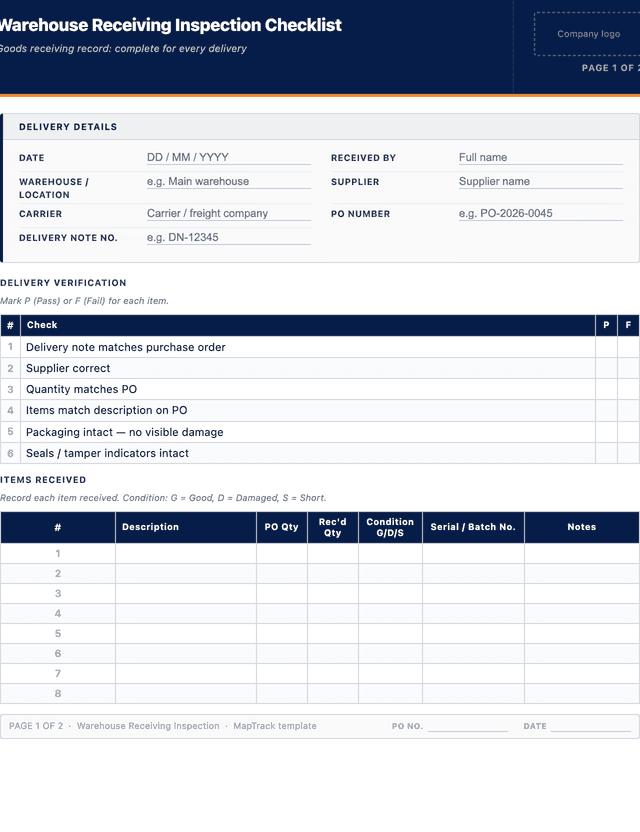
- Delivery verification: 6 pass/fail checks covering the delivery note against the PO, supplier, quantity, item description, packaging and seals.
- Items received: 12-row table with description, PO qty, received qty, condition, serial/batch number, notes.
- Condition assessment: 5 pass/fail checks covering damage, temperature, hazardous goods labels, expiry dates and certificates of conformance.
- Storage allocation: item, allocated location, stored by.
- Non-conformance: description, action (reject/accept with conditions/return/quarantine), NCR reference.
- Declaration and signatures: receiver and warehouse supervisor sign-off.
How to use this warehouse receiving inspection checklist
- Complete the delivery details: date, warehouse, supplier, carrier, PO number and delivery note number.: Record the delivery date, the receiving warehouse or location, the supplier name, carrier or freight company, PO number and delivery note reference. This information links the inspection to the purchasing and accounts payable records.
- Work through the delivery verification section. Mark pass or fail for each item. Do not accept the delivery if critical items fail.: Check that the delivery note matches the PO, the supplier is correct, quantities match, items match descriptions, packaging is intact and seals are in place. If any critical check fails (wrong supplier, significant quantity shortfall), hold the delivery and notify procurement before proceeding.
- Record each item received: description, PO quantity, received quantity, condition and serial/batch number.: Enter each line item from the delivery into the items received table. Compare PO quantity against received quantity, note the condition (acceptable, damaged, rejected) and record serial or batch numbers for traceability. This row-by-row record supports claims for short shipments.
- Complete the condition assessment: check for damage, temperature compliance, labelling, expiry dates and certificates.: Inspect the goods for visible damage, dents, leaks or contamination. For temperature-sensitive items, verify the temperature is within acceptable range. Check that hazardous goods labels are correct under WHS Regulations, expiry dates are acceptable and any required certificates of conformance are included.
- Allocate each accepted item to a storage location and record who stored it.: Assign each accepted item to a specific storage location (aisle, bay, shelf, bin) following your warehouse layout and AS 4084 load limits for racking. Record the name of the person who physically stored the item so any misplacement can be traced.
- If any items are non-conforming, document the issue, select the action (reject, accept with conditions, return or quarantine) and raise an NCR if required.: For each non-conforming item, describe the issue clearly, select the appropriate action (reject and return, accept with conditions, quarantine for further inspection) and record the NCR reference if your quality system requires one. Notify the supplier and procurement team promptly so claims can be lodged within contractual timeframes.
- The receiver and warehouse supervisor sign to confirm the inspection is complete.: The person who conducted the inspection signs and dates the form. The warehouse supervisor countersigns to confirm the inspection was completed to standard and that accepted goods have been stored correctly. File the completed checklist with the delivery documentation.
In MapTrack, you can manage your full asset register digitally. Each submission is stored as a timestamped PDF against the asset record.
Get the free templateEnter your email above to download the full warehouse receiving inspection checklist as a PDF.Back to download formHow often should you complete this checklist?
A receiving inspection should be completed for every delivery before goods are accepted into inventory. This applies to all inbound shipments, whether from suppliers, inter-site transfers or returns. For time-sensitive or temperature-controlled goods, the inspection must be completed immediately on arrival. The completed checklist should be filed with the delivery documentation and retained as part of your quality records. Any non-conformances should be reported immediately so that supplier claims can be lodged within the required timeframe.
Frequently asked questions
Applicable regulatory standards
This template is a starting point. Check the current requirements that apply to your equipment, work and location. The template alone does not establish compliance.
- AS 4084.2:2023 - Steel storage racking, Part 2: Operation and maintenance
- WHS Regulations 2011, Part 7.1 - Hazardous chemicals
- ISO 9001, clause 8.4 - Control of externally provided processes, products and services
Warehouse receiving inspection checklist preview
The numbers behind this warehouse receiving inspection checklist
Every figure below is sourced and dated, so you can quote it in a toolbox talk, a budget case or a board paper without having to chase the original report.
Embed this free template on your website
Run an industry blog, trade association site, or training resource? Drop a preview of this free warehouse receiving inspection checklist straight into your page. The snippet is self-contained, needs no scripts, and links readers back to the full free template.
<div style="max-width:480px;font-family:system-ui,-apple-system,'Segoe UI',Roboto,sans-serif;border:1px solid #E5E7EB;border-radius:12px;padding:20px;background:#ffffff;">
  <p style="font-size:12px;font-weight:700;letter-spacing:0.05em;text-transform:uppercase;color:#071D49;margin:0;">Free template</p>
  <p style="font-size:18px;font-weight:700;color:#071D49;margin:6px 0 0;">Warehouse receiving inspection checklist</p>
  <ul style="margin:12px 0 0;padding-left:18px;color:#374151;font-size:14px;line-height:1.6;">
    <li style="margin:4px 0;">Delivery details: date, received by, warehouse/location, supplier, carrier, PO number, delivery note number.</li>
    <li style="margin:4px 0;">Delivery verification: 6 pass/fail checks covering the delivery note against the PO, supplier, quantity, item description, packaging and seals.</li>
    <li style="margin:4px 0;">Items received: 12-row table with description, PO qty, received qty, condition, serial/batch number, notes.</li>
    <li style="margin:4px 0;">Condition assessment: 5 pass/fail checks covering damage, temperature, hazardous goods labels, expiry dates and certificates of conformance.</li>
    <li style="margin:4px 0;">Storage allocation: item, allocated location, stored by.</li>
    <li style="margin:4px 0;">Non-conformance: description, action (reject/accept with conditions/return/quarantine), NCR reference.</li>
  </ul>
  <p style="font-size:13px;color:#6B7280;margin:14px 0 0;padding-top:12px;border-top:1px solid #E5E7EB;">Free <a href="https://www.maptrack.com/templates/warehouse-receiving-inspection-checklist" style="color:#071D49;font-weight:600;text-decoration:none;">Warehouse receiving inspection checklist</a> by MapTrack</p>
</div>Free to reuse, including commercially. This template is published under a Creative Commons Attribution 4.0 licence. Copy it, adapt it, put it on your own site or in your own docs. All we ask is that you credit MapTrack with a link back to this page. The snippet above already includes that credit, so if you use it as-is you’re covered.
Cite this template
Writing about this topic? You’re welcome to quote this checklist. Here’s the wording to use so your readers can find the original.
The MapTrack warehouse receiving inspection checklist contains 11 checks.
- Short attribution
- MapTrack Warehouse receiving inspection checklist, https://www.maptrack.com/templates/warehouse-receiving-inspection-checklist
- Reference list
- MapTrack. (2026). Warehouse receiving inspection checklist [Checklist template]. Retrieved from https://www.maptrack.com/templates/warehouse-receiving-inspection-checklist
Free to reuse with credit under a Creative Commons Attribution 4.0 licence. If you’d rather link straight to it, the page is https://www.maptrack.com/templates/warehouse-receiving-inspection-checklist.
Need to manage your full asset register digitally?
Register every warehouse in MapTrack, attach digital forms, and get a complete history of every inspection, service and compliance record.