
Free template · PDF
Free plant inspection checklist
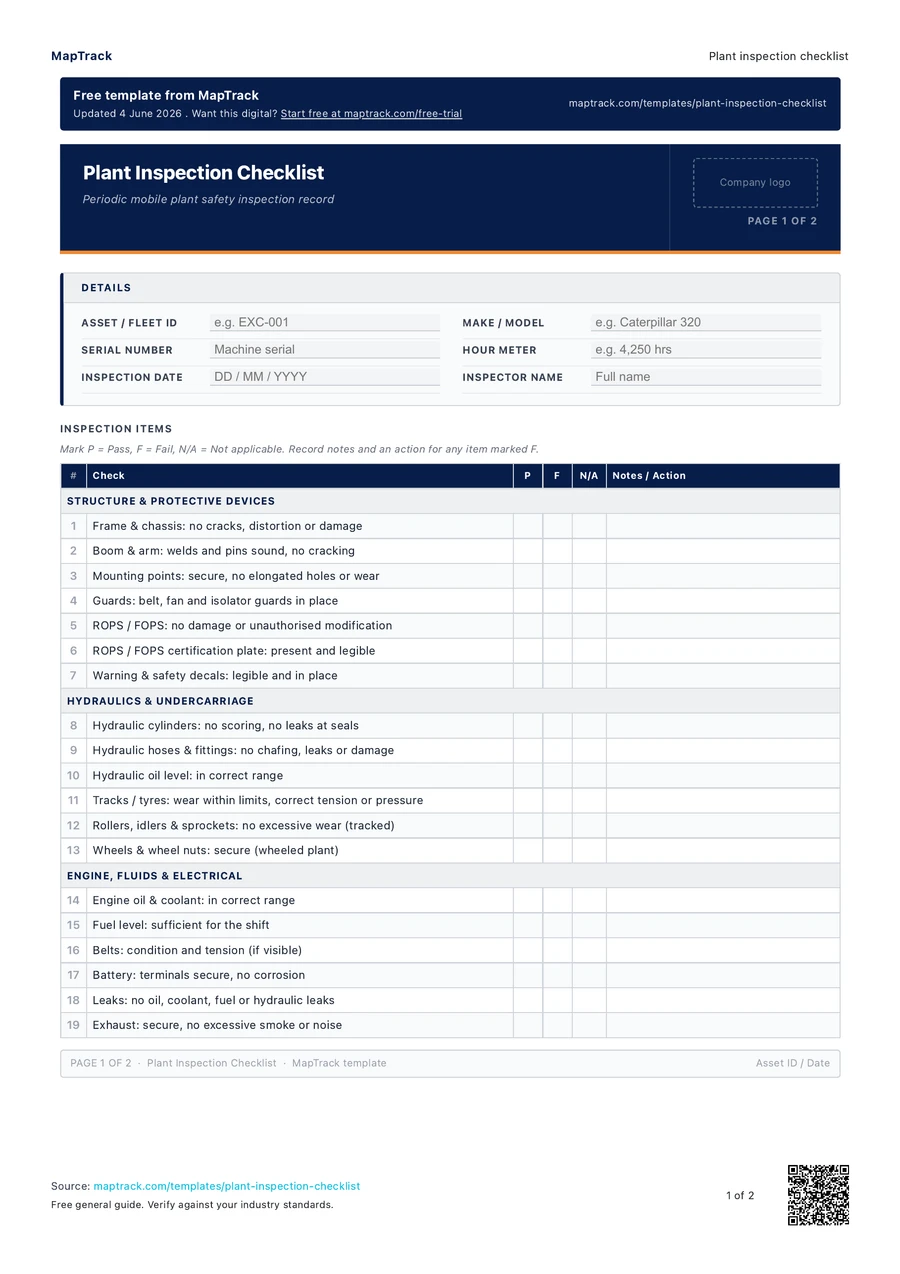
Free plant inspection checklist (PDF). Periodic mobile plant check: structure, guards, hydraulics, ROPS/FOPS and attachments. AU WHS. Download free.
Loading PDF page...

Read the form fields
30 checks · 5 sections · Sign-off
30 checks
The fields in the printable form, in a view that fits your screen.
- Asset / fleet ID
- Make / model
- Serial number
- Hour meter
- Inspection date
- Inspector name
Structure & Protective Devices
Hydraulics & Undercarriage
Engine, Fluids & Electrical
Attachments, Cabin & Controls
Compliance & Documentation
Declaration
I declare that I have carried out this periodic plant inspection and recorded the results accurately. I have reported any defects to my supervisor, and the machine will not return to service with any defect affecting safe operation, including structural, guard or ROPS/FOPS faults, until it has been rectified and signed off. This inspection does not replace the daily pre-start check.
Operator / Inspector
Signature · Print name · Date
Supervisor / Reviewer
Signature · Print name · Date
The MapTrack plant inspection checklist contains 30 checks across 5 sections.

Co-Founder & Commercial Director
Make this form your own
Add your fields and logo. Give your team a form they can use on site.
Free trial. No credit card. Work email needed.
Upload & use this form now for free



“MapTrack beat them all in every aspect.”
 Vincent Stone · HSEQ Advisor, Concept Tanks
After signup: upload this PDF, check the form MapTrack drafts, then save and publish it for your team.
General guidance only. Check the form against your equipment manual, site procedures and local requirements before using it.
Short answer
A plant inspection checklist records a periodic, deeper inspection of mobile plant such as excavators, loaders, dozers, rollers and telehandlers: structure, guards, hydraulics, ROPS and FOPS, undercarriage, engine, attachments, couplers and cab, each marked pass, fail or not applicable. Supervisors and workshops commonly run it monthly or at the service interval. Regulation 213 of the model WHS Regulations requires competent-person inspection following the manufacturer's recommendations.
Checked against Model WHS Regulations as at 5 December 2025 (cited within as the Work Health and Safety Regulations 2011) on by the MapTrack templates team. How we check templates
Key takeaways
- The MapTrack plant inspection checklist contains 30 checks across 5 sections. Sections covered: Structure & Protective Devices, Hydraulics & Undercarriage, Engine, Fluids & Electrical, Attachments, Cabin & Controls, Compliance & Documentation.
- A plant inspection checklist is a periodic safety inspection of mobile plant, going deeper than the daily pre-start across structure, guards, hydraulics, ROPS/FOPS and attachments.
- It supports the WHS Regulations 2011, Chapter 5 duties to inspect and maintain plant, and the record duties for registered plant.
- ROPS and FOPS protective structures must be checked for damage, modification and certification, never repaired or modified without engineering sign-off.
- Registrable plant should also have its plant and design registration and statutory inspection status confirmed during the inspection.
What is a plant inspection checklist?
A plant inspection checklist is a structured form for a thorough periodic safety inspection of mobile plant such as excavators, loaders, dozers, rollers and telehandlers. It covers the structure and chassis, guards and protective devices, the hydraulic system, the ROPS and FOPS operator-protective structures, tracks or tyres and undercarriage, engine and fluids, attachments and quick couplers, operator cabin and controls, and compliance items, recording a pass, fail or not-applicable result for each with notes on any defect. It is the deeper periodic check, not the quick daily pre-start.
Site supervisors, plant operators, workshops and HSE teams across construction, civil, mining and quarrying use this checklist to confirm a machine is in a safe and serviceable condition beyond the daily walk-around. It catches structural cracking, hydraulic wear, guard damage and coupler faults that a 5-minute pre-start will not find, and it documents that the plant was inspected and made safe. In MapTrack, the inspection runs as a mobile form against each machine, with meter readings, photos and defect work orders captured against the asset. Under the WHS Regulations 2011, Chapter 5, a person conducting a business must have plant inspected and maintained by a competent person, and registrable plant carries additional registration, record and statutory inspection duties.
Learn more about pre-start inspections in MapTrack.
Choose the format that fits your team
Download the PDF
Use the original printable form for a paper workflow. Check it against your equipment and site procedure before the job.
Keep completed copies in your own record system and arrange any follow-up through your normal process.
Download free PDFCustomise a form in MapTrack
Start a free trial, upload this PDF and MapTrack drafts the form. Adjust it to your workflow, then save and publish it for your team to use.
Sample answers on this page and completed PDF records aren't imported automatically.
Upload & use this form now for freeFree trial. No credit card. Work email needed.
Benefits of using this plant inspection checklist
- Mobile-plant coverage: one form checks structure, guards, hydraulics, ROPS/FOPS, undercarriage, attachments and compliance on earthmoving machines.
- Structural focus: a periodic check looks for cracking, wear and damage in the chassis and booms that a daily pre-start does not cover.
- ROPS and FOPS verified: operator-protective structures are inspected for damage, modification and certification, the items that protect a life in a rollover.
- Attachment safety: quick couplers, pins and locks are checked so an attachment cannot release during operation.
- Deeper than pre-start: developing hydraulic, structural and guard faults are surfaced before they cause a failure or an incident.
- WHS evidence: a signed periodic inspection is the documented proof of inspection and maintenance that Chapter 5 expects.
- Defect to work order: any failed item is logged with an action and rectified-by date so a machine is not run with a known fault.
What to include in a plant inspection checklist
- Machine details: asset or fleet ID, make and model, serial number, hour meter and inspection date.
- Structure and chassis: frame, boom, arm, welds and mounting points for cracks or damage.
- Guards and protective devices: belt guards, isolators, interlocks and warning labels.
- ROPS and FOPS: condition, damage, unauthorised modification and certification plate.
- Hydraulic system: cylinders, hoses, fittings, oil level and any leaks.
- Undercarriage: tracks, rollers, idlers, sprockets or tyres and wheel condition.
- Engine and fluids: oil, coolant, fuel, belts, battery and visible leaks.
- Attachments and couplers: quick coupler, pins, locks and attachment condition.
- Cabin and controls: seat, seatbelt, controls, gauges, horn, lights and reversing alarm.
- Compliance: plant and design registration, statutory inspection, operator competency.
- Overall result, defects table, and operator plus supervisor sign-off.
How to use this plant inspection checklist
Park the plant safely, isolate it and record the machine details.
Lower attachments to the ground, apply the park brake, shut down and isolate the machine, and follow lockout where required. Record the asset ID, make, model, serial number, hour meter and inspection date before you start so the record ties to the right machine.
Inspect the structure, chassis and protective structures.
Walk the machine checking the frame, boom, arm, welds and mounting points for cracks, distortion or damage, and inspect the ROPS and FOPS for damage, unauthorised modification and a valid certification plate. Protective structures must never be repaired or modified without engineering sign-off.
Check guards, hydraulics and for leaks.
Confirm all guards, isolators and interlocks are in place and undamaged, then inspect hydraulic cylinders, hoses and fittings for wear, chafing and leaks and check the hydraulic oil level. Treat any significant hydraulic leak or missing guard as a fail requiring rectification before use.
Inspect the undercarriage, engine and fluids.
Check tracks, rollers, idlers and sprockets, or tyres and wheels, for wear and damage, then with the engine cool check oil, coolant and fuel levels, belts and the battery, and look for leaks. Record the hour meter reading to support service-due tracking against the machine.
Check attachments, cabin, controls and compliance.
Inspect the quick coupler, pins, locks and any attachment so nothing can release in operation, confirm the seat, seatbelt, controls, gauges, horn, lights and reversing alarm work, and verify plant and design registration, statutory inspection status and operator competency where they apply.
Record the result, raise defects and sign off.
Mark the overall result, list any failed item in the defects table with an action and a rectified-by date, and complete the operator and supervisor sign-off. Take the machine out of service for any defect affecting safe operation, especially structural, guard or ROPS/FOPS faults, until it is rectified.
Try MapTrack free
Full access to every feature. No credit card required. Per-asset pricing so you scale as your fleet grows.
- No credit card required
How often should you complete this checklist?
Run a full plant inspection on a set periodic cycle, commonly monthly or aligned to the service interval and hour meter, and always after a significant repair, an incident or a structural concern, while the daily plant pre-start is completed every shift before use. Registrable plant should also be presented for statutory inspection at the required interval. In MapTrack, you can schedule the periodic inspection against each machine by date or by hour meter, so the deeper structural and compliance check runs reliably alongside the daily pre-start.
Make this form your own
From your template to your team.
Upload this PDF and MapTrack drafts the form. Adjust it for your equipment and site, then save and publish the digital form for your team.
- 01
Start your free trial
Use your work email to create your MapTrack account.
- 02
Customise, save and publish
Adjust the template fields and branding for your site.
- 03
Complete it on the job
Record checks, add photos and export a branded PDF.
Keep working offline
Load the form before you lose reception. Complete it offline and sync when you're back online.
Scan the asset. Open its form.
Use an asset's QR code to find and complete the forms that belong to it.
Show what you found
Capture photos and attach files so the next person has the details they need.
Take a branded PDF with you
Download completed forms as PDF reports with your company logo.
Completed paper records aren't imported automatically.
Frequently asked questions
Practical answers about the form, record keeping and using MapTrack.
A plant inspection checklist is a structured form for a periodic safety inspection of mobile plant such as excavators, loaders, dozers and rollers. It covers the structure and chassis, guards, hydraulics, the ROPS and FOPS protective structures, undercarriage, engine and fluids, attachments and couplers, the cabin, and compliance items, recording a pass, fail or not-applicable result for each. It produces a documented record that the machine was inspected in detail and that any defect was raised and rectified before the plant returned to work.
Link to this answerA daily pre-start is a quick walk-around the operator completes every shift to confirm a machine is safe to use that day. This plant inspection checklist is the deeper periodic check, run monthly or against the hour meter, that examines the structure, hydraulics, guards, ROPS/FOPS and attachments in detail. The pre-start is the daily safety gate; this checklist is the thorough periodic record that sits above it and surfaces structural and hydraulic faults a walk-around misses. Use both, not one in place of the other.
Link to this answerUnder the WHS Regulations 2011, Chapter 5, a person conducting a business must inspect and maintain plant so it stays without risk to health and safety, and records of that maintenance and inspection are required for registered plant and good practice for other plant. Some plant is registrable and requires plant and design registration plus statutory inspection before use. A documented periodic inspection, with defects recorded and rectified, is the practical way to meet those duties. Protective structures such as ROPS and FOPS are covered by AS 2294 and must not be modified without engineering approval.
Link to this answerRun a full inspection on a set cycle, commonly monthly or aligned to the service interval and hour meter, and always after a significant repair, an incident or any structural concern. This periodic inspection is in addition to the daily pre-start completed every shift. Registrable plant must also meet its statutory inspection interval. Scheduling the inspection by date or hour meter in a system like MapTrack keeps the deeper structural and compliance check on track while the daily pre-start continues before each shift.
Link to this answerYes. Download and use this plant inspection checklist for free: it downloads as a PDF you can print to complete by hand. No account is required. If you would rather run plant inspections on a phone, with hour meter capture, photos, defect work orders and a full inspection history against each machine, MapTrack can do that. Book a demo to see how it suits your site.
Link to this answerApplicable regulatory standards
This form is a starting point. Check the current requirements that apply to your equipment, work and location. The form alone does not establish compliance.
| Standard | Edition | Clauses this template relies on | Source |
|---|---|---|---|
| Model Work Health and Safety RegulationsCompetent-person inspection and maintenance per the manufacturer; record duties apply to registered plant, not to all plant. | Model WHS Regulations as at 5 December 2025 (cited within as the Work Health and Safety Regulations 2011) |
| Safe Work Australia (drafted by the Parliamentary Counsel's Committee) |
| Model Code of Practice: Managing risks of plant in the workplaceHow and when plant is inspected and maintained, and which plant carries record keeping duties. | November 2024 version (reviewed May 2018; amended 2021, 2023 and 2024) |
| Safe Work Australia |
| Model Work Health and Safety Act (Model Work Health and Safety Bill)Primary duty for safe plant, and the duty of whoever manages or controls plant at a workplace. | Model WHS Bill as at 5 December 2025 (includes the Model WHS Legislation Amendment (Incident Notification) 2025) |
| Safe Work Australia (drafted by the Parliamentary Counsel's Committee) |
| Earth-moving machinery - Protective structures, Part 1: GeneralEarth-moving machinery protective structures, general part; the ROPS and FOPS laboratory test parts are withdrawn. | AS 2294.1-1997 | Whole instrument | Standards AustraliaSold by the publisher |
| Occupational Health and Safety Regulations 2017 (Vic)Victoria: plant must be inspected as needed to monitor its risks. | Occupational Health and Safety Regulations 2017 (Vic), version 018 (in force from 20 October 2026) |
| Victorian Government (Victorian Legislation) |
Model Work Health and Safety Regulations
Edition: Model WHS Regulations as at 5 December 2025 (cited within as the Work Health and Safety Regulations 2011)
Competent-person inspection and maintenance per the manufacturer; record duties apply to registered plant, not to all plant.
- reg 213: Plant must be maintained, inspected and, if necessary, tested by a competent person, following manufacturer or competent person recommendations; annual inspection applies only if neither is practicable.
- reg 237: Records of tests, inspections, maintenance and alterations must be kept for plant required to be registered.
Safe Work Australia (drafted by the Parliamentary Counsel's Committee)
Model Code of Practice: Managing risks of plant in the workplace
Edition: November 2024 version (reviewed May 2018; amended 2021, 2023 and 2024)
How and when plant is inspected and maintained, and which plant carries record keeping duties.
- Section 3.5: Inspecting plant: how and when plant should be inspected by a competent person, reflecting reg 213.
- Section 3.6: Maintenance, repair and cleaning of plant, following manufacturer instructions and by competent people.
- Section 6: Record keeping for plant: the records required for registered plant and plant with presence-sensing safeguarding.
Model Work Health and Safety Act (Model Work Health and Safety Bill)
Edition: Model WHS Bill as at 5 December 2025 (includes the Model WHS Legislation Amendment (Incident Notification) 2025)
Primary duty for safe plant, and the duty of whoever manages or controls plant at a workplace.
- s 19: Primary duty of care: a PCBU must ensure, so far as is reasonably practicable, the health and safety of workers and others, including safe plant, systems, training and supervision.
- s 21: The person managing or controlling fixtures, fittings or plant at a workplace must ensure, so far as reasonably practicable, they are without risks to health and safety.
Safe Work Australia (drafted by the Parliamentary Counsel's Committee)
Earth-moving machinery - Protective structures, Part 1: General
Edition: AS 2294.1-1997
Earth-moving machinery protective structures, general part; the ROPS and FOPS laboratory test parts are withdrawn.
Standards AustraliaSold by the publisher
Occupational Health and Safety Regulations 2017 (Vic)
Edition: Occupational Health and Safety Regulations 2017 (Vic), version 018 (in force from 20 October 2026)
Victoria: plant must be inspected as needed to monitor its risks.
- reg 105: Requires plant to be inspected as needed to monitor risks, and steps to be taken to prevent unauthorised alteration of, or interference with, the plant.
Each source was read at its publisher and the page checked on 26 October 2026. The publisher's current text is the authority.
MapTrack publishes this template. The linked authorities publish their own guidance; they haven't endorsed this form.
The numbers behind this plant inspection checklist
The pages below gather the figures behind this kind of check. Each figure on them carries its source and date, so you can quote it in a toolbox talk, a budget case or a board paper without chasing the original report.
Get the free template
Enter your email above to download the full plant inspection checklist as a PDF.
Cite this template
Writing about this topic? You’re welcome to quote this checklist. Here’s the wording to use so your readers can find the original.
The MapTrack plant inspection checklist contains 30 checks across 5 sections.
- Short attribution
- MapTrack Plant inspection checklist, https://www.maptrack.com/templates/plant-inspection-checklist
- Reference list
- MapTrack. (2026). Plant inspection checklist [Checklist template]. Retrieved from https://www.maptrack.com/templates/plant-inspection-checklist
Free to reuse with credit under a Creative Commons Attribution 4.0 licence. If you’d rather link straight to it, the page is https://www.maptrack.com/templates/plant-inspection-checklist.
Embed this free template on your website
Run an industry blog, trade association site, or training resource? Drop a preview of this free plant inspection checklist straight into your page. The snippet is self-contained, needs no scripts, and links readers back to the full free template.
<div style="max-width:480px;font-family:system-ui,-apple-system,'Segoe UI',Roboto,sans-serif;border:1px solid #E5E7EB;border-radius:12px;padding:20px;background:#ffffff;">
  <p style="font-size:12px;font-weight:700;letter-spacing:0.05em;text-transform:uppercase;color:#071D49;margin:0;">Free template</p>
  <p style="font-size:18px;font-weight:700;color:#071D49;margin:6px 0 0;">Plant inspection checklist</p>
  <ul style="margin:12px 0 0;padding-left:18px;color:#374151;font-size:14px;line-height:1.6;">
    <li style="margin:4px 0;">Machine details: asset or fleet ID, make and model, serial number, hour meter and inspection date.</li>
    <li style="margin:4px 0;">Structure and chassis: frame, boom, arm, welds and mounting points for cracks or damage.</li>
    <li style="margin:4px 0;">Guards and protective devices: belt guards, isolators, interlocks and warning labels.</li>
    <li style="margin:4px 0;">ROPS and FOPS: condition, damage, unauthorised modification and certification plate.</li>
    <li style="margin:4px 0;">Hydraulic system: cylinders, hoses, fittings, oil level and any leaks.</li>
    <li style="margin:4px 0;">Undercarriage: tracks, rollers, idlers, sprockets or tyres and wheel condition.</li>
  </ul>
  <p style="font-size:13px;color:#6B7280;margin:14px 0 0;padding-top:12px;border-top:1px solid #E5E7EB;">Free <a href="https://www.maptrack.com/templates/plant-inspection-checklist" style="color:#071D49;font-weight:600;text-decoration:none;">Plant inspection checklist</a> by MapTrack</p>
</div>Free to reuse, including commercially. This template is published under a Creative Commons Attribution 4.0 licence. Copy it, adapt it, put it on your own site or in your own docs. All we ask is that you credit MapTrack with a link back to this page. The snippet above already includes that credit, so if you use it as-is you’re covered.
About the author

Co-Founder & Commercial Director
Jarrod has spent over a decade in technology consulting and asset management, including roles at Accenture (mining and heavy industry) and CGI as an Asset Management Consultant. He co-founded MapTrack and built and scaled its original platform, then rebuilt it with Lachlan and Alex from thousands of customer conversations and 300+ user research sessions with field teams. His consulting background gives him deep insight into the operational and compliance challenges facing asset-intensive Australian businesses.
View LinkedIn profile →Ready for your next job?
Keep the PDF handy, or upload it to MapTrack and turn it into a digital form for your team.