
Free template · PDF
Free equipment inspection checklist
Free equipment inspection checklist (PDF). Periodic plant inspection of guards, controls, hydraulics, engine, fluids and attachments.
Loading PDF page...
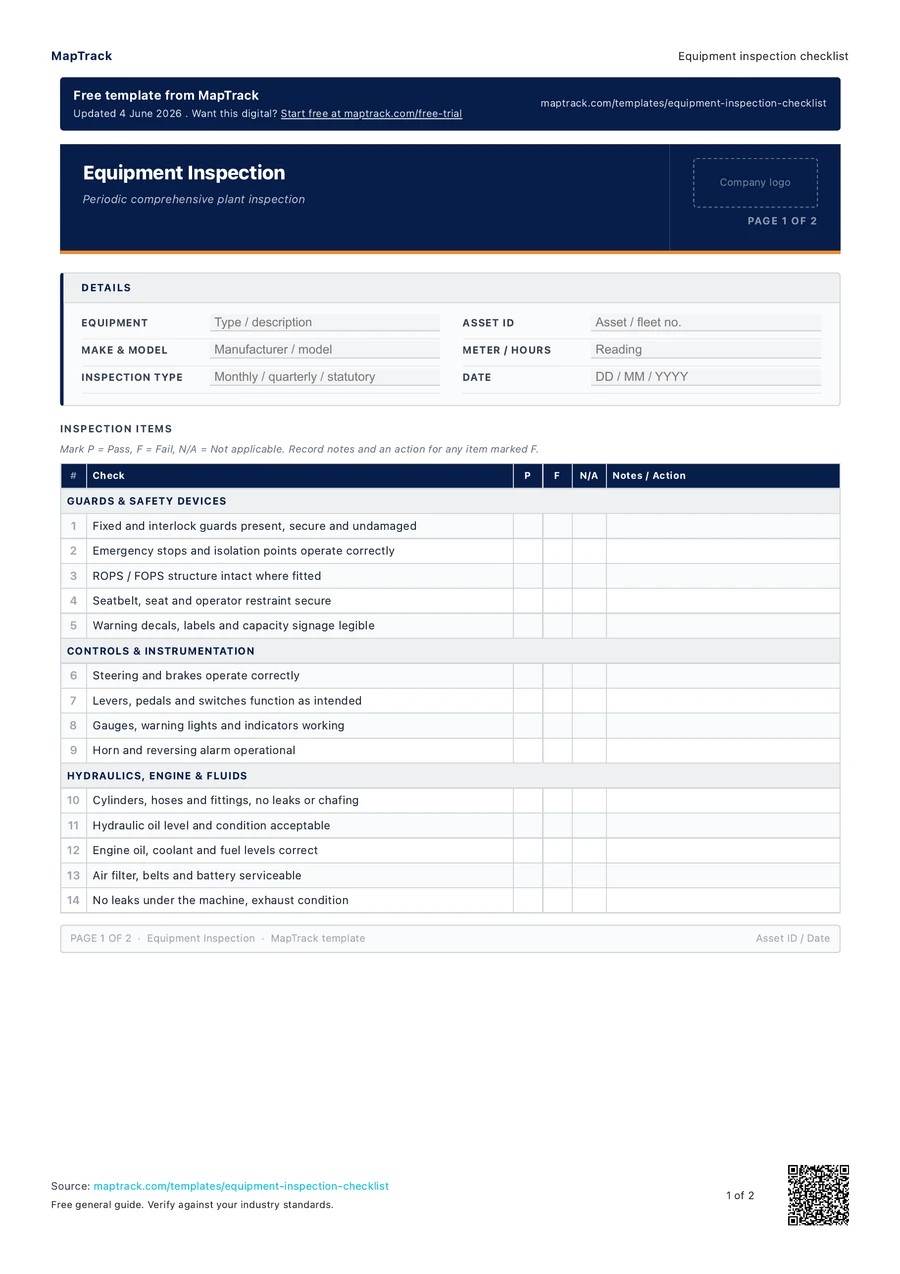

Read the form fields
23 checks · 5 sections · Sign-off
23 checks
The fields in the printable form, in a view that fits your screen.
- Equipment
- Asset ID
- Make & model
- Meter / hours
- Inspection type
- Date
Guards & safety devices
Controls & instrumentation
Hydraulics, engine & fluids
Attachments, tyres & structure
Compliance & documentation
Declaration
I confirm this periodic equipment inspection has been completed by a competent person, that defects have been recorded and that any unsafe plant has been withdrawn from service until rectified.
Inspector (competent person)
Signature · Print name · Date
Supervisor / Manager
Signature · Print name · Date
The MapTrack equipment inspection checklist contains 23 checks across 5 sections.

Co-Founder & Commercial Director
Make this form your own
Add your fields and logo. Give your team a form they can use on site.
Free trial. No credit card. Work email needed.
Upload & use this form now for free



“MapTrack beat them all in every aspect.”
 Vincent Stone · HSEQ Advisor, Concept Tanks
After signup: upload this PDF, check the form MapTrack drafts, then save and publish it for your team.
General guidance only. Check the form against your equipment manual, site procedures and local requirements before using it.
Short answer
An equipment inspection checklist records a periodic, competent-person inspection of plant: guards and safety devices, controls, hydraulics, engine and fluids, attachments, structure and documentation. Monthly or quarterly tiers are common practice. Regulation 213 of the model WHS Regulations requires inspection following the manufacturer's recommendations or, if there are none, a competent person's, with annual inspection only where neither is reasonably practicable.
Checked against Model WHS Regulations as at 5 December 2025 (cited within as the Work Health and Safety Regulations 2011) on by the MapTrack templates team. How we check templates
Key takeaways
- The MapTrack equipment inspection checklist contains 23 checks across 5 sections. Sections covered: Guards & safety devices, Controls & instrumentation, Hydraulics, engine & fluids, Attachments, tyres & structure, Compliance & documentation.
- An equipment inspection checklist is the periodic, comprehensive plant inspection: deeper and less frequent than the daily equipment pre-start check.
- It covers guards and safety devices, controls, hydraulics, engine and fluids, attachments and compliance against AS 4024 machinery safety requirements.
- The WHS Regulations 2011 Part 5.1 require plant to be maintained and inspected by a competent person, following the manufacturer's or a competent person's recommendations.
- Use this hub for scheduled monthly, quarterly or statutory inspections and the matching pre-start for the daily before-use check.
What is an equipment inspection checklist?
An equipment inspection checklist is a comprehensive, periodic inspection document used to assess the condition, safety and compliance of plant and equipment at scheduled intervals rather than before every single use. It is the hub a maintenance team, workshop or HSE coordinator uses for monthly, quarterly or statutory inspections, going beyond the quick daily check to examine guards and safety devices, controls and instrumentation, the hydraulic system, the engine and fluids, attachments and underbody, and the compliance documentation for each machine. It suits any item of mobile or fixed plant that does not have a more specific inspection form, from generators and compressors to excavators, loaders and workshop machinery.
This checklist is deliberately broader than the daily equipment pre-start checklist. The pre-start is the operator's before-use go or no-go check; this periodic inspection is the deeper review that catches wear, fatigue and creeping defects a daily check is not designed to find, and it builds the maintenance and compliance history behind each asset. Supervisors use it to plan servicing, prove due diligence and decide whether plant stays in service. In MapTrack, periodic equipment inspections are scheduled per asset with automatic reminders, and the results, readings and defect photos attach to the equipment record alongside its service history. Under the Australian WHS Act 2011 and WHS Regulations 2011, Part 5.1, the person with management or control of plant must ensure it is maintained and inspected by a competent person, following the manufacturer's or a competent person's recommendations, while AS 4024 (Safety of machinery) defines the guarding, emergency stop and safety system requirements verified during each inspection.
Learn more about maintenance and work orders in MapTrack.
Choose the format that fits your team
Download the PDF
Use the original printable form for a paper workflow. Check it against your equipment and site procedure before the job.
Keep completed copies in your own record system and arrange any follow-up through your normal process.
Download free PDFCustomise a form in MapTrack
Start a free trial, upload this PDF and MapTrack drafts the form. Adjust it to your workflow, then save and publish it for your team to use.
Sample answers on this page and completed PDF records aren't imported automatically.
Upload & use this form now for freeFree trial. No credit card. Work email needed.
Benefits of using this equipment inspection checklist
- Periodic depth: a scheduled comprehensive inspection finds wear, fatigue and corrosion that a fast daily pre-start is not designed to detect.
- One form for mixed fleets: a generic hub covers any item of plant without a specific inspection form, keeping standards consistent across the yard.
- Machinery safety: dedicated guard, emergency stop and isolation checks verify the AS 4024 safety functions that protect operators from moving parts.
- Maintenance evidence: each periodic inspection builds the documented service and compliance history auditors, insurers and regulators expect to see.
- Defect prioritisation: recording severity and an action against each fail lets workshops triage repairs and keep unsafe plant out of service.
- Lower downtime: catching hydraulic, fluid and structural issues at a scheduled interval prevents the unplanned breakdowns that stop a job.
- Compliance visibility: tracking registration, inspection due dates and operator competency against each asset surfaces gaps before they become breaches.
What to include in an equipment inspection checklist
- Asset details: equipment type, asset or fleet ID, make and model, serial number, hour or meter reading, site and inspection date.
- Inspection type: scheduled interval (monthly, quarterly, annual) or statutory inspection, and the competent person performing it.
- Guards and safety devices: fixed and interlock guards, emergency stops, isolation points, ROPS or FOPS, seatbelt, warning decals.
- Controls and instrumentation: steering, brakes, levers, switches, gauges, warning lights, horn and reversing alarm.
- Hydraulic system: cylinders, hoses, fittings, oil level and condition, leaks, and smooth full-range operation.
- Engine and fluids: oil, coolant, fuel, exhaust, air filter, belts, battery condition and any leaks under the machine.
- Attachments and underbody: attachment security and rating, pins and lock, tyres or tracks, undercarriage and structure.
- Structural condition: chassis, welds, mounts and protective structures for cracks, deformation or corrosion.
- Compliance and documentation: registration, last and next inspection, service records, operator competency and keys.
- Declaration and sign-off: confirmation the inspection was completed, defects recorded and unsafe plant withdrawn from use.
How to use this equipment inspection checklist
Define the inspection scope and interval before you start.
Confirm which asset you are inspecting and whether this is a scheduled monthly, quarterly or statutory inspection rather than a daily pre-start. Record the equipment type, asset or fleet number, make, model, serial number and current hour or meter reading so the result attaches to the correct asset and interval.
Isolate the plant and inspect guards and safety devices first.
Where the inspection requires access to moving parts, isolate and lock out the energy source. Check fixed and interlock guards are present and secure, test emergency stops and isolation points, and confirm ROPS or FOPS, the seatbelt and warning decals are intact, in line with AS 4024 machinery safety requirements.
Examine controls, hydraulics, engine and fluids in turn.
Test steering, brakes, levers, gauges and warning devices, then operate the hydraulics through full travel watching for drift or leaking hoses and cylinders. Check oil, coolant, fuel, the air filter, belts and battery, and look under the machine for leaks. Use sight, sound and feel for abnormal wear or vibration.
Inspect attachments, tyres or tracks and the structure.
Confirm any attachment is secure, correctly rated and pinned, then check tyres or tracks and the undercarriage for wear and damage. Examine the chassis, welds, mounts and protective structures for cracks, deformation or corrosion that would affect the safe operation of the machine under load.
Mark each item Pass, Fail or N/A and log defects with severity.
Record a result for every item. For each fail, write a clear defect description, location and severity, and withdraw the plant from service for critical defects such as failed guarding, brake faults or structural cracks. Assign the rectification action and responsible person so the repair is tracked to closure rather than forgotten.
Confirm compliance, sign off and store the record.
Check registration, service records and operator competency are current and the next inspection date is set. Sign and date the form, then file it against the asset's maintenance history. In MapTrack, submit the periodic inspection so it attaches to the equipment record with readings and defect photos and triggers the next scheduled inspection.
Try MapTrack free
Full access to every feature. No credit card required. Per-asset pricing so you scale as your fleet grows.
- No credit card required
How often should you complete this checklist?
Use this checklist for periodic inspections on a set frequency rather than every use. Common intervals are monthly or quarterly for general plant, with statutory inspections at the cadence the relevant standard or manufacturer specifies, and an annual comprehensive review for most assets. Always complete a fresh inspection after a major repair, after a machine has sat idle, or before it moves to a new site. Run the matching equipment pre-start checklist daily for the before-use check. In MapTrack, periodic inspections are scheduled per asset with reminders so nothing falls due unnoticed.
Make this form your own
From your template to your team.
Upload this PDF and MapTrack drafts the form. Adjust it for your equipment and site, then save and publish the digital form for your team.
- 01
Start your free trial
Use your work email to create your MapTrack account.
- 02
Customise, save and publish
Adjust the template fields and branding for your site.
- 03
Complete it on the job
Record checks, add photos and export a branded PDF.
Keep working offline
Load the form before you lose reception. Complete it offline and sync when you're back online.
Scan the asset. Open its form.
Use an asset's QR code to find and complete the forms that belong to it.
Show what you found
Capture photos and attach files so the next person has the details they need.
Take a branded PDF with you
Download completed forms as PDF reports with your company logo.
Completed paper records aren't imported automatically.
Frequently asked questions
Practical answers about the form, record keeping and using MapTrack.
An equipment inspection checklist is a comprehensive, periodic document used to assess the condition, safety and compliance of plant and equipment at scheduled intervals such as monthly, quarterly or statutory inspections. It covers guards and safety devices, controls, the hydraulic system, the engine and fluids, attachments and underbody, structural condition and compliance documentation. It gives maintenance teams a consistent way to inspect any machine that does not have a more specific form and to build the service history behind each asset.
Link to this answerAn equipment pre-start checklist is the operator's quick before-use check completed daily, designed for a fast go or no-go decision. This equipment inspection checklist is the periodic, comprehensive review carried out monthly, quarterly or to a statutory schedule by a competent person. It goes deeper, examining hydraulics, structure, fluids and safety systems to catch wear and fatigue, and it builds the maintenance and compliance record. Use the pre-start every shift and this checklist for the scheduled deeper inspection.
Link to this answerUnder the WHS Act 2011, a person conducting a business has a primary duty to ensure plant is safe and without risks to health. The WHS Regulations 2011, Part 5.1 require that plant is maintained and inspected by a competent person following the manufacturer's or a competent person's recommendations, and that records are kept for registered plant. AS 4024, Safety of machinery, defines the guarding, emergency stop and safety system requirements that a periodic inspection should verify. A documented inspection is the practical evidence of meeting these duties.
Link to this answerRun periodic inspections on a set frequency rather than every use: monthly or quarterly is common for general plant, with statutory inspections at the cadence the relevant standard or manufacturer specifies and an annual comprehensive review for most assets. Always inspect again after a major repair, after a machine has been idle, or before it moves to a new site. The daily before-use check is handled separately by the equipment pre-start checklist, which complements this periodic inspection.
Link to this answerYes. This equipment inspection checklist is free to download and use. It downloads as a PDF you can print to complete by hand. No account is required, and you can adapt it to any item of plant that does not have a more specific form. If you would rather schedule periodic inspections per asset with reminders, readings and defect photos that attach to each equipment record, MapTrack can do that. Book a demo to see how it works.
Link to this answerApplicable regulatory standards
This form is a starting point. Check the current requirements that apply to your equipment, work and location. The form alone does not establish compliance.
| Standard | Edition | Clauses this template relies on | Source |
|---|---|---|---|
| Model Work Health and Safety RegulationsCompetent-person maintenance and inspection following manufacturer recommendations, which may include before-use checks, and managing plant risks under Part 3.1. | Model WHS Regulations as at 5 December 2025 (cited within as the Work Health and Safety Regulations 2011) |
| Safe Work Australia (drafted by the Parliamentary Counsel's Committee) |
| Model Work Health and Safety Act (Model Work Health and Safety Bill)Primary duty, and the duty of whoever manages or controls plant, so far as reasonably practicable. | Model WHS Bill as at 5 December 2025 (includes the Model WHS Legislation Amendment (Incident Notification) 2025) |
| Safe Work Australia (drafted by the Parliamentary Counsel's Committee) |
| Model Code of Practice: Managing risks of plant in the workplaceGuidance on how and when a competent person inspects plant, and on maintenance and repair. | November 2024 version (reviewed May 2018; amended 2021, 2023 and 2024) |
| Safe Work Australia |
| Safety of machinery (AS 4024 and AS/NZS 4024 series)Machinery safety series behind the guard, interlock and emergency stop checks; cite the part for the safety function checked. | Multi-part series; each part has its own edition (for example AS 4024.1100:2019, AS/NZS 4024.1601:2024, AS/NZS 4024.1603:2019) | Whole instrument | Standards Australia and Standards New ZealandSold by the publisher |
Model Work Health and Safety Regulations
Edition: Model WHS Regulations as at 5 December 2025 (cited within as the Work Health and Safety Regulations 2011)
Competent-person maintenance and inspection following manufacturer recommendations, which may include before-use checks, and managing plant risks under Part 3.1.
- reg 213: Plant must be maintained, inspected and, if necessary, tested by a competent person, following manufacturer or competent person recommendations; annual inspection applies only if neither is practicable.
- reg 203: A person managing or controlling plant must manage its risks in line with Part 3.1.
Safe Work Australia (drafted by the Parliamentary Counsel's Committee)
Model Work Health and Safety Act (Model Work Health and Safety Bill)
Edition: Model WHS Bill as at 5 December 2025 (includes the Model WHS Legislation Amendment (Incident Notification) 2025)
Primary duty, and the duty of whoever manages or controls plant, so far as reasonably practicable.
- s 19: Primary duty of care: a PCBU must ensure, so far as is reasonably practicable, the health and safety of workers and others, including safe plant, systems, training and supervision.
- s 21: The person managing or controlling fixtures, fittings or plant at a workplace must ensure, so far as reasonably practicable, they are without risks to health and safety.
Safe Work Australia (drafted by the Parliamentary Counsel's Committee)
Model Code of Practice: Managing risks of plant in the workplace
Edition: November 2024 version (reviewed May 2018; amended 2021, 2023 and 2024)
Guidance on how and when a competent person inspects plant, and on maintenance and repair.
- Section 3.5: Inspecting plant: how and when plant should be inspected by a competent person, reflecting reg 213.
- Section 3.6: Maintenance, repair and cleaning of plant, following manufacturer instructions and by competent people.
Safety of machinery (AS 4024 and AS/NZS 4024 series)
Edition: Multi-part series; each part has its own edition (for example AS 4024.1100:2019, AS/NZS 4024.1601:2024, AS/NZS 4024.1603:2019)
Machinery safety series behind the guard, interlock and emergency stop checks; cite the part for the safety function checked.
Standards Australia and Standards New ZealandSold by the publisher
Each source was read at its publisher and the page checked on 26 October 2026. The publisher's current text is the authority.
MapTrack publishes this template. The linked authorities publish their own guidance; they haven't endorsed this form.
The numbers behind this equipment inspection checklist
The pages below gather the figures behind this kind of check. Each figure on them carries its source and date, so you can quote it in a toolbox talk, a budget case or a board paper without chasing the original report.
Get the free template
Enter your email above to download the full equipment inspection checklist as a PDF.
Cite this template
Writing about this topic? You’re welcome to quote this checklist. Here’s the wording to use so your readers can find the original.
The MapTrack equipment inspection checklist contains 23 checks across 5 sections.
- Short attribution
- MapTrack Equipment inspection checklist, https://www.maptrack.com/templates/equipment-inspection-checklist
- Reference list
- MapTrack. (2026). Equipment inspection checklist [Checklist template]. Retrieved from https://www.maptrack.com/templates/equipment-inspection-checklist
Free to reuse with credit under a Creative Commons Attribution 4.0 licence. If you’d rather link straight to it, the page is https://www.maptrack.com/templates/equipment-inspection-checklist.
Embed this free template on your website
Run an industry blog, trade association site, or training resource? Drop a preview of this free equipment inspection checklist straight into your page. The snippet is self-contained, needs no scripts, and links readers back to the full free template.
<div style="max-width:480px;font-family:system-ui,-apple-system,'Segoe UI',Roboto,sans-serif;border:1px solid #E5E7EB;border-radius:12px;padding:20px;background:#ffffff;">
  <p style="font-size:12px;font-weight:700;letter-spacing:0.05em;text-transform:uppercase;color:#071D49;margin:0;">Free template</p>
  <p style="font-size:18px;font-weight:700;color:#071D49;margin:6px 0 0;">Equipment inspection checklist</p>
  <ul style="margin:12px 0 0;padding-left:18px;color:#374151;font-size:14px;line-height:1.6;">
    <li style="margin:4px 0;">Asset details: equipment type, asset or fleet ID, make and model, serial number, hour or meter reading, site and inspection date.</li>
    <li style="margin:4px 0;">Inspection type: scheduled interval (monthly, quarterly, annual) or statutory inspection, and the competent person performing it.</li>
    <li style="margin:4px 0;">Guards and safety devices: fixed and interlock guards, emergency stops, isolation points, ROPS or FOPS, seatbelt, warning decals.</li>
    <li style="margin:4px 0;">Controls and instrumentation: steering, brakes, levers, switches, gauges, warning lights, horn and reversing alarm.</li>
    <li style="margin:4px 0;">Hydraulic system: cylinders, hoses, fittings, oil level and condition, leaks, and smooth full-range operation.</li>
    <li style="margin:4px 0;">Engine and fluids: oil, coolant, fuel, exhaust, air filter, belts, battery condition and any leaks under the machine.</li>
  </ul>
  <p style="font-size:13px;color:#6B7280;margin:14px 0 0;padding-top:12px;border-top:1px solid #E5E7EB;">Free <a href="https://www.maptrack.com/templates/equipment-inspection-checklist" style="color:#071D49;font-weight:600;text-decoration:none;">Equipment inspection checklist</a> by MapTrack</p>
</div>Free to reuse, including commercially. This template is published under a Creative Commons Attribution 4.0 licence. Copy it, adapt it, put it on your own site or in your own docs. All we ask is that you credit MapTrack with a link back to this page. The snippet above already includes that credit, so if you use it as-is you’re covered.
About the author

Co-Founder & Commercial Director
Jarrod has spent over a decade in technology consulting and asset management, including roles at Accenture (mining and heavy industry) and CGI as an Asset Management Consultant. He co-founded MapTrack and built and scaled its original platform, then rebuilt it with Lachlan and Alex from thousands of customer conversations and 300+ user research sessions with field teams. His consulting background gives him deep insight into the operational and compliance challenges facing asset-intensive Australian businesses.
View LinkedIn profile →Ready for your next job?
Keep the PDF handy, or upload it to MapTrack and turn it into a digital form for your team.