
Free template · PDF
Free duct cleaning inspection checklist
Free HVAC duct cleaning inspection checklist (PDF-ready). NADCA ACR 2025 surface assessment particulate sampling and post-clean verification.
Loading PDF page...
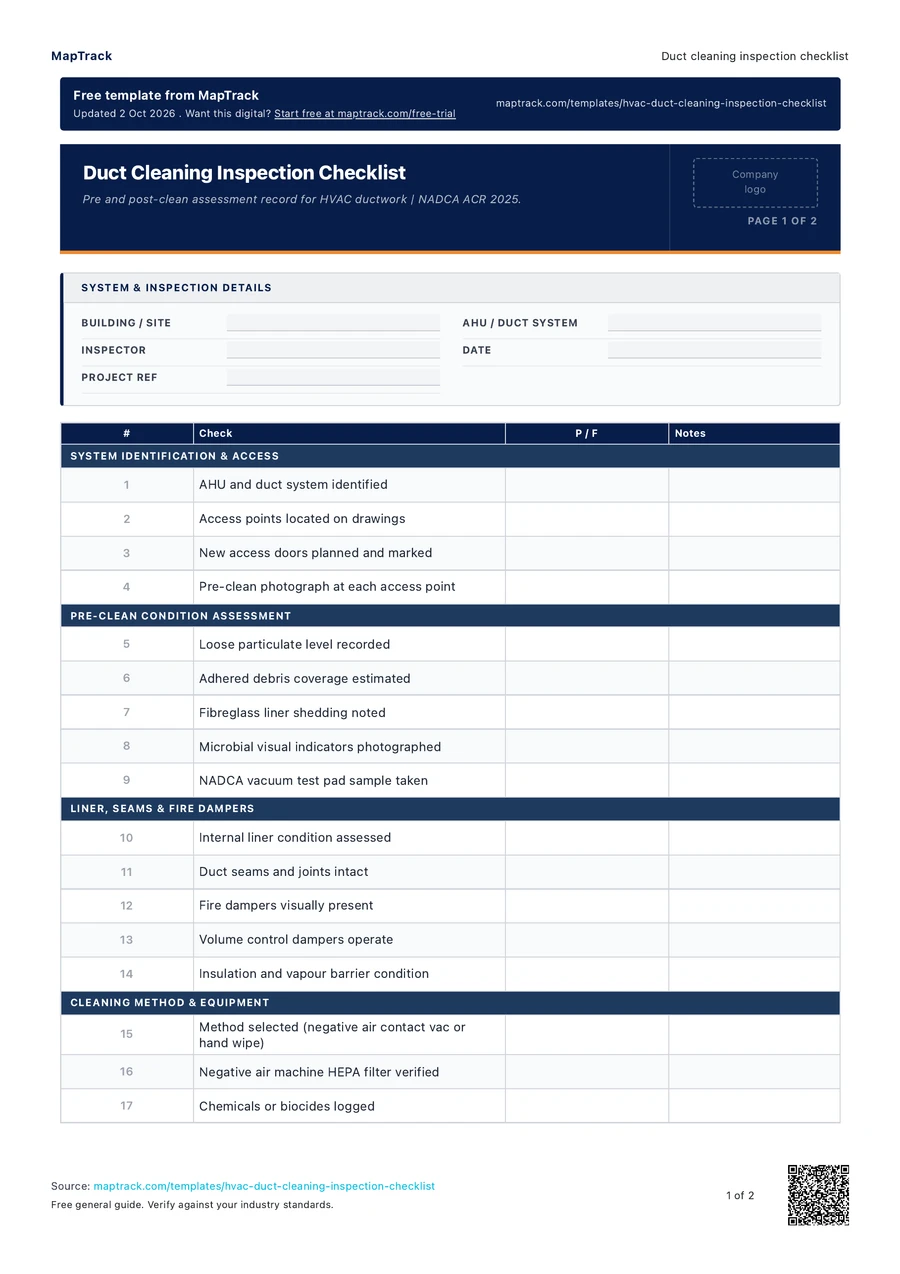

Read the form fields
28 checks · 6 sections · Sign-off
28 checks
The fields in the printable form, in a view that fits your screen.
- Building / site
- AHU / duct system
- Inspector
- Date
- Project ref
System identification & access
Pre-clean condition assessment
Liner, seams & fire dampers
Cleaning method & equipment
Post-clean verification
Defects & sign-off
Declaration & Sign-Off
I confirm that all items have been inspected/completed as indicated above. Any defects or concerns have been noted and reported.
Completed By
Printed name · Signature · Date
Reviewed / Approved By
Printed name · Signature · Date
The MapTrack duct cleaning inspection checklist contains 28 checks across 6 sections.

Co-Founder & Commercial Director
Make this form your own
Add your fields and logo. Give your team a form they can use on site.
Free 30-day trial. No credit card. Work email needed.
Upload & use this form now for free



“MapTrack beat them all in every aspect.”
 Vincent Stone · HSEQ Advisor, Concept Tanks
After signup: upload this PDF, check the form MapTrack drafts, then save and publish it for your team.
General guidance only. Check the form against your equipment manual, site procedures and local requirements before using it.
Key takeaways
- The MapTrack duct cleaning inspection checklist contains 28 checks across 6 sections. Sections covered: System identification & access, Pre-clean condition assessment, Liner, seams & fire dampers, Cleaning method & equipment, Post-clean verification, Defects & sign-off.
- Project and site details: building level AHU served duct system designation and inspection date
- Access points: location type (panel hinged access door or removed grille) and any new access points cut during the project
- Surface contamination assessment: loose particulate adhered debris fibreglass shedding corrosion and microbial visual indicators recorded against the ACR assessment criteria
What is a duct cleaning inspection checklist?
A duct cleaning inspection checklist is a structured form used by HVAC technicians and air quality specialists to assess the cleanliness of supply return and exhaust ductwork before during and after a cleaning project. It records surface contamination levels particulate accumulation microbial visual indicators access point locations and post-clean verification readings against ACR, The NADCA Standard (2025 edition). The checklist drives a defensible decision on whether ductwork requires cleaning what cleaning method is appropriate (mechanical agitation with negative air contact vacuuming or hand wiping) and whether the result meets the post-clean acceptance criteria before the system is returned to service.
In Australia HVAC duct hygiene falls under the WHS Act 2011 duty to provide and maintain a safe work environment, and AS/NZS 3666.2 sets minimum operation and maintenance requirements for air-handling and water systems for microbial control. ACR, The NADCA Standard for Assessment, Cleaning and Restoration of HVAC Systems (2025 edition, released 24 September 2025) is the industry standard used by Australian and New Zealand cleaners, and ISO 16890 classifies the general ventilation filters that protect cleaned ductwork from rapid recontamination. A documented inspection checklist provides the photographic and measurement evidence that ductwork was assessed and cleaned to standard supporting indoor air quality complaints insurer claims and compliance audits. MapTrack helps facilities teams retain duct inspection records linked to each AHU and duct run so historical condition can be tracked over multiple cleaning cycles.
Learn more about maintenance and work orders in MapTrack.
Choose the format that fits your team
Download the PDF
Use the original printable form for a paper workflow. Check it against your equipment and site procedure before the job.
Keep completed copies in your own record system and arrange any follow-up through your normal process.
Download free PDFCustomise a form in MapTrack
Start a free trial, upload this PDF and MapTrack drafts the form. Adjust it to your workflow, then save and publish it for your team to use.
Sample answers on this page and completed PDF records aren't imported automatically.
Upload & use this form now for freeFree 30-day trial. No credit card. Work email needed.
Benefits of using this duct cleaning inspection checklist
- NADCA ACR 2025 structure: organises every inspection around ACR, The NADCA Standard (2025 edition), so the result can be explained to clients, insurers and air quality auditors
- Pre-clean baseline: photographic and measurement evidence captured before work starts protects the cleaner from disputes about pre-existing damage or contamination
- Method selection: surface assessment of loose particulate adhered debris and microbial indicators drives the correct choice of negative-air contact vacuuming or hand wiping
- IAQ protection: catches mould rodent intrusion and fibreglass shedding that recirculate through occupied zones and trigger sick-building complaints from tenants
- Post-clean verification: the Surface Comparison Test or the NADCA Vacuum Test, cleanliness verification methods named in ACR 2025, confirms the duct is clean before the system is returned to service
- Compliance documentation: signed inspection records support WHS audits lease obligations and tenant indoor air quality complaints with defensible evidence
What to include in a duct cleaning inspection checklist
- Project and site details: building level AHU served duct system designation and inspection date
- Access points: location type (panel hinged access door or removed grille) and any new access points cut during the project
- Surface contamination assessment: loose particulate adhered debris fibreglass shedding corrosion and microbial visual indicators recorded against the ACR assessment criteria
- Particulate sampling: NADCA vacuum test pad results in milligrams per 100 square centimetres for supply return and exhaust
- Microbial assessment: visible mould or biofilm presence tape-lift sample location and any submitted laboratory report reference
- Damage and defects: torn internal liner damaged duct seams missing fire dampers or volume control dampers found during access
- Photographic record: before and after photos at each major access point with timestamp and location reference
- Equipment and method: cleaning method used equipment list negative air machine HEPA filter rating and chemical applied if any
- Post-clean verification: Surface Comparison Test result for accessible surfaces, and a NADCA Vacuum Test sample if specified (NADCA pass level: no more than 0.75 mg per 100 square centimetres)
- Final sign-off: cleaner trade qualifications supervisor sign-off and client acknowledgement
How to use this duct cleaning inspection checklist
Plan the system and review drawings
obtain the AHU schedule and as-built ductwork drawings identify all supply return and exhaust runs locate existing access points and plan where new access doors will be cut for hose insertion
Conduct a pre-clean walkthrough
open every accessible panel photograph the internal duct surface at each location measure particulate accumulation and assess surface contamination against the ACR 2025 assessment criteria
Document microbial indicators
where visible mould slime or biofilm is found photograph the area record the location and dimensions and tape-lift sample for laboratory analysis if the client or specification requires it
Select the cleaning method and equipment
based on the surface assessment choose negative-air mechanical agitation contact vacuuming or hand wiping and confirm the negative air machine HEPA filter is rated at least 99.97 percent at 0.3 microns
Carry out cleaning to NADCA acceptance criteria
section by section agitate or vacuum the duct interior work upstream to downstream so dislodged debris is captured by the negative air collector and never leaves the duct system
Verify post-clean condition
re-open each access point photograph the cleaned surface verify cleanliness with the Surface Comparison Test (no visible debris dust film or microbial indicators) and take a NADCA Vacuum Test sample where the specification demands it
Restore the system and sign off
seal all access doors with approved tape or hardware replace filters in the AHU return the system to service complete the inspection checklist with signatures and lodge photographic records and any laboratory reports with the client
How often should you complete this checklist?
ACR, The NADCA Standard sets recommended inspection intervals by building use, with cleaning triggered by inspection findings rather than a fixed calendar interval; NADCA's certification material gives one year as the minimum inspection interval for healthcare facilities. AS/NZS 3666.2 sets the operation and maintenance requirements for microbial control in air-handling systems, and IAQ complaints or post-event remediation (fire flood rodent intrusion construction works) typically warrant an immediate inspection regardless of schedule.
Critical environments such as hospitals laboratories and food production sites may require annual inspections and particulate verification. The WHS Act 2011 requires the PCBU to provide and maintain safe plant, and documented duct inspections give evidence for the mechanical ventilation requirements of AS 1668.2 and lease IAQ obligations. MapTrack scheduling can automate inspection reminders at the interval you set against each AHU and duct system.
Make this form your own
From your template to your team.
Upload this PDF and MapTrack drafts the form. Adjust it for your equipment and site, then save and publish the digital form for your team.
- 01
Start your free trial
Use your work email to create your MapTrack account.
- 02
Customise, save and publish
Adjust the template fields and branding for your site.
- 03
Complete it on the job
Record checks, add photos and export a branded PDF.
Keep working offline
Load the form before you lose reception. Complete it offline and sync when you're back online.
Scan the asset. Open its form.
Use an asset's QR code to find and complete the forms that belong to it.
Show what you found
Capture photos and attach files so the next person has the details they need.
Take a branded PDF with you
Download completed forms as PDF reports with your company logo.
Completed paper records aren't imported automatically.
Frequently asked questions
Practical answers about the form, record keeping and using MapTrack.
ACR, The NADCA Standard for Assessment, Cleaning and Restoration of HVAC Systems (2025 edition, released 24 September 2025) is the industry standard for HVAC duct cleaning used by Australian and New Zealand cleaners. AS/NZS 3666.2 sets operation and maintenance requirements for microbial control in air-handling and water systems, AS 1668.2:2024 covers mechanical ventilation, and the WHS Act 2011 sets the PCBU duty to provide and maintain a safe work environment. ISO 16890 classifies the general ventilation filters that protect cleaned ductwork from rapid recontamination after the system is returned to service.
Link to this answerACR, The NADCA Standard (2025 edition) sets the assessment criteria. Loose particulate above the NADCA Vacuum Test threshold adhered debris covering more than a small portion of the duct surface visible mould or biofilm rodent or insect intrusion fibreglass liner shedding or post-event contamination from fire flood or construction works all indicate cleaning is required. Inspection at the interval ACR recommends for the building type is the trigger. Cleaning itself is condition-based rather than calendar-based.
Link to this answerA visual verification checks that cleaned surfaces show no visible debris, settled dust film or microbial indicators; ACR 2025 names the Surface Comparison Test for this. A particulate test is stricter: a NADCA Vacuum Test sample is taken after cleaning and weighed, and NADCA's published pass level is no more than 0.75 milligrams of debris per 100 square centimetres. Particulate tests are normally specified for critical environments or where the original inspection found heavy contamination.
Link to this answerACR, The NADCA Standard recommends inspection intervals by building use, with cleaning triggered by findings rather than fixed scheduling; NADCA's certification material gives one year as the minimum for healthcare facilities. Laboratory and food production facilities typically also inspect annually and may require post-clean particulate verification. Any IAQ complaint water ingress rodent or fire event triggers an inspection regardless of the calendar interval. Document every inspection in the asset record so condition history is available for trending and capital planning.
Link to this answerVisual confirmation of damper presence and gross condition can be recorded during a duct cleaning inspection but routine service of fire and smoke dampers is a separate activity under AS 1851-2012 (Routine service of fire protection systems and equipment), carried out by a fire systems contractor, not the duct cleaner. Note any visibly damaged or missing dampers on the duct inspection checklist for the client to address through the fire systems contractor.
Link to this answerApplicable regulatory standards
This form is a starting point. Check the current requirements that apply to your equipment, work and location. The form alone does not establish compliance.
- ACR, The NADCA Standard for Assessment, Cleaning and Restoration of HVAC Systems (2025 edition)
- AS/NZS 3666.2:2011 - Air-handling and water systems of buildings - Microbial control - Operation and maintenance
- AS 1668.2:2024 - The use of ventilation and airconditioning in buildings - Mechanical ventilation in buildings
- ISO 16890
- WHS Act 2011
MapTrack publishes this template. The linked authorities publish their own guidance; they haven't endorsed this form.
The numbers behind this duct cleaning inspection checklist
Every figure below is sourced and dated, so you can quote it in a toolbox talk, a budget case or a board paper without having to chase the original report.
Cite this template
Writing about this topic? You’re welcome to quote this checklist. Here’s the wording to use so your readers can find the original.
The MapTrack duct cleaning inspection checklist contains 28 checks across 6 sections.
- Short attribution
- MapTrack Duct cleaning inspection checklist, https://www.maptrack.com/templates/hvac-duct-cleaning-inspection-checklist
- Reference list
- MapTrack. (2026). Duct cleaning inspection checklist [Checklist template]. Retrieved from https://www.maptrack.com/templates/hvac-duct-cleaning-inspection-checklist
Free to reuse with credit under a Creative Commons Attribution 4.0 licence. If you’d rather link straight to it, the page is https://www.maptrack.com/templates/hvac-duct-cleaning-inspection-checklist.
Embed this free template on your website
Run an industry blog, trade association site, or training resource? Drop a preview of this free duct cleaning inspection checklist straight into your page. The snippet is self-contained, needs no scripts, and links readers back to the full free template.
<div style="max-width:480px;font-family:system-ui,-apple-system,'Segoe UI',Roboto,sans-serif;border:1px solid #E5E7EB;border-radius:12px;padding:20px;background:#ffffff;">
  <p style="font-size:12px;font-weight:700;letter-spacing:0.05em;text-transform:uppercase;color:#071D49;margin:0;">Free template</p>
  <p style="font-size:18px;font-weight:700;color:#071D49;margin:6px 0 0;">Duct cleaning inspection checklist</p>
  <ul style="margin:12px 0 0;padding-left:18px;color:#374151;font-size:14px;line-height:1.6;">
    <li style="margin:4px 0;">Project and site details: building level AHU served duct system designation and inspection date</li>
    <li style="margin:4px 0;">Access points: location type (panel hinged access door or removed grille) and any new access points cut during the project</li>
    <li style="margin:4px 0;">Surface contamination assessment: loose particulate adhered debris fibreglass shedding corrosion and microbial visual indicators recorded against the ACR assessment criteria</li>
    <li style="margin:4px 0;">Particulate sampling: NADCA vacuum test pad results in milligrams per 100 square centimetres for supply return and exhaust</li>
    <li style="margin:4px 0;">Microbial assessment: visible mould or biofilm presence tape-lift sample location and any submitted laboratory report reference</li>
    <li style="margin:4px 0;">Damage and defects: torn internal liner damaged duct seams missing fire dampers or volume control dampers found during access</li>
  </ul>
  <p style="font-size:13px;color:#6B7280;margin:14px 0 0;padding-top:12px;border-top:1px solid #E5E7EB;">Free <a href="https://www.maptrack.com/templates/hvac-duct-cleaning-inspection-checklist" style="color:#071D49;font-weight:600;text-decoration:none;">Duct cleaning inspection checklist</a> by MapTrack</p>
</div>Free to reuse, including commercially. This template is published under a Creative Commons Attribution 4.0 licence. Copy it, adapt it, put it on your own site or in your own docs. All we ask is that you credit MapTrack with a link back to this page. The snippet above already includes that credit, so if you use it as-is you’re covered.
About the author

Co-Founder & Commercial Director
Jarrod has spent over a decade in technology consulting and asset management, including roles at Accenture (mining and heavy industry) and CGI as an Asset Management Consultant. He co-founded MapTrack and built and scaled its original platform, then rebuilt it with Lachlan and Alex from thousands of customer conversations and 300+ user research sessions with field teams. His consulting background gives him deep insight into the operational and compliance challenges facing asset-intensive Australian businesses.
View LinkedIn profile →Ready for your next job?
Keep the PDF handy, or upload it to MapTrack and turn it into a digital form for your team.