
Free fire sprinkler system inspection checklist
Free fire sprinkler system inspection checklist (PDF-ready). Covers heads, valves, gauges, alarms and AS 1851 compliance. Digitise with MapTrack.
Updated 12 Oct 2026
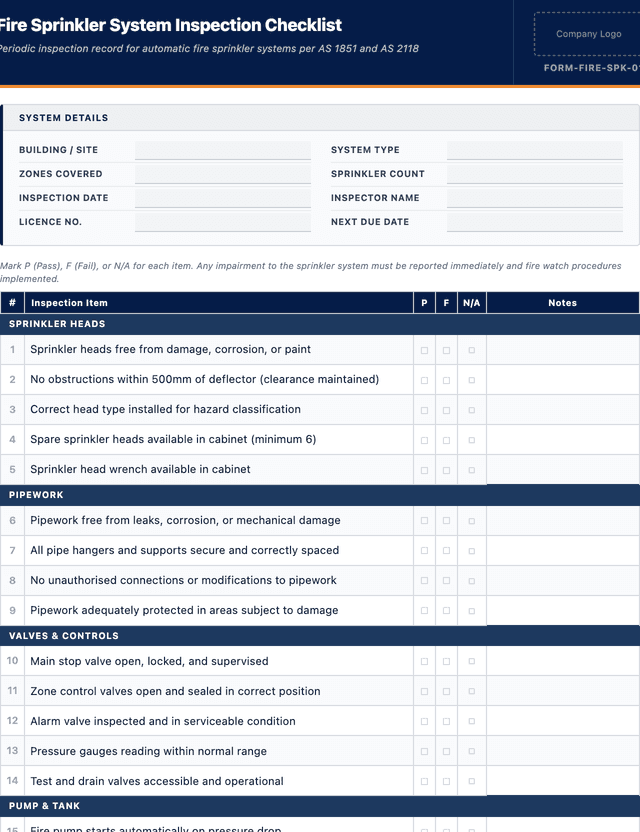
Fire Sprinkler System Inspection Checklist
Periodic inspection record for automatic fire sprinkler systems per AS 1851 and AS 2118
Sprinkler Heads
Pipework
Valves & Controls
Pump & Tank
Alarm & Monitoring
How to use: download the PDF, print or complete digitally on any device.
- PDF format, ready to print or fill on screen
- Use as-is or customise to suit your operation
- Go digital in MapTrack for photos, reminders and audit trails
Two ways to use it
Use in MapTrack →Use it digitally instead
Unlimited usersThese same 23 checks, already built.




- Scan the asset’s QR tag with any phone
- Submitted forms can trigger alerts
- Photos on fails, audit-ready records
- Export responses, PDF reports with your logo
Free trial. No credit card needed.
Trusted by teams across Australia and New Zealand
We respect your privacy. Unsubscribe anytime.
These templates are free general guides provided as-is. They do not constitute legal, safety or compliance advice. You are responsible for ensuring any form meets your specific workplace obligations, industry standards and applicable regulations.
Don't just download it - use it live. Start a free workspace with this fire sprinkler system inspection checklist already built, so your crew can run it from a phone.

Co-Founder & Commercial Director
Key takeaways
- The MapTrack fire sprinkler system inspection checklist contains 23 checks across 5 sections. Sections covered: Sprinkler Heads, Pipework, Valves & Controls, Pump & Tank, Alarm & Monitoring.
Enter your email below to download this fire sprinkler system inspection checklist as a ready-to-use PDF.
Used by construction, mining and field service teams










What is a fire sprinkler system inspection checklist?
A fire sprinkler system inspection checklist is a structured document used to verify the operational readiness and condition of automatic fire sprinkler systems in commercial, industrial and residential buildings. The checklist guides the inspector through a systematic assessment of sprinkler heads, control valves, alarm valves, gauges, piping, hangers, water supplies and system signage. Unlike the NFPA 25 variant, which references US standards, this checklist references AS 1851-2012 (Routine service of fire protection systems and equipment) and AS 2118.1:2017 (Automatic fire sprinkler systems, Part 1: General systems).
Automatic sprinkler systems are the most effective fixed fire suppression system, controlling or extinguishing fire in the early stages before it can spread. However, sprinkler systems can only perform if they are properly maintained: heads must be unobstructed, valves must be open, water supply must be adequate and alarm devices must function. Section 2 of AS 1851-2012 sets the routine service schedule for sprinkler systems, from monthly tasks through six-monthly, yearly and five-yearly service to items due every 10, 25 and 30 years. The WHS Act 2011, Section 19 requires the PCBU to maintain fire protection systems. A sprinkler system that fails due to a closed valve, obstructed head or degraded water supply can result in total loss of the building and potential loss of life.
Learn more about compliance and inspections in MapTrack.
Benefits of using this fire sprinkler system inspection checklist
- Fire suppression readiness: confirms the sprinkler system will activate and suppress fire when needed.
- AS 1851 records: each completed checklist is a dated pass or fail record to keep with your contractor's AS 1851-2012 service records, whose sprinkler schedule is in Section 2.
- Valve management: systematic valve checks prevent the most common cause of sprinkler failure, a closed control valve.
- Insurance compliance: sprinkler-protected buildings receive significant insurance premium reductions, but only if the system is maintained.
- Defect tracking: identifies obstructed heads, leaking pipes, faulty alarms and degraded water supply before they compromise the system.
- Building compliance: provides documentation for the Annual Fire Safety Statement and fire authority inspections.
Benefits of digitising forms in MapTrack
When you digitise sprinkler system checklists in MapTrack, you get:
- Field users can easily scan a QR code to complete a form on mobile. Unlimited users.
- Email the right people when a form is submitted, with an automation you set up.
- File every completed form against the asset, location or person it covers.
- Download any completed form as a PDF, with failed answers listed at the top.
- Fill in forms offline; they upload when the device is back online.
- Build conditional logic (show or hide questions based on answers).
- Take pictures or attach photos. Not possible with a paper-based form.
- Electronic signatures.
- Edit forms later without reprinting.
- Set who can view, fill in or edit forms with user roles.
- Upload a paper form (PDF, Word, Excel or a photo) and MapTrack's AI builds a digital version for you to check.
- Schedule fire extinguisher, hydrant and alarm inspections, with an email to the assigned person in the week before each is due.
- Track emergency evacuation drill records and corrective actions per site.
- Keep a digital fire safety register, with every inspection filed against its asset or site.
Book a demo to see how MapTrack handles sprinkler system checklists.
Try MapTrack free for 30 days
Full access to every feature. No credit card required. Per-asset pricing so you scale as your fleet grows.
- No credit card required
- 30 days free trial
- Cancel anytime
Less loss and downtime
“Doing monthly site audits in MapTrack has drastically reduced our equipment loss and downtime.”

Khalid El-Hussein
NSW Store Manager, Axis Services Group
What to include in a fire sprinkler system inspection checklist
This fire sprinkler system inspection checklist covers 11 key areas:
- System details: building name, system type (wet, dry, pre-action), zones covered, number of sprinkler heads, riser location.
- Inspector details: name, licence or accreditation, company, inspection date, inspection type (weekly/monthly/quarterly/annual).
- Sprinkler heads: visual condition, clearance from storage and obstructions, correct temperature rating for the area, spare head cabinet.
- Control valves: position (fully open), valve sealed or locked open, tamper switch connected to fire alarm panel.
- Alarm valve and check valves: alarm valve condition, water motor gong or electric bell, check valve operation.
- Gauges: system pressure, supply pressure, readings within normal operating range.
- Piping and hangers: leaks, corrosion, mechanical damage, hanger condition, seismic bracing (where required).
- Water supply: tank level (if gravity or tank supply), pump test results (if pump supply), town main pressure.
- Alarm devices: water flow alarm activation, tamper alarm activation, signal transmission to fire alarm panel and monitoring.
- Defect register: item, AS 1851 reference, defect description, corrective action, target date.
- Sign-off: inspector and building owner or facility manager.
How to use this fire sprinkler system inspection checklist
- Record system details and confirm the inspection scope: Note the building name, system type, zones being inspected and the inspection frequency being performed. Obtain the previous inspection report and note any outstanding defects from the last cycle that need follow-up.
- Inspect all sprinkler heads in the zone for condition and clearance: Walk the zone and visually check every accessible sprinkler head. Confirm heads are free of paint, dust, corrosion and physical damage. Verify the minimum clearance below the deflector is maintained and no storage, shelving or equipment obstructs the spray pattern. Check that each head has the correct temperature rating for its location.
- Check all control valves, alarm valves and gauges: Confirm every control valve is in the fully open position, locked or sealed open and connected to a tamper switch. Read the system and supply pressure gauges and compare to the normal operating range. Inspect the alarm valve for condition and check that the water motor gong or electric alarm bell is connected.
- Inspect piping, hangers and water supply: Walk the pipe runs checking for leaks, corrosion, mechanical damage and missing or damaged hangers. For tank-fed systems, check the tank water level. For pump-fed systems, review the most recent pump test results. For town main supply, check the supply pressure gauge.
- Test alarm devices and record defects: Activate the water flow alarm (via the test valve) and confirm the signal is received at the fire alarm panel and transmitted to the monitoring company. Log all defects with the AS 1851 clause reference, description, corrective action and target date. Sign the checklist and schedule the next inspection.
In MapTrack, you can manage fire safety inspections and equipment checks digitally. Each submission is stored as a timestamped PDF against the asset record.
Get the free templateEnter your email above to download the full fire sprinkler system inspection checklist as a PDF.Back to download formHow often should you complete this checklist?
AS 1851-2012 sets the routine service schedule for sprinkler systems in Section 2: monthly tasks, then six-monthly, yearly and five-yearly service, and items due every 10, 25 and 30 years, with no weekly or quarterly frequency. Five-yearly internal pipe inspections may also be required. The building essential safety measures schedule or the local fire authority may impose additional requirements. In MapTrack, schedule each inspection tier and receive automated reminders when tests are due.
Frequently asked questions
Applicable regulatory standards
This template is a starting point. Check the current requirements that apply to your equipment, work and location. The template alone does not establish compliance.
- AS 1851-2012 - Routine service of fire protection systems and equipment (Section 2: sprinkler systems)
- AS 2118.1:2017 - Automatic fire sprinkler systems, General systems
Check the current source
Fire sprinkler system inspection checklist preview
The numbers behind this fire sprinkler system inspection checklist
Every figure below is sourced and dated, so you can quote it in a toolbox talk, a budget case or a board paper without having to chase the original report.
Embed this free template on your website
Run an industry blog, trade association site, or training resource? Drop a preview of this free fire sprinkler system inspection checklist straight into your page. The snippet is self-contained, needs no scripts, and links readers back to the full free template.
<div style="max-width:480px;font-family:system-ui,-apple-system,'Segoe UI',Roboto,sans-serif;border:1px solid #E5E7EB;border-radius:12px;padding:20px;background:#ffffff;">
  <p style="font-size:12px;font-weight:700;letter-spacing:0.05em;text-transform:uppercase;color:#071D49;margin:0;">Free template</p>
  <p style="font-size:18px;font-weight:700;color:#071D49;margin:6px 0 0;">Fire sprinkler system inspection checklist</p>
  <ul style="margin:12px 0 0;padding-left:18px;color:#374151;font-size:14px;line-height:1.6;">
    <li style="margin:4px 0;">System details: building name, system type (wet, dry, pre-action), zones covered, number of sprinkler heads, riser location.</li>
    <li style="margin:4px 0;">Inspector details: name, licence or accreditation, company, inspection date, inspection type (weekly/monthly/quarterly/annual).</li>
    <li style="margin:4px 0;">Sprinkler heads: visual condition, clearance from storage and obstructions, correct temperature rating for the area, spare head cabinet.</li>
    <li style="margin:4px 0;">Control valves: position (fully open), valve sealed or locked open, tamper switch connected to fire alarm panel.</li>
    <li style="margin:4px 0;">Alarm valve and check valves: alarm valve condition, water motor gong or electric bell, check valve operation.</li>
    <li style="margin:4px 0;">Gauges: system pressure, supply pressure, readings within normal operating range.</li>
  </ul>
  <p style="font-size:13px;color:#6B7280;margin:14px 0 0;padding-top:12px;border-top:1px solid #E5E7EB;">Free <a href="https://www.maptrack.com/templates/fire-sprinkler-system-inspection-checklist" style="color:#071D49;font-weight:600;text-decoration:none;">Fire sprinkler system inspection checklist</a> by MapTrack</p>
</div>Free to reuse, including commercially. This template is published under a Creative Commons Attribution 4.0 licence. Copy it, adapt it, put it on your own site or in your own docs. All we ask is that you credit MapTrack with a link back to this page. The snippet above already includes that credit, so if you use it as-is you’re covered.
Cite this template
Writing about this topic? You’re welcome to quote this checklist. Here’s the wording to use so your readers can find the original.
The MapTrack fire sprinkler system inspection checklist contains 23 checks across 5 sections.
- Short attribution
- MapTrack Fire sprinkler system inspection checklist, https://www.maptrack.com/templates/fire-sprinkler-system-inspection-checklist
- Reference list
- MapTrack. (2026). Fire sprinkler system inspection checklist [Checklist template]. Retrieved from https://www.maptrack.com/templates/fire-sprinkler-system-inspection-checklist
Free to reuse with credit under a Creative Commons Attribution 4.0 licence. If you’d rather link straight to it, the page is https://www.maptrack.com/templates/fire-sprinkler-system-inspection-checklist.
Need to manage fire safety inspections and equipment checks digitally?
Register every sprinkler system in MapTrack, attach digital forms, and get a complete history of every inspection, service and compliance record.
Compliance and inspections · All templates · Pricing · Book a demo