
Free template · PDF
Free chain of responsibility (cor) policy template
Free chain of responsibility policy (PDF-ready). Set CoR duties across mass, dimension, loading, speed, fatigue and maintenance under the HVNL.
Loading PDF page...
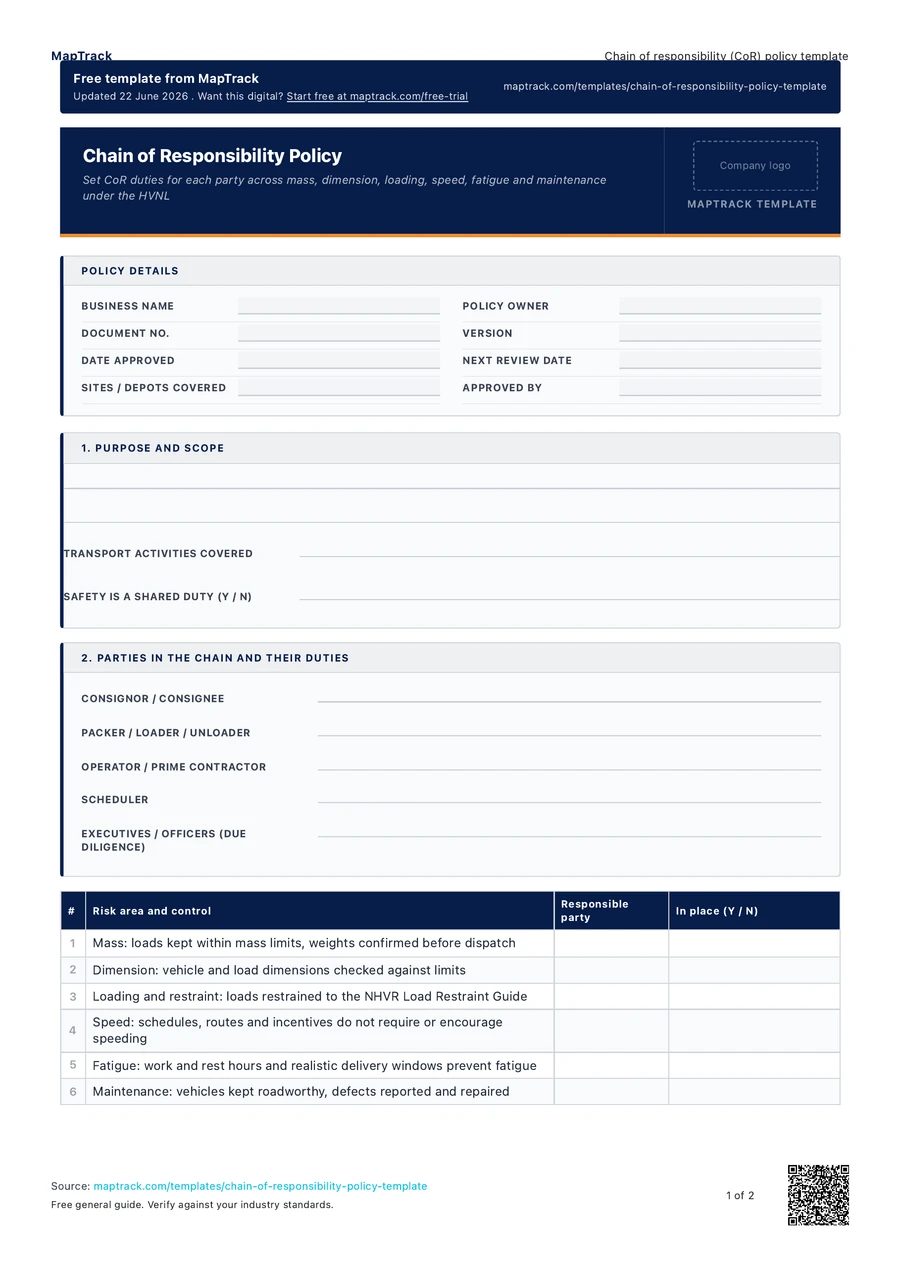

Read the form fields
6 checks · Sign-off
6 checks
The fields in the printable form, in a view that fits your screen.
- Business name
- Policy owner
- Document no.
- Version
- Date approved
- Next review date
- Sites / depots covered
- Approved by
Checklist
Prepared by (policy owner)
Signature · Print name · Position · Date
Approved by (executive / officer)
Signature · Print name · Position · Date
The MapTrack chain of responsibility (cor) policy template contains 6 checks.

Co-Founder & Commercial Director
Make this form your own
Add your fields and logo. Give your team a form they can use on site.
Free 30-day trial. No credit card. Work email needed.
Upload & use this form now for free



“MapTrack beat them all in every aspect.”
 Vincent Stone · HSEQ Advisor, Concept Tanks
After signup: upload this PDF, check the form MapTrack drafts, then save and publish it for your team.
General guidance only. Check the form against your equipment manual, site procedures and local requirements before using it.
Key takeaways
- The MapTrack chain of responsibility (cor) policy template contains 6 checks.
- Chain of Responsibility makes heavy vehicle safety a shared duty across every party in the supply chain, not just the driver.
- A CoR policy must cover mass, dimension, loading, speed, fatigue and maintenance, each with a named control and party.
- Executives and officers must exercise due diligence; a signed policy is part of that evidence.
- A party cannot contract out of its CoR duty under the Heavy Vehicle National Law.
- Review the policy yearly and after any incident, contract change or change to the HVNL.
What is a chain of responsibility (cor) policy template?
A chain of responsibility policy is a written statement of how a business meets its Chain of Responsibility duties under the Heavy Vehicle National Law. Chain of Responsibility, usually shortened to CoR, makes safety a shared duty across everyone who influences a transport task, not just the driver behind the wheel. The policy names each party in the supply chain, the consignor, consignee, packer, loader, unloader, operator, scheduler, prime contractor and the executives who oversee them, and sets out what each one must do to ensure the safety of transport activities so far as is reasonably practicable. It covers the main risk areas of mass, dimension, loading restraint, speed, fatigue and vehicle maintenance, and explains how the business identifies, controls and reviews those risks.
The policy matters because under the HVNL a party cannot contract out of its safety duty, and a breach can expose both the company and its officers to enforcement. A clear, signed policy turns an abstract legal obligation into day to day practice for schedulers, loading crews and managers. It records the controls that prevent overloading, unsafe loads, unrealistic schedules that push drivers to speed or drive fatigued, and poorly maintained vehicles. Kept alongside fleet, maintenance and load records, the policy is the document a business relies on to show a regulator, customer or insurer that it actively manages heavy vehicle safety across the whole chain rather than leaving it to the driver alone.
Learn more about compliance and inspections in MapTrack.
Choose the format that fits your team
Download the PDF
Use the original printable form for a paper workflow. Check it against your equipment and site procedure before the job.
Keep completed copies in your own record system and arrange any follow-up through your normal process.
Download free PDFCustomise a form in MapTrack
Start a free trial, upload this PDF and MapTrack drafts the form. Adjust it to your workflow, then save and publish it for your team to use.
Sample answers on this page and completed PDF records aren't imported automatically.
Upload & use this form now for freeFree 30-day trial. No credit card. Work email needed.
Benefits of using this chain of responsibility (cor) policy template
- Shared accountability: names the CoR duty of every party so safety is not left to the driver alone but owned across the chain.
- Due diligence evidence: gives executives and officers a documented basis for the due diligence the HVNL expects of them.
- Risk coverage: addresses all the heavy vehicle risk areas of mass, dimension, loading, speed, fatigue and maintenance in one place.
- Consistent decisions: gives schedulers and loading crews one agreed standard so safety is not traded away under delivery pressure.
- Customer assurance: lets you show consignors, consignees and prime contractors that your business actively manages transport safety.
- Audit and incident ready: creates a signed baseline you can present to the NHVR, an auditor or an insurer after an incident or on request.
What to include in a chain of responsibility (cor) policy template
- Purpose and scope: the transport activities, sites and vehicles covered, and a statement that safety is a shared duty under the HVNL
- Parties in the chain: the consignor, packer, loader, operator, scheduler, consignee and others, with the CoR duty that applies to each
- Mass duties: how loads are kept within mass limits and how weights are confirmed before dispatch
- Dimension duties: how vehicle and load dimensions are checked against limits, including any restricted access vehicle conditions
- Loading and restraint duties: how loads are restrained to the NHVR Load Restraint Guide standard and who verifies the restraint
- Speed duties: how schedules, routes and incentives are set so they do not require or encourage speeding
- Fatigue duties: how work and rest hours and realistic delivery windows prevent fatigue, linked to the fatigue management plan
- Maintenance duties: how vehicles are kept roadworthy through scheduled servicing, defect reporting and repair
- Roles, reporting and review: who is responsible, how breaches and near misses are reported, and when the policy is reviewed
How to use this chain of responsibility (cor) policy template
Map your supply chain and the parties in it
List every party that influences a transport task across your operation, including consignors, packers, loaders, schedulers, operators and consignees. Identify which CoR party each role is under the HVNL so the duty is matched to the right person rather than left unassigned.
Identify the safety risks in each area
Work through mass, dimension, loading restraint, speed, fatigue and maintenance, and record where each risk arises in your tasks. Look at real pressure points such as tight delivery windows, peak loads and yard turnaround that can push a party to cut a safety corner.
Set the controls and write them into the policy
For each risk area, document the control that keeps the activity safe so far as is reasonably practicable, such as weighing before dispatch, restraint checks, realistic scheduling and a maintenance program. Assign the control to the party best placed to manage it.
Consult, approve and communicate
Consult the parties and workers affected, have an executive approve and sign the policy to show officer due diligence, then communicate it through induction and toolbox talks. People can only meet a duty they know about, so make the expectations visible to every role.
Monitor, report and review
Track breaches, defects, overloads and near misses, and act on them. Review the policy at least annually and after any incident, regulatory change, new contract or route change, and update the controls whenever the review shows the current arrangements are no longer adequate.
How often should you complete this policy?
Treat the policy as a standing document and review it at least once a year, and sooner whenever something changes that affects transport safety. Common triggers are a new customer or contract, a change to routes or delivery windows, a fleet or vehicle type change, a CoR breach or near miss, an enforcement action, or an amendment to the Heavy Vehicle National Law or your accreditation.
The policy sets the framework, but the duties live in daily practice. Mass checks, restraint verification, schedule sign off and defect reporting happen on every relevant task, not once a year. Use the annual review to confirm the framework is still right, and rely on the day to day controls and records to show the duties are actually being met between reviews.
Make this form your own
From your template to your team.
Upload this PDF and MapTrack drafts the form. Adjust it for your equipment and site, then save and publish the digital form for your team.
- 01
Start your free trial
Use your work email to create your MapTrack account.
- 02
Customise, save and publish
Adjust the template fields and branding for your site.
- 03
Complete it on the job
Record checks, add photos and export a branded PDF.
Keep working offline
Load the form before you lose reception. Complete it offline and sync when you're back online.
Scan the asset. Open its form.
Use an asset's QR code to find and complete the forms that belong to it.
Show what you found
Capture photos and attach files so the next person has the details they need.
Take a branded PDF with you
Download completed forms as PDF reports with your company logo.
Completed paper records aren't imported automatically.
Frequently asked questions
Practical answers about the form, record keeping and using MapTrack.
Chain of Responsibility covers every party who has influence or control over a heavy vehicle transport task, not just the driver. That includes the consignor, packer, loader, unloader, operator, scheduler, prime contractor and consignee, as well as the executives and officers who oversee them. Each party has a duty to ensure the safety of transport activities so far as is reasonably practicable. Because the duty is shared, a party cannot pass it on or contract out of it, which is why a written policy that names each role matters.
Link to this answerA CoR policy should cover the recognised heavy vehicle risk areas: mass, so loads stay within limits; dimension, so vehicle and load size stay within limits; loading and restraint, so loads are secured to the NHVR Load Restraint Guide standard; speed, so schedules and incentives do not push drivers to speed; fatigue, so work and rest arrangements prevent impairment; and vehicle maintenance, so vehicles stay roadworthy. Addressing each area with a named control and a responsible party is how the policy shows the duty is being met.
Link to this answerA CoR policy is the governing document. It states the duties, names the parties, sets the controls and is signed off by an executive to show officer due diligence. A CoR checklist is an operational tool used on the ground to confirm specific controls were applied to a task, such as a load being weighed and restrained before dispatch. The two work together: the policy sets the standard, and the checklist captures the day to day evidence that the standard was followed on each job.
Link to this answerReview the policy at least annually, and sooner whenever something changes the risk. Triggers include a new contract or customer, a change to routes or delivery windows, a fleet change, a CoR breach or near miss, an enforcement action, or a change to the Heavy Vehicle National Law or your accreditation. The annual review keeps the framework current, while the daily controls such as mass checks, restraint verification and defect reporting provide the ongoing evidence that the duties are met between reviews.
Link to this answerNo. The Chain of Responsibility duty under the HVNL sits alongside the primary duty of care in the Work Health and Safety Act, and the two are deliberately aligned. Meeting one does not discharge the other. A business still needs its WHS systems for the broader workplace, while the CoR policy focuses on heavy vehicle transport safety across the supply chain. In practice the policy should reference your WHS framework so the controls, reporting and review cycles work together rather than as two separate systems.
Link to this answerThe Heavy Vehicle National Law, and the Chain of Responsibility duties that sit within it, applies in all states and territories except Western Australia and the Northern Territory, which have not adopted the HVNL and run their own heavy vehicle laws instead. The safety principle of shared responsibility across the supply chain still applies under those regimes, but the specific duties, definitions and references differ. If you operate in WA or the NT, treat this policy as a starting framework and check the obligations against your local heavy vehicle law rather than relying on the HVNL wording.
Link to this answerYes, it is completely free. It downloads as a PDF you can keep or print for your depot, drivers and loading crews. You do not need a MapTrack account. If you want to move beyond paper, MapTrack keeps your fleet records, maintenance history and asset tracking in one place, so the evidence behind your CoR duties is easy to find when a customer, auditor or the NHVR asks. Start free or book a demo to see how.
Link to this answerApplicable regulatory standards
This form is a starting point. Check the current requirements that apply to your equipment, work and location. The form alone does not establish compliance.
- Heavy Vehicle National Law - Chain of Responsibility (the primary duty: each party in the supply chain must ensure the safety of transport activities so far as is reasonably practicable)
- Heavy Vehicle National Law - duties of executives and officers to exercise due diligence over transport safety
- National Heavy Vehicle Regulator (NHVR) - Chain of Responsibility guidance and the four risk areas of speed, fatigue, mass and dimension, and loading
- Work Health and Safety Act 2011 - primary duty of care, aligned with the heavy vehicle safety duty
- NHVR Load Restraint Guide - load restraint performance standards referenced by the loading duty
- Model Work Health and Safety Act (Safe Work Australia)
- Heavy Vehicle National Law and Regulations (NHVR)
MapTrack publishes this template. The linked authorities publish their own guidance; they haven't endorsed this form.
The numbers behind this chain of responsibility (cor) policy template
Every figure below is sourced and dated, so you can quote it in a toolbox talk, a budget case or a board paper without having to chase the original report.
Cite this template
Writing about this topic? You’re welcome to quote this checklist. Here’s the wording to use so your readers can find the original.
The MapTrack chain of responsibility (cor) policy template contains 6 checks.
- Short attribution
- MapTrack Chain of responsibility (CoR) policy template, https://www.maptrack.com/templates/chain-of-responsibility-policy-template
- Reference list
- MapTrack. (2026). Chain of responsibility (CoR) policy template [Checklist template]. Retrieved from https://www.maptrack.com/templates/chain-of-responsibility-policy-template
Free to reuse with credit under a Creative Commons Attribution 4.0 licence. If you’d rather link straight to it, the page is https://www.maptrack.com/templates/chain-of-responsibility-policy-template.
Embed this free template on your website
Run an industry blog, trade association site, or training resource? Drop a preview of this free chain of responsibility (cor) policy template straight into your page. The snippet is self-contained, needs no scripts, and links readers back to the full free template.
<div style="max-width:480px;font-family:system-ui,-apple-system,'Segoe UI',Roboto,sans-serif;border:1px solid #E5E7EB;border-radius:12px;padding:20px;background:#ffffff;">
  <p style="font-size:12px;font-weight:700;letter-spacing:0.05em;text-transform:uppercase;color:#071D49;margin:0;">Free template</p>
  <p style="font-size:18px;font-weight:700;color:#071D49;margin:6px 0 0;">Chain of responsibility (CoR) policy template</p>
  <ul style="margin:12px 0 0;padding-left:18px;color:#374151;font-size:14px;line-height:1.6;">
    <li style="margin:4px 0;">Purpose and scope: the transport activities, sites and vehicles covered, and a statement that safety is a shared duty under the HVNL</li>
    <li style="margin:4px 0;">Parties in the chain: the consignor, packer, loader, operator, scheduler, consignee and others, with the CoR duty that applies to each</li>
    <li style="margin:4px 0;">Mass duties: how loads are kept within mass limits and how weights are confirmed before dispatch</li>
    <li style="margin:4px 0;">Dimension duties: how vehicle and load dimensions are checked against limits, including any restricted access vehicle conditions</li>
    <li style="margin:4px 0;">Loading and restraint duties: how loads are restrained to the NHVR Load Restraint Guide standard and who verifies the restraint</li>
    <li style="margin:4px 0;">Speed duties: how schedules, routes and incentives are set so they do not require or encourage speeding</li>
  </ul>
  <p style="font-size:13px;color:#6B7280;margin:14px 0 0;padding-top:12px;border-top:1px solid #E5E7EB;">Free <a href="https://www.maptrack.com/templates/chain-of-responsibility-policy-template" style="color:#071D49;font-weight:600;text-decoration:none;">Chain of responsibility (CoR) policy template</a> by MapTrack</p>
</div>Free to reuse, including commercially. This template is published under a Creative Commons Attribution 4.0 licence. Copy it, adapt it, put it on your own site or in your own docs. All we ask is that you credit MapTrack with a link back to this page. The snippet above already includes that credit, so if you use it as-is you’re covered.
About the author

Co-Founder & Commercial Director
Jarrod has spent over a decade in technology consulting and asset management, including roles at Accenture (mining and heavy industry) and CGI as an Asset Management Consultant. He co-founded MapTrack and built and scaled its original platform, then rebuilt it with Lachlan and Alex from thousands of customer conversations and 300+ user research sessions with field teams. His consulting background gives him deep insight into the operational and compliance challenges facing asset-intensive Australian businesses.
View LinkedIn profile →Ready for your next job?
Keep the PDF handy, or upload it to MapTrack and turn it into a digital form for your team.