
Free template · PDF
Free load restraint checklist
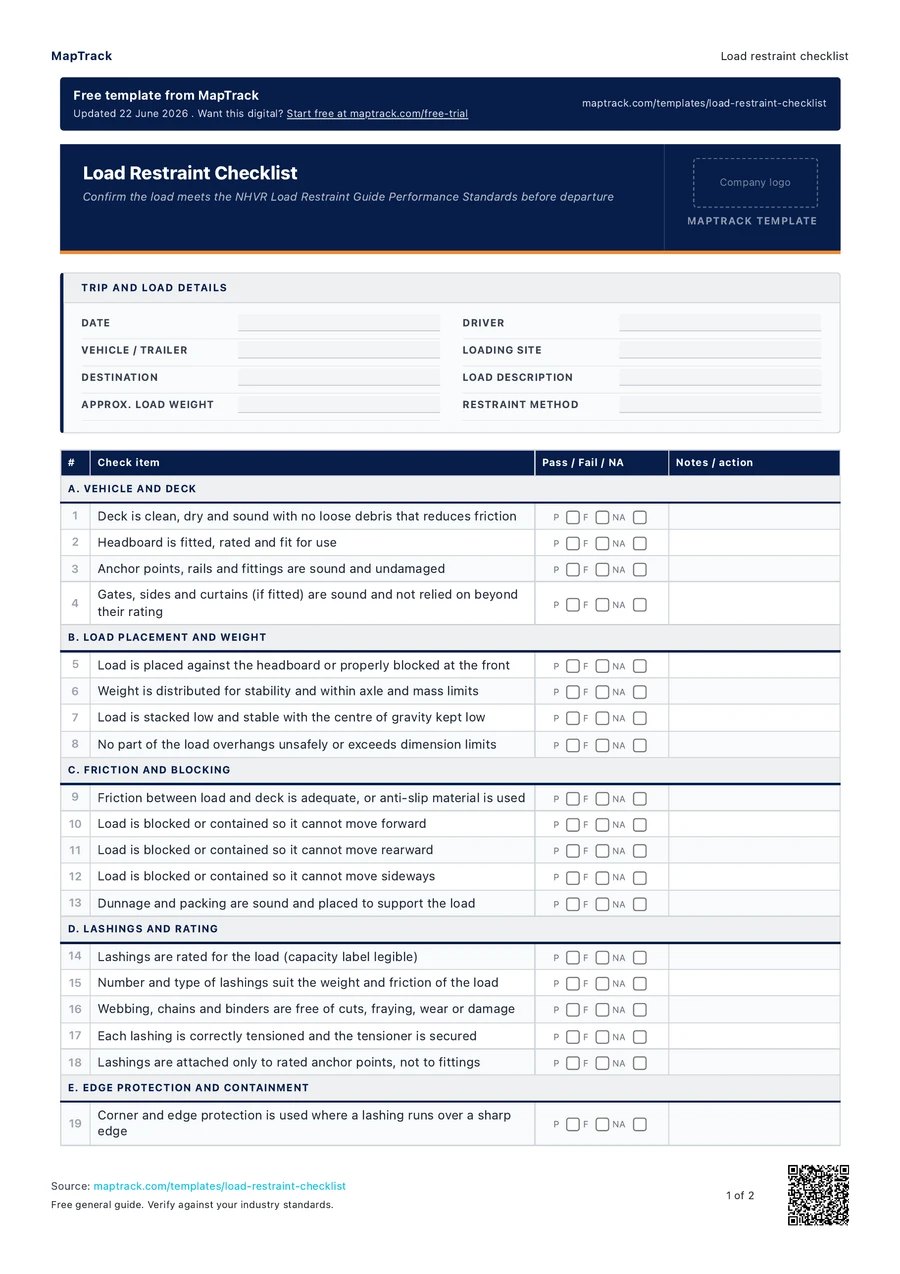
Free load restraint checklist (PDF-ready). Check loads to the NHVR Load Restraint Guide: performance standards, rated restraints, friction and lashing.
Loading PDF page...

Read the form fields
24 checks · 6 sections · Sign-off
24 checks
The fields in the printable form, in a view that fits your screen.
- Date
- Driver
- Vehicle / trailer
- Loading site
- Destination
- Load description
- Approx. load weight
- Restraint method
A. Vehicle and deck
B. Load placement and weight
C. Friction and blocking
D. Lashings and rating
E. Edge protection and containment
F. Final check and in-transit
Loaded / checked by
Signature · Print name · Role · Date
Driver acceptance
Signature · Print name · Time · Date
The MapTrack load restraint checklist contains 24 checks across 6 sections.

Co-Founder & Commercial Director
Make this form your own
Add your fields and logo. Give your team a form they can use on site.
Free 30-day trial. No credit card. Work email needed.
Upload & use this form now for free



“MapTrack beat them all in every aspect.”
 Vincent Stone · HSEQ Advisor, Concept Tanks
After signup: upload this PDF, check the form MapTrack drafts, then save and publish it for your team.
General guidance only. Check the form against your equipment manual, site procedures and local requirements before using it.
Key takeaways
- The MapTrack load restraint checklist contains 24 checks across 6 sections. Sections covered: A. Vehicle and deck, B. Load placement and weight, C. Friction and blocking, D. Lashings and rating, E. Edge protection and containment, F. Final check and in-transit.
- A load restraint checklist confirms a load is secured to the NHVR Load Restraint Guide standard before departure.
- The Guide sets Performance Standards: the load must hold under forward, rearward, sideways and downward forces.
- Restraint comes from placement, friction, blocking and rated lashings working together, not straps alone.
- Loading is a shared Chain of Responsibility duty across packer, loader, operator and driver.
- Recheck and retension restraints early in the trip and after the first stops, since loads settle.
What is a load restraint checklist?
A load restraint checklist is a pre departure check that confirms a load is secured to the standard set by the NHVR Load Restraint Guide before a heavy vehicle leaves the yard. The Load Restraint Guide sets Performance Standards a restraint system must meet, which require the load to stay in place under defined forward, rearward, sideways and downward forces that occur during normal driving, braking and cornering. The checklist walks the loader or driver through the things that make a load secure: that the load is placed against a headboard or properly blocked, that friction between the load and the deck is adequate, that lashings are rated, in good condition and tensioned, that the number of lashings suits the weight and friction, and that edge protection, gates and any containment are in place. It is completed for each load so the check is repeatable and recorded.
Load restraint matters because an unsecured load is one of the clearest and most dangerous failures in road transport. A load that shifts or falls can cause a rollover, injure other road users and close a road, and the duty to prevent it is shared across the chain through Chain of Responsibility, falling on the packer, loader, operator and driver as well as the consignor. Working to the Load Restraint Guide and recording the check on a consistent checklist is how a business shows it loads safely so far as is reasonably practicable. Kept with the vehicle and trip records, the completed checklist is the day to day evidence that each load met the performance standard before it moved, which supports both the loading duty under the Heavy Vehicle National Law and the broader duty of care.
Learn more about GPS and fleet tracking in MapTrack.
Choose the format that fits your team
Download the PDF
Use the original printable form for a paper workflow. Check it against your equipment and site procedure before the job.
Keep completed copies in your own record system and arrange any follow-up through your normal process.
Download free PDFCustomise a form in MapTrack
Start a free trial, upload this PDF and MapTrack drafts the form. Adjust it to your workflow, then save and publish it for your team to use.
Sample answers on this page and completed PDF records aren't imported automatically.
Upload & use this form now for freeFree 30-day trial. No credit card. Work email needed.
Benefits of using this load restraint checklist
- Safer loads: confirms each load is secured to the NHVR Load Restraint Guide standard before the vehicle leaves the yard.
- Consistent checks: gives every loader and driver the same repeatable steps so restraint does not depend on memory or habit.
- Chain of Responsibility evidence: records that the packer, loader and driver met the shared loading duty for each trip.
- Fewer incidents: catching loose lashings, poor blocking or low friction before departure prevents loads shifting in transit.
- Restraint condition control: prompts a check of webbing, chains and devices so worn or damaged restraints are taken out of use.
- Audit and incident ready: a dated, completed checklist is clear proof the load met the performance standard before it moved.
What to include in a load restraint checklist
- Trip and vehicle details: date, vehicle and trailer, driver, loading site and destination
- Load description: what is being carried, its approximate weight and how it is distributed on the deck
- Vehicle and deck condition: deck clean and sound, headboard rated and fit for use, anchor points and rails in good condition
- Load placement: load against the headboard or properly blocked, weight within limits and distributed for stability
- Friction: surface between load and deck provides adequate friction, or additional restraint added to compensate
- Blocking and containment: load blocked, gated or contained so it cannot move forward, rearward or sideways
- Lashings and rating: lashings are rated, the correct number and type for the load, undamaged and correctly tensioned
- Edge protection and equipment: corner and edge protection in place, dunnage, chains, binders and webbing in good condition
- Final check and sign off: load checked all round, restraints secure, and the check signed by the person responsible
How to use this load restraint checklist
Plan the load and check the vehicle
Before loading, confirm the deck is clean and sound, the headboard is rated and fit for use, and the anchor points and rails are in good condition. Plan how the load will sit so weight is distributed for stability and within mass limits across the axle groups.
Place and block the load
Load against the headboard or block the load so it cannot move forward, and arrange items so they cannot shift sideways or rearward. Good placement and blocking does much of the restraint work, so it comes before lashings rather than relying on straps to hold a poorly stacked load.
Assess friction and choose the restraint method
Judge the friction between the load and the deck, because more friction means fewer lashings are needed and less friction means more. Choose tie down, direct restraint such as blocking and containment, or a combination, matched to the weight, shape and friction of the load.
Apply and tension rated restraints
Use lashings that are rated for the load, in good condition and free of cuts, fraying or damage, and apply the correct number and type. Tension each lashing properly and add edge protection where a strap runs over a sharp corner so it is not cut under load.
Do a final all round check and record it
Walk around the loaded vehicle and confirm placement, blocking and every restraint is secure to the Load Restraint Guide standard. Sign the checklist, and recheck restraint tension early in the trip and after the first stops, since loads can settle and lashings can loosen.
How often should you complete this checklist?
Complete a load restraint check for every load before the vehicle leaves, no matter how short the trip, because an unsecured load is a risk on any road. The check is part of loading, so it happens each time a vehicle is loaded rather than on a periodic schedule.
Restraint does not end at the gate. Lashings can lose tension as a load settles, so check and retension restraints early in the journey and after the first stops, and again whenever part of the load is removed or rearranged at a delivery point. The restraint equipment itself, the webbing, chains, binders and dunnage, should be inspected regularly and taken out of service when worn or damaged, so the gear relied on for each load is sound.
Make this form your own
From your template to your team.
Upload this PDF and MapTrack drafts the form. Adjust it for your equipment and site, then save and publish the digital form for your team.
- 01
Start your free trial
Use your work email to create your MapTrack account.
- 02
Customise, save and publish
Adjust the template fields and branding for your site.
- 03
Complete it on the job
Record checks, add photos and export a branded PDF.
Keep working offline
Load the form before you lose reception. Complete it offline and sync when you're back online.
Scan the asset. Open its form.
Use an asset's QR code to find and complete the forms that belong to it.
Show what you found
Capture photos and attach files so the next person has the details they need.
Take a branded PDF with you
Download completed forms as PDF reports with your company logo.
Completed paper records aren't imported automatically.
Frequently asked questions
Practical answers about the form, record keeping and using MapTrack.
In Australia the reference is the NHVR Load Restraint Guide, which sets the Performance Standards a restraint system must meet. Those standards require the load to stay in place under defined forces: a large proportion of the load weight acting forward, and lesser proportions acting rearward and sideways, plus a downward force. In practice this means the combination of placement, friction, blocking and lashings must hold the load through hard braking, acceleration and cornering. A checklist built around the Guide confirms each of those elements is in place before the vehicle moves.
Link to this answerLoad restraint is a shared duty under Chain of Responsibility in the Heavy Vehicle National Law. The packer, loader, operator and driver all have a duty to ensure the load is restrained so it does not move or fall, and the consignor influences it through what is sent and how it is presented. The driver is responsible for the vehicle being safe to drive, but they are not the only party accountable for the load. A recorded checklist helps show that each party in the loading process met its duty for that trip.
Link to this answerThere is no single number, because it depends on the weight of the load and the friction between the load and the deck. More friction means fewer lashings are needed to meet the performance standard, and less friction means more. The NHVR Load Restraint Guide provides the method and worked guidance to calculate it for tie down restraint, and direct restraint such as blocking and containment can reduce or replace lashings. The safe approach is to follow the Guide for the specific load rather than apply a fixed rule of thumb.
Link to this answerTie down restraint uses lashings tensioned over the load to increase the downward force and the friction holding it to the deck. Direct restraint holds the load in place directly through blocking, containment or attaching it to anchor points, so the load presses against a headboard, gate or fitting rather than relying on friction. Most loads use a combination. The Load Restraint Guide covers both methods, and choosing the right mix for the weight, shape and friction of the load is part of the check.
Link to this answerYes. Loads can settle and lashings can lose tension in the first part of a journey, so the accepted practice is to check and retension restraints early in the trip and after the first stops, and again whenever the load is partly removed or rearranged. The pre departure checklist confirms the load was secure when it left, but a quick recheck on the road catches the tension loss that happens once the vehicle is moving, which is when many loads slip from secure to unsafe.
Link to this answerYes, it is completely free. It downloads as a PDF you can keep or print as a pad for your drivers and loading crews. You do not need a MapTrack account. If you want to move beyond paper, MapTrack lets you run checks like this as mobile forms and keeps fleet, asset and maintenance records in one place, so your loading evidence and vehicle history are easy to find. Start free or book a demo to see how.
Link to this answerApplicable regulatory standards
This form is a starting point. Check the current requirements that apply to your equipment, work and location. The form alone does not establish compliance.
- NHVR Load Restraint Guide - the Performance Standards a restraint system must meet (forward, rearward, sideways and downward forces)
- Heavy Vehicle National Law - loading requirements and the duty to ensure a load is restrained so it does not move or fall
- Heavy Vehicle National Law - Chain of Responsibility loading and restraint duties shared across the chain
- AS/NZS 4380 Motor vehicles, cargo restraint systems (transport webbing for load restraint)
- Work Health and Safety Act 2011 - primary duty of care for safe loading and transport activities
- Model Work Health and Safety Act (Safe Work Australia)
- Heavy Vehicle National Law and Regulations (NHVR)
MapTrack publishes this template. The linked authorities publish their own guidance; they haven't endorsed this form.
The numbers behind this load restraint checklist
Every figure below is sourced and dated, so you can quote it in a toolbox talk, a budget case or a board paper without having to chase the original report.
Cite this template
Writing about this topic? You’re welcome to quote this checklist. Here’s the wording to use so your readers can find the original.
The MapTrack load restraint checklist contains 24 checks across 6 sections.
- Short attribution
- MapTrack Load restraint checklist, https://www.maptrack.com/templates/load-restraint-checklist
- Reference list
- MapTrack. (2026). Load restraint checklist [Checklist template]. Retrieved from https://www.maptrack.com/templates/load-restraint-checklist
Free to reuse with credit under a Creative Commons Attribution 4.0 licence. If you’d rather link straight to it, the page is https://www.maptrack.com/templates/load-restraint-checklist.
Embed this free template on your website
Run an industry blog, trade association site, or training resource? Drop a preview of this free load restraint checklist straight into your page. The snippet is self-contained, needs no scripts, and links readers back to the full free template.
<div style="max-width:480px;font-family:system-ui,-apple-system,'Segoe UI',Roboto,sans-serif;border:1px solid #E5E7EB;border-radius:12px;padding:20px;background:#ffffff;">
  <p style="font-size:12px;font-weight:700;letter-spacing:0.05em;text-transform:uppercase;color:#071D49;margin:0;">Free template</p>
  <p style="font-size:18px;font-weight:700;color:#071D49;margin:6px 0 0;">Load restraint checklist</p>
  <ul style="margin:12px 0 0;padding-left:18px;color:#374151;font-size:14px;line-height:1.6;">
    <li style="margin:4px 0;">Trip and vehicle details: date, vehicle and trailer, driver, loading site and destination</li>
    <li style="margin:4px 0;">Load description: what is being carried, its approximate weight and how it is distributed on the deck</li>
    <li style="margin:4px 0;">Vehicle and deck condition: deck clean and sound, headboard rated and fit for use, anchor points and rails in good condition</li>
    <li style="margin:4px 0;">Load placement: load against the headboard or properly blocked, weight within limits and distributed for stability</li>
    <li style="margin:4px 0;">Friction: surface between load and deck provides adequate friction, or additional restraint added to compensate</li>
    <li style="margin:4px 0;">Blocking and containment: load blocked, gated or contained so it cannot move forward, rearward or sideways</li>
  </ul>
  <p style="font-size:13px;color:#6B7280;margin:14px 0 0;padding-top:12px;border-top:1px solid #E5E7EB;">Free <a href="https://www.maptrack.com/templates/load-restraint-checklist" style="color:#071D49;font-weight:600;text-decoration:none;">Load restraint checklist</a> by MapTrack</p>
</div>Free to reuse, including commercially. This template is published under a Creative Commons Attribution 4.0 licence. Copy it, adapt it, put it on your own site or in your own docs. All we ask is that you credit MapTrack with a link back to this page. The snippet above already includes that credit, so if you use it as-is you’re covered.
About the author

Co-Founder & Commercial Director
Jarrod has spent over a decade in technology consulting and asset management, including roles at Accenture (mining and heavy industry) and CGI as an Asset Management Consultant. He co-founded MapTrack and built and scaled its original platform, then rebuilt it with Lachlan and Alex from thousands of customer conversations and 300+ user research sessions with field teams. His consulting background gives him deep insight into the operational and compliance challenges facing asset-intensive Australian businesses.
View LinkedIn profile →Ready for your next job?
Keep the PDF handy, or upload it to MapTrack and turn it into a digital form for your team.