
Free asset disposal and write-off form
Free asset disposal form template (PDF-ready). Covers disposal reason, method, condition, approval chain and residual value. Download free.
Updated 2 May 2026
Asset Disposal Form
| # | Role | Name | Signature | Date | Approved |
|---|---|---|---|---|---|
| e.g. | - | - | - | 12/03/2024 | - |
| 1 | |||||
| 2 | |||||
| 3 | |||||
| 4 | |||||
| 5 |
The PDF includes all 4 numbered rows, ready to print or fill on screen.
How to use: download the PDF, print or complete digitally on any device.
- PDF format, ready to print or fill on screen
- Use as-is or customise to suit your operation
- Go digital in MapTrack for photos, reminders and audit trails
Two ways to use it
Use in MapTrack →Use it digitally instead
Unlimited usersThese same 5 columns, already built.




- Scan the asset’s QR tag with any phone
- Submitted forms can trigger alerts
- Photos on fails, audit-ready records
- Export responses, PDF reports with your logo
Free trial. No credit card needed.
Trusted by teams across Australia and New Zealand
We respect your privacy. Unsubscribe anytime.
These templates are free general guides provided as-is. They do not constitute legal, safety or compliance advice. You are responsible for ensuring any form meets your specific workplace obligations, industry standards and applicable regulations.
Don't just download it - use it live. Start a free workspace with this asset disposal and write-off form already built, so your crew can run it from a phone.

Co-Founder & Commercial Director
Key takeaways
- The MapTrack asset disposal and write-off form has 5 columns and room for 4 entries. Columns: Role, Name, Signature, Date, Approved.
Enter your email below to download this asset disposal and write-off form as a ready-to-use PDF.
Used by construction, mining and field service teams











What is an asset disposal and write-off form?
An asset disposal form is a formal document used to record and authorise the removal of an asset from an organisation's asset register. It captures essential information about the asset being disposed of, including identification, financial details (original cost, current book value), the reason for disposal, the proposed disposal method, condition at disposal, environmental and data security considerations, and the approval chain. The form creates a single source of truth for the entire disposal lifecycle, from request through to final sign-off and register update.
A well-documented disposal process ensures financial accuracy, maintains audit trails, supports tax and insurance reporting, and meets regulatory and environmental obligations. In Australia, state and territory EPA regulations govern the disposal of hazardous materials, e-waste and batteries, while racking and storage equipment falls under AS 4084. Organisations subject to government grants or contracts may also need to demonstrate that assets were disposed of in accordance with funding conditions. Using a standardised disposal form ensures every disposal follows the same governance process, regardless of the asset type or value.
The WHS Regulations 2011 require that plant being decommissioned or disposed of does not create risks to health and safety, which includes ensuring hazardous substances are removed, energy sources are isolated and sharp or heavy components are handled safely during dismantling. Environmental Protection Acts at the state and territory level impose specific obligations for the disposal of regulated waste, including oils, refrigerants, asbestos-containing materials and electronic waste. Under AS/NZS ISO 55001 (Asset management), organisations are expected to plan for asset end-of-life as part of the full lifecycle approach, including disposal governance, value recovery and environmental impact assessment. Failure to document disposals properly can result in ghost assets remaining on the register, inaccurate depreciation schedules, insurance over-payment for assets no longer held, and regulatory penalties for incorrect waste disposal.
Learn more about asset tracking in MapTrack.
Benefits of using this asset disposal and write-off form
- Financial accuracy: ensures disposed assets are removed from the register and depreciation schedules are updated promptly for correct reporting.
- Audit compliance: documented disposal records provide evidence for internal and external financial audits as required by auditing standards.
- Approval governance: formal approval chain prevents unauthorised disposal or misappropriation of assets across the organisation.
- Environmental compliance: prompts consideration of environmental disposal requirements for hazardous materials, e-waste and batteries under state EPA regulations.
- Data security: includes IT asset data sanitisation verification before disposal to prevent information leaks or privacy breaches.
- Tax and insurance: captures proceeds, capital gains or losses and supports insurance claims for damaged or stolen assets at end of life.
- Consistent process: standardises the disposal workflow so every asset type follows the same governance steps, reducing errors and oversights.
Benefits of digitising forms in MapTrack
When you move your log / registers from paper to MapTrack, you get:
- Field users can easily scan a QR code to complete a form on mobile. Unlimited users.
- Email the right people when a form is submitted, with an automation you set up.
- File every completed form against the asset, location or person it covers.
- Download any completed form as a PDF, with failed answers listed at the top.
- Fill in forms offline; they upload when the device is back online.
- Build conditional logic (show or hide questions based on answers).
- Take pictures or attach photos. Not possible with a paper-based form.
- Electronic signatures.
- Edit forms later without reprinting.
- Set who can view, fill in or edit forms with user roles.
- Upload a paper form (PDF, Word, Excel or a photo) and MapTrack's AI builds a digital version for you to check.
- Keep one asset register with each asset's location, condition and custody history.
- Schedule calibration and record certification and warranty expiry dates against each asset.
- See each asset's value over time in the Asset Depreciation report.
Book a demo to see how MapTrack handles log / registers.
Try MapTrack free for 30 days
Full access to every feature. No credit card required. Per-asset pricing so you scale as your fleet grows.
- No credit card required
- 30 days free trial
- Cancel anytime
1-2 days/week saved
“Bloody amazing! We used to spend 1-2 days a week tracking and managing our generators alone.”

Steve McAllister
Asset Coordinator, Saunders International
What to include in an asset disposal and write-off form
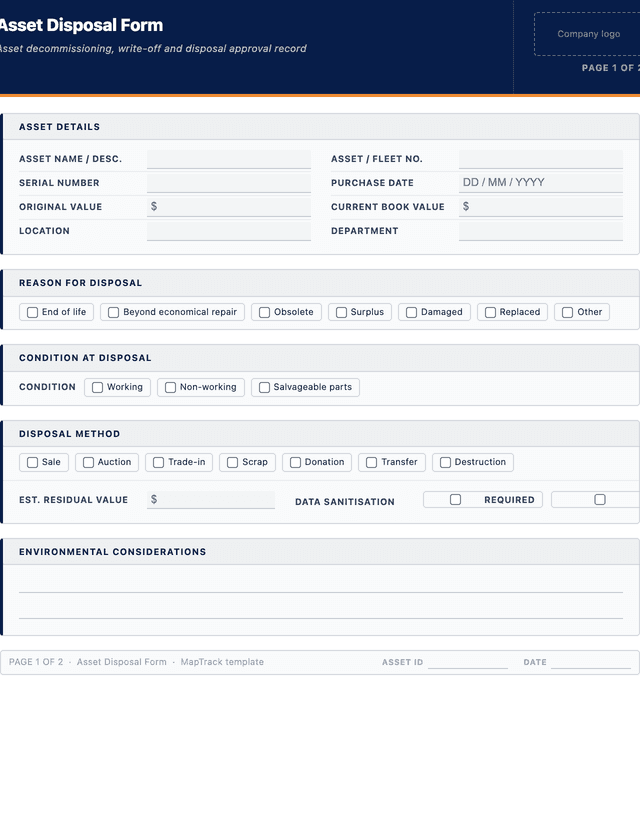
This asset disposal and write-off form covers 8 key areas:
- Asset details: name/description, asset/fleet number, serial number, purchase date, original value, current book value, location, department.
- Disposal reason: end of life, beyond economical repair, obsolete, surplus, damaged, replaced, other.
- Condition: working, non-working, salvageable parts.
- Disposal method: sale, auction, trade-in, scrap, donation, transfer, destruction.
- Financial: estimated residual/sale value, data sanitisation required (for IT assets).
- Environmental considerations: hazardous materials, e-waste, special disposal requirements.
- Approval chain: requester, department manager, finance, asset manager.
- Disposal record: disposal date, method used, proceeds received, certificate of destruction reference.
How to use this asset disposal and write-off form
- Record the asset details, including serial number, purchase date and current book value.: Pull the asset record from your register or asset management system. Confirm the serial number, original purchase cost, depreciation method and current book value so the financial impact of disposal is accurately captured.
- Select the reason for disposal and the asset condition.: Choose the disposal reason from the standard list (end of life, beyond economical repair, obsolete, surplus, damaged, replaced). Record the current condition as working, non-working or salvageable parts to guide the disposal method.
- Choose the proposed disposal method and note environmental considerations.: Select the disposal method (sale, auction, trade-in, scrap, donation, transfer or destruction). Note any environmental requirements such as hazardous material handling, e-waste recycling or battery disposal in accordance with your state or territory EPA regulations.
- Obtain quotes or valuations where required by organisational policy.: For assets above your organisation disposal threshold, obtain at least two written quotes or an independent valuation. Attach the quotes to the form so approvers can verify that the disposal method achieves reasonable value recovery.
- Route for approval through the required chain (requester, department manager, finance, asset manager).: Submit the completed form for sequential approval. Each approver reviews the disposal reason, proposed method, financial impact and environmental considerations before signing off. Record each approval with name, signature and date.
- After disposal, complete the disposal record with the date, method used, proceeds and any certificates.: Once the asset has been physically disposed of, record the actual disposal date, method used, proceeds received and reference any certificate of destruction. Update the asset register to remove the asset and adjust depreciation schedules accordingly.
In MapTrack, you can manage your full asset register digitally. Each submission is stored as a timestamped PDF against the asset record.
Get the free templateEnter your email above to download the full asset disposal and write-off form as a PDF.Back to download formHow often should you complete this log / register?
An asset disposal form should be completed whenever an asset is removed from the organisation's register. This includes assets that have reached end of useful life, assets damaged beyond economical repair, obsolete or surplus equipment, assets being traded in for replacements, and IT assets being decommissioned. Every disposal should be documented regardless of the asset's book value. Many organisations set approval thresholds (e.g. assets over $5,000 require senior management approval) to ensure appropriate governance. In MapTrack, you can enforce approval workflows and maintain a complete disposal history for every asset.
Frequently asked questions
Applicable regulatory standards
This template is a starting point. Check the current requirements that apply to your equipment, work and location. The template alone does not establish compliance.
- WHS Regulations 2011 - Safe decommissioning and disposal of plant
- Environmental Protection Act (state and territory based) - Regulated waste disposal
- AS/NZS ISO 55001 - Asset management (lifecycle planning and disposal governance)
- AS 4084 - Steel storage racking (disposal of racking and storage equipment)
Asset disposal and write-off form preview
The numbers behind this asset disposal and write-off form
Every figure below is sourced and dated, so you can quote it in a toolbox talk, a budget case or a board paper without having to chase the original report.
Embed this free template on your website
Run an industry blog, trade association site, or training resource? Drop a preview of this free asset disposal and write-off form straight into your page. The snippet is self-contained, needs no scripts, and links readers back to the full free template.
<div style="max-width:480px;font-family:system-ui,-apple-system,'Segoe UI',Roboto,sans-serif;border:1px solid #E5E7EB;border-radius:12px;padding:20px;background:#ffffff;">
  <p style="font-size:12px;font-weight:700;letter-spacing:0.05em;text-transform:uppercase;color:#071D49;margin:0;">Free template</p>
  <p style="font-size:18px;font-weight:700;color:#071D49;margin:6px 0 0;">Asset disposal and write-off form</p>
  <ul style="margin:12px 0 0;padding-left:18px;color:#374151;font-size:14px;line-height:1.6;">
    <li style="margin:4px 0;">Asset details: name/description, asset/fleet number, serial number, purchase date, original value, current book value, location, department.</li>
    <li style="margin:4px 0;">Disposal reason: end of life, beyond economical repair, obsolete, surplus, damaged, replaced, other.</li>
    <li style="margin:4px 0;">Condition: working, non-working, salvageable parts.</li>
    <li style="margin:4px 0;">Disposal method: sale, auction, trade-in, scrap, donation, transfer, destruction.</li>
    <li style="margin:4px 0;">Financial: estimated residual/sale value, data sanitisation required (for IT assets).</li>
    <li style="margin:4px 0;">Environmental considerations: hazardous materials, e-waste, special disposal requirements.</li>
  </ul>
  <p style="font-size:13px;color:#6B7280;margin:14px 0 0;padding-top:12px;border-top:1px solid #E5E7EB;">Free <a href="https://www.maptrack.com/templates/asset-disposal-form" style="color:#071D49;font-weight:600;text-decoration:none;">Asset disposal and write-off form</a> by MapTrack</p>
</div>Free to reuse, including commercially. This template is published under a Creative Commons Attribution 4.0 licence. Copy it, adapt it, put it on your own site or in your own docs. All we ask is that you credit MapTrack with a link back to this page. The snippet above already includes that credit, so if you use it as-is you’re covered.
Cite this template
Writing about this topic? You’re welcome to quote this checklist. Here’s the wording to use so your readers can find the original.
The MapTrack asset disposal and write-off form has 5 columns and room for 4 entries.
- Short attribution
- MapTrack Asset disposal and write-off form, https://www.maptrack.com/templates/asset-disposal-form
- Reference list
- MapTrack. (2026). Asset disposal and write-off form [Checklist template]. Retrieved from https://www.maptrack.com/templates/asset-disposal-form
Free to reuse with credit under a Creative Commons Attribution 4.0 licence. If you’d rather link straight to it, the page is https://www.maptrack.com/templates/asset-disposal-form.
Need to manage your full asset register digitally?
Register every asset in MapTrack, attach digital forms, and get a complete history of every inspection, service and compliance record.