
Free SWMS template
Free SWMS template for high-risk construction work in Australia, including QLD: the 18 work types, steps, hazards, controls, review and worker sign-on.
Updated 2 Oct 2026
Safe Work Method Statement (SWMS)
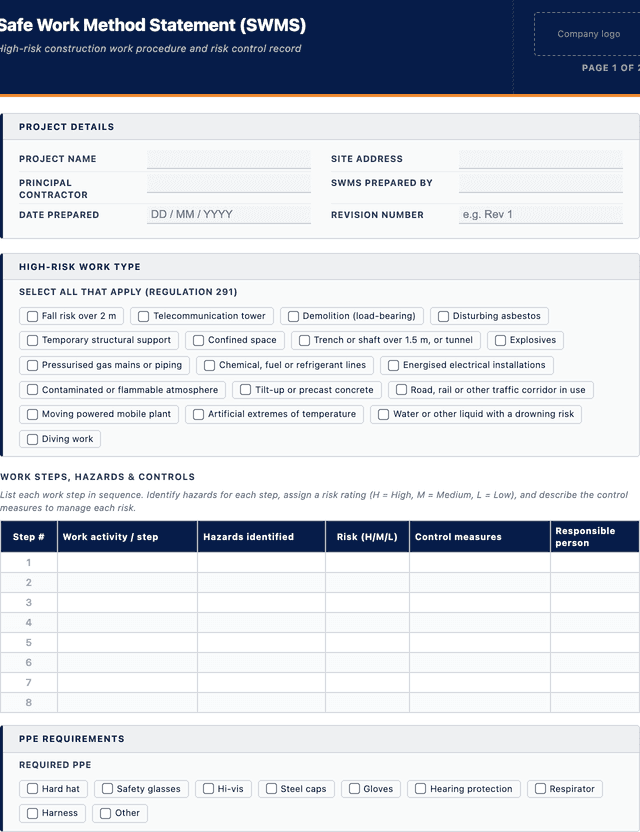
List each work step in sequence. Identify hazards for each step, assign a risk rating (H = High, M = Medium, L = Low), and describe the control measures to manage each risk.
| # | Step # | Work activity / step | Hazards identified | Risk (H/M/L) | Control measures | Responsible person |
|---|---|---|---|---|---|---|
| e.g. | - | - | - | - | - | S. Carter |
| 1 | ||||||
| 2 | ||||||
| 3 | ||||||
| 4 | ||||||
| 5 |
The PDF includes all 12 numbered rows, ready to print or fill on screen.
Prepared by
Signature
Print name
Position
Date
Approved by
Signature
Print name
Position
Date
How to use: download the PDF, print or complete digitally on any device.
- PDF format, ready to print or fill on screen
- Use as-is or customise to suit your operation
- Go digital in MapTrack for photos, reminders and audit trails
Two ways to use it
Use in MapTrack →Use it digitally instead
Unlimited usersThese same 6 columns, already built.




- Scan the asset’s QR tag with any phone
- Submitted forms can trigger alerts
- Photos on fails, audit-ready records
- Export responses, PDF reports with your logo
Free trial. No credit card needed.
Trusted by teams across Australia and New Zealand
We respect your privacy. Unsubscribe anytime.
These templates are free general guides provided as-is. They do not constitute legal, safety or compliance advice. You are responsible for ensuring any form meets your specific workplace obligations, industry standards and applicable regulations.
Don't just download it - use it live. Start a free workspace with this SWMS template already built, so your crew can run it from a phone.

Co-Founder & Commercial Director
Key takeaways
- The MapTrack SWMS template has 6 columns and room for 12 entries. Columns: Step #, Work activity / step, Hazards identified, Risk (H/M/L), Control measures, Responsible person.
Enter your email below to download this SWMS template as a ready-to-use PDF.
Used by construction, mining and field service teams











What is a SWMS template?
A Safe Work Method Statement (SWMS) is a written document required under the Australian Work Health and Safety (WHS) Regulations before any high-risk construction work begins. It identifies the type of high-risk work, breaks the job into steps, lists the hazards associated with each step, assesses the risk level, and describes the control measures that will be used to eliminate or minimise those risks. A copy must be readily accessible to every worker doing the high-risk work (regulation 303), and Safe Work Australia's own SWMS template has a section for each worker to sign and date when they receive it.
A SWMS is not just a compliance document. When prepared properly and reviewed on site, it is a practical tool that ensures everyone involved understands the hazards they face and the controls they must follow. The business carrying out the high-risk work must make sure a SWMS is prepared before the work starts (regulation 299), and on a construction project of $250,000 or more the principal contractor must take all reasonable steps to get a copy first (regulation 312). Safe Work Australia says the person carrying out the work is best placed to prepare it, with the workers who'll do the job. The model WHS Regulations list 18 types of high-risk construction work that require a SWMS, 19 in the ACT and Victoria, including working at heights, demolition, confined space entry, excavation deeper than 1.5 metres and work near energised electrical installations. Part 6.3 of the Regulations sets out the SWMS duties, from preparing the statement before the work starts (regulation 299) to keeping it (regulation 303). It must be reviewed and, as necessary, revised whenever the control measures for the work are revised (regulation 302), and if the work isn't being done the way the SWMS sets out, it must stop until it can be (regulation 300). Keeping completed SWMS on file provides documented evidence of compliance during regulator audits and insurance reviews.
Learn more about compliance and inspections in MapTrack.
Benefits of using this SWMS template
- Legal compliance: a SWMS is mandatory for high-risk construction work under Australian WHS Regulations. Without one, a PCBU faces enforcement action and penalties.
- Risk reduction: breaking work into steps and identifying hazards at each step forces a structured risk assessment before work begins, catching risks that might otherwise be overlooked.
- Worker awareness: every worker signs onto the SWMS, confirming they have read and understood the hazards and controls. This creates shared accountability on site.
- Audit trail: a signed SWMS provides documented evidence that risks were assessed, controls were planned, and workers were informed, which is critical during regulator audits and incident investigations.
- Subcontractor management: principal contractors can require subcontractors to submit a SWMS before starting work, ensuring consistent safety standards across all trades on site.
- Incident records: after an incident, a completed SWMS shows how the work was planned and which controls were meant to be in place, and it must be kept for at least 2 years after a notifiable incident (regulation 303).
Benefits of digitising forms in MapTrack
When you move your checklists from paper to MapTrack, you get:
- Field users can easily scan a QR code to complete a form on mobile. Unlimited users.
- Email the right people when a form is submitted, with an automation you set up.
- File every completed form against the asset, location or person it covers.
- Download any completed form as a PDF, with failed answers listed at the top.
- Fill in forms offline; they upload when the device is back online.
- Build conditional logic (show or hide questions based on answers).
- Take pictures or attach photos. Not possible with a paper-based form.
- Electronic signatures.
- Edit forms later without reprinting.
- Set who can view, fill in or edit forms with user roles.
- Upload a paper form (PDF, Word, Excel or a photo) and MapTrack's AI builds a digital version for you to check.
- Email safety managers when a hazard report is submitted, with an automation you set up.
- Keep every hazard and incident report against the site it came from, with photos.
- Turn a hazard report into a corrective-action work order with its own review step.
Book a demo to see how MapTrack handles checklists.
Try MapTrack free for 30 days
Full access to every feature. No credit card required. Per-asset pricing so you scale as your fleet grows.
- No credit card required
- 30 days free trial
- Cancel anytime
1-2 days/week saved
“Bloody amazing! We used to spend 1-2 days a week tracking and managing our generators alone.”

Steve McAllister
Asset Coordinator, Saunders International
What to include in a SWMS template
This SWMS template covers 10 key areas:
- High-risk work activity: the specific type of high-risk construction work being carried out (e.g. working at heights, demolition, confined space entry).
- Work steps: each task or activity broken into sequential steps, from set-up through to pack-down.
- Hazards per step: the hazards identified for each work step (e.g. falls, falling objects, electrical contact, crush injuries).
- Risk rating: a risk assessment for each hazard (High, Medium or Low) based on likelihood and consequence.
- Control measures: the specific controls to eliminate or minimise each risk, following the hierarchy of controls.
- Responsible persons: who is responsible for implementing each control measure.
- PPE requirements: the personal protective equipment required for the work (hard hat, harness, respirator, etc.).
- Emergency procedures: what to do if something goes wrong, including emergency contacts and rescue plans.
- Monitoring and review: how the controls will be implemented, monitored and reviewed, who reviews the SWMS and when (regulation 299 requires this).
- Sign-on register: every worker involved in the high-risk work signs to confirm they have read, understood and agreed to follow the SWMS.
How to use this SWMS template
- Identify the high-risk construction work activity: Determine which category of high-risk construction work (HRCW) applies from the list in the WHS Regulations: a risk of falling more than 2 metres, demolition of load-bearing structure, work likely to disturb asbestos, confined spaces, trenches or shafts deeper than 1.5 metres, work near energised electrical installations, use of explosives, work beside roads or railways in use, work where powered mobile plant is moving, and the rest of the 18 in regulation 291. Record the activity description at the top of the SWMS. One SWMS can cover several high-risk activities on the same job, or you can prepare a separate one for each activity.
- Break the job into sequential work steps: List every step of the task from setup through to pack-down in the order they will be performed. Keep steps granular enough to identify specific hazards at each stage. For example, rather than a single step "erect scaffold", break it into "unload scaffold components", "lay sole boards and base plates", "erect first lift", "install bracing and ties" and so on. Involve the workers who will perform the task because they know the practical steps better than anyone.
- Identify hazards for each work step: For every step, ask: what could go wrong and who could be harmed? Record each hazard alongside the step it relates to. Common hazards for HRCW include falls from height, falling objects, crush injuries from plant, electrical contact, engulfment, atmospheric hazards in confined spaces and structural collapse. Consider interactions between trades, weather conditions, ground conditions and the sequence of work.
- Assess the risk and define control measures: Rate each hazard as High, Medium or Low using a risk matrix based on likelihood and consequence. For each hazard, define the control measures that will eliminate or minimise the risk, following the hierarchy of controls. Be specific: rather than "use PPE", write "all workers to wear full-body harness with twin-tail lanyard connected to a rated anchor point at all times above 2 metres". Assign a responsible person for each control.
- Document PPE requirements and emergency procedures: List every item of PPE required for the work: hard hat, safety glasses, hi-vis vest, steel-cap boots, harness, respirator, hearing protection and any task-specific items. In the emergency procedures section, describe what to do if something goes wrong, including rescue procedures for work at height or confined space, first aid arrangements, emergency contact numbers and the location of emergency equipment.
- Brief workers and complete the sign-on register: Before any high-risk construction work begins, brief every worker who will carry out the task on the SWMS content. Walk through each step, hazard and control measure. Allow time for questions and concerns. Each worker then signs the sign-on register to confirm they have read, understood and agree to follow the SWMS. Keep the signed SWMS on site and accessible to all workers throughout the duration of the work.
In MapTrack, you can digitise safety inspections and compliance forms. Each submission is stored as a timestamped PDF against the asset record.
Get the free templateEnter your email above to download the full SWMS template as a PDF.Back to download formHow often should you complete this checklist?
A SWMS must be prepared before any high-risk construction work (HRCW) commences, as required by WHS Regulations 2011 Chapter 6. Before each shift or work day, the SWMS should be reviewed on site to confirm that the documented hazards and controls still reflect actual conditions. If weather, ground conditions or the sequence of work has changed since the SWMS was written, it must be revised and workers re-briefed before the task resumes.
Beyond the daily pre-start review, the SWMS should be formally reassessed whenever a new trade or subcontractor joins the task, when the scope of work changes, after an incident or near miss related to the activity, or when new plant or materials are introduced. At a minimum, principal contractors should audit SWMS compliance monthly across all active high-risk activities on site. Annually, the organisation's library of SWMS templates should be reviewed against current legislation, codes of practice and Safe Work Australia guidance to ensure they remain current. ISO 31000 principles recommend embedding this review into the broader risk management cycle.
Frequently asked questions
Applicable regulatory standards
This template is a starting point. Check the current requirements that apply to your equipment, work and location. The template alone does not establish compliance.
- WHS Regulations 2011 - Chapter 6 (construction work)
- Safe Work Australia - Safe work method statement for high risk construction work: information sheet
- Model Code of Practice: Construction work (Safe Work Australia)
- Work Health and Safety Regulation 2011 (Qld) - Part 6.3
- WHS Act 2011 (Section 19 - Primary duty of care)
- ISO 31000 - Risk management
Check the current source
SWMS template preview
The numbers behind this SWMS template
Every figure below is sourced and dated, so you can quote it in a toolbox talk, a budget case or a board paper without having to chase the original report.
Embed this free template on your website
Run an industry blog, trade association site, or training resource? Drop a preview of this free SWMS template straight into your page. The snippet is self-contained, needs no scripts, and links readers back to the full free template.
<div style="max-width:480px;font-family:system-ui,-apple-system,'Segoe UI',Roboto,sans-serif;border:1px solid #E5E7EB;border-radius:12px;padding:20px;background:#ffffff;">
  <p style="font-size:12px;font-weight:700;letter-spacing:0.05em;text-transform:uppercase;color:#071D49;margin:0;">Free template</p>
  <p style="font-size:18px;font-weight:700;color:#071D49;margin:6px 0 0;">SWMS template</p>
  <ul style="margin:12px 0 0;padding-left:18px;color:#374151;font-size:14px;line-height:1.6;">
    <li style="margin:4px 0;">High-risk work activity: the specific type of high-risk construction work being carried out (e.g. working at heights, demolition, confined space entry).</li>
    <li style="margin:4px 0;">Work steps: each task or activity broken into sequential steps, from set-up through to pack-down.</li>
    <li style="margin:4px 0;">Hazards per step: the hazards identified for each work step (e.g. falls, falling objects, electrical contact, crush injuries).</li>
    <li style="margin:4px 0;">Risk rating: a risk assessment for each hazard (High, Medium or Low) based on likelihood and consequence.</li>
    <li style="margin:4px 0;">Control measures: the specific controls to eliminate or minimise each risk, following the hierarchy of controls.</li>
    <li style="margin:4px 0;">Responsible persons: who is responsible for implementing each control measure.</li>
  </ul>
  <p style="font-size:13px;color:#6B7280;margin:14px 0 0;padding-top:12px;border-top:1px solid #E5E7EB;">Free <a href="https://www.maptrack.com/templates/swms-template" style="color:#071D49;font-weight:600;text-decoration:none;">SWMS template</a> by MapTrack</p>
</div>Free to reuse, including commercially. This template is published under a Creative Commons Attribution 4.0 licence. Copy it, adapt it, put it on your own site or in your own docs. All we ask is that you credit MapTrack with a link back to this page. The snippet above already includes that credit, so if you use it as-is you’re covered.
Cite this template
Writing about this topic? You’re welcome to quote this checklist. Here’s the wording to use so your readers can find the original.
The MapTrack SWMS template has 6 columns and room for 12 entries.
- Short attribution
- MapTrack SWMS template, https://www.maptrack.com/templates/swms-template
- Reference list
- MapTrack. (2026). SWMS template [Checklist template]. Retrieved from https://www.maptrack.com/templates/swms-template
Free to reuse with credit under a Creative Commons Attribution 4.0 licence. If you’d rather link straight to it, the page is https://www.maptrack.com/templates/swms-template.
Need to digitise safety inspections and compliance forms?
Register every asset in MapTrack, attach digital forms, and get a complete history of every inspection, service and compliance record.
Compliance and inspections · All templates · Pricing · Book a demo