
Free site mobilisation checklist
Free site mobilisation checklist (PDF-ready). Cover site establishment, amenities, services, inductions, plant, permits and environmental controls.
Updated 5 July 2026
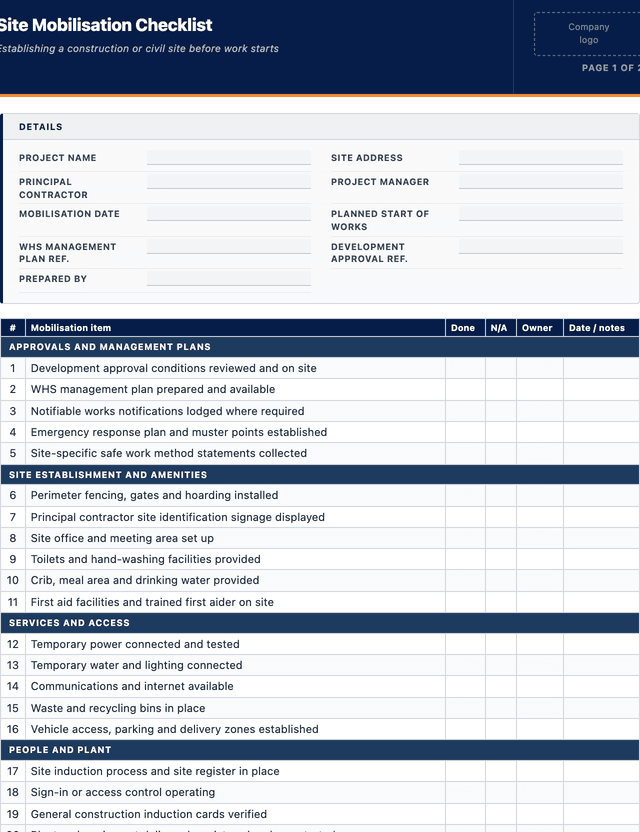
Site Mobilisation Checklist
Establishing a construction or civil site before work starts
APPROVALS AND MANAGEMENT PLANS
SITE ESTABLISHMENT AND AMENITIES
SERVICES AND ACCESS
PEOPLE AND PLANT
ENVIRONMENTAL AND TRAFFIC CONTROLS
How to use: download the PDF, print or complete digitally on any device.
- PDF format, ready to print or fill on screen
- Use as-is or customise to suit your operation
- Go digital in MapTrack for photos, reminders and audit trails
Two ways to use it
Use in MapTrack →Use it digitally instead
Unlimited usersUpload this PDF and MapTrack drafts the form for you.




- Scan the asset’s QR tag with any phone
- Submitted forms can trigger alerts
- Photos on fails, audit-ready records
- Export responses, PDF reports with your logo
Free trial. No credit card needed.
Trusted by teams across Australia and New Zealand
We respect your privacy. Unsubscribe anytime.
These templates are free general guides provided as-is. They do not constitute legal, safety or compliance advice. You are responsible for ensuring any form meets your specific workplace obligations, industry standards and applicable regulations.
Don't just download it - use it live. Start a free workspace, upload this site mobilisation checklist and MapTrack drafts it as a form your crew can run from a phone.

Co-Founder & Commercial Director
Key takeaways
- The MapTrack site mobilisation checklist contains 27 checks across 5 sections. Sections covered: APPROVALS AND MANAGEMENT PLANS, SITE ESTABLISHMENT AND AMENITIES, SERVICES AND ACCESS, PEOPLE AND PLANT, ENVIRONMENTAL AND TRAFFIC CONTROLS.
Enter your email below to download this site mobilisation checklist as a ready-to-use PDF.
Used by construction, mining and field service teams











What is a site mobilisation checklist?
A site mobilisation checklist is the structured list a construction or civil team works through to establish a site before productive work begins. It covers site establishment and fencing, welfare amenities, temporary services such as power and water, inductions and the register of who is on site, plant and equipment delivery, permits and approvals, and the environmental and traffic controls that must be in place from day one. Completed before the first crew mobilises, it turns a bare block into a controlled, compliant workplace.
This checklist matters because the mobilisation phase is where most avoidable problems are set up or prevented. A site that opens without amenities, without an induction process, without traffic management or without confirmed services either stops within days or runs unsafely and out of compliance. Under the model WHS Regulations the principal contractor for a construction project has specific duties, including preparing a WHS management plan and site signage before work starts, and managing the site so workers and the public are not put at risk. A consistent mobilisation checklist is how a project manager confirms those duties are met before anyone picks up a tool.
Learn more about asset tracking in MapTrack.
Benefits of using this site mobilisation checklist
- Compliant from day one: confirming the WHS management plan, signage and site controls before work starts meets the principal contractor's duties.
- No productivity stalls: establishing amenities, power, water and access up front stops the crew standing idle waiting on the basics.
- Controlled site access: a working induction and sign-in process means only inducted, authorised people and plant enter the site.
- Safer public interface: traffic management and perimeter controls in place at mobilisation protect neighbours, pedestrians and passing traffic.
- Environmental controls ready: sediment, dust and spill controls installed before earthworks begin keeps the project ahead of its approvals.
- Clear accountability: assigning an owner and a done date to each item shows exactly what is ready and what is outstanding before crews arrive.
Benefits of digitising forms in MapTrack
When you move from paper or static PDFs to digital forms in MapTrack, you get:
- Field users can easily scan a QR code to complete a form on mobile. Unlimited users.
- Email the right people when a form is submitted, with an automation you set up.
- File every completed form against the asset, location or person it covers.
- Download any completed form as a PDF, with failed answers listed at the top.
- Fill in forms offline; they upload when the device is back online.
- Build conditional logic (show or hide questions based on answers).
- Take pictures or attach photos. Not possible with a paper-based form.
- Electronic signatures.
- Edit forms later without reprinting.
- Set who can view, fill in or edit forms with user roles.
- Upload a paper form (PDF, Word, Excel or a photo) and MapTrack's AI builds a digital version for you to check.
- Collect SWMS sign-ons as signed forms against each site.
- Track tool and plant movements between job sites as they are scanned, checked out and returned.
- Download completed site forms as PDFs when a principal contractor asks for them.
Book a demo to see how MapTrack handles forms.
Try MapTrack free for 30 days
Full access to every feature. No credit card required. Per-asset pricing so you scale as your fleet grows.
- No credit card required
- 30 days free trial
- Cancel anytime
1-2 days/week saved
“Bloody amazing! We used to spend 1-2 days a week tracking and managing our generators alone.”

Steve McAllister
Asset Coordinator, Saunders International
What to include in a site mobilisation checklist
This site mobilisation checklist covers 11 key areas:
- Project and site details, principal contractor, and mobilisation date
- Site establishment: fencing, gates, hoarding and site identification signage
- Welfare amenities: toilets, crib and meal areas, drinking water, first aid
- Temporary services: power, water, lighting, communications and waste
- WHS management plan, site rules, emergency plan and muster points
- Induction process, site register and sign-in or access control
- Plant and equipment delivery, and pre-start and registration checks
- Permits, approvals and notifications required before work starts
- Environmental controls: sediment fencing, dust suppression, spill kits
- Traffic management plan, pedestrian routes and public interface controls
- Utilities located and marked, and any excavation or service permits
How to use this site mobilisation checklist
- Confirm approvals and the WHS management plan: Before anything is set up, confirm the development approval conditions, the WHS management plan, and any notifiable-works notifications are in place. These set the rules every other mobilisation task must follow, and starting without them exposes the project from day one.
- Establish the site perimeter and signage: Install fencing, gates, hoarding and site identification signage so the boundary between the workplace and the public is clear and controlled. This is a specific principal-contractor duty and the foundation for controlling who and what enters the site.
- Set up amenities and temporary services: Establish toilets, crib and meal areas, drinking water, first aid, and connect temporary power, water, lighting and communications. A site without working amenities and services cannot run productively or lawfully, so these go in before crews mobilise.
- Stand up induction and access control: Put the site induction, sign-in process and site register in place so every person and subcontractor is inducted before entry. Confirm plant arriving on site is registered, pre-started and operated only by licensed operators before it works.
- Install environmental and traffic controls: Install sediment fencing, dust suppression and spill kits, and set up the traffic management plan with pedestrian routes and public-interface controls. Locate and mark underground services before any excavation so the ground is safe to break.
In MapTrack, you can track construction equipment across every site. Each submission is stored as a timestamped PDF against the asset record.
Get the free templateEnter your email above to download the full site mobilisation checklist as a PDF.Back to download formHow often should you complete this form?
Complete the full mobilisation checklist once per project, before the first crew mobilises and productive work begins. Every item should carry an owner and a done date, and the checklist should be signed off by the site or project manager before the site is declared open.
Re-check the controls whenever the site changes materially, such as a new work zone opening, a change in traffic conditions, or a new stage of works. Some elements, like amenities cleaning, first aid stocks and environmental control condition, then move into routine site inspections rather than staying a one-off mobilisation task.
Frequently asked questions
Applicable regulatory standards
This template is a starting point. Check the current requirements that apply to your equipment, work and location. The template alone does not establish compliance.
- Model Work Health and Safety (WHS) Act and Regulations, as enacted in each state and territory (in Victoria, the Occupational Health and Safety Act 2004 (Vic) and OHS Regulations 2017 (Vic))
- Model WHS Regulations Part 6.4 - additional duties of a principal contractor for a construction project (WHS management plan, signage)
- Model Code of Practice: Construction work (Safe Work Australia); SWMS required for high risk construction work (model WHS Regulations regs 291 and 299)
- Locate underground services via Before You Dig Australia (BYDA); relevant state or territory environmental protection and development approval requirements
Check the current source
Site Mobilisation Checklist preview
The numbers behind this site mobilisation checklist
Every figure below is sourced and dated, so you can quote it in a toolbox talk, a budget case or a board paper without having to chase the original report.
Embed this free template on your website
Run an industry blog, trade association site, or training resource? Drop a preview of this free site mobilisation checklist straight into your page. The snippet is self-contained, needs no scripts, and links readers back to the full free template.
<div style="max-width:480px;font-family:system-ui,-apple-system,'Segoe UI',Roboto,sans-serif;border:1px solid #E5E7EB;border-radius:12px;padding:20px;background:#ffffff;">
  <p style="font-size:12px;font-weight:700;letter-spacing:0.05em;text-transform:uppercase;color:#071D49;margin:0;">Free template</p>
  <p style="font-size:18px;font-weight:700;color:#071D49;margin:6px 0 0;">Site Mobilisation Checklist</p>
  <ul style="margin:12px 0 0;padding-left:18px;color:#374151;font-size:14px;line-height:1.6;">
    <li style="margin:4px 0;">Project and site details, principal contractor, and mobilisation date</li>
    <li style="margin:4px 0;">Site establishment: fencing, gates, hoarding and site identification signage</li>
    <li style="margin:4px 0;">Welfare amenities: toilets, crib and meal areas, drinking water, first aid</li>
    <li style="margin:4px 0;">Temporary services: power, water, lighting, communications and waste</li>
    <li style="margin:4px 0;">WHS management plan, site rules, emergency plan and muster points</li>
    <li style="margin:4px 0;">Induction process, site register and sign-in or access control</li>
  </ul>
  <p style="font-size:13px;color:#6B7280;margin:14px 0 0;padding-top:12px;border-top:1px solid #E5E7EB;">Free <a href="https://www.maptrack.com/templates/site-mobilisation-checklist" style="color:#071D49;font-weight:600;text-decoration:none;">Site Mobilisation Checklist</a> by MapTrack</p>
</div>Free to reuse, including commercially. This template is published under a Creative Commons Attribution 4.0 licence. Copy it, adapt it, put it on your own site or in your own docs. All we ask is that you credit MapTrack with a link back to this page. The snippet above already includes that credit, so if you use it as-is you’re covered.
Cite this template
Writing about this topic? You’re welcome to quote this checklist. Here’s the wording to use so your readers can find the original.
The MapTrack site mobilisation checklist contains 27 checks across 5 sections.
- Short attribution
- MapTrack Site Mobilisation Checklist, https://www.maptrack.com/templates/site-mobilisation-checklist
- Reference list
- MapTrack. (2026). Site Mobilisation Checklist [Checklist template]. Retrieved from https://www.maptrack.com/templates/site-mobilisation-checklist
Free to reuse with credit under a Creative Commons Attribution 4.0 licence. If you’d rather link straight to it, the page is https://www.maptrack.com/templates/site-mobilisation-checklist.
Need to track construction equipment across every site?
Register every asset in MapTrack, attach digital forms, and get a complete history of every inspection, service and compliance record.