
Free forklift log book
Free forklift log book (PDF-ready). Record operator, pre-start result, hours, faults and refuel for every shift against AS 2359 and WHS duties.
Updated 5 July 2026
Forklift Log Book
Daily pre-start, operator and hour record for a powered industrial truck
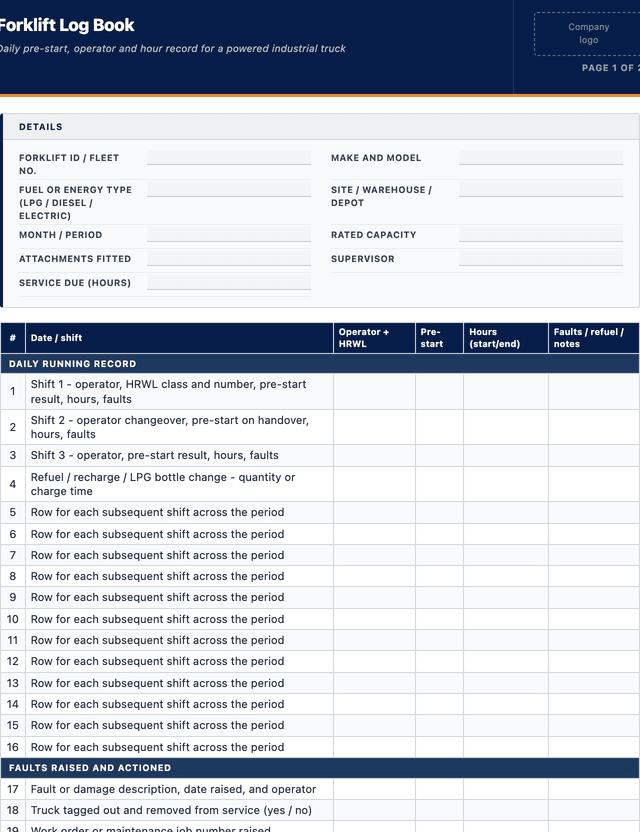
DAILY RUNNING RECORD
FAULTS RAISED AND ACTIONED
SUPERVISOR REVIEW
How to use: download the PDF, print or complete digitally on any device.
- PDF format, ready to print or fill on screen
- Use as-is or customise to suit your operation
- Go digital in MapTrack for photos, reminders and audit trails
Two ways to use it
Use in MapTrack →Use it digitally instead
Unlimited usersUpload this PDF and MapTrack drafts the form for you.




- Scan the asset’s QR tag with any phone
- Submitted forms can trigger alerts
- Photos on fails, audit-ready records
- Export responses, PDF reports with your logo
Free trial. No credit card needed.
Trusted by teams across Australia and New Zealand
We respect your privacy. Unsubscribe anytime.
These templates are free general guides provided as-is. They do not constitute legal, safety or compliance advice. You are responsible for ensuring any form meets your specific workplace obligations, industry standards and applicable regulations.
Don't just download it - use it live. Start a free workspace, upload this forklift log book and MapTrack drafts it as a form your crew can run from a phone.

Co-Founder & Commercial Director
Key takeaways
- The MapTrack forklift log book contains 23 checks across 3 sections. Sections covered: DAILY RUNNING RECORD, FAULTS RAISED AND ACTIONED, SUPERVISOR REVIEW.
Enter your email below to download this forklift log book as a ready-to-use PDF.
Used by construction, mining and field service teams











What is a forklift log book?
A forklift log book is a bound running record that captures how a powered industrial truck is used and checked, one line per shift or per operator changeover. Each entry records the date and time, the operator and their high risk work licence, the pre-start check result, the hour-meter reading, any faults or damage found, and whether the truck was refuelled, recharged or had its LPG bottle changed. Kept with the machine, it is the first thing a supervisor, hire company or WHS inspector reaches for to see whether the forklift was fit for use on any given day.
A log book matters because a forklift is one of the highest-risk pieces of plant on any site or in any warehouse, and the person operating it changes often. Under the model WHS Regulations a person conducting a business or undertaking must maintain plant so it stays safe and must ensure operators hold the correct high risk work licence, and AS 2359.2 sets out the operations requirements for powered industrial trucks (AS 2359.1:2019 covers their design). Forklifts sit under the AS 2359 series and are excluded from the AS 1418 and AS 2550 crane standards. A consistent daily record ties each set of hours to a named, licensed operator and a completed pre-start, so faults are caught before they cause an incident and the service history stays complete for the fleet register.
Learn more about GPS and fleet tracking in MapTrack.
Keeping a log book for every forklift? Our guide compares plant and equipment management software in Australia.
Benefits of using this forklift log book
- Fit-for-use evidence: a completed pre-start line each shift proves the forklift was checked before it carried a load or moved.
- Licence accountability: recording the operator and their high risk work licence ties every shift to a named, qualified person.
- Early fault capture: a place to note steering, brake, hydraulic or tyne defects means problems are logged before they escalate.
- Accurate service intervals: a running hour-meter reading each shift feeds the service schedule so maintenance lands on hours, not guesswork.
- Fuel and energy tracking: recording refuel, recharge or gas-bottle changes exposes creeping consumption that often signals a developing fault.
- Audit and hire trail: a dated, signed log demonstrates a controlled process for WHS reviews and satisfies hire-company usage records.
Benefits of digitising forms in MapTrack
When you move from paper or static PDFs to digital forms in MapTrack, you get:
- Field users can easily scan a QR code to complete a form on mobile. Unlimited users.
- Email the right people when a form is submitted, with an automation you set up.
- File every completed form against the asset, location or person it covers.
- Download any completed form as a PDF, with failed answers listed at the top.
- Fill in forms offline; they upload when the device is back online.
- Build conditional logic (show or hide questions based on answers).
- Take pictures or attach photos. Not possible with a paper-based form.
- Electronic signatures.
- Edit forms later without reprinting.
- Set who can view, fill in or edit forms with user roles.
- Upload a paper form (PDF, Word, Excel or a photo) and MapTrack's AI builds a digital version for you to check.
- Schedule services by odometer, engine hours or date for every vehicle.
- Keep fuel receipts and service records with each vehicle's inspections.
- Record repair costs on each work order against the vehicle.
Book a demo to see how MapTrack handles forms.
Try MapTrack free for 30 days
Full access to every feature. No credit card required. Per-asset pricing so you scale as your fleet grows.
- No credit card required
- 30 days free trial
- Cancel anytime
Intuitive for field crews
“MapTrack's a great platform - intuitive for the guys out in the field and also has fantastic support.”

Matthew Anderson
Maintenance Planning Supervisor, Supagas
What to include in a forklift log book
This forklift log book covers 10 key areas:
- Forklift ID, make, model and fuel or energy type (LPG, diesel, electric)
- Site, warehouse or depot where the truck is operating
- Date and shift, with time on and time off
- Operator name and high risk work licence number and class
- Pre-start check result: pass, pass with defects, or fail (do not operate)
- Hour-meter reading at start and end of shift
- Faults, damage or near misses observed during the shift
- Refuel, recharge or LPG bottle change, with quantity or duration
- Load-related notes such as unusual loads, attachments fitted, or ground conditions
- Operator signature and supervisor review or sign-off
How to use this forklift log book
- Complete the pre-start before first use: At the start of each shift the operator walks around the forklift and checks tyres, forks, mast, hydraulics, brakes, horn, lights, seatbelt and data plate. Record the result in the log before the truck moves a load, and tag out any machine that fails.
- Record operator, licence and hours: Write the operator name, high risk work licence class and number, and the hour-meter reading. This ties the shift to a qualified person and gives an accurate usage figure that the service schedule and the fleet register both rely on.
- Log faults and damage as they happen: During the shift note any new noise, leak, warning light, steering or brake change, or damage to forks or guards. A fault raised on the line becomes a maintenance job rather than a problem the next operator inherits without warning.
- Note refuel, recharge and gas changes: Record each refuel, battery recharge or LPG bottle change with the quantity or charge time. Tracking energy use over the week reveals leaks, worn seals or a battery losing capacity well before the truck fails to start or stalls under load.
- Sign off and review at end of shift: The operator signs the entry and the supervisor reviews the log, actions any defects raised, and confirms the truck is fit for the next shift or removes it from service. File the book with the machine so the record travels with the asset.
In MapTrack, you can track your fleet with GPS and digital pre-starts. Each submission is stored as a timestamped PDF against the asset record.
Get the free templateEnter your email above to download the full forklift log book as a PDF.Back to download formHow often should you complete this form?
Complete one entry every shift, and a fresh entry whenever the operator changes, so every set of hours is tied to a named, licensed person and a valid pre-start. A forklift that runs across two or three shifts a day should show two or three lines, not one.
Review the log weekly at a toolbox or fleet meeting to spot repeat faults, rising fuel or charge consumption, and any shifts run without a recorded pre-start. Reconcile the hour-meter readings against the service schedule each month so planned servicing lands on actual usage rather than a calendar guess.
Frequently asked questions
Applicable regulatory standards
This template is a starting point. Check the current requirements that apply to your equipment, work and location. The template alone does not establish compliance.
- Model Work Health and Safety (WHS) Act and Regulations, as enacted in each state and territory (in Victoria, the Occupational Health and Safety Act 2004 (Vic) and OHS Regulations 2017 (Vic)) - plant maintenance and inspection duties
- AS 2359.1:2019 Powered industrial trucks - General requirements (design) and AS 2359.2 (operations)
- High risk work licence classes LF (forklift truck) and LO (order-picking forklift), model WHS Regulations Schedule 3, issued by state and territory WHS regulators
- Model Code of Practice: Managing the risks of plant in the workplace (Safe Work Australia)
Forklift Log Book preview
The numbers behind this forklift log book
Every figure below is sourced and dated, so you can quote it in a toolbox talk, a budget case or a board paper without having to chase the original report.
Embed this free template on your website
Run an industry blog, trade association site, or training resource? Drop a preview of this free forklift log book straight into your page. The snippet is self-contained, needs no scripts, and links readers back to the full free template.
<div style="max-width:480px;font-family:system-ui,-apple-system,'Segoe UI',Roboto,sans-serif;border:1px solid #E5E7EB;border-radius:12px;padding:20px;background:#ffffff;">
  <p style="font-size:12px;font-weight:700;letter-spacing:0.05em;text-transform:uppercase;color:#071D49;margin:0;">Free template</p>
  <p style="font-size:18px;font-weight:700;color:#071D49;margin:6px 0 0;">Forklift Log Book</p>
  <ul style="margin:12px 0 0;padding-left:18px;color:#374151;font-size:14px;line-height:1.6;">
    <li style="margin:4px 0;">Forklift ID, make, model and fuel or energy type (LPG, diesel, electric)</li>
    <li style="margin:4px 0;">Site, warehouse or depot where the truck is operating</li>
    <li style="margin:4px 0;">Date and shift, with time on and time off</li>
    <li style="margin:4px 0;">Operator name and high risk work licence number and class</li>
    <li style="margin:4px 0;">Pre-start check result: pass, pass with defects, or fail (do not operate)</li>
    <li style="margin:4px 0;">Hour-meter reading at start and end of shift</li>
  </ul>
  <p style="font-size:13px;color:#6B7280;margin:14px 0 0;padding-top:12px;border-top:1px solid #E5E7EB;">Free <a href="https://www.maptrack.com/templates/forklift-log-book-template" style="color:#071D49;font-weight:600;text-decoration:none;">Forklift Log Book</a> by MapTrack</p>
</div>Free to reuse, including commercially. This template is published under a Creative Commons Attribution 4.0 licence. Copy it, adapt it, put it on your own site or in your own docs. All we ask is that you credit MapTrack with a link back to this page. The snippet above already includes that credit, so if you use it as-is you’re covered.
Cite this template
Writing about this topic? You’re welcome to quote this checklist. Here’s the wording to use so your readers can find the original.
The MapTrack forklift log book contains 23 checks across 3 sections.
- Short attribution
- MapTrack Forklift Log Book, https://www.maptrack.com/templates/forklift-log-book-template
- Reference list
- MapTrack. (2026). Forklift Log Book [Checklist template]. Retrieved from https://www.maptrack.com/templates/forklift-log-book-template
Free to reuse with credit under a Creative Commons Attribution 4.0 licence. If you’d rather link straight to it, the page is https://www.maptrack.com/templates/forklift-log-book-template.
Need to track your fleet with GPS and digital pre-starts?
Register every asset in MapTrack, attach digital forms, and get a complete history of every inspection, service and compliance record.
GPS and fleet tracking · All templates · Pricing · Book a demo