
Free scaffolding SWMS template
Free scaffolding SWMS template (PDF-ready). Covers erect, alter and dismantle controls, licensing and AS/NZS 1576 inspection.
Updated 10 Aug 2026
Scaffolding Safe Work Method Statement (SWMS)
High-risk construction work: erecting, altering and dismantling scaffold
Checklist
How to use: download the PDF, print or complete digitally on any device.
- PDF format, ready to print or fill on screen
- Use as-is or customise to suit your operation
- Go digital in MapTrack for photos, reminders and audit trails
Download free PDF template
Use in MapTrack →



Trusted by teams across Australia and New Zealand
We respect your privacy. Unsubscribe anytime.
Or set it up in MapTrack
- Fill it in on a phone, attach photos to any check
- Automatic reports and audit trails
- Upload the PDF and MapTrack drafts the form for you
Free 30-day trial. No credit card. Personal email accepted.
Don't just download it - use it live. Start a free workspace, upload this scaffolding SWMS template and MapTrack drafts it as a form your crew can run from a phone.

Co-Founder & Commercial Director
Key takeaways
- The MapTrack scaffolding SWMS template contains 4 checks.
- Scaffolding work with a fall risk over 2 metres is high risk construction work and needs a SWMS before it starts.
- A fall risk over 4 metres requires a basic, intermediate or advanced scaffolding high risk work licence.
- Most scaffold incidents happen during erection and dismantling, so fall protection sequencing is critical.
- A competent person must inspect the scaffold before use, after any alteration or incident, and at least every 30 days.
- An incomplete or untagged scaffold must not be used until it is inspected, tagged and handed over.
Enter your email below to download this scaffolding SWMS template as a ready-to-use PDF.
Used by construction, mining and field service teams









What is a scaffolding SWMS template?
A scaffolding safe work method statement (SWMS) is a high risk construction work document that sets out the hazards of erecting, altering and dismantling a scaffold, the risk of each step and the control measures that keep workers and the public safe. It records the scaffold type and duty rating, the high risk work licence class held by the scaffolders, the foundation and tie arrangement, the edge protection and fall arrest used during erection, and the handover inspection before anyone uses the completed scaffold. The SWMS is prepared before work starts, kept on site and worked through step by step by the crew.
Scaffolding is treated as high risk construction work because most serious scaffold incidents happen during erection and dismantling, before edge protection is complete, or when an incomplete or overloaded scaffold is used. Under the WHS Regulations 2011, Regulation 291, work with a risk of a person falling more than 2 metres is high risk construction work, and Regulation 299 requires a SWMS to be prepared for it. Where a person or object could fall more than 4 metres from the scaffold or working platform, the work must be carried out by a person holding the relevant class of high risk work licence. A scaffolding SWMS that is generic, not tensioned to the actual site, or signed but ignored leaves crews exposed to falls, collapse and falling components, and leaves the PCBU exposed to enforcement action.
Learn more about compliance and inspections in MapTrack.
Benefits of using this scaffolding SWMS template
- Fall prevention: documents the edge protection and fall arrest used at each lift so workers are protected before a platform is fully decked and guarded.
- Collapse control: captures the foundation, sole board, base plate, tie and bracing requirements that keep the scaffold standing under its rated load.
- Licence assurance: confirms the correct basic, intermediate or advanced scaffolding licence is held for any work with a fall risk over 4 metres.
- Public protection: sets the exclusion zones, overhead protection and gantry arrangements that keep people passing below clear of falling components.
- Handover discipline: ties the scaffold tag and handover inspection to first use, so an incomplete scaffold cannot quietly be put into service.
- Audit evidence: a worked and signed SWMS gives the principal contractor and the regulator proof that the scaffolding controls were planned and followed.
Benefits of digitising forms in MapTrack
When you move your procedures from paper to MapTrack, you get:
- Field users can easily scan a QR code to complete a form on mobile. Unlimited users.
- Email the right people when a form is submitted, with an automation you set up.
- File every completed form against the asset, location or person it covers.
- Download any completed form as a PDF, with failed answers listed at the top.
- Fill in forms offline; they upload when the device is back online.
- Build conditional logic (show or hide questions based on answers).
- Take pictures or attach photos. Not possible with a paper-based form.
- Electronic signatures.
- Edit forms later without reprinting.
- Set who can view, fill in or edit forms with user roles.
- Upload a paper form (PDF, Word, Excel or a photo) and MapTrack's AI builds a digital version for you to check.
- Email safety managers when a hazard report is submitted, with an automation you set up.
- Keep every hazard and incident report against the site it came from, with photos.
- Turn a hazard report into a corrective-action work order with its own review step.
Book a demo to see how MapTrack handles procedures.
Try MapTrack free for 30 days
Full access to every feature. No credit card required. Per-asset pricing so you scale as your fleet grows.
- No credit card required
- 30 days free trial
- Cancel anytime
1-2 days/week saved
“Bloody amazing! We used to spend 1-2 days a week tracking and managing our generators alone.”

Steve McAllister
Asset Coordinator, Saunders International
What to include in a scaffolding SWMS template
This scaffolding SWMS template covers 9 key areas:
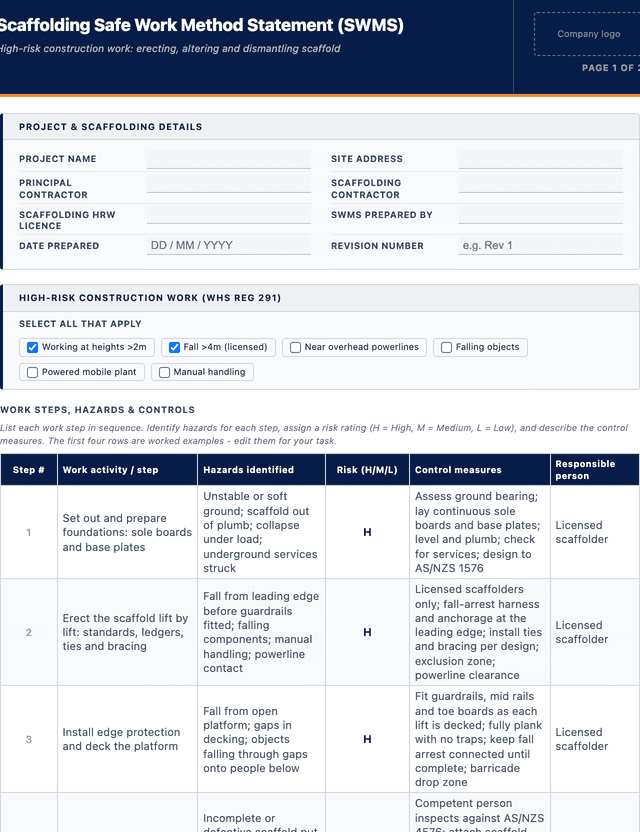
- Project and scaffold details: site address, principal contractor, scaffold type and duty rating, working height, fall distance, and the licence class required.
- Scaffolder competency: names and high risk work licence classes (basic, intermediate, advanced), the supervising scaffolder, and confirmation of currency.
- Hazards and risk rating: a risk for each step including falls during erection and dismantling, collapse, falling components, powerline contact and manual handling.
- Foundation and access: ground assessment, sole boards and base plates, levelling, scaffold ties, bracing, and safe access by ladder bays or stair towers.
- Fall protection during work: the edge protection sequence, fall arrest anchorage, harness and lanyard use, and how the leading edge is managed at each lift.
- Plant, materials and powerlines: component handling, mechanical lifting or gin wheels, minimum approach distances to overhead powerlines and any permit needed.
- Exclusion zones and the public: barricades, overhead protection, gantries, signage, and controls for pedestrians and traffic passing below the work area.
- Scaffold tag and handover: the scaffold tag (scafftag) system, the handover certificate, and the rule that an incomplete or untagged scaffold must not be used.
- Inspection and review: the competent person inspection before use, after any alteration or incident, and at least every 30 days, plus the SWMS review triggers.
How to use this scaffolding SWMS template
- Plan the scaffold and confirm the licence class before any work starts.: Establish the scaffold type, duty rating and the maximum distance a person or object could fall. Where that distance exceeds 4 metres, confirm the scaffolders hold the relevant basic, intermediate or advanced high risk work licence, and check the design against AS/NZS 1576 for the loads and configuration planned.
- Prepare the foundations, access and the fall protection sequence.: Assess the ground and set firm sole boards and adjustable base plates so the scaffold is level and stable. Plan the tie and bracing pattern, the safe access bays, and the order in which edge protection and fall arrest are installed so workers are protected as each lift is built and decked.
- Set exclusion zones and check clearances to overhead powerlines.: Before lifting components, establish barricaded exclusion zones and overhead protection to keep the public and other trades clear of the drop zone. Identify any overhead powerlines, apply the minimum approach distance for the state, and arrange isolation, tiger tails or a permit where the clearance cannot be maintained.
- Erect, tie and inspect the scaffold, then tag and hand it over.: Build the scaffold in the planned sequence, installing ties, bracing, guardrails, mid rails and toe boards as each lift is completed. A competent person then inspects the finished scaffold, attaches a scaffold tag showing it is complete and safe, and issues the handover certificate before anyone other than the erection crew uses it.
- Inspect on schedule, control alterations and dismantle under the SWMS.: Re-inspect the scaffold at least every 30 days, after any alteration, and after any incident, severe weather or repair, updating the tag each time. Only a licensed scaffolder may alter the scaffold. When work is finished, dismantle from the top down under the same fall protection and exclusion controls used during erection.
In MapTrack, you can digitise safety inspections and compliance forms. Each submission is stored as a timestamped PDF against the asset record.
Get the free templateEnter your email above to download the full scaffolding SWMS template as a PDF.Back to download formHow often should you complete this procedure?
A scaffolding SWMS is prepared before the high risk construction work begins and is reviewed whenever the work, the scaffold design or the site conditions change, when a control is found to be inadequate, or after any incident or near miss. It is not a one off document. The crew works through it on the day, and it stays on site and available to the principal contractor and the regulator for the duration of the work.
The scaffold itself must be inspected by a competent person before it is first used, before use resumes after an incident or repairs, and at least every 30 days under the WHS Regulations 2011, Regulation 225. Many sites also inspect after severe weather and at the start of each shift as a matter of practice. In MapTrack, attach the SWMS to the scaffolding work order, schedule the 30 day inspections as recurring tasks against the scaffold asset, and keep the tag status, handover certificate and inspection history in one auditable record.
Frequently asked questions
Applicable regulatory standards
This template is a starting point. Check the current requirements that apply to your equipment, work and location. The template alone does not establish compliance.
- WHS Regulations 2011, Regulation 291 - Meaning of high risk construction work (includes risk of a person falling more than 2 metres)
- WHS Regulations 2011, Regulation 299 - Duty to prepare a safe work method statement for high risk construction work
- WHS Regulations 2011, Regulation 225 - Inspection of scaffolds by a competent person before use, after an incident or repair, and at least every 30 days
- AS/NZS 1576 - Scaffolding (general requirements for design and construction)
- AS/NZS 4576 - Guidelines for scaffolding (selection, erection, alteration, dismantling, inspection and use)
Check the current source
Scaffolding SWMS template preview
The numbers behind this scaffolding SWMS template
Every figure below is sourced and dated, so you can quote it in a toolbox talk, a budget case or a board paper without having to chase the original report.
Embed this free template on your website
Run an industry blog, trade association site, or training resource? Drop a preview of this free scaffolding SWMS template straight into your page. The snippet is self-contained, needs no scripts, and links readers back to the full free template.
<div style="max-width:480px;font-family:system-ui,-apple-system,'Segoe UI',Roboto,sans-serif;border:1px solid #E5E7EB;border-radius:12px;padding:20px;background:#ffffff;">
  <p style="font-size:12px;font-weight:700;letter-spacing:0.05em;text-transform:uppercase;color:#071D49;margin:0;">Free template</p>
  <p style="font-size:18px;font-weight:700;color:#071D49;margin:6px 0 0;">Scaffolding SWMS template</p>
  <ul style="margin:12px 0 0;padding-left:18px;color:#374151;font-size:14px;line-height:1.6;">
    <li style="margin:4px 0;">Project and scaffold details: site address, principal contractor, scaffold type and duty rating, working height, fall distance, and the licence class required.</li>
    <li style="margin:4px 0;">Scaffolder competency: names and high risk work licence classes (basic, intermediate, advanced), the supervising scaffolder, and confirmation of currency.</li>
    <li style="margin:4px 0;">Hazards and risk rating: a risk for each step including falls during erection and dismantling, collapse, falling components, powerline contact and manual handling.</li>
    <li style="margin:4px 0;">Foundation and access: ground assessment, sole boards and base plates, levelling, scaffold ties, bracing, and safe access by ladder bays or stair towers.</li>
    <li style="margin:4px 0;">Fall protection during work: the edge protection sequence, fall arrest anchorage, harness and lanyard use, and how the leading edge is managed at each lift.</li>
    <li style="margin:4px 0;">Plant, materials and powerlines: component handling, mechanical lifting or gin wheels, minimum approach distances to overhead powerlines and any permit needed.</li>
  </ul>
  <p style="font-size:13px;color:#6B7280;margin:14px 0 0;padding-top:12px;border-top:1px solid #E5E7EB;">Free <a href="https://www.maptrack.com/templates/scaffolding-swms" style="color:#071D49;font-weight:600;text-decoration:none;">Scaffolding SWMS template</a> by MapTrack</p>
</div>Free to reuse, including commercially. This template is published under a Creative Commons Attribution 4.0 licence. Copy it, adapt it, put it on your own site or in your own docs. All we ask is that you credit MapTrack with a link back to this page. The snippet above already includes that credit, so if you use it as-is you’re covered.
Cite this template
Writing about this topic? You’re welcome to quote this checklist. Here’s the wording to use so your readers can find the original.
The MapTrack scaffolding SWMS template contains 4 checks.
- Short attribution
- MapTrack Scaffolding SWMS template, https://www.maptrack.com/templates/scaffolding-swms
- Reference list
- MapTrack. (2026). Scaffolding SWMS template [Checklist template]. Retrieved from https://www.maptrack.com/templates/scaffolding-swms
Free to reuse with credit under a Creative Commons Attribution 4.0 licence. If you’d rather link straight to it, the page is https://www.maptrack.com/templates/scaffolding-swms.
Need to digitise safety inspections and compliance forms?
Register every asset in MapTrack, attach digital forms, and get a complete history of every inspection, service and compliance record.
Compliance and inspections · All templates · Pricing · Book a demo