
Free template · PDF
Free mining equipment maintenance checklist
Free mining equipment maintenance checklist (PDF-ready). ROPS, fire suppression, dust control, brakes, isolation and GET checks for heavy mining plant.
Loading PDF page...
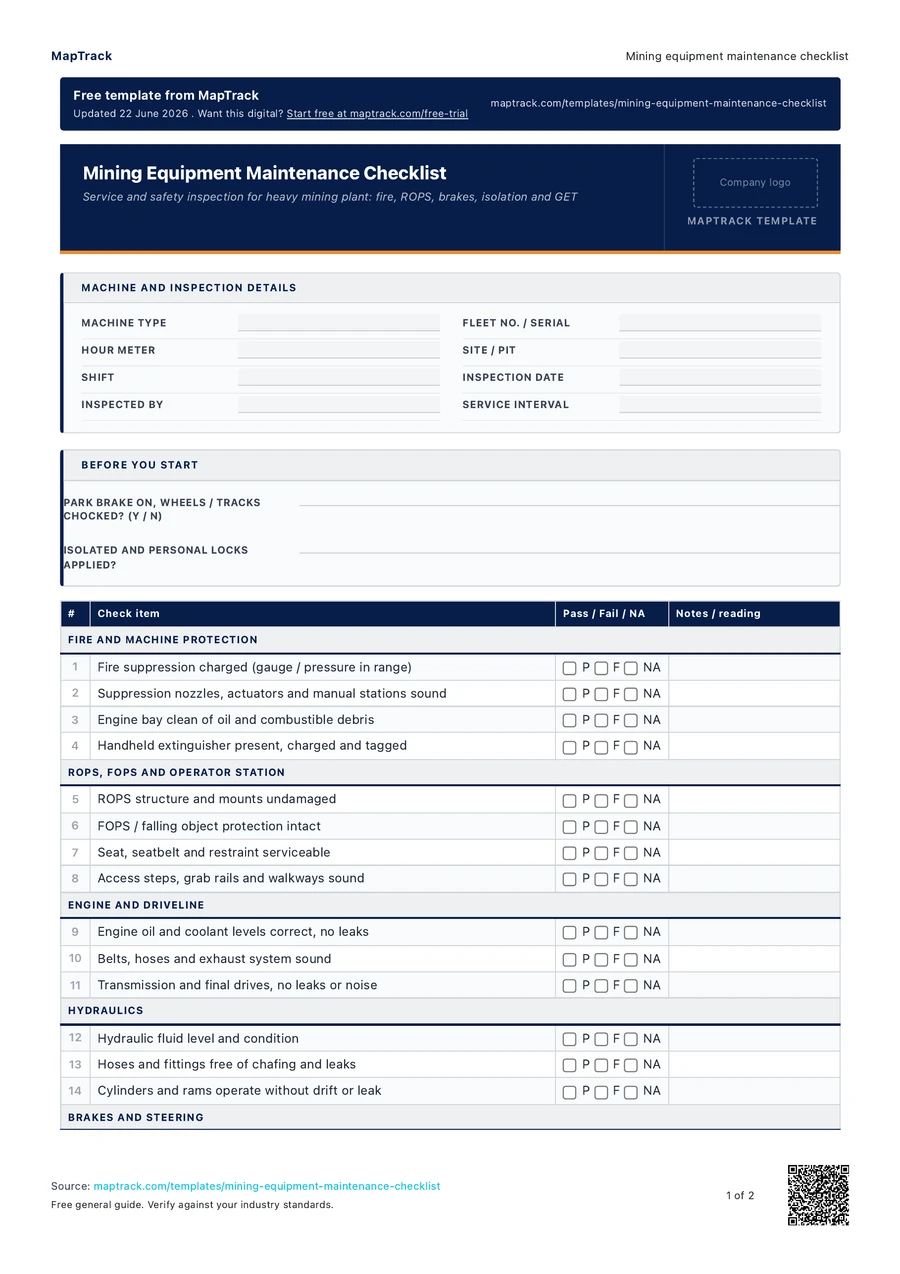

Read the form fields
27 checks · 8 sections · Sign-off
27 checks
The fields in the printable form, in a view that fits your screen.
- Machine type
- Fleet no. / serial
- Hour meter
- Site / pit
- Shift
- Inspection date
- Inspected by
- Service interval
Fire and machine protection
ROPS, FOPS and operator station
Engine and driveline
Hydraulics
Brakes and steering
Tyres, tracks and ground engaging tools
Dust suppression, isolation and electrical
Warning devices and lighting
Inspected by (fitter)
Signature · Print name · Time taken · Date
Reviewed / approved by (supervisor)
Signature · Print name · Next due · Date
The MapTrack mining equipment maintenance checklist contains 27 checks across 8 sections.

Co-Founder & Commercial Director
Make this form your own
Add your fields and logo. Give your team a form they can use on site.
Free 30-day trial. No credit card. Work email needed.
Upload & use this form now for free



“MapTrack beat them all in every aspect.”
 Vincent Stone · HSEQ Advisor, Concept Tanks
After signup: upload this PDF, check the form MapTrack drafts, then save and publish it for your team.
General guidance only. Check the form against your equipment manual, site procedures and local requirements before using it.
Key takeaways
- The MapTrack mining equipment maintenance checklist contains 27 checks across 8 sections. Sections covered: Fire and machine protection, ROPS, FOPS and operator station, Engine and driveline, Hydraulics, Brakes and steering, Tyres, tracks and ground engaging tools, Dust suppression, isolation and electrical, Warning devices and lighting.
- A mining checklist adds fire suppression, ROPS, FOPS, dust control, braking and isolation to the standard heavy plant inspection.
- It reflects the harsh mining duty cycle and the mines regulation that sits over general WHS duties.
- Fire suppression and brake checks are weighted heavily because the consequences in a pit are severe.
- Tracking tyre, track and GET wear controls some of the largest costs on mining plant.
- A dated inspection trail is evidence of a controlled process for the mining regulation, WHS and ISO 55001.
What is a mining equipment maintenance checklist?
A mining equipment maintenance checklist is a heavy plant inspection sheet built for the mining environment, where machines work long shifts in dust, heat and rough ground and where the safety systems carry real consequences. It steps a fitter through the engine, driveline, hydraulics, tyres or tracks and the structure of a haul truck, excavator, dozer, loader or grader, but it gives equal weight to the mining safety systems: ROPS and FOPS structures, fire suppression, dust suppression, the service and park brakes, isolation and lockout points, ground engaging tools, lighting and the emergency stops. Every line is marked pass, fail or not applicable so the machine condition is captured in one dated, auditable record.
This differs from a generic heavy equipment checklist because the mining context changes what can hurt people and what the law expects. Mine sites operate under the mining safety regulation in addition to the general Work Health and Safety duties, fire suppression and rollover protection are not optional extras, and isolation discipline is central to keeping fitters alive during service. A consistent checklist makes those controls a measured routine rather than an assumption: it forces the brake, fire, dust and isolation checks that prevent the events a mine fears most, and it builds the component history behind planned maintenance, tyre management and repair versus replace decisions on assets that cost a fortune to stand idle.
Learn more about maintenance and work orders in MapTrack.
Choose the format that fits your team
Download the PDF
Use the original printable form for a paper workflow. Check it against your equipment and site procedure before the job.
Keep completed copies in your own record system and arrange any follow-up through your normal process.
Download free PDFCustomise a form in MapTrack
Start a free trial, upload this PDF and MapTrack drafts the form. Adjust it to your workflow, then save and publish it for your team to use.
Sample answers on this page and completed PDF records aren't imported automatically.
Upload & use this form now for freeFree 30-day trial. No credit card. Work email needed.
Benefits of using this mining equipment maintenance checklist
- Safer machines: dedicated ROPS, FOPS, brake, fire and isolation checks keep the controls that protect operators and fitters proven and current.
- Less unplanned downtime: catching wear early on driveline, hydraulics and GET avoids failures that strand a machine in the pit mid shift.
- Fire risk control: routine inspection of suppression and the engine bay reduces the machine fire risk that mining heat and debris create.
- Lower running cost: tracking tyre, track and component condition supports replacement on real wear rather than premature or overdue change outs.
- Complete asset history: each dated inspection builds the record behind planned maintenance, criticality decisions and budget on high value plant.
- Audit evidence: a consistent inspection trail demonstrates a controlled maintenance process for the mining regulation, WHS duties and ISO 55001.
What to include in a mining equipment maintenance checklist
- Machine details: type, fleet number, serial, hour meter, site or pit, shift and inspection date
- Engine and driveline: oil and coolant levels, leaks, belts, exhaust and transmission condition
- Hydraulics: fluid level and condition, hoses, cylinders, leaks and ram operation
- Brakes: service brake, park brake, retarder or emergency brake test and response
- ROPS and FOPS: structure, mounts, glass and falling object protection condition
- Fire suppression: charge or pressure, nozzles, actuators, manual stations and engine bay cleanliness
- Dust suppression: water cart, sprays, cab pressurisation and filtration where fitted
- Isolation and lockout: battery isolator, isolation points, stored energy and lockout provisions
- Ground engaging tools: bucket teeth, edges, blades, ripper and wear plate condition
- Lighting, beacons, reversing alarm, emergency stops and operator restraint
- Sign off: defects raised, fit for service decision, fitter and supervisor names and dates
How to use this mining equipment maintenance checklist
Isolate the machine before service
Park on stable level ground, ground all attachments, apply the park brake and chock the wheels or tracks. Isolate the machine, dissipate stored hydraulic and electrical energy and apply personal locks before any service work begins, then record the hour meter and machine details.
Inspect the mining safety systems
Check the fire suppression charge, nozzles, actuators and manual stations, and clear the engine bay of the debris and oil that feed a machine fire. Confirm ROPS and FOPS structures and mounts are sound, the dust suppression and cab filtration work, and the emergency stops, reversing alarm and beacons all function.
Check driveline, hydraulics and brakes
Work through engine oil and coolant, transmission, belts and visible leaks, then assess hydraulic fluid, hoses and cylinders for damage and weeping. Test the service brake, park brake and any retarder or emergency brake against specification, because brake performance on a loaded machine on a grade is not negotiable.
Assess tyres, tracks and ground engaging tools
Inspect tyres for cuts, pressure and tread or undercarriage components for wear and tension, since these are major cost and safety items on mining plant. Check ground engaging tools such as bucket teeth, cutting edges, blades and wear plates, and note any that are near or past their replacement point.
Record defects and decide fit for service
Mark every line pass, fail or not applicable with the reading where one applies, and raise a work order for each failed item. Make a clear fit for service or hold decision, list the parts required, then have the fitter and supervisor sign and file the sheet against the asset history.
How often should you complete this checklist?
Operators complete a prestart inspection before every shift covering the daily safety items such as brakes, fire suppression, steering, lights and visible leaks, and a machine with a defect that affects safety is held until it is made right. Fitters run the full maintenance checklist on the manufacturer service interval measured in engine hours, which on hard worked mining plant often falls every week or two given the high hour accumulation.
Tie the schedule to the mine maintenance management plan and lift the frequency on critical machines, after a brake, fire or structural event, or when a component trend shows accelerating wear. Mining plant earns its keep only when it is running, so the discipline of catching wear at the planned inspection rather than in an unplanned breakdown is what keeps a fleet available and the cost per hour under control.
Make this form your own
From your template to your team.
Upload this PDF and MapTrack drafts the form. Adjust it for your equipment and site, then save and publish the digital form for your team.
- 01
Start your free trial
Use your work email to create your MapTrack account.
- 02
Customise, save and publish
Adjust the template fields and branding for your site.
- 03
Complete it on the job
Record checks, add photos and export a branded PDF.
Keep working offline
Load the form before you lose reception. Complete it offline and sync when you're back online.
Scan the asset. Open its form.
Use an asset's QR code to find and complete the forms that belong to it.
Show what you found
Capture photos and attach files so the next person has the details they need.
Take a branded PDF with you
Download completed forms as PDF reports with your company logo.
Completed paper records aren't imported automatically.
Frequently asked questions
Practical answers about the form, record keeping and using MapTrack.
Mining plant sits under the general Work Health and Safety Act primary duty of care and, in most jurisdictions, an additional mines and petroleum sites regulation that sets specific duties for mining operations and plant. Rollover and falling object protection are judged against ISO 3471 and ISO 3449, and ISO 55001 frames the asset management records. A consistent, dated checklist that records the brake, fire suppression, ROPS, FOPS and isolation checks is strong objective evidence that the machine was maintained to those duties, which matters both at audit and after any incident on site.
Link to this answerA general heavy equipment checklist focuses on keeping the machine mechanically sound. A mining checklist keeps all of that but adds the safety systems the mining environment and regulation demand: fire suppression, ROPS and FOPS, dust suppression and cab filtration, retarder and emergency braking, strict isolation and lockout, and ground engaging tool wear. The mining version also reflects the harsher duty cycle, where machines accumulate hours fast in dust and heat, so it inspects fire and brake items more closely than a checklist written for general construction plant.
Link to this answerMining machines run hot, work hard and collect oily debris in the engine bay, which is exactly the mix that starts a machine fire, and a fire on a large machine in a pit is both a serious safety event and a very expensive loss. The checklist confirms the suppression system is charged, the nozzles aim at the risk areas, the actuators and manual stations work, and the engine bay is clean. Catching a discharged bottle or a blocked nozzle on a planned inspection is far cheaper than discovering it does not work when a fire starts.
Link to this answerOperators inspect before every shift for the daily safety critical items, and fitters service on the manufacturer hour interval. Because mining plant accumulates engine hours quickly under continuous operation, a service interval set in hours often arrives every week or two in practice rather than monthly. Increase the frequency on critical machines, after a safety event, or when wear trends point to a developing problem, and always hold a machine from service if a prestart or inspection finds a defect that affects brakes, fire suppression or structural protection.
Link to this answerYes, it is completely free. It downloads as a PDF you can keep or print as a pad for the workshop and crib room. You do not need a MapTrack account. If you want to move beyond paper, MapTrack schedules inspections against each machine, captures prestart defects from a phone in the pit, tracks parts, tyres and downtime, and keeps the full maintenance history in one place. Start free or book a demo to see how.
Link to this answerApplicable regulatory standards
This form is a starting point. Check the current requirements that apply to your equipment, work and location. The form alone does not establish compliance.
- Work Health and Safety Act 2011 and primary duty of care (s19)
- Work Health and Safety (Mines and Petroleum Sites) Regulation, mining plant duties
- ISO 3471 ROPS and ISO 3449 FOPS performance for earthmoving machinery
- ISO 55001:2024 Asset management (controlled maintenance records)
- Model Work Health and Safety Act (Safe Work Australia)
- ISO 55001:2024, Asset management system requirements (ISO catalogue)
MapTrack publishes this template. The linked authorities publish their own guidance; they haven't endorsed this form.
The numbers behind this mining equipment maintenance checklist
Every figure below is sourced and dated, so you can quote it in a toolbox talk, a budget case or a board paper without having to chase the original report.
Cite this template
Writing about this topic? You’re welcome to quote this checklist. Here’s the wording to use so your readers can find the original.
The MapTrack mining equipment maintenance checklist contains 27 checks across 8 sections.
- Short attribution
- MapTrack Mining equipment maintenance checklist, https://www.maptrack.com/templates/mining-equipment-maintenance-checklist
- Reference list
- MapTrack. (2026). Mining equipment maintenance checklist [Checklist template]. Retrieved from https://www.maptrack.com/templates/mining-equipment-maintenance-checklist
Free to reuse with credit under a Creative Commons Attribution 4.0 licence. If you’d rather link straight to it, the page is https://www.maptrack.com/templates/mining-equipment-maintenance-checklist.
Embed this free template on your website
Run an industry blog, trade association site, or training resource? Drop a preview of this free mining equipment maintenance checklist straight into your page. The snippet is self-contained, needs no scripts, and links readers back to the full free template.
<div style="max-width:480px;font-family:system-ui,-apple-system,'Segoe UI',Roboto,sans-serif;border:1px solid #E5E7EB;border-radius:12px;padding:20px;background:#ffffff;">
  <p style="font-size:12px;font-weight:700;letter-spacing:0.05em;text-transform:uppercase;color:#071D49;margin:0;">Free template</p>
  <p style="font-size:18px;font-weight:700;color:#071D49;margin:6px 0 0;">Mining equipment maintenance checklist</p>
  <ul style="margin:12px 0 0;padding-left:18px;color:#374151;font-size:14px;line-height:1.6;">
    <li style="margin:4px 0;">Machine details: type, fleet number, serial, hour meter, site or pit, shift and inspection date</li>
    <li style="margin:4px 0;">Engine and driveline: oil and coolant levels, leaks, belts, exhaust and transmission condition</li>
    <li style="margin:4px 0;">Hydraulics: fluid level and condition, hoses, cylinders, leaks and ram operation</li>
    <li style="margin:4px 0;">Brakes: service brake, park brake, retarder or emergency brake test and response</li>
    <li style="margin:4px 0;">ROPS and FOPS: structure, mounts, glass and falling object protection condition</li>
    <li style="margin:4px 0;">Fire suppression: charge or pressure, nozzles, actuators, manual stations and engine bay cleanliness</li>
  </ul>
  <p style="font-size:13px;color:#6B7280;margin:14px 0 0;padding-top:12px;border-top:1px solid #E5E7EB;">Free <a href="https://www.maptrack.com/templates/mining-equipment-maintenance-checklist" style="color:#071D49;font-weight:600;text-decoration:none;">Mining equipment maintenance checklist</a> by MapTrack</p>
</div>Free to reuse, including commercially. This template is published under a Creative Commons Attribution 4.0 licence. Copy it, adapt it, put it on your own site or in your own docs. All we ask is that you credit MapTrack with a link back to this page. The snippet above already includes that credit, so if you use it as-is you’re covered.
About the author

Co-Founder & Commercial Director
Jarrod has spent over a decade in technology consulting and asset management, including roles at Accenture (mining and heavy industry) and CGI as an Asset Management Consultant. He co-founded MapTrack and built and scaled its original platform, then rebuilt it with Lachlan and Alex from thousands of customer conversations and 300+ user research sessions with field teams. His consulting background gives him deep insight into the operational and compliance challenges facing asset-intensive Australian businesses.
View LinkedIn profile →Ready for your next job?
Keep the PDF handy, or upload it to MapTrack and turn it into a digital form for your team.