
Free bore and water pump maintenance checklist
Free bore and water pump maintenance checklist (PDF-ready). Maintain rural and irrigation pumps: motor, seals, pressure, controls, electrical safety.
Updated 5 July 2026
Bore and Water Pump Maintenance Checklist
Scheduled maintenance for rural and irrigation pumping systems
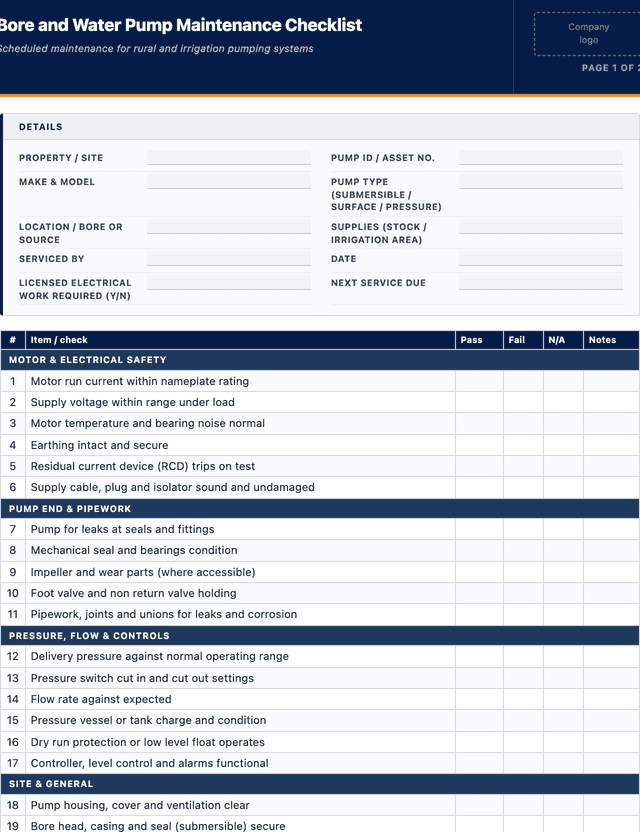
MOTOR & ELECTRICAL SAFETY
PUMP END & PIPEWORK
PRESSURE, FLOW & CONTROLS
SITE & GENERAL
How to use: download the PDF, print or complete digitally on any device.
- PDF format, ready to print or fill on screen
- Use as-is or customise to suit your operation
- Go digital in MapTrack for photos, reminders and audit trails
Download free PDF template
Use in MapTrack →



Trusted by teams across Australia and New Zealand
We respect your privacy. Unsubscribe anytime.
Or set it up in MapTrack
- Fill it in on a phone, attach photos to any check
- Automatic reports and audit trails
- Upload the PDF and MapTrack drafts the form for you
Free 30-day trial. No credit card. Personal email accepted.
Don't just download it - use it live. Start a free workspace, upload this bore and water pump maintenance checklist and MapTrack drafts it as a form your crew can run from a phone.

Co-Founder & Commercial Director
Key takeaways
- The MapTrack bore and water pump maintenance checklist contains 22 checks across 4 sections. Sections covered: MOTOR & ELECTRICAL SAFETY, PUMP END & PIPEWORK, PRESSURE, FLOW & CONTROLS, SITE & GENERAL.
Enter your email below to download this bore and water pump maintenance checklist as a ready-to-use PDF.
Used by construction, mining and field service teams











What is a bore and water pump maintenance checklist?
A bore and water pump maintenance checklist is a scheduled maintenance sheet for rural, irrigation and stock water pumping systems, covering submersible bore pumps, surface and pressure pumps and their motors, controls and pipework. It steps a competent person through the motor and electrical supply, the pump end and seals, the pressure and flow performance, the pressure vessel or tank and controls, the pipework and fittings, and the safety and electrical protection such as earthing and residual current devices. It is used to keep a pump reliable and safe rather than waiting for it to fail, which on a farm or remote property can mean stock without water or a crop without irrigation for days.
Water pumps combine electricity and water, often outdoors and in damp locations, which makes electrical safety the first priority: faulty earthing or protection on a bore or pressure pump is a genuine electrocution risk. In Australia, electrical work on the wiring and connection must be carried out by a licensed electrician, and test and tag of portable and connected equipment follows AS/NZS 3760:2022. There is no specific safe-use Australian Standard for a bore or water pump, so it is treated as general plant under the model Work Health and Safety (WHS) Regulations and maintained to the manufacturer's schedule. A consistent maintenance checklist keeps the pump performing, records the electrical safety checks, extends the life of the motor and seals, and supports the duty to maintain plant under the model WHS Regulations (mirrored in each state and territory except Victoria, which uses the OHS Regulations 2017 (Vic)) and the asset management discipline of ISO 55001:2024.
Learn more about maintenance and work orders in MapTrack.
Benefits of using this bore and water pump maintenance checklist
- Water security: planned maintenance keeps stock water and irrigation running instead of failing at the worst time.
- Electrical safety: earthing, RCD protection and cable condition are checked so a wet outdoor pump does not become an electrocution risk.
- Longer pump life: keeping seals, bearings and pressure settings right stops the motor and pump end wearing out early.
- Complete pump history: every signed checklist adds to the record that repair versus replace decisions depend on.
- Lower running cost: catching a dropping pressure, a leak or a struggling motor early avoids a burnt out motor and a big bill.
- Accountability: a named person and date against each service means every interval has a clear owner and paper trail.
Benefits of digitising forms in MapTrack
When you move from paper or static PDFs to digital forms in MapTrack, you get:
- Field users can easily scan a QR code to complete a form on mobile. Unlimited users.
- Email the right people when a form is submitted, with an automation you set up.
- File every completed form against the asset, location or person it covers.
- Download any completed form as a PDF, with failed answers listed at the top.
- Fill in forms offline; they upload when the device is back online.
- Build conditional logic (show or hide questions based on answers).
- Take pictures or attach photos. Not possible with a paper-based form.
- Electronic signatures.
- Edit forms later without reprinting.
- Set who can view, fill in or edit forms with user roles.
- Upload a paper form (PDF, Word, Excel or a photo) and MapTrack's AI builds a digital version for you to check.
- Raise a work order from a submitted form with an automation you set up.
- Track service intervals by hours, kilometres or calendar date in one place.
- Attach supplier invoices and parts receipts to each maintenance record.
Book a demo to see how MapTrack handles forms.
Try MapTrack free for 30 days
Full access to every feature. No credit card required. Per-asset pricing so you scale as your fleet grows.
- No credit card required
- 30 days free trial
- Cancel anytime
1-2 days/week saved
“Bloody amazing! We used to spend 1-2 days a week tracking and managing our generators alone.”

Steve McAllister
Asset Coordinator, Saunders International
What to include in a bore and water pump maintenance checklist
This bore and water pump maintenance checklist covers 10 key areas:
- Pump ID or asset number, make, model and type (submersible bore, surface, pressure)
- Location, bore or source and the area or stock it supplies
- Motor: run current, voltage, temperature, noise and mounting
- Electrical supply: cable condition, earthing, RCD and isolator
- Pump end: seals, bearings, impeller and for leaks
- Pressure and flow: delivery pressure, cut in and cut out settings and flow
- Pressure vessel or tank: charge, condition and float or level control
- Controls: pressure switch, controller, dry run protection and alarms
- Pipework, foot valve, non return valve and fittings for leaks
- Defects found, licensed electrical work required, and next service due
How to use this bore and water pump maintenance checklist
- Isolate the electrical supply first: Switch off and lock out the pump at the isolator before any work, and confirm it is dead. Because a water pump combines electricity and water, isolation is the first and most important step, and any work on the wiring or connection must be left to a licensed electrician.
- Check the motor and electrical safety: With the pump running, check the motor run current and voltage against the rating, feel for excess heat and listen for bearing noise. Confirm the earthing is intact, the residual current device trips when tested and the supply cable is sound and free of damage.
- Inspect the pump end and pipework: Check the pump for leaks at the seals and fittings, inspect the impeller and bearings where accessible, and look over the pipework, foot valve and non return valve. A weeping seal or a leaking foot valve quietly loads the motor and wastes water and power.
- Verify pressure, flow and controls: Check the delivery pressure and flow against normal, confirm the pressure switch cut in and cut out settings, test the pressure vessel charge, and verify dry run protection and any level controls or alarms actually operate as intended.
- Record defects and set the next service: Note every fault, flag any wiring or connection work that must go to a licensed electrician, raise follow up work for parts to be changed out, then sign the checklist off and record the date the next service falls due against the pump.
In MapTrack, you can schedule and track maintenance digitally, by date or meter reading. Each submission is stored as a timestamped PDF against the asset record.
Get the free templateEnter your email above to download the full bore and water pump maintenance checklist as a PDF.Back to download formHow often should you complete this form?
Service a bore or water pump on a regular schedule, commonly every three to six months for a working system, with more frequent checks over peak irrigation season or in dry conditions when the pump runs hardest and a failure hurts most. Water quality matters too: bores with sandy, mineral heavy or corrosive water wear pump ends and seals faster and need closer attention.
Electrical safety checks such as earthing, RCD operation and cable condition should be part of every service, and test and tag of connected and portable equipment follows the AS/NZS 3760:2022 intervals for the environment, which are shorter for wet and outdoor conditions. Record each service against the pump so wear trends are visible and a struggling motor or dropping pressure is caught before the pump burns out.
Frequently asked questions
Applicable regulatory standards
This template is a starting point. Check the current requirements that apply to your equipment, work and location. The template alone does not establish compliance.
- Model Work Health and Safety (WHS) Act and Regulations, as enacted in each state and territory (in Victoria, the Occupational Health and Safety Act 2004 (Vic) and OHS Regulations 2017 (Vic)) - there is no specific safe-use Australian Standard for a bore or water pump, so it is maintained as general plant under regulation 213 plus the manufacturer's schedule
- AS/NZS 3760:2022 In-service safety inspection and testing of electrical equipment (portable and connected equipment)
- AS/NZS 3000:2018 Electrical installations (Wiring Rules) for fixed connection (licensed electrician)
- ISO 55001:2024 Asset management - Asset management systems - Requirements (controlled maintenance records and asset history)
- Manufacturer (OEM) maintenance schedule for the specific pump
Bore and Water Pump Maintenance Checklist preview
The numbers behind this bore and water pump maintenance checklist
Every figure below is sourced and dated, so you can quote it in a toolbox talk, a budget case or a board paper without having to chase the original report.
Embed this free template on your website
Run an industry blog, trade association site, or training resource? Drop a preview of this free bore and water pump maintenance checklist straight into your page. The snippet is self-contained, needs no scripts, and links readers back to the full free template.
<div style="max-width:480px;font-family:system-ui,-apple-system,'Segoe UI',Roboto,sans-serif;border:1px solid #E5E7EB;border-radius:12px;padding:20px;background:#ffffff;">
  <p style="font-size:12px;font-weight:700;letter-spacing:0.05em;text-transform:uppercase;color:#071D49;margin:0;">Free template</p>
  <p style="font-size:18px;font-weight:700;color:#071D49;margin:6px 0 0;">Bore and Water Pump Maintenance Checklist</p>
  <ul style="margin:12px 0 0;padding-left:18px;color:#374151;font-size:14px;line-height:1.6;">
    <li style="margin:4px 0;">Pump ID or asset number, make, model and type (submersible bore, surface, pressure)</li>
    <li style="margin:4px 0;">Location, bore or source and the area or stock it supplies</li>
    <li style="margin:4px 0;">Motor: run current, voltage, temperature, noise and mounting</li>
    <li style="margin:4px 0;">Electrical supply: cable condition, earthing, RCD and isolator</li>
    <li style="margin:4px 0;">Pump end: seals, bearings, impeller and for leaks</li>
    <li style="margin:4px 0;">Pressure and flow: delivery pressure, cut in and cut out settings and flow</li>
  </ul>
  <p style="font-size:13px;color:#6B7280;margin:14px 0 0;padding-top:12px;border-top:1px solid #E5E7EB;">Free <a href="https://www.maptrack.com/templates/bore-pump-maintenance-checklist" style="color:#071D49;font-weight:600;text-decoration:none;">Bore and Water Pump Maintenance Checklist</a> by MapTrack</p>
</div>Free to reuse, including commercially. This template is published under a Creative Commons Attribution 4.0 licence. Copy it, adapt it, put it on your own site or in your own docs. All we ask is that you credit MapTrack with a link back to this page. The snippet above already includes that credit, so if you use it as-is you’re covered.
Cite this template
Writing about this topic? You’re welcome to quote this checklist. Here’s the wording to use so your readers can find the original.
The MapTrack bore and water pump maintenance checklist contains 22 checks across 4 sections.
- Short attribution
- MapTrack Bore and Water Pump Maintenance Checklist, https://www.maptrack.com/templates/bore-pump-maintenance-checklist
- Reference list
- MapTrack. (2026). Bore and Water Pump Maintenance Checklist [Checklist template]. Retrieved from https://www.maptrack.com/templates/bore-pump-maintenance-checklist
Free to reuse with credit under a Creative Commons Attribution 4.0 licence. If you’d rather link straight to it, the page is https://www.maptrack.com/templates/bore-pump-maintenance-checklist.
Need to schedule and track maintenance digitally, by date or meter reading?
Register every asset in MapTrack, attach digital forms, and get a complete history of every inspection, service and compliance record.
Maintenance and work orders · All templates · Pricing · Book a demo