
Free air compressor service log book
Free air compressor service log book (PDF-ready). Service history for screw and reciprocating compressors: oil, filters, belts, receiver, safety valve.
Updated 5 July 2026
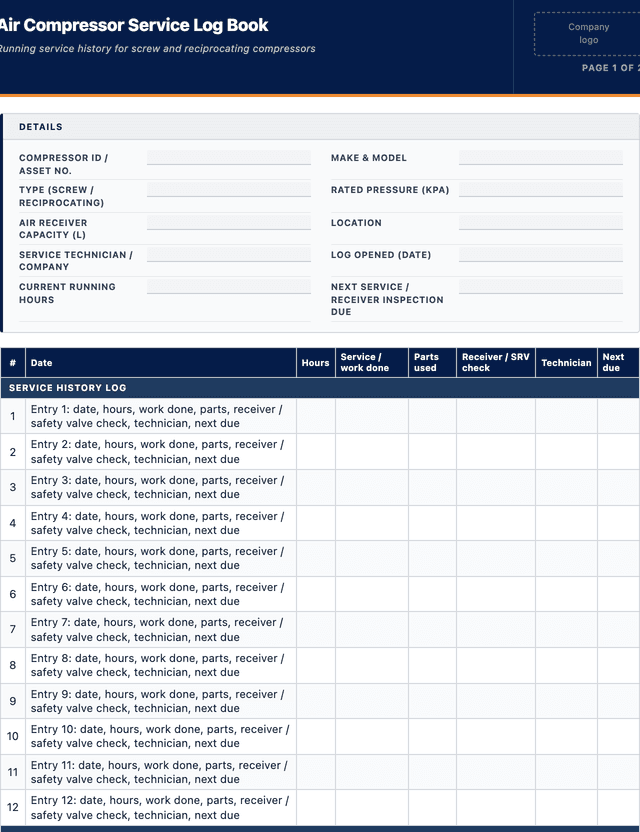
Air Compressor Service Log Book
Running service history for screw and reciprocating compressors
SERVICE HISTORY LOG
SERVICE ITEMS REFERENCE (tick per service)
How to use: download the PDF, print or complete digitally on any device.
- PDF format, ready to print or fill on screen
- Use as-is or customise to suit your operation
- Go digital in MapTrack for photos, reminders and audit trails
Two ways to use it
Use in MapTrack →Use it digitally instead
Unlimited usersUpload this PDF and MapTrack drafts the form for you.




- Scan the asset’s QR tag with any phone
- Submitted forms can trigger alerts
- Photos on fails, audit-ready records
- Export responses, PDF reports with your logo
Free trial. No credit card needed.
Trusted by teams across Australia and New Zealand
We respect your privacy. Unsubscribe anytime.
These templates are free general guides provided as-is. They do not constitute legal, safety or compliance advice. You are responsible for ensuring any form meets your specific workplace obligations, industry standards and applicable regulations.
Don't just download it - use it live. Start a free workspace, upload this air compressor service log book and MapTrack drafts it as a form your crew can run from a phone.

Co-Founder & Commercial Director
Key takeaways
- The MapTrack air compressor service log book contains 21 checks across 2 sections. Sections covered: SERVICE HISTORY LOG, SERVICE ITEMS REFERENCE (tick per service).
Enter your email below to download this air compressor service log book as a ready-to-use PDF.
Used by construction, mining and field service teams











What is an air compressor service log book?
An air compressor service log book is a running record of every service, inspection and repair on a reciprocating or rotary screw air compressor and its air receiver over the life of the unit. Each entry captures the date, the running hours, the work done, the compressor oil, air and oil filters, belts and separator element replaced, the state of the receiver and its drain, and the check of the pressure safety valve. It is a chronological history that stays with the machine, so anyone can see when it was last serviced, what was done and when the next service falls due, rather than relying on scattered sheets or memory.
A compressor is often the utility that a whole workshop, plant or process depends on, and it stores energy in a pressurised air receiver, which makes the receiver a pressure vessel with its own inspection duties. AS/NZS 3788:2024 covers the in service inspection of pressure equipment, and its hazard level under AS 4343-2014 drives whether the receiver must be registered with the regulator and how often it is inspected. A poorly maintained receiver with a corroded shell or a stuck safety valve is a genuine explosion risk. A disciplined service log keeps the compressor reliable, records the receiver and safety valve checks needed for pressure equipment, and supports the duty to maintain plant under the model Work Health and Safety (WHS) Regulations (mirrored in each state and territory except Victoria, which uses the OHS Regulations 2017 (Vic)) and the asset management discipline of ISO 55001:2024.
Learn more about maintenance and work orders in MapTrack.
Benefits of using this air compressor service log book
- Reliable air supply: a logged service schedule keeps the compressor that a whole workshop depends on from failing without warning.
- Pressure vessel safety: recording the receiver and safety valve checks keeps the pressure equipment inspection duties visible and current.
- Complete service history: a single running record shows every service, element and repair without hunting through loose sheets.
- Warranty protection: a dated log of servicing on the OEM schedule is what warranty and insurance claims rely on.
- Cost visibility: recording hours, oil, filters and elements per service shows the true running cost of the unit over time.
- Accountability: a named technician and date against every entry means each service has a clear owner and paper trail.
Benefits of digitising forms in MapTrack
When you move from paper or static PDFs to digital forms in MapTrack, you get:
- Field users can easily scan a QR code to complete a form on mobile. Unlimited users.
- Email the right people when a form is submitted, with an automation you set up.
- File every completed form against the asset, location or person it covers.
- Download any completed form as a PDF, with failed answers listed at the top.
- Fill in forms offline; they upload when the device is back online.
- Build conditional logic (show or hide questions based on answers).
- Take pictures or attach photos. Not possible with a paper-based form.
- Electronic signatures.
- Edit forms later without reprinting.
- Set who can view, fill in or edit forms with user roles.
- Upload a paper form (PDF, Word, Excel or a photo) and MapTrack's AI builds a digital version for you to check.
- Raise a work order from a submitted form with an automation you set up.
- Track service intervals by hours, kilometres or calendar date in one place.
- Attach supplier invoices and parts receipts to each maintenance record.
Book a demo to see how MapTrack handles forms.
Try MapTrack free for 30 days
Full access to every feature. No credit card required. Per-asset pricing so you scale as your fleet grows.
- No credit card required
- 30 days free trial
- Cancel anytime
1-2 days/week saved
“Bloody amazing! We used to spend 1-2 days a week tracking and managing our generators alone.”

Steve McAllister
Asset Coordinator, Saunders International
What to include in an air compressor service log book
This air compressor service log book covers 10 key areas:
- Compressor ID or asset number, make, model and type (screw or reciprocating)
- Rated pressure, air receiver capacity and location
- Date of each service entry and running hours at service
- Service type: routine, minor, major, repair or receiver inspection
- Compressor oil, oil filter, air filter and separator element changes
- Belts, drive coupling and cooler condition
- Air receiver condition, internal or external inspection and drain
- Pressure safety or relief valve test and set pressure
- Pressure switch, unloader and controls operation
- Technician name, parts used and next service due (date or hours)
How to use this air compressor service log book
- Open the log against the machine: Record the compressor ID, make, model, type, rated pressure and current running hours at the top of the entry so the service is tied to the right unit and the hours give context to the work logged.
- Depressurise and isolate before working: Isolate the electrical supply, lock out the unit, then bleed the air receiver and system down to zero pressure and confirm it with the gauge. Working on a compressor or receiver still under pressure is a serious hazard, so full depressurisation comes first.
- Carry out the scheduled service: Complete the tasks for the interval reached: change the compressor oil and oil filter, air filter and separator element, check belts and coupling, clean the coolers, and inspect for leaks. Record what was actually done rather than ticking a generic list.
- Check the receiver and safety valve: Drain condensate from the receiver, inspect the shell and fittings for corrosion, and test the pressure safety valve lifts at its set pressure. Log the receiver inspection separately so the pressure equipment record under AS/NZS 3788:2024 stays traceable.
- Log the entry and set the next service: Write up the parts used, the results and the technician name, restore pressure and confirm the unit cycles and unloads correctly, then record the running hours or date at which the next service and next receiver inspection fall due.
In MapTrack, you can schedule and track maintenance digitally, by date or meter reading. Each submission is stored as a timestamped PDF against the asset record.
Get the free templateEnter your email above to download the full air compressor service log book as a PDF.Back to download formHow often should you complete this form?
Follow the manufacturer schedule for the compressor: oil, filters and separator elements at set running hours, belts and coolers checked regularly, and a major service less often. Duty cycle, ambient dust and heat all shorten the effective interval, so a hard working unit in a dusty workshop needs more frequent attention than the hour meter alone suggests.
The air receiver is a pressure vessel and has its own inspection cadence under AS/NZS 3788:2024, set by its hazard level (AS 4343-2014) and a competent person: typically periodic external inspections plus less frequent internal inspection and, where required, hydrostatic testing. Drain condensate from the receiver frequently, daily on a humid site, and log the receiver and safety valve checks alongside the compressor services so the pressure equipment record stays current.
Frequently asked questions
Applicable regulatory standards
This template is a starting point. Check the current requirements that apply to your equipment, work and location. The template alone does not establish compliance.
- Model Work Health and Safety (WHS) Act and Regulations, as enacted in each state and territory (in Victoria, the Occupational Health and Safety Act 2004 (Vic) and OHS Regulations 2017 (Vic))
- Model WHS Regulations, regulation 213 (maintenance of plant) and Chapter 5 pressure equipment duties
- AS/NZS 3788:2024 Pressure equipment - In-service inspection (air receiver)
- AS 4343-2014 Pressure equipment - Hazard levels (drives registration and inspection frequency)
- AS/NZS 3760:2022 In-service safety inspection and testing of electrical equipment (electrical parts)
- ISO 55001:2024 Asset management - Asset management systems - Requirements (controlled maintenance records and asset history)
- Manufacturer (OEM) service schedule for the compressor
Air Compressor Service Log Book preview
The numbers behind this air compressor service log book
Every figure below is sourced and dated, so you can quote it in a toolbox talk, a budget case or a board paper without having to chase the original report.
Embed this free template on your website
Run an industry blog, trade association site, or training resource? Drop a preview of this free air compressor service log book straight into your page. The snippet is self-contained, needs no scripts, and links readers back to the full free template.
<div style="max-width:480px;font-family:system-ui,-apple-system,'Segoe UI',Roboto,sans-serif;border:1px solid #E5E7EB;border-radius:12px;padding:20px;background:#ffffff;">
  <p style="font-size:12px;font-weight:700;letter-spacing:0.05em;text-transform:uppercase;color:#071D49;margin:0;">Free template</p>
  <p style="font-size:18px;font-weight:700;color:#071D49;margin:6px 0 0;">Air Compressor Service Log Book</p>
  <ul style="margin:12px 0 0;padding-left:18px;color:#374151;font-size:14px;line-height:1.6;">
    <li style="margin:4px 0;">Compressor ID or asset number, make, model and type (screw or reciprocating)</li>
    <li style="margin:4px 0;">Rated pressure, air receiver capacity and location</li>
    <li style="margin:4px 0;">Date of each service entry and running hours at service</li>
    <li style="margin:4px 0;">Service type: routine, minor, major, repair or receiver inspection</li>
    <li style="margin:4px 0;">Compressor oil, oil filter, air filter and separator element changes</li>
    <li style="margin:4px 0;">Belts, drive coupling and cooler condition</li>
  </ul>
  <p style="font-size:13px;color:#6B7280;margin:14px 0 0;padding-top:12px;border-top:1px solid #E5E7EB;">Free <a href="https://www.maptrack.com/templates/air-compressor-service-log-book" style="color:#071D49;font-weight:600;text-decoration:none;">Air Compressor Service Log Book</a> by MapTrack</p>
</div>Free to reuse, including commercially. This template is published under a Creative Commons Attribution 4.0 licence. Copy it, adapt it, put it on your own site or in your own docs. All we ask is that you credit MapTrack with a link back to this page. The snippet above already includes that credit, so if you use it as-is you’re covered.
Cite this template
Writing about this topic? You’re welcome to quote this checklist. Here’s the wording to use so your readers can find the original.
The MapTrack air compressor service log book contains 21 checks across 2 sections.
- Short attribution
- MapTrack Air Compressor Service Log Book, https://www.maptrack.com/templates/air-compressor-service-log-book
- Reference list
- MapTrack. (2026). Air Compressor Service Log Book [Checklist template]. Retrieved from https://www.maptrack.com/templates/air-compressor-service-log-book
Free to reuse with credit under a Creative Commons Attribution 4.0 licence. If you’d rather link straight to it, the page is https://www.maptrack.com/templates/air-compressor-service-log-book.
Need to schedule and track maintenance digitally, by date or meter reading?
Register every asset in MapTrack, attach digital forms, and get a complete history of every inspection, service and compliance record.
Maintenance and work orders · All templates · Pricing · Book a demo