
Free parts kitting procedure template
Free parts kitting procedure template (PDF-ready). Pre-stage kits for planned work orders: BOM, picking, audit, delivery, reconciliation, SMRP stock-outs.
Updated 2 Oct 2026
Parts Kitting Procedure
Pre-staged parts kits for planned work orders | SMRP stock-out metric 5.5.33.
Scope & roles
Bill of materials validation
Picking, packaging & staging
Returns & feedback
How to use: download the PDF, print or complete digitally on any device.
- PDF format, ready to print or fill on screen
- Use as-is or customise to suit your operation
- Go digital in MapTrack for photos, reminders and audit trails
Download free PDF template
Use in MapTrack →



Trusted by teams across Australia and New Zealand
We respect your privacy. Unsubscribe anytime.
Or set it up in MapTrack
- Fill it in on a phone, attach photos to any check
- Automatic reports and audit trails
- Upload the PDF and MapTrack drafts the form for you
Free 30-day trial. No credit card. Personal email accepted.
Don't just download it - use it live. Start a free workspace, upload this parts kitting procedure template and MapTrack drafts it as a form your crew can run from a phone.

Co-Founder & Commercial Director
Key takeaways
- The MapTrack parts kitting procedure template contains 20 checks across 4 sections. Sections covered: Scope & roles, Bill of materials validation, Picking, packaging & staging, Returns & feedback.
Enter your email below to download this parts kitting procedure template as a ready-to-use PDF.
Used by construction, mining and field service teams











What is a parts kitting procedure template?
A parts kitting procedure is a controlled storeroom and planning workflow used to assemble pre-staged parts kits for each planned work order before the work is scheduled, so that the technician arrives on site or at the asset with every part, consumable and special tool already picked, packaged, labelled and verified. The procedure governs the entire kitting cycle: how the planner builds the bill of materials (BOM) against the standard job plan, how the storeperson picks the parts against the BOM, how the kit is staged and labelled with work order number and target start date, how missing parts are escalated before the work is scheduled, how the kit is delivered to the technician at the work-order start, and how any unused parts are returned and reconciled to the storeroom after the work completes. Kitting is the operational discipline that converts a planned work order into a ready-to-execute job, eliminating the wrench-time loss that comes from parts hunting, multiple storeroom trips, mid-job substitution and the rework caused by working with the wrong part.
For any maintenance organisation that wants to break out of reactive mode, kitting is one of the most practical storeroom disciplines. Doc Palmer, author of the Maintenance Planning and Scheduling Handbook, puts typical workforce wrench time at 25 to 35 percent and says planning and scheduling can raise it above 50 percent. Wrench time excludes the time spent obtaining parts, tools and instructions, which is the time kitting takes out of the job; on Palmer's arithmetic, lifting a crew from 25 to 50 percent wrench time lets 30 people do the work of 60. Kitting also surfaces stock-outs days before the job is scheduled, instead of at the asset. SMRP (the Society for Maintenance and Reliability Professionals) defines wrench time (metric 5.6.1) and storeroom measures such as stock outs (5.5.33) in its Best Practices metrics, which gives a kitting programme standard definitions to report against. ISO 55001:2024 sets the requirements for an asset management system, and a documented kitting procedure is one way to show that planned work is genuinely planned (not just scheduled). The procedure also creates the data trail needed for inventory accuracy, stock-out root cause analysis and obsolescence management - none of which is possible when parts are picked ad hoc at the moment of execution.
Learn more about maintenance and work orders in MapTrack.
Benefits of using this parts kitting procedure template
- Wrench-time recovery: typical wrench time is 25 to 35 percent and planning and scheduling can raise it above 50 percent (Doc Palmer); kitting removes the parts-fetching time that wrench time excludes.
- Stock-out prevention before scheduling: building the kit days before the work order is released surfaces stock-outs against the planned start date, when the planner still has time to expedite, substitute or reschedule.
- Reduced reactive substitution: with the right part on hand at the start of the job, technicians stop substituting non-standard parts mid-job, which is the single largest source of premature failure after maintenance.
- Higher schedule attainment: work that starts with a complete kit is less likely to stall mid-job, which shows up in the SMRP schedule compliance metrics (5.4.3 and 5.4.4) and PM and PdM compliance (5.4.14).
- Storeroom inventory accuracy: each kit movement is a controlled transaction, which keeps storeroom records and transactions (SMRP metrics 5.5.35 and 5.5.36) more accurate than ad hoc picking.
- Audit and traceability: every part issued is tied to a work order, an asset, a technician and a date, supporting warranty claims, recalls and root cause analysis.
Benefits of digitising forms in MapTrack
When you move your procedures from paper to MapTrack, you get:
- Field users can easily scan a QR code to complete a form on mobile. Unlimited users.
- Email the right people when a form is submitted, with an automation you set up.
- File every completed form against the asset, location or person it covers.
- Download any completed form as a PDF, with failed answers listed at the top.
- Fill in forms offline; they upload when the device is back online.
- Build conditional logic (show or hide questions based on answers).
- Take pictures or attach photos. Not possible with a paper-based form.
- Electronic signatures.
- Edit forms later without reprinting.
- Set who can view, fill in or edit forms with user roles.
- Upload a paper form (PDF, Word, Excel or a photo) and MapTrack's AI builds a digital version for you to check.
- Raise a work order from a submitted form with an automation you set up.
- Track service intervals by hours, kilometres or calendar date in one place.
- Attach supplier invoices and parts receipts to each maintenance record.
Book a demo to see how MapTrack handles procedures.
Try MapTrack free for 30 days
Full access to every feature. No credit card required. Per-asset pricing so you scale as your fleet grows.
- No credit card required
- 30 days free trial
- Cancel anytime
1-2 days/week saved
“Bloody amazing! We used to spend 1-2 days a week tracking and managing our generators alone.”

Steve McAllister
Asset Coordinator, Saunders International
What to include in a parts kitting procedure template
This parts kitting procedure template covers 10 key areas:
- Scope and applicability: which work types require kitting (all planned PM and capital work, defined corrective above a labour-hours threshold), which are excluded (emergency response, true reactive break-ins), and how exceptions are escalated.
- Roles and responsibilities: planner builds the BOM and triggers kitting; storeperson picks, stages, labels and reconciles; technician verifies kit at the start of the job and returns unused parts at the end; supervisor approves expediting and substitution.
- Bill of materials standard: the rules for building the BOM against the standard job plan, including primary part numbers, approved substitutes, quantities, units of issue, lead times and the special-tool list attached to the job plan.
- Kitting trigger and lead time: the rules that trigger kit assembly (typically work-order release date minus 5 to 7 working days), the kit-ready milestone before scheduling, and the storeroom service-level agreement to the planner.
- Picking and packaging standard: pick path, kit container (tote, trolley, pallet), package labelling, kit packing list with part numbers and quantities, and the storeroom check-out transaction in the CMMS.
- Staging and identification: physical staging location for ready kits (dedicated rack with work-order labels and start dates), shelf-life and FIFO discipline, security and access controls, and the way kits are handed off to the field.
- Stock-out and missing-part workflow: what happens when a part is not available (expedite, substitute, defer the work order, escalate to planning), the documented decision authority, and the change to the work-order status.
- Delivery, verification and unused-part return: how the kit is delivered to the technician (storeroom collection or scheduled drop), the technician kit-verification step before starting work, and the controlled return of any unused parts on work-order close.
- Storeroom transactions and audit trail: every pick, return, substitution and write-off captured as a transaction against the work order, with the parts cost flowed through to the work-order actuals and onwards to the asset cost record.
- KPIs and review cadence: kitting service level (percent of planned work orders kitted to plan), kit completeness (percent of kits with zero missing parts at start of work), unused-part return percentage and storeroom inventory accuracy, reviewed weekly with the planner and storeroom supervisor.
How to use this parts kitting procedure template
- Build and validate the bill of materials against the standard job plan. The planner pulls the standard job plan for the work-order type, validates the BOM line by line against the actual asset configuration and any in-service modifications, confirms quantities and units of issue, and flags any item without an approved primary or substitute part. A BOM that has not been validated against the asset is the most common cause of an incomplete kit on the day.
- Trigger kit assembly on a defined lead time and confirm parts availability. Set the standard kit-build trigger at work-order release date minus 5 to 7 working days so the storeperson has time to pull, expedite or escalate. The CMMS reserves the parts against the work order at trigger, so any other planned work cannot consume them. If any line is short, the storeperson initiates the documented expedite-substitute-defer workflow with the planner before scheduling is confirmed.
- Pick, package, label and stage the kit to the storeroom standard. The storeperson follows the documented pick path, packages parts into the designated container (tote, trolley, pallet), labels the kit with the work-order number, asset ID, planned start date and technician name, and stages the kit in the dedicated ready-kit rack. The pick is recorded as a CMMS transaction against the work order so storeroom on-hand balances reflect the reservation.
- Deliver the kit, verify it with the technician and start the work. At the planned start time the technician collects the kit (or the kit is delivered to the asset), verifies the packing list against the physical contents, signs the kit-verification step in the CMMS and starts the work. Any discrepancy between the packing list and the physical kit is documented before the job starts, not at the asset two hours in.
- Reconcile unused parts and close the loop. On work-order completion the technician returns any unused parts to the storeroom against the work order, the storeperson processes the controlled return (back to bin location, not write-off), and the planner reviews the actual usage versus the BOM. Recurring overpicks become BOM corrections; recurring underpicks become BOM additions; both are fed back into the standard job plan so the kit converges to actual job content over time.
In MapTrack, you can schedule and track maintenance digitally, by date or meter reading. Each submission is stored as a timestamped PDF against the asset record.
Get the free templateEnter your email above to download the full parts kitting procedure template as a PDF.Back to download formHow often should you complete this procedure?
Parts kitting is a continuous workflow, not a periodic event. Kits are assembled job-by-job on the defined lead time (typically 5 to 7 working days before the planned work-order start date), aligned to the weekly planning and scheduling cadence common in mature maintenance organisations. The standard rhythm is: Monday-Tuesday planner finalises the schedule for the following week and releases work orders to kitting, Wednesday-Friday storeroom builds the kits, Sunday-Monday kits are staged and verified, work orders execute through the week. The procedure itself is reviewed quarterly with the planner, storeroom supervisor and reliability engineer to look at kit completeness, stock-out trends and BOM accuracy. A full procedure refresh is triggered by a major change to the storeroom layout, the CMMS, the work-management process, or the introduction of a new asset class with a new BOM standard. In MapTrack, kit transactions are captured against each work order automatically, surfacing kit service level and BOM accuracy on a live storeroom dashboard.
Frequently asked questions
Applicable regulatory standards
This template is a starting point. Check the current requirements that apply to your equipment, work and location. The template alone does not establish compliance.
- ISO 55001:2024 (Asset management - Asset management system - Requirements)
- ISO 55002:2018 (Asset management - Management systems - Guidelines for the application of ISO 55001)
- SMRP Best Practices metrics (numbering as in the 5th edition): Stock Outs (5.5.33), Storeroom Transactions (5.5.35), Storeroom Records (5.5.36), Wrench Time (5.6.1)
- Doc Palmer, Maintenance Planning and Scheduling Handbook (McGraw-Hill), and "The What, Why and How of Wrench Time" (Reliable Plant)
- EN 13306:2017 (Maintenance terminology)
Check the current source
Parts kitting procedure template preview
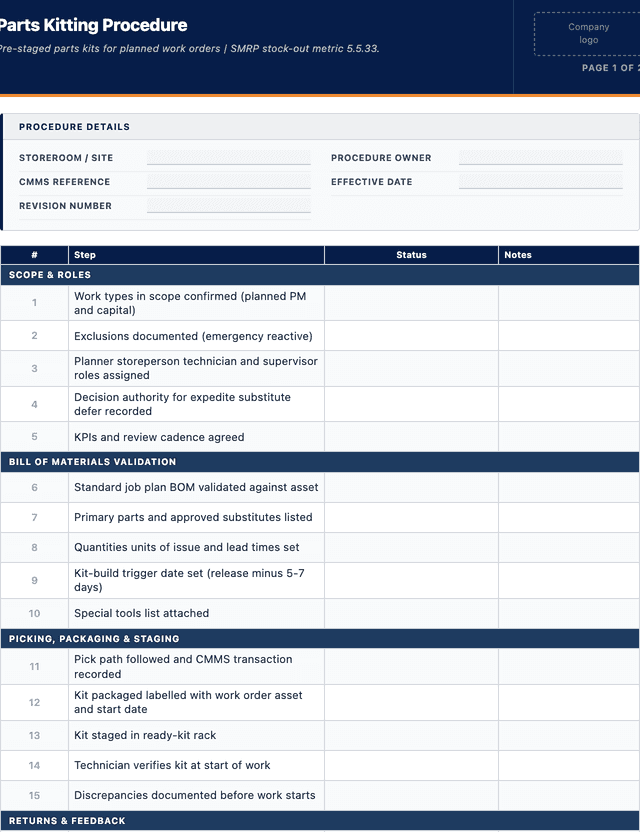
The numbers behind this parts kitting procedure template
Every figure below is sourced and dated, so you can quote it in a toolbox talk, a budget case or a board paper without having to chase the original report.
Embed this free template on your website
Run an industry blog, trade association site, or training resource? Drop a preview of this free parts kitting procedure template straight into your page. The snippet is self-contained, needs no scripts, and links readers back to the full free template.
<div style="max-width:480px;font-family:system-ui,-apple-system,'Segoe UI',Roboto,sans-serif;border:1px solid #E5E7EB;border-radius:12px;padding:20px;background:#ffffff;">
  <p style="font-size:12px;font-weight:700;letter-spacing:0.05em;text-transform:uppercase;color:#071D49;margin:0;">Free template</p>
  <p style="font-size:18px;font-weight:700;color:#071D49;margin:6px 0 0;">Parts kitting procedure template</p>
  <ul style="margin:12px 0 0;padding-left:18px;color:#374151;font-size:14px;line-height:1.6;">
    <li style="margin:4px 0;">Scope and applicability: which work types require kitting (all planned PM and capital work, defined corrective above a labour-hours threshold), which are excluded (emergency response, true reactive break-ins), and how exceptions are escalated.</li>
    <li style="margin:4px 0;">Roles and responsibilities: planner builds the BOM and triggers kitting; storeperson picks, stages, labels and reconciles; technician verifies kit at the start of the job and returns unused parts at the end; supervisor approves expediting and substitution.</li>
    <li style="margin:4px 0;">Bill of materials standard: the rules for building the BOM against the standard job plan, including primary part numbers, approved substitutes, quantities, units of issue, lead times and the special-tool list attached to the job plan.</li>
    <li style="margin:4px 0;">Kitting trigger and lead time: the rules that trigger kit assembly (typically work-order release date minus 5 to 7 working days), the kit-ready milestone before scheduling, and the storeroom service-level agreement to the planner.</li>
    <li style="margin:4px 0;">Picking and packaging standard: pick path, kit container (tote, trolley, pallet), package labelling, kit packing list with part numbers and quantities, and the storeroom check-out transaction in the CMMS.</li>
    <li style="margin:4px 0;">Staging and identification: physical staging location for ready kits (dedicated rack with work-order labels and start dates), shelf-life and FIFO discipline, security and access controls, and the way kits are handed off to the field.</li>
  </ul>
  <p style="font-size:13px;color:#6B7280;margin:14px 0 0;padding-top:12px;border-top:1px solid #E5E7EB;">Free <a href="https://www.maptrack.com/templates/parts-kitting-procedure-template" style="color:#071D49;font-weight:600;text-decoration:none;">Parts kitting procedure template</a> by MapTrack</p>
</div>Free to reuse, including commercially. This template is published under a Creative Commons Attribution 4.0 licence. Copy it, adapt it, put it on your own site or in your own docs. All we ask is that you credit MapTrack with a link back to this page. The snippet above already includes that credit, so if you use it as-is you’re covered.
Cite this template
Writing about this topic? You’re welcome to quote this checklist. Here’s the wording to use so your readers can find the original.
The MapTrack parts kitting procedure template contains 20 checks across 4 sections.
- Short attribution
- MapTrack Parts kitting procedure template, https://www.maptrack.com/templates/parts-kitting-procedure-template
- Reference list
- MapTrack. (2026). Parts kitting procedure template [Checklist template]. Retrieved from https://www.maptrack.com/templates/parts-kitting-procedure-template
Free to reuse with credit under a Creative Commons Attribution 4.0 licence. If you’d rather link straight to it, the page is https://www.maptrack.com/templates/parts-kitting-procedure-template.
Need to schedule and track maintenance digitally, by date or meter reading?
Register every asset in MapTrack, attach digital forms, and get a complete history of every inspection, service and compliance record.
Maintenance and work orders · All templates · Pricing · Book a demo