
Free template · PDF
Free garage and workshop inspection checklist
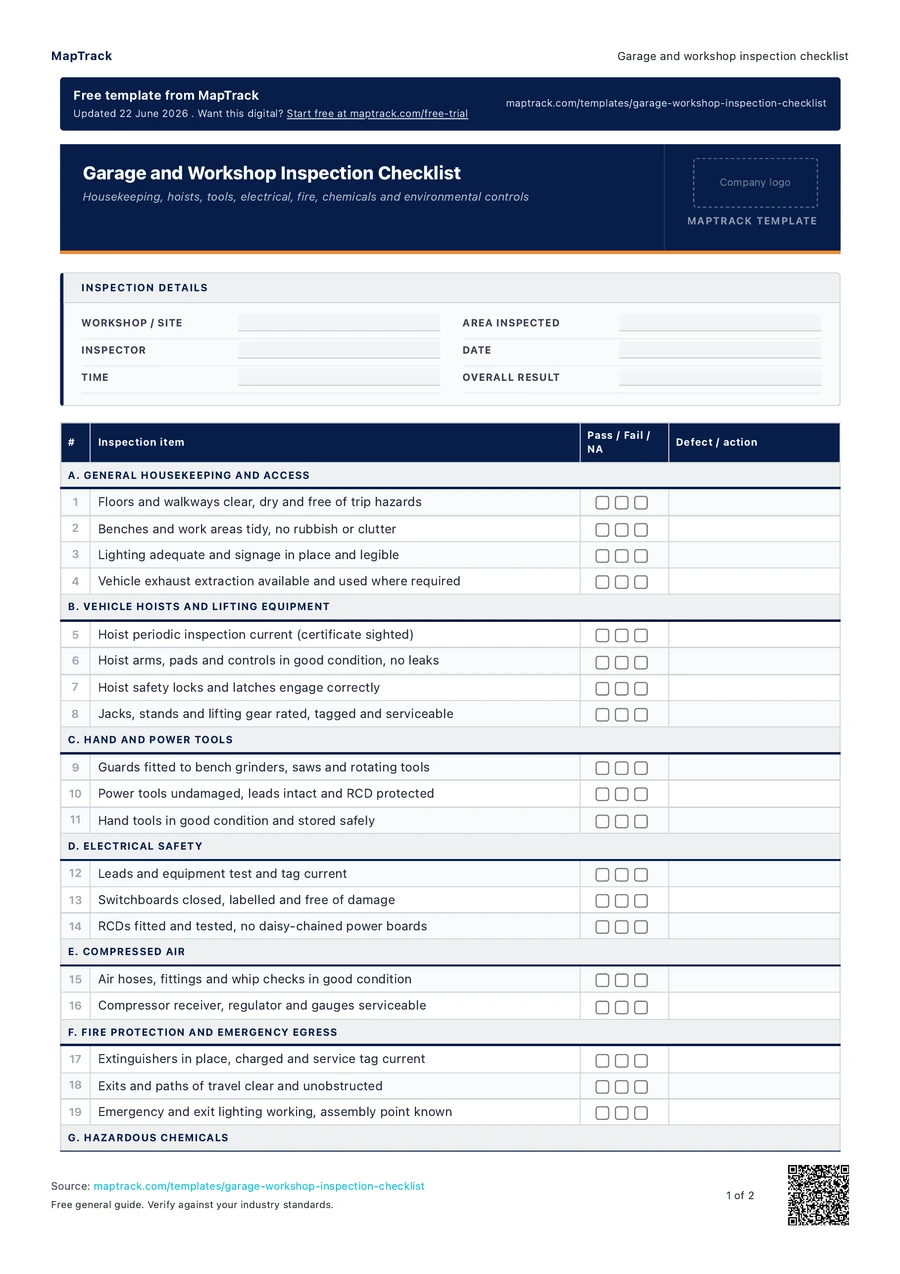
Free garage and workshop inspection checklist (PDF-ready). Housekeeping, hoists, tools, electrical, fire, chemicals and environmental controls.
Loading PDF page...

Read the form fields
30 checks · 9 sections · Sign-off
30 checks
The fields in the printable form, in a view that fits your screen.
- Workshop / site
- Area inspected
- Inspector
- Date
- Time
- Overall result
A. General housekeeping and access
B. Vehicle hoists and lifting equipment
C. Hand and power tools
D. Electrical safety
E. Compressed air
F. Fire protection and emergency egress
G. Hazardous chemicals
H. Environmental controls
I. First aid, PPE and welfare
Inspected by
Signature · Print name · Role · Date
Reviewed by (workshop manager)
Signature · Print name · Actions closed? · Date
The MapTrack garage and workshop inspection checklist contains 30 checks across 9 sections.

Make this form your own
Add your fields and logo. Give your team a form they can use on site.
Free 30-day trial. No credit card. Work email needed.
Upload & use this form now for free



“MapTrack beat them all in every aspect.”
 Vincent Stone · HSEQ Advisor, Concept Tanks
After signup: upload this PDF, check the form MapTrack drafts, then save and publish it for your team.
General guidance only. Check the form against your equipment manual, site procedures and local requirements before using it.
Key takeaways
- The MapTrack garage and workshop inspection checklist contains 30 checks across 9 sections. Sections covered: A. General housekeeping and access, B. Vehicle hoists and lifting equipment, C. Hand and power tools, D. Electrical safety, E. Compressed air, F. Fire protection and emergency egress, G. Hazardous chemicals, H. Environmental controls, I. First aid, PPE and welfare.
- A workshop inspection confirms housekeeping, hoists, tools, electrical, fire, chemicals and environmental controls are safe.
- A documented inspection supports the WHS primary duty to provide and maintain a safe workplace.
- It confirms statutory programs such as hoist inspection and electrical test and tag are current, it does not replace them.
- Every failed line needs a specific defect note, an owner and a due date to be useful.
- Tag unsafe equipment such as a faulty hoist out of service immediately rather than waiting for the repair.
What is a garage and workshop inspection checklist?
A garage and workshop inspection checklist is a structured walk around used to confirm that a vehicle or plant workshop is safe, tidy and compliant before and during operation. It groups the inspection into the areas that cause most workshop incidents: general housekeeping and access, vehicle hoists and lifting equipment, hand and power tools, electrical safety and leads, compressed air, fire protection and emergency egress, hazardous chemicals and storage, and environmental controls such as bunding, spill kits and waste. Each line is a specific item the inspector marks pass, fail or not applicable, with space to note the defect and the corrective action, so the result is a dated record rather than a vague impression that the workshop looked fine.
A workshop concentrates a lot of risk into a small space: vehicles suspended on hoists, energised tools, flammable liquids, compressed air and people working underneath loads. The Work Health and Safety Act places a primary duty on the business to provide and maintain a safe workplace, and the Work Health and Safety Regulation sets specific duties for plant and the working environment. A regular, documented inspection is how a workshop manager demonstrates that duty is being met in practice: it catches the frayed lead, the overdue hoist inspection or the blocked exit before it causes harm, and the trail of completed checklists is objective evidence of a controlled, well maintained facility during an audit or after an incident.
Learn more about GPS and fleet tracking in MapTrack.
Choose the format that fits your team
Download the PDF
Use the original printable form for a paper workflow. Check it against your equipment and site procedure before the job.
Keep completed copies in your own record system and arrange any follow-up through your normal process.
Download free PDFCustomise a form in MapTrack
Start a free trial, upload this PDF and MapTrack drafts the form. Adjust it to your workflow, then save and publish it for your team to use.
Sample answers on this page and completed PDF records aren't imported automatically.
Upload & use this form now for freeFree 30-day trial. No credit card. Work email needed.
Benefits of using this garage and workshop inspection checklist
- Safer workshop: a regular structured walk around catches frayed leads, leaking hoists and blocked exits before they injure someone working underneath a load.
- Compliance evidence: a dated trail of completed inspections demonstrates the WHS primary duty to provide and maintain a safe workplace is being met in practice.
- Less downtime: finding tool, hoist and electrical faults early keeps the workshop running instead of losing a bay to an avoidable breakdown or incident.
- Clear accountability: a named inspector and assigned corrective actions mean defects are owned and closed out, not noted once and forgotten.
- Hoist and lifting assurance: a dedicated section confirms vehicle hoists and lifting gear are within inspection date and free of obvious defects before use.
- Environmental control: checking bunding, spill kits and waste storage protects drains and soil and supports environmental and dangerous goods obligations.
What to include in a garage and workshop inspection checklist
- Workshop and inspection details: site, area, inspector, date and overall result
- General housekeeping: clear floors and walkways, tidy benches, signage and adequate lighting
- Vehicle hoists and lifting equipment: condition, inspection currency, controls and safety locks
- Hand and power tools: guards in place, condition, RCD protection and safe storage
- Electrical safety: leads, test and tag currency, switchboards and RCDs free of damage
- Compressed air: hoses, fittings, whip checks, regulators and receiver condition
- Fire protection and egress: extinguishers in date, exits clear and emergency lighting working
- Hazardous chemicals: labelling, safety data sheets, segregation and approved storage
- Environmental controls: bunding, spill kits, drainage protection and waste segregation
- First aid, PPE and welfare: stocked first aid, available PPE and clean amenities
- Corrective actions: each defect logged with owner, due date and close out
How to use this garage and workshop inspection checklist
Plan the inspection and gather records
Decide the scope and frequency, and have the supporting records to hand such as hoist inspection certificates and the test and tag register. Walking with the paperwork lets the inspector confirm currency on the spot rather than guessing whether equipment is in date.
Work through the workshop section by section
Move through the checklist in order, from housekeeping and access to hoists, tools, electrical, compressed air, fire, chemicals and environmental controls. Mark each line pass, fail or not applicable so nothing is skipped and the result is consistent between inspections.
Record defects with enough detail to act
For every fail, write what is wrong and where, not just a tick in the fail column. A clear note such as bay two hoist locking latch not engaging is actionable; a bare fail is not, and the defect tends to drift unfixed until the next inspection.
Assign and prioritise corrective actions
Give each defect an owner and a due date, and prioritise by risk. Anything that makes equipment unsafe, such as a faulty hoist or damaged lead, should be tagged out of service immediately rather than left in use until the repair is scheduled.
Close out and file the inspection
Confirm corrective actions are completed, sign off the inspection and file it. Track which actions are still open against the next inspection so issues are genuinely resolved and the dated record builds the compliance history of the facility.
How often should you complete this checklist?
Run a documented workshop inspection on a regular cycle, monthly for most busy vehicle and plant workshops, with a quick daily housekeeping and access check at the start of each shift. Higher risk items have their own legislated cycles: vehicle hoists require periodic inspection by a competent person, electrical equipment must be tested and tagged on the relevant interval, and fire equipment is serviced to AS 1851. The monthly checklist confirms those programs are current, it does not replace them.
Also inspect after any change that alters the risk, such as installing a new hoist, changing the chemicals stored on site, or following a workshop incident or near miss. Review the trend of recurring defects over time, because the same fault appearing inspection after inspection is a signal to fix the underlying cause rather than re-logging it each month.
Make this form your own
From your template to your team.
Upload this PDF and MapTrack drafts the form. Adjust it for your equipment and site, then save and publish the digital form for your team.
- 01
Start your free trial
Use your work email to create your MapTrack account.
- 02
Customise, save and publish
Adjust the template fields and branding for your site.
- 03
Complete it on the job
Record checks, add photos and export a branded PDF.
Keep working offline
Load the form before you lose reception. Complete it offline and sync when you're back online.
Scan the asset. Open its form.
Use an asset's QR code to find and complete the forms that belong to it.
Show what you found
Capture photos and attach files so the next person has the details they need.
Take a branded PDF with you
Download completed forms as PDF reports with your company logo.
Completed paper records aren't imported automatically.
Frequently asked questions
Practical answers about the form, record keeping and using MapTrack.
The Work Health and Safety Act places a primary duty on a business to provide and maintain a workplace, plant and systems of work that are safe and without risks to health. The Work Health and Safety Regulation adds specific duties for plant and the working environment. A regular documented inspection is the practical mechanism for meeting those duties in a workshop: it verifies hoists, electrical equipment, fire protection and chemical storage are controlled, and the completed records provide objective evidence that the duty holder was actively managing risk, which is exactly what a regulator looks for after an incident.
Link to this answerVehicle hoists are lifting equipment and require periodic inspection and maintenance by a competent person at the interval set by the manufacturer and the relevant standard, typically at least annually, with daily operator checks before use. This workshop checklist does not replace that statutory inspection. Instead, the hoist section confirms the certified inspection is current and that there are no obvious defects such as fluid leaks or a locking latch that will not engage. Treat a failed hoist line as a reason to tag the hoist out of service immediately.
Link to this answerA workshop inspection is a recurring check against a fixed list of known items to confirm the facility is in a safe condition right now. A risk assessment is a deeper, less frequent exercise that identifies hazards, evaluates the level of risk and decides what controls are needed. The two work together: the risk assessment defines which controls matter and feeds the content of the inspection checklist, and the regular inspection then verifies those controls are still in place and effective day to day.
Link to this answerThe inspection should be done by someone competent in the workshop environment, usually the workshop supervisor, leading hand or a nominated health and safety representative, who understands the equipment and can judge whether an item is a genuine defect. They mark each line, record defects and assign corrective actions. For specialised items such as hoist certification or electrical test and tag, the checklist confirms a suitably qualified person has done the underlying inspection rather than the workshop inspector performing it themselves.
Link to this answerYes, it is completely free. It downloads as a PDF you can keep or print as a pad for the workshop. You do not need a MapTrack account. If you want to move beyond paper, MapTrack runs inspections as mobile forms, schedules recurring checks, and tracks corrective actions and asset history to close out, so defects are followed through instead of sitting in a folder. Start free or book a demo to see how.
Link to this answerApplicable regulatory standards
This form is a starting point. Check the current requirements that apply to your equipment, work and location. The form alone does not establish compliance.
- Work Health and Safety Act 2011, primary duty to provide a safe workplace
- Work Health and Safety Regulation 2025 (NSW), plant and workplace duties (including general workplace and plant requirements)
- AS 2550 series, Cranes, hoists and winches (safe use, where applicable to vehicle hoists)
- AS 1851, Routine service of fire protection systems and equipment
- Model WHS Regulations (Safe Work Australia)
- Model Work Health and Safety Act (Safe Work Australia)
- AS 1851-2012, Routine service of fire protection systems and equipment (Standards Australia)
- AS 2550 series, Cranes, hoists and winches, safe use (Standards Australia listing)
MapTrack publishes this template. The linked authorities publish their own guidance; they haven't endorsed this form.
The numbers behind this garage and workshop inspection checklist
Every figure below is sourced and dated, so you can quote it in a toolbox talk, a budget case or a board paper without having to chase the original report.
Cite this template
Writing about this topic? You’re welcome to quote this checklist. Here’s the wording to use so your readers can find the original.
The MapTrack garage and workshop inspection checklist contains 30 checks across 9 sections.
- Short attribution
- MapTrack Garage and workshop inspection checklist, https://www.maptrack.com/templates/garage-workshop-inspection-checklist
- Reference list
- MapTrack. (2026). Garage and workshop inspection checklist [Checklist template]. Retrieved from https://www.maptrack.com/templates/garage-workshop-inspection-checklist
Free to reuse with credit under a Creative Commons Attribution 4.0 licence. If you’d rather link straight to it, the page is https://www.maptrack.com/templates/garage-workshop-inspection-checklist.
Embed this free template on your website
Run an industry blog, trade association site, or training resource? Drop a preview of this free garage and workshop inspection checklist straight into your page. The snippet is self-contained, needs no scripts, and links readers back to the full free template.
<div style="max-width:480px;font-family:system-ui,-apple-system,'Segoe UI',Roboto,sans-serif;border:1px solid #E5E7EB;border-radius:12px;padding:20px;background:#ffffff;">
  <p style="font-size:12px;font-weight:700;letter-spacing:0.05em;text-transform:uppercase;color:#071D49;margin:0;">Free template</p>
  <p style="font-size:18px;font-weight:700;color:#071D49;margin:6px 0 0;">Garage and workshop inspection checklist</p>
  <ul style="margin:12px 0 0;padding-left:18px;color:#374151;font-size:14px;line-height:1.6;">
    <li style="margin:4px 0;">Workshop and inspection details: site, area, inspector, date and overall result</li>
    <li style="margin:4px 0;">General housekeeping: clear floors and walkways, tidy benches, signage and adequate lighting</li>
    <li style="margin:4px 0;">Vehicle hoists and lifting equipment: condition, inspection currency, controls and safety locks</li>
    <li style="margin:4px 0;">Hand and power tools: guards in place, condition, RCD protection and safe storage</li>
    <li style="margin:4px 0;">Electrical safety: leads, test and tag currency, switchboards and RCDs free of damage</li>
    <li style="margin:4px 0;">Compressed air: hoses, fittings, whip checks, regulators and receiver condition</li>
  </ul>
  <p style="font-size:13px;color:#6B7280;margin:14px 0 0;padding-top:12px;border-top:1px solid #E5E7EB;">Free <a href="https://www.maptrack.com/templates/garage-workshop-inspection-checklist" style="color:#071D49;font-weight:600;text-decoration:none;">Garage and workshop inspection checklist</a> by MapTrack</p>
</div>Free to reuse, including commercially. This template is published under a Creative Commons Attribution 4.0 licence. Copy it, adapt it, put it on your own site or in your own docs. All we ask is that you credit MapTrack with a link back to this page. The snippet above already includes that credit, so if you use it as-is you’re covered.
About the author

Co-Founder & Commercial Director
Jarrod has spent over a decade in technology consulting and asset management, including roles at Accenture (mining and heavy industry) and CGI as an Asset Management Consultant. He co-founded MapTrack and built and scaled its original platform, then rebuilt it with Lachlan and Alex from thousands of customer conversations and 300+ user research sessions with field teams. His consulting background gives him deep insight into the operational and compliance challenges facing asset-intensive Australian businesses.
View LinkedIn profile →Ready for your next job?
Keep the PDF handy, or upload it to MapTrack and turn it into a digital form for your team.