
Free DVIR - driver vehicle inspection report
Free DVIR driver vehicle inspection report (PDF-ready). Pre-trip and post-trip inspection covering brakes, tyres and lights. Download free.
Updated 10 Aug 2026
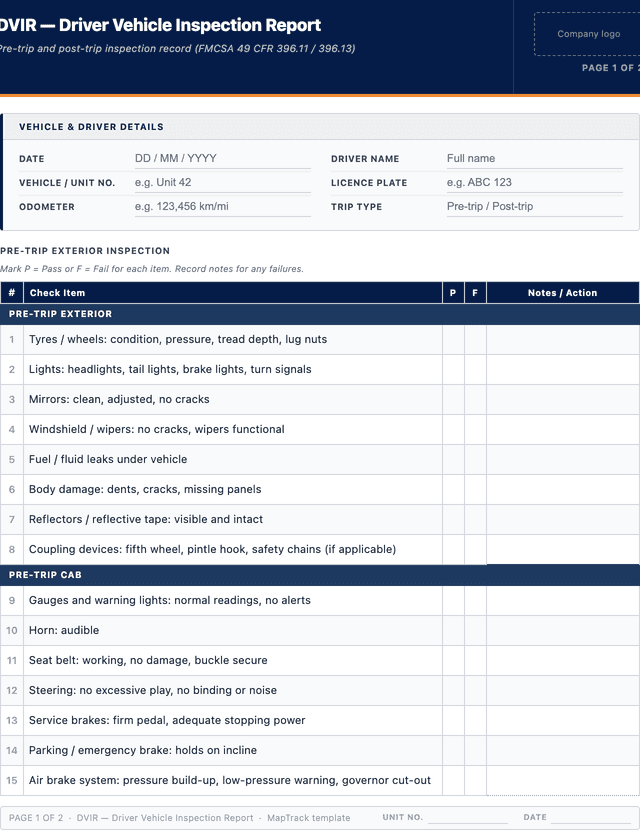
DVIR - Driver Vehicle Inspection Report
Pre-trip and post-trip inspection record (FMCSA 49 CFR 396.11 / 396.13)
Pre-Trip Exterior
Pre-Trip Cab
Safety Equipment
Repair Certification by the Motor Carrier or Agent (if defects listed)
Name
Signature
Date
Driver Sign-off
Signature
Print name
Date
Reviewed by Supervisor
Signature
Print name
Date
Next Driver
Signature
Print name
Date
How to use: download the PDF, print or complete digitally on any device.
- PDF format, ready to print or fill on screen
- Use as-is or customise to suit your operation
- Go digital in MapTrack for photos, reminders and audit trails
Two ways to use it
Use in MapTrack →Use it digitally instead
Unlimited usersThese same 20 checks, already built.




- Scan the asset’s QR tag with any phone
- Submitted forms can trigger alerts
- Photos on fails, audit-ready records
- Export responses, PDF reports with your logo
Free trial. No credit card needed.
Trusted by teams across Australia and New Zealand
We respect your privacy. Unsubscribe anytime.
These templates are free general guides provided as-is. They do not constitute legal, safety or compliance advice. You are responsible for ensuring any form meets your specific workplace obligations, industry standards and applicable regulations.
Don't just download it - use it live. Start a free workspace with this DVIR - driver vehicle inspection report already built, so your crew can run it from a phone.

Co-Founder & Commercial Director
Key takeaways
- The MapTrack DVIR - driver vehicle inspection report contains 20 checks across 3 sections. Sections covered: Pre-Trip Exterior, Pre-Trip Cab, Safety Equipment.
- A DVIR is a written record of a pre-trip and post-trip inspection of a commercial motor vehicle. In the US it is mandated by FMCSA under 49 CFR 396.11 and 396.13; in Australia NHVR requires daily inspections under the Heavy Vehicle National Law.
- A written DVIR must be prepared at the end of each day for every commercial motor vehicle operated. The next driver must review the most recent DVIR before driving and verify that any reported defects have been corrected.
- The DVIR must cover service and parking brakes, steering, lights and reflectors, tyres, horn, wipers, mirrors, coupling devices, wheels and rims, and emergency equipment. Any defect affecting safety must be corrected before the vehicle returns to service.
- When a defect is corrected, the mechanic signs the verification section to close the loop. The driver, the mechanic and the motor carrier all carry chain-of-responsibility obligations under HVNL Chapter 4 and FMCSA Part 396.
- FMCSA 49 CFR 396.11(c) requires the motor carrier to retain each DVIR for at least 90 days. Many operators keep records for 12 months or longer; NHVR recommends three years to support audit and insurance reviews.
Enter your email below to download this DVIR - driver vehicle inspection report as a ready-to-use PDF.
Used by construction, mining and field service teams











What is a DVIR - driver vehicle inspection report?
A DVIR (Driver Vehicle Inspection Report) is a written record of a pre-trip and post-trip inspection of a commercial motor vehicle. In the United States, DVIRs are mandated by the Federal Motor Carrier Safety Administration (FMCSA) under 49 CFR 396.11 and 396.13. Before driving, a driver must be satisfied the vehicle is in safe operating condition (49 CFR 396.13), and at the end of each day's work the driver reports in writing any defect or deficiency found in, or reported on, the parts the rule lists: service brakes and trailer brake connections, parking brake, steering, lights and reflectors, tyres, horn, windshield wipers, rear vision mirrors, coupling devices, wheels and rims, and emergency equipment (49 CFR 396.11). In Australia, heavy vehicles (over 4.5 tonnes GVM or ATM) come under the Heavy Vehicle National Law, whose primary duty requires each party in the chain of responsibility to ensure, so far as is reasonably practicable, the safety of its transport activities. The DVIR creates an audit trail of vehicle condition, defect identification and correction.
The DVIR process ensures that defects are identified, reported and corrected before the vehicle returns to service. When a driver reports a defect, the motor carrier or its agent must repair any defect likely to affect safe operation and certify on the report that it has been repaired, or that repair is unnecessary, before the vehicle is driven again (49 CFR 396.11). The next driver then reviews the previous DVIR before operating the vehicle, creating a continuous chain of accountability between drivers, mechanics and fleet managers. Under section 26C of the Heavy Vehicle National Law (HVNL), which has not commenced in Western Australia or the Northern Territory, that primary duty applies to every party in the chain of responsibility. Section 19 of the WHS Act 2011 places a primary duty of care on the person conducting a business or undertaking (PCBU) to ensure, so far as is reasonably practicable, the health and safety of workers. A documented DVIR that captures the condition of every safety-critical component before and after each trip provides the evidence needed to demonstrate compliance with both FMCSA regulations and Australian work health and safety obligations.
Learn more about GPS and fleet tracking in MapTrack.
Benefits of using this DVIR - driver vehicle inspection report
- Regulatory compliance: meet FMCSA 49 CFR 396.11/396.13 requirements and Australian NHVR daily inspection obligations.
- Early defect detection: systematic pre-trip inspections catch brake, tyre, lighting and steering issues before they cause breakdowns or accidents.
- Driver accountability: the signed report confirms the driver has personally inspected the vehicle and certified its condition.
- Mechanic verification: when defects are corrected, the mechanic sign-off creates a clear chain of responsibility.
- Audit trail: completed DVIRs provide documented evidence for DOT audits, safety investigations and insurance claims.
- Reduced downtime: identifying and correcting minor defects early prevents costly roadside breakdowns and out-of-service orders.
Benefits of digitising forms in MapTrack
When you digitise vehicle checklists in MapTrack, you get:
- Field users can easily scan a QR code to complete a form on mobile. Unlimited users.
- Email the right people when a form is submitted, with an automation you set up.
- File every completed form against the asset, location or person it covers.
- Download any completed form as a PDF, with failed answers listed at the top.
- Fill in forms offline; they upload when the device is back online.
- Build conditional logic (show or hide questions based on answers).
- Take pictures or attach photos. Not possible with a paper-based form.
- Electronic signatures.
- Edit forms later without reprinting.
- Set who can view, fill in or edit forms with user roles.
- Upload a paper form (PDF, Word, Excel or a photo) and MapTrack's AI builds a digital version for you to check.
- Schedule services by odometer, engine hours or date for every vehicle.
- Keep fuel receipts and service records with each vehicle's inspections.
- Record repair costs on each work order against the vehicle.
Book a demo to see how MapTrack handles vehicle checklists.
Try MapTrack free for 30 days
Full access to every feature. No credit card required. Per-asset pricing so you scale as your fleet grows.
- No credit card required
- 30 days free trial
- Cancel anytime
Intuitive for field crews
“MapTrack's a great platform - intuitive for the guys out in the field and also has fantastic support.”

Matthew Anderson
Maintenance Planning Supervisor, Supagas
What to include in a DVIR - driver vehicle inspection report
This DVIR - driver vehicle inspection report covers 8 key areas:
- Vehicle details: date, driver name, vehicle/unit number, licence plate, odometer reading, trip type (pre-trip or post-trip).
- Pre-trip exterior (P/F): tyres/wheels condition and pressure, lights (headlights, tail, brake, turn), mirrors, windshield/wipers, fuel/fluid leaks, body damage, reflectors/reflective tape, coupling devices.
- Pre-trip cab (P/F): gauges and warning lights, horn, seat belt, steering play, service brakes, parking/emergency brake, air brake system pressure and build-up.
- Safety equipment (P/F): fire extinguisher, warning triangles/flares, first aid kit, spare tyre/jack/wrench, load securement.
- Post-trip defects table: item number, description of defect, severity (minor/major).
- Defect certification: driver statement that defects need not be corrected or have been corrected.
- Mechanic verification: mechanic name, signature and date confirming corrections.
- Driver declaration and sign-off: certification that the vehicle has been inspected and is/is not safe to operate.
How to use this DVIR - driver vehicle inspection report
- Complete the vehicle details section - date, driver name, vehicle/unit number, licence plate, odometer and trip type.: Record the exact odometer reading and confirm the vehicle unit number matches the assigned vehicle. Note whether this is a pre-trip or post-trip inspection. Use 24-hour time format for consistency.
- Conduct the pre-trip exterior walk-around. Inspect tyres, lights, mirrors, windshield, body and coupling devices. Mark Pass or Fail for each item.: Start at the driver door and walk clockwise around the vehicle. Check each tyre for tread depth, inflation and sidewall damage. Confirm all lights illuminate and mirrors are secure. Inspect coupling devices for wear and proper engagement.
- Complete the pre-trip cab inspection. Check gauges, horn, seat belt, steering, brakes (service, parking, air system). Mark Pass or Fail.: Start the engine and verify all gauges read within normal range. Test the horn, check the seat belt latch, and turn the steering wheel to feel for excessive play. Apply the service brake and confirm firm pedal feel. Build air pressure to governor cut-out.
- Verify safety equipment - fire extinguisher, warning devices, first aid kit, spare tyre and load securement.: Confirm the fire extinguisher is fully charged and within its service date. Check that three warning triangles or flares are present and accessible. Inspect the first aid kit contents and verify the spare tyre is inflated and serviceable.
- After the trip, record any defects noted during operation in the post-trip defects table with severity ratings.: Document each defect with a clear description, location on the vehicle and severity rating (minor or major). Include any unusual noises, vibrations, warning lights or handling issues observed during the trip.
- Complete the defect certification - confirm whether defects need correction or have been corrected. If corrected, the mechanic must sign.: If defects were reported, the motor carrier must certify that repairs have been completed or that no repair is needed. The mechanic performing the repair signs and dates the verification section to close the defect loop.
- Sign the driver declaration certifying the inspection has been completed and the vehicle is or is not safe to operate.: The driver signs the declaration to confirm they personally performed the inspection, reviewed the previous DVIR, and certify the vehicle condition. The motor carrier keeps the report, the certification of repairs and the driver's review for three months from the date the report was prepared (49 CFR 396.11).
In MapTrack, you can track your fleet with GPS and digital pre-starts. Each submission is stored as a timestamped PDF against the asset record.
Get the free templateEnter your email above to download the full DVIR - driver vehicle inspection report as a PDF.Back to download formHow often should you complete this checklist?
Under FMCSA rules, at the end of each day's work the driver prepares a written report on each vehicle operated that lists any defect or deficiency found or reported; no report is required when none is found (49 CFR 396.11). Before driving, the driver must be satisfied the vehicle is in safe operating condition. If the last report listed defects, the next driver reviews it and signs it to acknowledge the carrier's certification that the defects were repaired or that repair was unnecessary (49 CFR 396.13). In Australia, the Heavy Vehicle National Law's primary duty covers heavy vehicle safety; check your own safety management system for how often your drivers check their vehicles. Best practice is to complete both a pre-trip and post-trip inspection, even if only one is legally required, to catch defects early and maintain a continuous record of vehicle condition.
Frequently asked questions
Applicable regulatory standards
This template is a starting point. Check the current requirements that apply to your equipment, work and location. The template alone does not establish compliance.
- FMCSA 49 CFR 396.11 - Driver Vehicle Inspection Reports
- FMCSA 49 CFR 396.13 - Driver inspection
- Heavy Vehicle National Law (HVNL) section 26C - primary duty
- WHS Act 2011 (Section 19 - Primary duty of care)
DVIR - driver vehicle inspection report preview
The numbers behind this DVIR - driver vehicle inspection report
Every figure below is sourced and dated, so you can quote it in a toolbox talk, a budget case or a board paper without having to chase the original report.
Embed this free template on your website
Run an industry blog, trade association site, or training resource? Drop a preview of this free DVIR - driver vehicle inspection report straight into your page. The snippet is self-contained, needs no scripts, and links readers back to the full free template.
<div style="max-width:480px;font-family:system-ui,-apple-system,'Segoe UI',Roboto,sans-serif;border:1px solid #E5E7EB;border-radius:12px;padding:20px;background:#ffffff;">
  <p style="font-size:12px;font-weight:700;letter-spacing:0.05em;text-transform:uppercase;color:#071D49;margin:0;">Free template</p>
  <p style="font-size:18px;font-weight:700;color:#071D49;margin:6px 0 0;">DVIR - driver vehicle inspection report</p>
  <ul style="margin:12px 0 0;padding-left:18px;color:#374151;font-size:14px;line-height:1.6;">
    <li style="margin:4px 0;">Vehicle details: date, driver name, vehicle/unit number, licence plate, odometer reading, trip type (pre-trip or post-trip).</li>
    <li style="margin:4px 0;">Pre-trip exterior (P/F): tyres/wheels condition and pressure, lights (headlights, tail, brake, turn), mirrors, windshield/wipers, fuel/fluid leaks, body damage, reflectors/reflective tape, coupling devices.</li>
    <li style="margin:4px 0;">Pre-trip cab (P/F): gauges and warning lights, horn, seat belt, steering play, service brakes, parking/emergency brake, air brake system pressure and build-up.</li>
    <li style="margin:4px 0;">Safety equipment (P/F): fire extinguisher, warning triangles/flares, first aid kit, spare tyre/jack/wrench, load securement.</li>
    <li style="margin:4px 0;">Post-trip defects table: item number, description of defect, severity (minor/major).</li>
    <li style="margin:4px 0;">Defect certification: driver statement that defects need not be corrected or have been corrected.</li>
  </ul>
  <p style="font-size:13px;color:#6B7280;margin:14px 0 0;padding-top:12px;border-top:1px solid #E5E7EB;">Free <a href="https://www.maptrack.com/templates/dvir-driver-vehicle-inspection-report" style="color:#071D49;font-weight:600;text-decoration:none;">DVIR - driver vehicle inspection report</a> by MapTrack</p>
</div>Free to reuse, including commercially. This template is published under a Creative Commons Attribution 4.0 licence. Copy it, adapt it, put it on your own site or in your own docs. All we ask is that you credit MapTrack with a link back to this page. The snippet above already includes that credit, so if you use it as-is you’re covered.
Cite this template
Writing about this topic? You’re welcome to quote this checklist. Here’s the wording to use so your readers can find the original.
The MapTrack DVIR - driver vehicle inspection report contains 20 checks across 3 sections.
- Short attribution
- MapTrack DVIR - driver vehicle inspection report, https://www.maptrack.com/templates/dvir-driver-vehicle-inspection-report
- Reference list
- MapTrack. (2026). DVIR - driver vehicle inspection report [Checklist template]. Retrieved from https://www.maptrack.com/templates/dvir-driver-vehicle-inspection-report
Free to reuse with credit under a Creative Commons Attribution 4.0 licence. If you’d rather link straight to it, the page is https://www.maptrack.com/templates/dvir-driver-vehicle-inspection-report.
Need to track your fleet with GPS and digital pre-starts?
Register every vehicle in MapTrack, attach digital forms, and get a complete history of every inspection, service and compliance record.
GPS and fleet tracking · All templates · Pricing · Book a demo