
Licence, induction and VOC records for every worker
Have each worker’s competency evidence ready when a site asks: inductions and VOCs signed off as forms, licences and expiry dates on their person record.

Co-Founder & GM of Operations
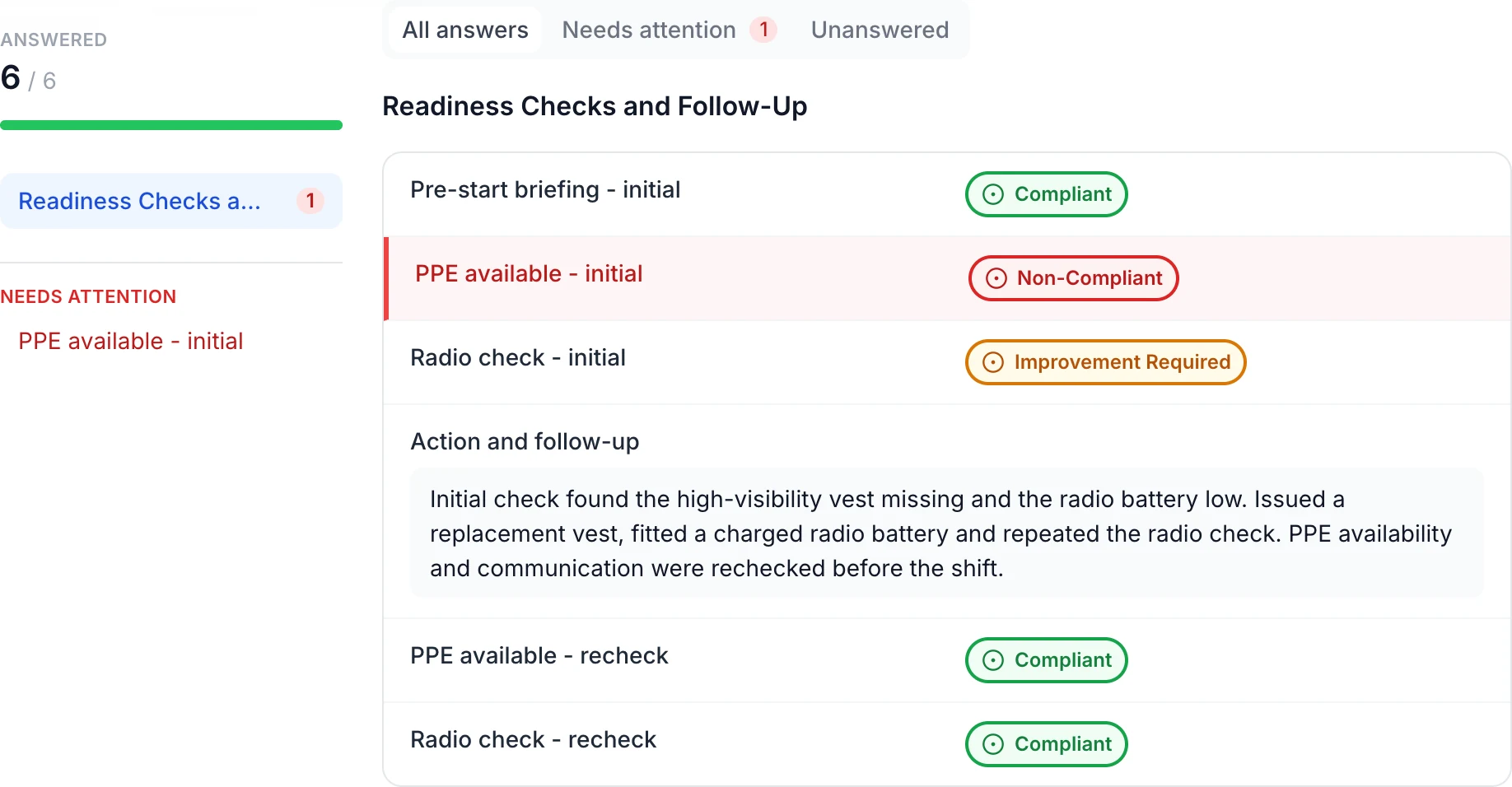
Keep worker checks and follow-up with the person
The saved check retains the missing PPE and low radio battery findings. The follow-up records a replacement vest, charged battery and repeated checks, with both rechecks marked Compliant.
MapTrack app · Demonstration data · Captured
About this screenshot
Saved demonstration Person form linked to a worker record. All six answers appear here.
Trusted by construction, mining and field service teams
















Three kinds of competency evidence, kept apart
Most workers on a site carry three kinds of evidence, and each answers a different question. An induction shows they were told about this site's hazards, rules and emergency procedures. A licence, where one applies, shows they were trained and assessed on a class of plant or vehicle. A verification of competency (VOC) shows they can safely run the particular machine they will use. Mixing them up is how gaps open: a licence doesn't prove someone knows your machine, and a VOC doesn't replace a licence the law requires. Keeping each one as its own dated record on the same person lets you see at a glance what a worker holds and when each was last done.
- Practical consequence: Keep the induction, the licence and each VOC as separate records on the same person, each with its own date, so you can see which sites and machines each worker is covered for.
- What we do not do: MapTrack doesn't assess, approve or license anyone, and it doesn't check a worker against a machine. It keeps the records your supervisors and assessors sign off.
Inductions: the white card and the site induction
In Australia the white card is general construction induction training under Part 6.5 of the model WHS Regulations. A business must not direct or allow a worker to carry out construction work unless they've completed it (regulation 317), and the card has no expiry date, though the training must be done again if it was completed more than 2 years ago and the worker hasn't done construction work in the preceding 2 years. The site induction is different. The model WHS Act and Regulations don't use the term; it's how most businesses meet the duty to provide the information, training and instruction needed to protect people from the work's risks (section 19(3)(f) of the Act), suitable and adequate for the work and readily understandable (regulation 39). There's no single mandated frequency for a site induction; common practice is a new one whenever site conditions change significantly.
- In practice: Record the white card number and issue date in fields on the person, with a copy in their files, and complete each site's induction as a form against them with the date and the supervisor's signature.
A licence is not a VOC, and a VOC is not a licence
A high risk work licence shows a worker was trained and assessed on a class of plant, such as a forklift or a slewing crane. It doesn't show they know your machine: its controls, attachments, capacities and the way it works around people on your site. SafeWork NSW's Moving plant on construction sites code (December 2025) says this directly: a licence confirms training in the functions and risks of the plant it covers, but not specific knowledge of a particular make and model, so businesses should have systems to make sure operators are competent regardless of the licence held. A verification of competency is that system. It evaluates the operator's skill against set standards on the item of plant they will use, and the code adds that one machine with several attachments may need a VOC for each attachment.
- In practice: A useful VOC record answers five questions: who was assessed, on which machine and attachments, by which assessor, on what date, and the result.
When a VOC should be done again
The NSW code sets no fixed expiry. It says re-verification should follow any unsafe operation, such as a near miss, a dangerous occurrence or a significant breach of site rules, and a change in plant, process or operating environment. It also says the currency of the training and any gap in experience are relevant to whether a competency is still current. In practice that means three questions for each operator: when were they last assessed on this machine, has anything happened since, and has the machine or the job changed. A dated VOC on the person record answers the first one straight away, and the incident or change is what triggers the next assessment.
Driver licences: what to keep on the person
For drivers, the record that matters is the licence class against the vehicle they'll drive, the expiry date, any conditions printed on the licence, and when and how it was last checked. In Australia that means classes such as C, LR, MR, HR, HC and MC, checked against the vehicle's class. For a licence issued in England, Wales or Scotland, you can check it on GOV.UK with the driver's permission and a check code they create, which shows the vehicles they can drive, penalty points and disqualifications. Either way, the check itself happens outside MapTrack. What MapTrack holds is the result: the licence details and expiry in fields on the driver's person record, a copy in their files, and each check completed as a form with its date and the checker's signature.
- In practice: Record each check of a driver’s licence as a form against the person, so each one keeps its own date and outcome instead of overwriting the last one.
The problem
The competency usually exists. The evidence is scattered. Induction sheets sit in a folder at the site office, VOC forms in another at the depot, photos of licences and white cards live on a supervisor's phone, and expiry dates are in a spreadsheet only one person updates. Then a principal contractor asks for the crew's licences, inductions and VOCs before mobilisation, or an incident review asks who assessed the operator on that machine and when they were inducted, and the answer takes a day of digging. When a worker moves between crews or sites, their paperwork usually doesn't move with them.
How MapTrack addresses it
MapTrack keeps competency on the person, the same way it keeps inspections on the machine. Each worker has a person record. Custom fields hold their licence class, number and expiry, white card number and anything else you track. Copies of licences, cards and tickets go in its files. Inductions and VOCs are forms completed against that person on a phone: each item marked, photos where they help, and a signature on the screen. Each signed-off form stays on the person record with its date and answers, and downloads as a PDF on your letterhead when a site or auditor asks. MapTrack keeps the records; your procedure decides who is competent.
How it works
- 1
Bring in your people
Import your workers from a spreadsheet, then add custom fields for licence class, licence number, expiry date and card numbers.
- 2
Set up your induction and VOC forms
Build each one as a form with the items your supervisors and assessors check, or start from our free site induction and VOC templates.
- 3
Sign them off on the person
The supervisor or assessor completes the form against the worker's person record on a phone, at the gate or beside the machine, and signs on the screen.
- 4
Send the evidence when it is asked for
Open the person record for licence details, copies, inductions and signed-off VOCs, and download each form as a PDF on your letterhead.
What each person record holds
Each of these sits on the worker, so their competency evidence travels with them between crews and sites.
Licence details and expiry
Custom fields for licence class, number and expiry date, white card number and anything else you track, set up the way your team already does it.
Free licence register templateSigned-off inductions
Each site induction is a form completed against the person, with the supervisor’s signature saved on it and printed on its PDF.
Free site induction checklistSigned-off VOC forms
Each VOC is a form completed against the person, with the assessor’s signature saved on it and printed on its PDF.
Free VOC form templateChecks of driver licences
Each check completed as a form against the driver, with the date, what was sighted and who checked it.
Free driver licence verification formCopies of cards and tickets
Photos or scans of licences, white cards, tickets and training certificates in the person’s files.
Their other forms
Worker checks and other forms completed against the person, with their answers and follow-up notes kept.
Forms and checklistsWhy teams move competency records off paper
The evidence follows the person
Inductions, licence details, copies and VOCs sit on one person record, so they move with the worker between crews and sites.
Signed off where the work is
The supervisor or assessor completes the form on a phone at the gate or beside the plant and signs on the screen, with no sheet to scan in later.
Each record keeps its own date
The induction covers the site, the licence covers the class and the VOC covers your machine. Each has its own date on the same record.
Ready for the principal contractor
Each completed form downloads as a PDF on your letterhead, so mobilisation paperwork is a few clicks.
The plant and vehicles these workers run
The instruments this recordkeeping sits under
Which plant needs a licence, how competency is verified, what induction training a worker needs and what evidence a business must sight and keep are set by the instruments below and by each state’s version of them, not by MapTrack. In Great Britain, checking a driving licence is a GOV.UK service. We support the recordkeeping; the assessment and the decision about who does what remain yours.
Check the current source
- Code of Practice: Moving plant on construction sites (SafeWork NSW, December 2025)
- Model WHS Regulations (Safe Work Australia)
- Model Work Health and Safety Act (Safe Work Australia)
- Check someone's driving licence information (GOV.UK)
MapTrack keeps the records these standards ask you to keep. It does not certify your work or make you compliant, and the current text of each instrument is the authority.
Every worker’s inductions, licences and VOCs in one place
Full access to every feature. No credit card required. Per-asset pricing so you scale as your fleet grows.
- No credit card required
Frequently asked questions
What can MapTrack keep on a worker’s record?
What is a verification of competency (VOC)?
Is a VOC the same as a high risk work licence?
Does a white card expire?
What licence records does the business have to keep?
How do I check a UK driving licence for work?
Does MapTrack check whether a worker is competent or licensed?
Can the induction or VOC be done on a phone?
A principal contractor wants our crew’s competencies before we mobilise. What do we send?
Can we bring in our existing licence spreadsheet?
Explore
- Pricing
- Book a demo
- MapTrack vs Asset Panda
- Alternative to Asset Panda
- Alternative to spreadsheets
- Commercial GPS tracking
- Construction equipment GPS tracking
- Construction
- Vehicle pre-start checklist
- Hardware store
Related use cases
- Tool theft prevention
- Tool tracking for construction
- Equipment utilisation tracking
- Plant and machinery compliance
- Fleet pre-start inspections
- Equipment maintenance scheduling
- Asset audits and stocktakes
- Equipment hire and rental tracking
- Fire extinguisher inspections
- Test and tag tracking
- Shutdown and turnaround management
- Multi-site equipment management
- GPS geofence time onsite
- Calibration tracking
- Bulk inspections and testing
- Lifting gear and crane inspections
- SWMS and plant risk assessments
- Asset documents and certificates
- Equipment custody and handover
- Offline inspections
- One system for fleet, plant and tools
- Plant hire chargeout and job costing
- Forklift inspections
- EWP inspections
- Harness and ladder inspections
- Crane inspections
- PPE register
- Scaffold tagging
- First aid and AED inspections
Get competency records off paper
Join construction, mining and field service teams across Australia.
4.9 on G2 · 5.0 on Capterra, GetApp & Software Advice· Source: G2.com, Inc.
- No credit card required
Competency management · High risk work licence · Site induction and the white card · How to do a site induction · Equipment competency and licence matrix · High risk work licence register template · Pricing