
Free eyewash station inspection checklist
Free eyewash station inspection checklist (PDF-ready). Covers water flow, temperature, cleanliness, signage and AS 4775 compliance. Download free.
Updated 2 Oct 2026
Eyewash Station Inspection Checklist
Weekly and quarterly eyewash and safety shower compliance record
Location & Accessibility
Water Flow & Delivery
Water Quality & Temperature
Physical Condition & Cleanliness
Self-Contained Units (if applicable)
Compliance & Documentation
Inspector Sign-off
Signature
Print name
Date & time
Supervisor / Safety Officer Acknowledgement
Signature
Print name
Date
How to use: download the PDF, print or complete digitally on any device.
- PDF format, ready to print or fill on screen
- Use as-is or customise to suit your operation
- Go digital in MapTrack for photos, reminders and audit trails
Two ways to use it
Use in MapTrack →Use it digitally instead
Unlimited usersThese same 24 checks, already built.




- Scan the asset’s QR tag with any phone
- Submitted forms can trigger alerts
- Photos on fails, audit-ready records
- Export responses, PDF reports with your logo
Free trial. No credit card needed.
Trusted by teams across Australia and New Zealand
We respect your privacy. Unsubscribe anytime.
These templates are free general guides provided as-is. They do not constitute legal, safety or compliance advice. You are responsible for ensuring any form meets your specific workplace obligations, industry standards and applicable regulations.
Don't just download it - use it live. Start a free workspace with this eyewash station inspection checklist already built, so your crew can run it from a phone.

Co-Founder & Commercial Director
Key takeaways
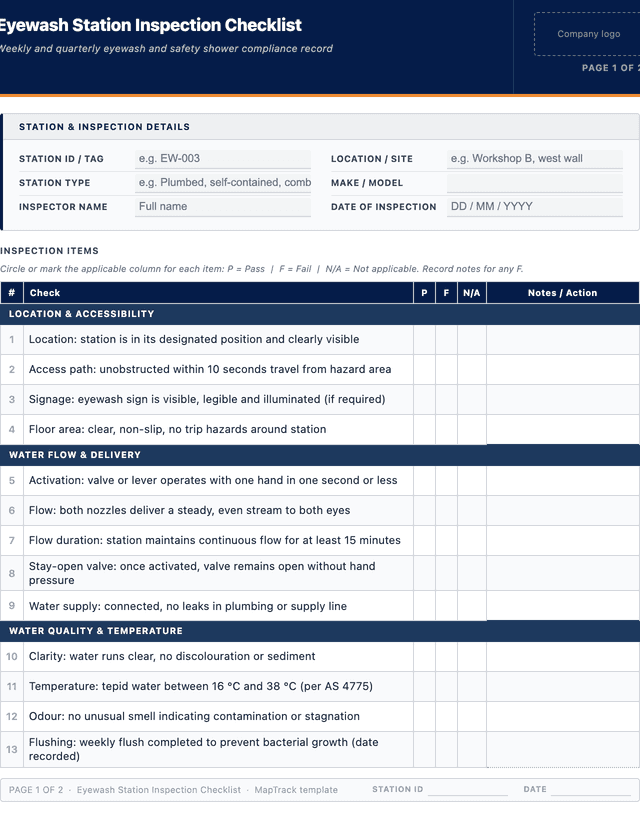
- The MapTrack eyewash station inspection checklist contains 24 checks across 6 sections. Sections covered: Location & Accessibility, Water Flow & Delivery, Water Quality & Temperature, Physical Condition & Cleanliness, Self-Contained Units (if applicable), Compliance & Documentation.
Enter your email below to download this eyewash station inspection checklist as a ready-to-use PDF.
Used by construction, mining and field service teams











What is an eyewash station inspection checklist?
An eyewash station inspection checklist is a structured form used to verify that an emergency eyewash station is operational, accessible and compliant with Australian Standard AS 4775 (Emergency eyewash and shower equipment). It covers the access path, signage, water flow and delivery, water temperature and quality, physical condition of the unit, and compliance documentation. Regular inspections ensure the station will work when it is needed most, prevent bacterial growth in plumbing, and provide documented evidence of compliance for WHS audits and regulator inspections.
Eyewash stations are a critical piece of emergency safety equipment in any workplace that handles chemicals, corrosive substances, biological hazards or dust-generating processes. AS 4775 requires that eyewash stations be located within 10 seconds travel time of the hazard, deliver tepid water (16 to 38 degrees Celsius) at a sufficient flow rate, and remain accessible and unobstructed at all times. Without regular inspection and flushing, stagnant water in the supply line can harbour bacteria such as Legionella, and components can degrade to the point where the station fails during an actual emergency. The ANSI Z358.1 standard provides similar requirements for workplaces in the United States.
Learn more about compliance and inspections in MapTrack.
Benefits of using this eyewash station inspection checklist
- Emergency readiness: confirm the station activates quickly and delivers continuous flow when an eye exposure occurs.
- AS 4775 compliance: documented inspections demonstrate your site meets Australian Standard requirements for emergency eyewash equipment.
- Water quality: weekly flushing and temperature checks prevent bacterial growth such as Legionella in stagnant lines.
- Accessibility: verify the station is within 10 seconds travel time, clearly signed and free of obstructions.
- Self-contained unit management: track fluid levels, expiry dates and seal integrity for portable or cartridge-based units.
- Audit trail: maintain a verifiable inspection history for WHS audits, incident investigations and regulator visits.
Benefits of digitising forms in MapTrack
When you digitise eyewash station checklists in MapTrack, you get:
- Field users can easily scan a QR code to complete a form on mobile. Unlimited users.
- Email the right people when a form is submitted, with an automation you set up.
- File every completed form against the asset, location or person it covers.
- Download any completed form as a PDF, with failed answers listed at the top.
- Fill in forms offline; they upload when the device is back online.
- Build conditional logic (show or hide questions based on answers).
- Take pictures or attach photos. Not possible with a paper-based form.
- Electronic signatures.
- Edit forms later without reprinting.
- Set who can view, fill in or edit forms with user roles.
- Upload a paper form (PDF, Word, Excel or a photo) and MapTrack's AI builds a digital version for you to check.
- Assign audits and send reminder emails to the people doing them.
- Keep every audit, inspection and sign-off against the asset or site it covers.
- Track corrective actions as work orders from finding to close-out, with each change in the activity log.
Book a demo to see how MapTrack handles eyewash station checklists.
Try MapTrack free for 30 days
Full access to every feature. No credit card required. Per-asset pricing so you scale as your fleet grows.
- No credit card required
- 30 days free trial
- Cancel anytime
1-2 days/week saved
“Bloody amazing! We used to spend 1-2 days a week tracking and managing our generators alone.”

Steve McAllister
Asset Coordinator, Saunders International
What to include in an eyewash station inspection checklist
This eyewash station inspection checklist covers 10 key areas:
- Station details: station ID, location, type (plumbed, self-contained, combination), make/model.
- Inspector details: name, inspection date.
- Location and accessibility: visibility, unobstructed path, signage, floor condition.
- Water flow and delivery: activation speed, dual-stream flow, 15-minute duration, stay-open valve, supply line.
- Water quality and temperature: clarity, tepid range (16-38 degrees Celsius), odour, flushing record.
- Physical condition: nozzle covers, nozzle cleanliness, bowl/basin, body/frame, drain.
- Self-contained units: fluid level, expiry date, tamper seal.
- Compliance: inspection tag, AS 4775 compliance, operating instructions.
- Defect register: item, description, action required.
- Sign-off: inspector and supervisor.
How to use this eyewash station inspection checklist
- Record station details including ID, location, type and make/model.: Confirm the station ID matches your register. Note whether the unit is plumbed, self-contained or a combination unit. Record the make, model and installation date for maintenance tracking purposes.
- Check the access path is clear and the station can be reached within 10 seconds from the nearest hazard area.: Walk the path from the closest chemical or hazard area to the station and time the walk. Confirm there are no obstructions, locked doors or obstacles that would delay access in an emergency.
- Activate the station and verify both nozzles deliver a steady, even stream. Confirm the valve stays open without hand pressure.: The valve must be a stay-open type that allows hands-free operation per AS 4775. Let the water run for at least three minutes during weekly flushing to clear stagnant water from the supply line.
- Check water temperature is within the tepid range (16-38 degrees Celsius) and the water runs clear.: Use a thermometer to verify the water temperature falls within the tepid range required by AS 4775. Water that is too cold or too hot can cause further injury during an eye irrigation emergency.
- Inspect nozzle covers, basin, body and drain for damage, blockage or contamination.: Confirm nozzle covers are in place to protect the spray heads from dust and debris. Check the basin and drain for cracks, blockages or signs of contamination that could affect water quality.
- For self-contained units, check fluid level, expiry date and tamper seal.: Verify the fluid reservoir is full, the solution has not expired, and the tamper seal is intact. Replace the cartridge or fluid if the expiry date has passed or the seal has been broken.
- Record any defects and report per your site procedures. Tag the station out of service if it fails critical items.: If the station fails to deliver adequate flow, the valve does not stay open, or the water is outside the tepid range, tag the station as out of service and arrange immediate repair.
- Sign off and date the form.: The inspector and the site supervisor should sign the completed checklist. Update the station inspection tag with the inspection date and file the record for audit and compliance tracking.
In MapTrack, you can automate compliance tracking and audit trails. Each submission is stored as a timestamped PDF against the asset record.
Get the free templateEnter your email above to download the full eyewash station inspection checklist as a PDF.Back to download formHow often should you complete this checklist?
Perform a weekly activation test to flush stagnant water from the supply line and confirm the station operates correctly with adequate flow. Weekly flushing is essential because stagnant water in the supply line can harbour bacteria such as Legionella, which poses a serious health risk if a worker needs to use the station. Complete a full inspection covering all checklist items monthly, including water temperature, nozzle condition, signage and accessibility.
Annual inspections should verify AS 4775 compliance, plumbing integrity, and replace self-contained unit cartridges or fluid as required. If the station has been relocated, repaired or reported as faulty, perform a fresh inspection before returning it to service. Sites with higher chemical exposure risks or those operating under stricter WHS management plans may require more frequent inspections. In MapTrack, you can schedule each inspection tier and track compliance across every station on site.
Frequently asked questions
Applicable regulatory standards
This template is a starting point. Check the current requirements that apply to your equipment, work and location. The template alone does not establish compliance.
- AS 4775:2007 - Emergency eyewash and shower equipment
- ANSI Z358.1 - Emergency eyewash and shower equipment
- WHS Regulations 2011 - Part 3.1 (managing risks to health and safety)
- Safe Work Australia - Code of Practice: Managing risks of hazardous chemicals in the workplace
Check the current source
Eyewash station inspection checklist preview
The numbers behind this eyewash station inspection checklist
Every figure below is sourced and dated, so you can quote it in a toolbox talk, a budget case or a board paper without having to chase the original report.
Embed this free template on your website
Run an industry blog, trade association site, or training resource? Drop a preview of this free eyewash station inspection checklist straight into your page. The snippet is self-contained, needs no scripts, and links readers back to the full free template.
<div style="max-width:480px;font-family:system-ui,-apple-system,'Segoe UI',Roboto,sans-serif;border:1px solid #E5E7EB;border-radius:12px;padding:20px;background:#ffffff;">
  <p style="font-size:12px;font-weight:700;letter-spacing:0.05em;text-transform:uppercase;color:#071D49;margin:0;">Free template</p>
  <p style="font-size:18px;font-weight:700;color:#071D49;margin:6px 0 0;">Eyewash station inspection checklist</p>
  <ul style="margin:12px 0 0;padding-left:18px;color:#374151;font-size:14px;line-height:1.6;">
    <li style="margin:4px 0;">Station details: station ID, location, type (plumbed, self-contained, combination), make/model.</li>
    <li style="margin:4px 0;">Inspector details: name, inspection date.</li>
    <li style="margin:4px 0;">Location and accessibility: visibility, unobstructed path, signage, floor condition.</li>
    <li style="margin:4px 0;">Water flow and delivery: activation speed, dual-stream flow, 15-minute duration, stay-open valve, supply line.</li>
    <li style="margin:4px 0;">Water quality and temperature: clarity, tepid range (16-38 degrees Celsius), odour, flushing record.</li>
    <li style="margin:4px 0;">Physical condition: nozzle covers, nozzle cleanliness, bowl/basin, body/frame, drain.</li>
  </ul>
  <p style="font-size:13px;color:#6B7280;margin:14px 0 0;padding-top:12px;border-top:1px solid #E5E7EB;">Free <a href="https://www.maptrack.com/templates/eyewash-station-inspection-checklist" style="color:#071D49;font-weight:600;text-decoration:none;">Eyewash station inspection checklist</a> by MapTrack</p>
</div>Free to reuse, including commercially. This template is published under a Creative Commons Attribution 4.0 licence. Copy it, adapt it, put it on your own site or in your own docs. All we ask is that you credit MapTrack with a link back to this page. The snippet above already includes that credit, so if you use it as-is you’re covered.
Cite this template
Writing about this topic? You’re welcome to quote this checklist. Here’s the wording to use so your readers can find the original.
The MapTrack eyewash station inspection checklist contains 24 checks across 6 sections.
- Short attribution
- MapTrack Eyewash station inspection checklist, https://www.maptrack.com/templates/eyewash-station-inspection-checklist
- Reference list
- MapTrack. (2026). Eyewash station inspection checklist [Checklist template]. Retrieved from https://www.maptrack.com/templates/eyewash-station-inspection-checklist
Free to reuse with credit under a Creative Commons Attribution 4.0 licence. If you’d rather link straight to it, the page is https://www.maptrack.com/templates/eyewash-station-inspection-checklist.
Need to automate compliance tracking and audit trails?
Register every eyewash station in MapTrack, attach digital forms, and get a complete history of every inspection, service and compliance record.
Compliance and inspections · All templates · Pricing · Book a demo