
Free toolbox talk template
Free toolbox talk template for Australian workplaces (PDF-ready). Topic guide, discussion points, hazard controls and attendee sign-on. Download now.
Updated 3 May 2026
How to use: download the PDF, print or complete digitally on any device.
- PDF format, ready to print or fill on screen
- Use as-is or customise to suit your operation
- Go digital in MapTrack for photos, reminders and audit trails
Download free PDF template
Use in MapTrack →



Trusted by teams across Australia and New Zealand
We respect your privacy. Unsubscribe anytime.
Or set it up in MapTrack
- Fill it in on a phone, attach photos to any check
- Automatic reports and audit trails
- The same checks as the PDF, ready to configure
Free 30-day trial. No credit card. Personal email accepted.
Don't just download it - use it live. Start a free workspace with this toolbox talk template already built, so your crew can run it from a phone.

Co-Founder & Commercial Director
Enter your email below to download this toolbox talk template as a ready-to-use PDF.
Used by construction, mining and field service teams










What is a toolbox talk template?
A toolbox talk (also called a toolbox meeting, safety briefing or pre-start talk) is a short, informal safety discussion held on site before work begins. It typically lasts 5 to 15 minutes and focuses on a single hazard or safety topic relevant to the day's work.
The purpose is simple: make sure every worker on site is aware of the specific risks they will face that day and the controls in place to manage them. Unlike a site induction (which is a one-off orientation covering broad site rules), toolbox talks are regular, recurring briefings that keep safety front of mind.
Toolbox talks are a widely accepted safety practice across Australian industries including construction, mining, civil, electrical, plumbing, HVAC, oil and gas, manufacturing and facilities management. Regulators such as SafeWork NSW, WorkSafe Victoria and Workplace Health and Safety Queensland routinely reference toolbox talks in their guidance materials as an expected part of a workplace safety management system.
Learn more about compliance and inspections in MapTrack.
Benefits of using this toolbox talk template
- Reduces incidents: workers who are briefed on specific hazards before starting work are less likely to be involved in safety incidents. Regular reinforcement builds safer habits.
- Legal compliance: toolbox talks help a PCBU demonstrate they have provided workers with information, training and instruction as required under the WHS Act. Documented records provide evidence during audits or investigations.
- Worker engagement: short, focused discussions give workers a voice. They can raise concerns, ask questions and share observations before work begins, not after something goes wrong.
- Consistency: a structured template ensures every briefing covers the same key points, regardless of who delivers it. Nothing gets missed.
- Faster response to change: when site conditions change (new hazard, weather event, equipment arrival), a toolbox talk is the quickest way to brief the entire crew.
- Audit trail: signed attendance records prove that safety briefings were delivered, who attended and what was covered. Essential for principal contractor requirements, insurer audits and regulator inspections.
Benefits of digitising forms in MapTrack
When you move your reports from paper to MapTrack, you get:
- Field users can easily scan a QR code to complete a form on mobile. Unlimited users.
- Email the right people when a form is submitted, with an automation you set up.
- File every completed form against the asset, location or person it covers.
- Download any completed form as a PDF, with failed answers listed at the top.
- Fill in forms offline; they upload when the device is back online.
- Build conditional logic (show or hide questions based on answers).
- Take pictures or attach photos. Not possible with a paper-based form.
- Electronic signatures.
- Edit forms later without reprinting.
- Set who can view, fill in or edit forms with user roles.
- Upload a paper form (PDF, Word, Excel or a photo) and MapTrack's AI builds a digital version for you to check.
- Email safety managers when a hazard report is submitted, with an automation you set up.
- Keep every hazard and incident report against the site it came from, with photos.
- Turn a hazard report into a corrective-action work order with its own review step.
Book a demo to see how MapTrack handles reports.
Try MapTrack free for 30 days
Full access to every feature. No credit card required. Per-asset pricing so you scale as your fleet grows.
- No credit card required
- 30 days free trial
- Cancel anytime
1-2 days/week saved
“Bloody amazing! We used to spend 1-2 days a week tracking and managing our generators alone.”

Steve McAllister
Asset Coordinator, Saunders International
What to include in a toolbox talk template
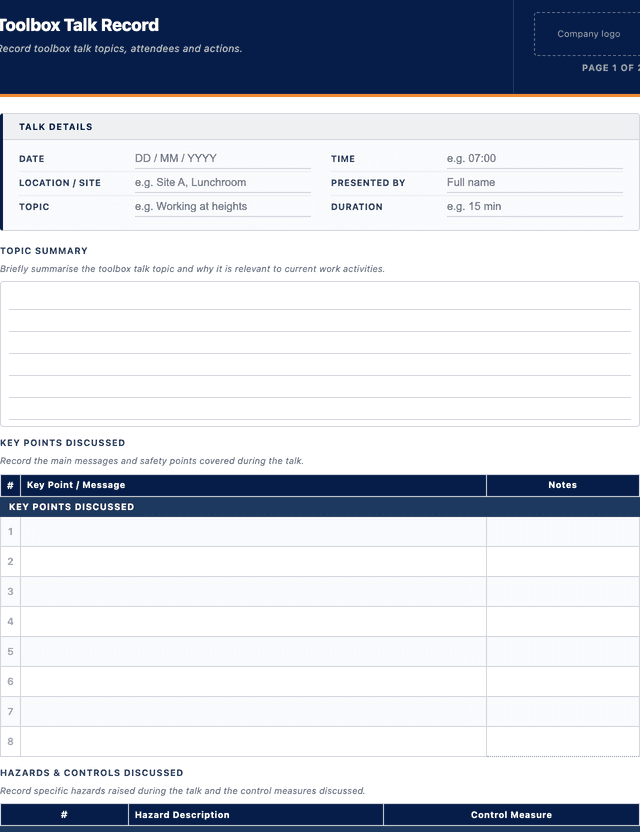
This toolbox talk template covers 8 key areas:
- Date, time and location: when and where the briefing was held.
- Presenter name: who delivered the talk.
- Topic: the specific safety topic being discussed (e.g. manual handling, working at height, heat stress).
- Key discussion points: the main hazards, risks and safe work practices covered during the briefing.
- Hazard controls: the specific controls in place to manage the identified risks (elimination, substitution, engineering controls, administrative controls, PPE).
- Actions and follow-ups: any corrective actions, improvements or follow-up items identified during the discussion.
- Questions and concerns: space for workers to raise issues, ask questions or flag hazards they have observed.
- Attendee sign-on: worker name, company, signature and date confirming they attended the briefing and understood the content.
How to use this toolbox talk template
- Choose a relevant safety topic: Select a topic that is directly relevant to the work being done that day or the current site conditions. Good sources include recent incidents or near misses, seasonal hazards (heat stress in summer, wet conditions in winter), upcoming high-risk activities, audit findings, or regulatory updates. Keep a rolling register of topics covered so you can track coverage and avoid repetition. Common topics include manual handling, working at heights, electrical safety, PPE use, fatigue management and traffic management.
- Prepare key discussion points and supporting material: Write three to five bullet points covering the main messages you want to communicate. Keep the content practical and specific to your site rather than generic. If possible, include a real example, a recent near miss from your site or industry. Prepare any visual aids: a photo of a hazard on your site, a section of the relevant code of practice, or a short demonstration. Preparation takes only a few minutes but significantly improves the quality of the briefing.
- Deliver the briefing on site, keeping it short and interactive: Gather the crew at the designated meeting point. Keep the talk to 5 to 15 minutes. Introduce the topic, explain why it matters today, and walk through your key points. Use plain language. Ask open questions to engage the group: "Has anyone seen this hazard on our site?" or "What would you do if you noticed this situation?". Encourage workers to share their own experiences and observations. A two-way conversation is far more effective than a one-way lecture.
- Discuss hazard controls and agree on any actions: Review the specific controls that are in place to manage the hazard being discussed. If any worker raises a concern or identifies a gap in the current controls, record it as an action item with a responsible person and a due date. This demonstrates that raising concerns leads to action, which encourages ongoing participation in future talks.
- Complete the attendance register and file the record: Pass the form around for every person present to print their name, note their company and sign. Record the date of the next scheduled toolbox talk. The presenter signs off on the form. File the completed record in the project safety file and enter any open actions into your corrective action tracking system. These records provide evidence of safety communication for WHS audits, client reviews and regulatory inspections.
In MapTrack, you can digitise safety inspections and compliance forms. Each submission is stored as a timestamped PDF against the asset record.
Get the free templateEnter your email above to download the full toolbox talk template as a PDF.Back to download formHow often should you complete this report?
Toolbox talks should be held before each shift on high-risk construction, mining and industrial sites where hazards change daily. On these sites, a daily pre-start briefing covering the specific tasks and hazards for that shift is standard practice and is often required by the principal contractor's safety management plan. For lower-risk workplaces such as warehouses, workshops or facilities management, weekly toolbox talks are considered best practice. Additional toolbox talks should be held whenever site conditions change significantly, when a new trade or subcontractor mobilises, after a near miss or incident, or when adverse weather affects the work.
On a monthly basis, supervisors should review toolbox talk records to confirm they are being held consistently, that a range of relevant topics has been covered, and that actions arising from previous talks have been closed out. Annually, the toolbox talk program should be reviewed as part of the WHS management system audit under AS/NZS ISO 45001:2018 Clause 7.4, including the topic register, attendance trends and the link between talk topics and incident or near-miss data. Safe Work Australia guidance on managing WHS risks emphasises the importance of ongoing worker consultation, which toolbox talks directly support.
Frequently asked questions
Applicable regulatory standards
This template is a starting point. Check the current requirements that apply to your equipment, work and location. The template alone does not establish compliance.
- Work Health and Safety Act 2011 (Cth) - Section 19 (duty to provide information, training and instruction)
- WHS Regulations 2011 - Part 3.2 (general workplace management)
- Safe Work Australia - Code of Practice: Construction work
- AS/NZS ISO 45001:2018 - Occupational health and safety management systems, Clause 7.4 (communication)
Toolbox talk template preview
The numbers behind this toolbox talk template
Every figure below is sourced and dated, so you can quote it in a toolbox talk, a budget case or a board paper without having to chase the original report.
Embed this free template on your website
Run an industry blog, trade association site, or training resource? Drop a preview of this free toolbox talk template straight into your page. The snippet is self-contained, needs no scripts, and links readers back to the full free template.
<div style="max-width:480px;font-family:system-ui,-apple-system,'Segoe UI',Roboto,sans-serif;border:1px solid #E5E7EB;border-radius:12px;padding:20px;background:#ffffff;">
  <p style="font-size:12px;font-weight:700;letter-spacing:0.05em;text-transform:uppercase;color:#071D49;margin:0;">Free template</p>
  <p style="font-size:18px;font-weight:700;color:#071D49;margin:6px 0 0;">Toolbox talk template</p>
  <ul style="margin:12px 0 0;padding-left:18px;color:#374151;font-size:14px;line-height:1.6;">
    <li style="margin:4px 0;">Date, time and location: when and where the briefing was held.</li>
    <li style="margin:4px 0;">Presenter name: who delivered the talk.</li>
    <li style="margin:4px 0;">Topic: the specific safety topic being discussed (e.g. manual handling, working at height, heat stress).</li>
    <li style="margin:4px 0;">Key discussion points: the main hazards, risks and safe work practices covered during the briefing.</li>
    <li style="margin:4px 0;">Hazard controls: the specific controls in place to manage the identified risks (elimination, substitution, engineering controls, administrative controls, PPE).</li>
    <li style="margin:4px 0;">Actions and follow-ups: any corrective actions, improvements or follow-up items identified during the discussion.</li>
  </ul>
  <p style="font-size:13px;color:#6B7280;margin:14px 0 0;padding-top:12px;border-top:1px solid #E5E7EB;">Free <a href="https://www.maptrack.com/templates/toolbox-talk" style="color:#071D49;font-weight:600;text-decoration:none;">Toolbox talk template</a> by MapTrack</p>
</div>Free to reuse, including commercially. This template is published under a Creative Commons Attribution 4.0 licence. Copy it, adapt it, put it on your own site or in your own docs. All we ask is that you credit MapTrack with a link back to this page. The snippet above already includes that credit, so if you use it as-is you’re covered.
Cite this template
Writing about this topic? You’re welcome to quote this checklist. Here’s the wording to use so your readers can find the original.
- Short attribution
- MapTrack Toolbox talk template, https://www.maptrack.com/templates/toolbox-talk
- Reference list
- MapTrack. (2026). Toolbox talk template [Checklist template]. Retrieved from https://www.maptrack.com/templates/toolbox-talk
Free to reuse with credit under a Creative Commons Attribution 4.0 licence. If you’d rather link straight to it, the page is https://www.maptrack.com/templates/toolbox-talk.
Need to digitise safety inspections and compliance forms?
Register every asset in MapTrack, attach digital forms, and get a complete history of every inspection, service and compliance record.
Compliance and inspections · All templates · Pricing · Book a demo