
Free template · PDF
Free TCO total cost of ownership equipment calculator
Free total cost of ownership equipment calculator (PDF-ready). Whole-of-life economics: acquisition, operating, maintenance, downtime, disposal. ISO 55000.
Loading PDF page...

Read the form fields
22 checks · 4 sections · Sign-off
22 checks
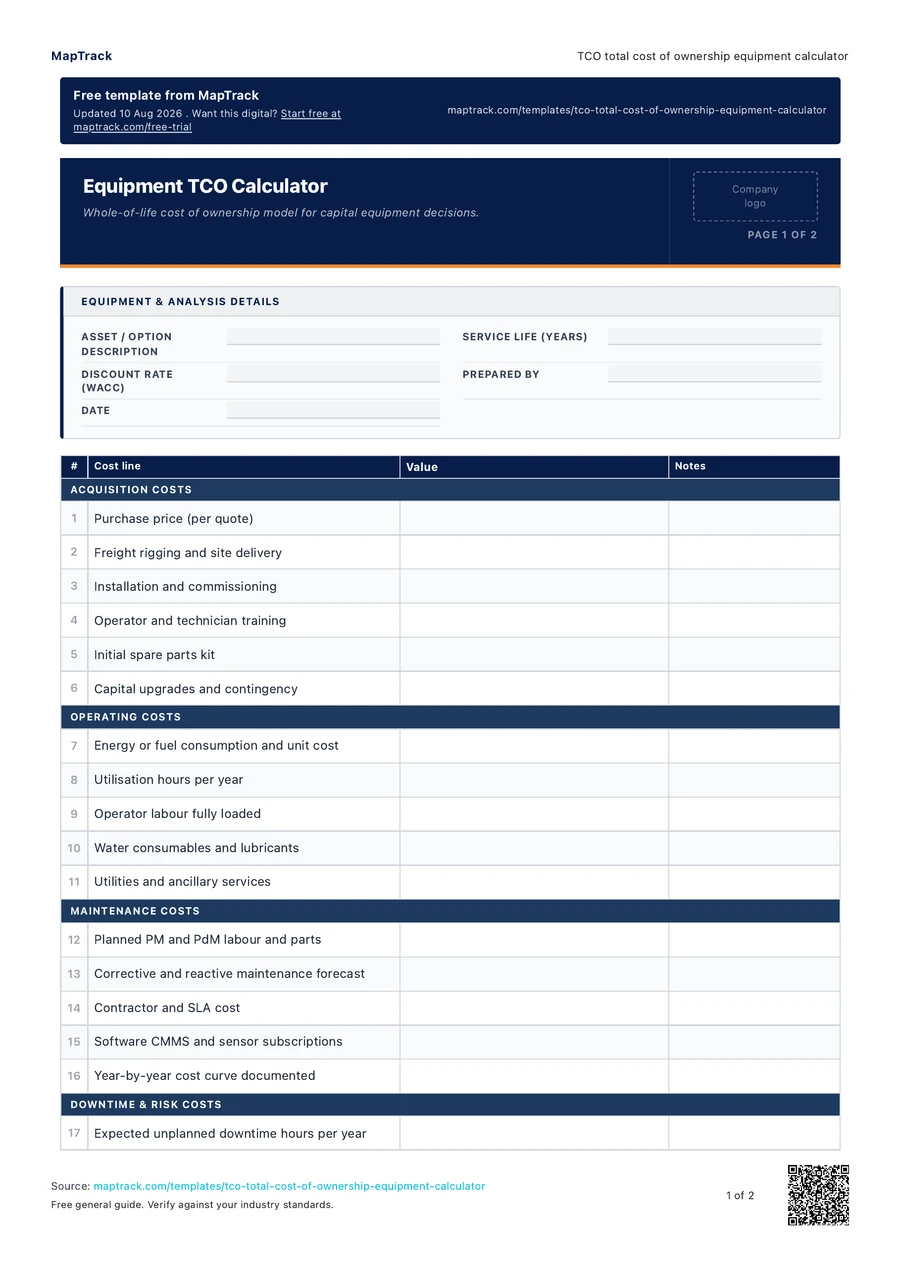
The fields in the printable form, in a view that fits your screen.
- Asset / option description
- Service life (years)
- Discount rate (WACC)
- Prepared by
- Date
Acquisition costs
Operating costs
Maintenance costs
Downtime & risk costs
Declaration & Sign-Off
I confirm that all items have been inspected/completed as indicated above. Any defects or concerns have been noted and reported.
Completed By
Printed name · Signature · Date
Reviewed / Approved By
Printed name · Signature · Date
The MapTrack TCO total cost of ownership equipment calculator contains 22 checks across 4 sections.

Co-Founder & Commercial Director
Make this form your own
Add your fields and logo. Give your team a form they can use on site.
Free 30-day trial. No credit card. Work email needed.
Upload & use this form now for free



“MapTrack beat them all in every aspect.”
 Vincent Stone · HSEQ Advisor, Concept Tanks
After signup: upload this PDF, check the form MapTrack drafts, then save and publish it for your team.
General guidance only. Check the form against your equipment manual, site procedures and local requirements before using it.
Key takeaways
- The MapTrack TCO total cost of ownership equipment calculator contains 22 checks across 4 sections. Sections covered: Acquisition costs, Operating costs, Maintenance costs, Downtime & risk costs.
- Asset and option definition: description of each equipment option being compared (make, model, capacity, configuration) with consistent units of capacity and utilisation across all options.
- Acquisition cost line: purchase price, freight and rigging, installation and commissioning, training, spare parts kit, capital upgrades, contingency and any opportunity cost of capital displaced.
- Operating cost projection: energy or fuel consumption multiplied by utilisation hours and unit cost, operator labour, water, consumables, lubricants and any utilities consumed over the planned service life.
What is a TCO total cost of ownership equipment calculator?
An equipment total cost of ownership calculator is a structured financial model used to compare the whole-of-life cost of two or more equipment options on a like-for-like basis, rather than comparing only the purchase price. The model captures every cost the asset will incur from the day of acquisition to the day of disposal, organised into the five lifecycle phases that ISO 55000 and the AS NZS 4536 lifecycle-costing standard treat as the canonical breakdown: acquisition cost (purchase, freight, install, commissioning, training), operating cost (energy, fuel, water, consumables, operator labour), maintenance cost (planned PM, predictive monitoring, corrective repairs, parts, contractor SLAs), downtime and reliability cost (lost production, customer penalties, safety incidents, recall risk) and end-of-life cost (decommissioning, environmental remediation, residual or disposal value). Each cost stream is projected over the expected service life, discounted to present value using the organisations weighted average cost of capital, and rolled up into a single net present cost (NPC) number that finance can compare against alternatives.
For capital-intensive operations, TCO is the document that decides whether the cheapest quote is actually the cheapest option. The Gartner TCO framework (originally developed for IT but adopted broadly across operational assets) and the ISO 55000 lifecycle-costing principles both make the same point: purchase price typically represents 10 to 30 percent of the lifetime cost of an industrial asset, with operating, maintenance and downtime costs making up the remainder. A drilling rig, a fleet vehicle, a packaging line, an HVAC chiller or a generator may have a 10 to 25 year service life, and the cumulative cost of fuel, energy, parts, contractor labour and unplanned downtime over that horizon dwarfs the initial purchase decision. A populated TCO calculator gives the asset manager, the finance partner and the executive sponsor a single, defensible number to compare alternatives and a sensitivity analysis that shows how the answer changes when fuel price, downtime cost or service life assumptions move. Without it, capital decisions default to whichever quote has the lowest sticker price, which is often the worst long-term outcome.
Learn more about asset tracking in MapTrack.
Choose the format that fits your team
Download the PDF
Use the original printable form for a paper workflow. Check it against your equipment and site procedure before the job.
Keep completed copies in your own record system and arrange any follow-up through your normal process.
Download free PDFCustomise a form in MapTrack
Start a free trial, upload this PDF and MapTrack drafts the form. Adjust it to your workflow, then save and publish it for your team to use.
Sample answers on this page and completed PDF records aren't imported automatically.
Upload & use this form now for freeFree 30-day trial. No credit card. Work email needed.
Benefits of using this TCO total cost of ownership equipment calculator
- Defensible capex decisions: a documented TCO with sensitivity analysis turns capital approvals from a sticker-price argument into a whole-of-life economic comparison the CFO and board can sign off.
- Vendor accountability: when the TCO model is shared with bidders, vendors are forced to commit to maintenance and reliability assumptions that finance can hold them to over the asset life.
- Energy and emissions visibility: forcing energy and fuel consumption into the model surfaces the true cost of low-efficiency options and supports ESG and scope 1 and 2 emissions reporting.
- Maintenance budget alignment: the maintenance phase of the TCO feeds directly into the annual maintenance budget for the new asset, removing the year-one underspend that plagues new capital projects.
- Disposal and residual visibility: end-of-life cost (decommissioning, remediation, residual value) is often ignored until the asset reaches retirement; the model forces a written assumption at acquisition.
- Sensitivity to assumption changes: built-in sensitivity on fuel price, utilisation, service life and downtime cost lets the team test whether the preferred option still wins if market conditions move 20 to 30 percent.
What to include in a TCO total cost of ownership equipment calculator
- Asset and option definition: description of each equipment option being compared (make, model, capacity, configuration) with consistent units of capacity and utilisation across all options.
- Acquisition cost line: purchase price, freight and rigging, installation and commissioning, training, spare parts kit, capital upgrades, contingency and any opportunity cost of capital displaced.
- Operating cost projection: energy or fuel consumption multiplied by utilisation hours and unit cost, operator labour, water, consumables, lubricants and any utilities consumed over the planned service life.
- Planned maintenance cost: PM and PdM labour, parts and contractor cost driven by the OEM-recommended schedule or the proposed reliability programme, with the year-by-year cost curve mapped to the asset age profile.
- Corrective and reactive maintenance: historic or modelled reactive maintenance hours per operating hour, parts cost, contractor cost and the cost-of-unreliability driver derived from MTBF and MTTR assumptions.
- Downtime cost: lost production hours per year multiplied by throughput rate and contribution margin per unit, plus customer penalty exposure, safety incident provision and recall or quality cost.
- End-of-life and residual: decommissioning cost, environmental remediation, transport and disposal fees, expected residual or salvage value, and the timing of those cashflows.
- Financial parameters: discount rate (weighted average cost of capital), inflation index for energy fuel labour and parts, currency, tax treatment (deductibility, depreciation method, capital allowance), and finance cost if leased.
- Sensitivity ranges: low base and high values for fuel price, utilisation, service life, downtime cost and maintenance escalation, with the model recalculating NPC under each scenario.
- Decision summary: net present cost per option, lifetime cost per output unit, payback against the next-best alternative, and a recommendation linked to the asset management plan and ISO 55001 objectives.
How to use this TCO total cost of ownership equipment calculator
Define the asset scope and the options being compared. Write the operational requirement (capacity, duty cycle, throughput, availability target) and translate it into a like-for-like options list so that every option has the same units of capacity, utilisation profile and service life assumption. Anything not normalised at this stage produces an apples-to-oranges comparison.
Build the cost projections for each lifecycle phase. For each option, model the five lifecycle phases (acquisition, operating, maintenance, downtime, end-of-life) over the planned service life. Source acquisition cost from vendor quotes, operating cost from energy or fuel rate cards, planned maintenance cost from OEM service schedules, reactive maintenance from CMMS history on similar assets, and downtime cost from the agreed lost-production formula with finance.
Apply financial parameters and discount to present value. Convert the year-by-year cashflows to present value using the organisations weighted average cost of capital. Apply the agreed inflation rates per cost category (energy and fuel typically escalate faster than parts and labour). Treat tax effects consistently (depreciation, capital allowances, deductibility), and convert finance cost into the model if the option is being leased rather than purchased.
Run sensitivity and risk analysis. The point of the TCO is not a single answer but a defensible range. Run sensitivity on the four variables that most often move the answer
fuel or energy price (plus or minus 20 to 30 percent), utilisation (plus or minus 15 percent), service life (shorter and longer by 25 percent), and downtime cost (plus or minus 30 percent). Identify the breakeven point at which the preferred option no longer wins, and flag any variable that crosses breakeven within the plausible range.
Present the decision and lock in the assumptions for post-acquisition tracking. The output is a short recommendation memo for the executive sponsor and finance partner
the preferred option, the net present cost gap to the next-best alternative, the assumptions driving the gap, and the sensitivity breakeven points. The assumptions are saved to the asset record so actual operating, maintenance and downtime cost can be tracked against the TCO model and variance fed into future capital cases.
How often should you complete this procedure?
A TCO model is built at three points in the asset lifecycle and refreshed on event triggers in between. First, at acquisition (the original decision document); second, at mid-life (typically year 5 to 7 of a 15 year asset) when remaining useful life can be reassessed against operating data; third, at end-of-life as the input to the equipment replacement decision. Between those points the model is refreshed when material assumptions change: a 20 percent or larger sustained move in fuel or energy price, a change in utilisation greater than 15 percent, a major reliability event that signals MTBF assumptions were wrong, a regulatory change (emissions, safety, decommissioning) that alters end-of-life cost, or a major capital upgrade that resets the acquisition baseline. Actual operating, maintenance and downtime cost should be tracked against the original TCO assumptions continuously - in MapTrack this is captured from completed work orders, fuel logs and downtime events and surfaced as TCO variance per asset.
Make this form your own
From your template to your team.
Upload this PDF and MapTrack drafts the form. Adjust it for your equipment and site, then save and publish the digital form for your team.
- 01
Start your free trial
Use your work email to create your MapTrack account.
- 02
Customise, save and publish
Adjust the template fields and branding for your site.
- 03
Complete it on the job
Record checks, add photos and export a branded PDF.
Keep working offline
Load the form before you lose reception. Complete it offline and sync when you're back online.
Scan the asset. Open its form.
Use an asset's QR code to find and complete the forms that belong to it.
Show what you found
Capture photos and attach files so the next person has the details they need.
Take a branded PDF with you
Download completed forms as PDF reports with your company logo.
Completed paper records aren't imported automatically.
Frequently asked questions
Practical answers about the form, record keeping and using MapTrack.
ISO 55001:2024 requires the organisation to consider the financial implications of asset management decisions across the lifecycle, and ISO 55002:2018 provides explicit guidance on lifecycle costing as a core decision-making technique. AS NZS 4536:1999 (Life cycle costing - An application guide) is the dedicated Australian and New Zealand standard for the methodology. Neither standard prescribes a specific template, but a documented TCO with sensitivity analysis is the de facto evidence used to satisfy ISO 55001 audits and capital governance committees. ASTM E2812-19 also provides standard practice for the format of asset management cost statements.
Link to this answerTCO, NPV and LCC overlap but answer different questions. Lifecycle costing (LCC) is the broadest term, defined by AS NZS 4536 as the total cost over the life of an asset. TCO is the operational subset of LCC focused on cost (not revenue), used to compare options. NPV is the financial calculation method that discounts future cashflows to present value, and is the engine inside both LCC and TCO models. In practice, finance often asks for NPV; asset managers build TCO; ISO 55001 audits reference LCC. A well-built TCO model is also an NPV model and satisfies the LCC requirements of ISO 55001.
Link to this answerUse the organisations weighted average cost of capital (WACC) agreed with finance. WACC is the blended cost of debt and equity funding used by the business, adjusted for tax. For Australian mid-market organisations WACC typically sits between 7 and 11 percent in nominal terms; large listed companies sit between 6 and 9 percent; government entities use a prescribed rate (typically 4 to 7 percent real). Always document the WACC in the model header, and run sensitivity at plus or minus 2 percentage points. Using a discount rate that is not aligned with finance is the most common reason a TCO model gets rejected at capital committee.
Link to this answerDowntime cost should be included as the cost-of-unreliability driver, calculated as expected unplanned downtime hours per year multiplied by lost production rate multiplied by contribution margin per unit. The most common double-counting error is to include both reactive maintenance labour and parts (already in the maintenance phase) and the full revenue impact of downtime - this overstates total cost. The correct treatment is: maintenance phase captures labour, parts and contractor cost for the repair; downtime phase captures lost production at contribution margin, customer penalties and any safety or quality consequence. Agree the formula with finance before the first model is built.
Link to this answerUse the realistic expected service life of the asset under the planned duty cycle, not the OEM theoretical life. For industrial fleet vehicles this is typically 7 to 10 years; for plant equipment 15 to 20 years; for buildings and HVAC 20 to 40 years. Source the life assumption from OEM technical literature, the organisations asset register history of similar assets, and an external benchmark such as the AASB 116 useful-life guidance or the ATO effective-life rulings for tax. Document the life assumption explicitly, and run sensitivity at plus and minus 25 percent because realistic life is one of the variables that moves the answer most.
Link to this answerThe Gartner TCO framework was originally developed for IT infrastructure but the underlying methodology applies directly to industrial equipment. Gartner divides cost into direct (visible budget line) and indirect (hidden or distributed) costs across acquisition, operations, support, downtime and disposal phases. The same direct or indirect split is useful for industrial assets: direct costs are easy to source from vendor quotes and CMMS records; indirect costs (operator productivity, energy stranded by inefficiency, downstream quality impact) require explicit modelling assumptions. The Gartner principle that hidden costs typically equal or exceed direct costs is borne out in industrial TCO models where downtime alone often dominates the visible budget lines.
Link to this answerApplicable regulatory standards
This form is a starting point. Check the current requirements that apply to your equipment, work and location. The form alone does not establish compliance.
- ISO 55000:2024 (Asset management - Overview principles and terminology)
- ISO 55001:2024 (Asset management - Management systems - Requirements)
- ISO 55002:2018 (Asset management - Guidelines for the application of ISO 55001)
- AS NZS 4536:1999 (Life cycle costing - An application guide)
- ASTM E2812-19 (Standard Practice for Asset Management Cost Statements)
MapTrack publishes this template. The linked authorities publish their own guidance; they haven't endorsed this form.
The numbers behind this TCO total cost of ownership equipment calculator
Every figure below is sourced and dated, so you can quote it in a toolbox talk, a budget case or a board paper without having to chase the original report.
Cite this template
Writing about this topic? You’re welcome to quote this checklist. Here’s the wording to use so your readers can find the original.
The MapTrack TCO total cost of ownership equipment calculator contains 22 checks across 4 sections.
- Short attribution
- MapTrack TCO total cost of ownership equipment calculator, https://www.maptrack.com/templates/tco-total-cost-of-ownership-equipment-calculator
- Reference list
- MapTrack. (2026). TCO total cost of ownership equipment calculator [Checklist template]. Retrieved from https://www.maptrack.com/templates/tco-total-cost-of-ownership-equipment-calculator
Free to reuse with credit under a Creative Commons Attribution 4.0 licence. If you’d rather link straight to it, the page is https://www.maptrack.com/templates/tco-total-cost-of-ownership-equipment-calculator.
Embed this free template on your website
Run an industry blog, trade association site, or training resource? Drop a preview of this free TCO total cost of ownership equipment calculator straight into your page. The snippet is self-contained, needs no scripts, and links readers back to the full free template.
<div style="max-width:480px;font-family:system-ui,-apple-system,'Segoe UI',Roboto,sans-serif;border:1px solid #E5E7EB;border-radius:12px;padding:20px;background:#ffffff;">
  <p style="font-size:12px;font-weight:700;letter-spacing:0.05em;text-transform:uppercase;color:#071D49;margin:0;">Free template</p>
  <p style="font-size:18px;font-weight:700;color:#071D49;margin:6px 0 0;">TCO total cost of ownership equipment calculator</p>
  <ul style="margin:12px 0 0;padding-left:18px;color:#374151;font-size:14px;line-height:1.6;">
    <li style="margin:4px 0;">Asset and option definition: description of each equipment option being compared (make, model, capacity, configuration) with consistent units of capacity and utilisation across all options.</li>
    <li style="margin:4px 0;">Acquisition cost line: purchase price, freight and rigging, installation and commissioning, training, spare parts kit, capital upgrades, contingency and any opportunity cost of capital displaced.</li>
    <li style="margin:4px 0;">Operating cost projection: energy or fuel consumption multiplied by utilisation hours and unit cost, operator labour, water, consumables, lubricants and any utilities consumed over the planned service life.</li>
    <li style="margin:4px 0;">Planned maintenance cost: PM and PdM labour, parts and contractor cost driven by the OEM-recommended schedule or the proposed reliability programme, with the year-by-year cost curve mapped to the asset age profile.</li>
    <li style="margin:4px 0;">Corrective and reactive maintenance: historic or modelled reactive maintenance hours per operating hour, parts cost, contractor cost and the cost-of-unreliability driver derived from MTBF and MTTR assumptions.</li>
    <li style="margin:4px 0;">Downtime cost: lost production hours per year multiplied by throughput rate and contribution margin per unit, plus customer penalty exposure, safety incident provision and recall or quality cost.</li>
  </ul>
  <p style="font-size:13px;color:#6B7280;margin:14px 0 0;padding-top:12px;border-top:1px solid #E5E7EB;">Free <a href="https://www.maptrack.com/templates/tco-total-cost-of-ownership-equipment-calculator" style="color:#071D49;font-weight:600;text-decoration:none;">TCO total cost of ownership equipment calculator</a> by MapTrack</p>
</div>Free to reuse, including commercially. This template is published under a Creative Commons Attribution 4.0 licence. Copy it, adapt it, put it on your own site or in your own docs. All we ask is that you credit MapTrack with a link back to this page. The snippet above already includes that credit, so if you use it as-is you’re covered.
About the author

Co-Founder & Commercial Director
Jarrod has spent over a decade in technology consulting and asset management, including roles at Accenture (mining and heavy industry) and CGI as an Asset Management Consultant. He co-founded MapTrack and built and scaled its original platform, then rebuilt it with Lachlan and Alex from thousands of customer conversations and 300+ user research sessions with field teams. His consulting background gives him deep insight into the operational and compliance challenges facing asset-intensive Australian businesses.
View LinkedIn profile →Ready for your next job?
Keep the PDF handy, or upload it to MapTrack and turn it into a digital form for your team.