
Free shutdown and startup planning checklist
Free shutdown and startup planning checklist (PDF-ready). Turnaround governance: scope, schedule, isolation, contractors, commissioning, SMRP 5.1.9 cost.
Updated 2 Oct 2026
Shutdown And Startup Planning Checklist
Major turnaround planning governance from scope freeze to commissioning handback.
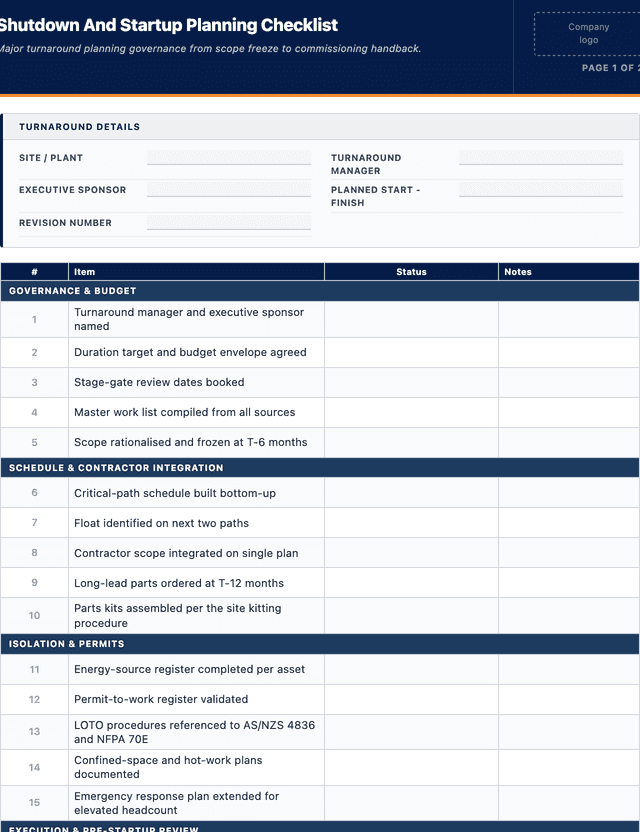
Governance & budget
Schedule & contractor integration
Isolation & permits
Execution & pre-startup review
How to use: download the PDF, print or complete digitally on any device.
- PDF format, ready to print or fill on screen
- Use as-is or customise to suit your operation
- Go digital in MapTrack for photos, reminders and audit trails
Two ways to use it
Use in MapTrack →Use it digitally instead
Unlimited usersUpload this PDF and MapTrack drafts the form for you.




- Scan the asset’s QR tag with any phone
- Submitted forms can trigger alerts
- Photos on fails, audit-ready records
- Export responses, PDF reports with your logo
Free trial. No credit card needed.
Trusted by teams across Australia and New Zealand
We respect your privacy. Unsubscribe anytime.
These templates are free general guides provided as-is. They do not constitute legal, safety or compliance advice. You are responsible for ensuring any form meets your specific workplace obligations, industry standards and applicable regulations.
Don't just download it - use it live. Start a free workspace, upload this shutdown and startup planning checklist and MapTrack drafts it as a form your crew can run from a phone.

Co-Founder & Commercial Director
Key takeaways
- The MapTrack shutdown and startup planning checklist contains 21 checks across 4 sections. Sections covered: Governance & budget, Schedule & contractor integration, Isolation & permits, Execution & pre-startup review.
Enter your email below to download this shutdown and startup planning checklist as a ready-to-use PDF.
Used by construction, mining and field service teams











What is a shutdown and startup planning checklist?
A shutdown and startup planning checklist is a master governance document used by a turnaround team to plan, execute and verify a major plant shutdown (turnaround, T A, outage, shut) and the subsequent controlled startup back to normal operations. It covers the full turnaround lifecycle: scope freeze and work-list rationalisation, schedule build to the critical path, contractor mobilisation, energy isolation and permit-to-work readiness, parts kitting and long-lead procurement, safety case and emergency response, execution control and progress reporting, mechanical completion and pre-startup safety review (PSSR), commissioning, performance test and handback to operations. Shutdowns are the single largest concentration of risk, capital and disruption in an asset-intensive operation: a typical heavy industrial turnaround compresses 12 to 36 months of work scope into 10 to 30 days, mobilises a contractor workforce 3 to 10 times normal headcount, costs $5 million to $500 million depending on scale, and routinely overruns on schedule and budget when planning discipline is weak.
The disciplines that separate predictable turnarounds from cost overruns are well established in turnaround practice: a scope freeze at T minus 6 months, a critical-path schedule built bottom-up from estimating norms, a risk-based work-list rationalisation that removes anything that doesnt earn its place in the window, and a stage-gate governance process running from T minus 24 months to startup. SMRP's Best Practices metrics include Maintenance Shutdown Costs (metric 5.1.9) for measuring the result. Safety is the other dimension that distinguishes good from bad turnarounds. Plant shutdown work concentrates high-hazard activities (energy isolation, confined space entry, working at heights, hot work, and hazardous-energy control under NFPA 70E for electrical work and OSHA 29 CFR 1910.147 in the US), managed within an OHS management system such as ISO 45001 (adopted in Australia as AS/NZS ISO 45001:2018, which replaced AS/NZS 4801:2001), with elevated incident rates if the safety case isnt built into the plan from the start. NFPA 70E specifically requires documented electrical-safety procedures and energised-work permits, and ISO 45001 requires the safety management system to extend across contractors. The planning checklist is the document that proves the plan was structured, the gates were held, and execution had the inputs it needed to succeed - and it is the document the executive sponsor, the insurance assessor and the regulator will ask for if anything goes wrong.
Learn more about maintenance and work orders in MapTrack.
Benefits of using this shutdown and startup planning checklist
- Predictable schedule and cost: stage-gated planning from T-24 months to startup, with scope freeze at T-6 months, delivers turnarounds that finish within plus or minus 10 percent of schedule and budget against the 30 to 50 percent overruns typical of un-gated turnarounds.
- Safety case built into the plan: explicit coverage of ISO 45001 (AS/NZS ISO 45001:2018, which replaced AS/NZS 4801) and NFPA 70E requirements in the planning phase, not as an afterthought, removes the structural drivers of the elevated turnaround injury rate.
- Contractor integration: a single planning standard for in-house and contractor scope eliminates the silo gap where contractor schedules, parts and permits collide with the host schedule on day one.
- Scope discipline: a documented work-list rationalisation forces every job to earn its place in the window, reducing scope by 20 to 30 percent and freeing critical-path resource for genuinely needed work.
- Faster startup with fewer surprises: mechanical completion checklists, PSSR walkdowns and structured commissioning steps surface defects before live operation, cutting first-week reactive incidents.
- Audit-ready documentation: the populated checklist is the evidence document for insurers, regulators and the executive review committee, replacing anecdotal post-mortems with a structured turnaround record.
Benefits of digitising forms in MapTrack
When you move your plans from paper to MapTrack, you get:
- Field users can easily scan a QR code to complete a form on mobile. Unlimited users.
- Email the right people when a form is submitted, with an automation you set up.
- File every completed form against the asset, location or person it covers.
- Download any completed form as a PDF, with failed answers listed at the top.
- Fill in forms offline; they upload when the device is back online.
- Build conditional logic (show or hide questions based on answers).
- Take pictures or attach photos. Not possible with a paper-based form.
- Electronic signatures.
- Edit forms later without reprinting.
- Set who can view, fill in or edit forms with user roles.
- Upload a paper form (PDF, Word, Excel or a photo) and MapTrack's AI builds a digital version for you to check.
- Raise a work order from a submitted form with an automation you set up.
- Track service intervals by hours, kilometres or calendar date in one place.
- Attach supplier invoices and parts receipts to each maintenance record.
Book a demo to see how MapTrack handles plans.
Try MapTrack free for 30 days
Full access to every feature. No credit card required. Per-asset pricing so you scale as your fleet grows.
- No credit card required
- 30 days free trial
- Cancel anytime
1-2 days/week saved
“Bloody amazing! We used to spend 1-2 days a week tracking and managing our generators alone.”

Steve McAllister
Asset Coordinator, Saunders International
What to include in a shutdown and startup planning checklist
This shutdown and startup planning checklist covers 10 key areas:
- Turnaround charter and governance: turnaround manager, executive sponsor, host site, planning team, contractor leads, governance committee, stage gates from T-24 months to startup with go/no-go criteria at each gate.
- Scope register and rationalisation: master work list from operations, maintenance, inspections, projects and HSE, with each item risk-rated, justified against the in-window criteria, and either accepted or deferred to next opportunity.
- Critical-path schedule: bottom-up schedule built from estimating norms (typical maintenance estimating reference), with critical path identified, float documented, and integration of in-house and contractor scope on a single plan.
- Contractor mobilisation: contractor selection, scope of work, contract type, mobilisation date, demobilisation date, supervision ratios, induction, qualification verification and host-site safety integration.
- Isolation, permit-to-work and LOTO readiness: energy-source register per asset, isolation plan, permit-to-work register, LOTO procedure references, electrical safety procedures aligned to NFPA 70E (or local equivalent), confined-space entry plans.
- Parts kitting and long-lead procurement: long-lead items identified at T-12 months, ordered against the freeze, parts kits per work order pre-staged to the site kitting procedure, contingency stock for emergent scope.
- Safety case and emergency response: turnaround-specific risk register, safety case within the ISO 45001 (AS/NZS ISO 45001:2018) management system, emergency response plan extension for elevated headcount, gas testing regime, fire watch standard, MEWP and crane lift plans.
- Mechanical completion and PSSR: mechanical completion punch-list per work order, pre-startup safety review walkdown protocol, sign-off authority, defect closure tracking and conditional-startup authorisation if punchlist remains.
- Commissioning and performance test: equipment-by-equipment commissioning sequence, performance acceptance criteria, instrument loop checks, control-system tests, handback-to-operations criteria and performance test run.
- Lessons learned and KPI capture: turnaround duration versus plan, cost versus budget, scope creep percentage, schedule attainment, safety performance (TRIFR LTIFR), rework and post-startup incidents captured for the next turnaround cycle.
How to use this shutdown and startup planning checklist
- Build the turnaround charter and lock the stage-gate schedule at T-24 to T-18 months. Name the turnaround manager and executive sponsor, set the high-level scope envelope, agree the duration target and budget envelope with operations and finance, and book the stage-gate review dates. The earliest gates (concept, scope build, schedule build, scope freeze) set the entire trajectory of the turnaround - work that arrives later than the stage gate disrupts every downstream activity.
- Compile and rationalise the master work list at T-12 to T-9 months. Pull every candidate job from operations, maintenance, inspections (pressure vessel, electrical, structural), projects and HSE. Risk-rate each job (must do in window, should do in window, can defer), challenge the value and the duration of every job, and either accept or defer to the next opportunity. The objective is to enter the schedule build with a defensible list, not the unfiltered combined wish-list.
- Build the critical-path schedule and freeze the scope at T-6 months. Build the schedule bottom-up from the work list using standard estimating norms (typical heavy industrial norms: turnaround duration is a function of critical-path job duration, not headcount). Identify the critical path, document float on the next two paths, and integrate contractor scope on the same plan. Hold the scope freeze gate at T-6 months - scope added after freeze requires executive sponsor sign-off and an explicit critical-path impact assessment.
- Mobilise contractors, kit parts and finalise the safety case at T-3 to T-1 months. Issue contractor packages, complete inductions and qualification checks, mobilise long-lead parts, kit parts per the site kitting procedure, complete the energy isolation plan, validate the permit-to-work register, finalise the emergency response plan for elevated headcount and run the safety case review. Walk the contractor leads through the host-site standards and run a desktop simulation of the first 48 hours.
- Execute, complete mechanical completion and PSSR, then commission and hand back. During execution, run the daily turnaround governance forum (T-time progress, safety statistics, scope creep, critical-path status), close out work orders to mechanical completion, walk the pre-startup safety review with the operations team, address punch-list items per the PSSR protocol, commission in a controlled sequence and run the performance test. Sign back to operations against the documented handback criteria and capture lessons learned for the next turnaround.
In MapTrack, you can schedule and track maintenance digitally, by date or meter reading. Each submission is stored as a timestamped PDF against the asset record.
Get the free templateEnter your email above to download the full shutdown and startup planning checklist as a PDF.Back to download formHow often should you complete this plan?
Shutdown frequency depends on asset class and process. Continuous-process plants (oil and gas, petrochemical, power, primary metals) plan major turnarounds on cycles of 2 to 6 years, set by inspection statutory intervals (pressure vessel, vessel relief, fired heater, electrical compliance) and OEM service intervals on the largest rotating equipment. Mining processing plants typically run annual mid-life shutdowns plus a major turnaround every 4 to 6 years. Manufacturing plants run planned shutdowns annually or biannually, with a major capital shutdown every 5 to 10 years. The planning effort itself spans 18 to 36 months for a major turnaround: T-24 months governance and concept, T-12 months scope build, T-6 months scope freeze, T-3 months mobilisation, execution, then 1 to 3 months post-turnaround lessons learned and as-built capture. In MapTrack, the planning checklist, scope register and progress dashboard live against the site turnaround record, so each subsequent turnaround starts with the previous turnarounds lessons learned instead of from scratch.
Frequently asked questions
Applicable regulatory standards
This template is a starting point. Check the current requirements that apply to your equipment, work and location. The template alone does not establish compliance.
- ISO 45001:2018 (Occupational health and safety management systems)
- AS/NZS ISO 45001:2018 (OHS management systems; replaced AS/NZS 4801:2001)
- NFPA 70E-2024 (Standard for Electrical Safety in the Workplace)
- OSHA 29 CFR 1910.147 (The control of hazardous energy LOTO)
- SMRP Best Practices metrics (numbering as in the 5th edition): Maintenance Shutdown Costs (5.1.9)
- AS/NZS 4836:2023 (Safe working on or near low-voltage and extra-low voltage electrical installations and equipment)
Shutdown and startup planning checklist preview
The numbers behind this shutdown and startup planning checklist
Every figure below is sourced and dated, so you can quote it in a toolbox talk, a budget case or a board paper without having to chase the original report.
Embed this free template on your website
Run an industry blog, trade association site, or training resource? Drop a preview of this free shutdown and startup planning checklist straight into your page. The snippet is self-contained, needs no scripts, and links readers back to the full free template.
<div style="max-width:480px;font-family:system-ui,-apple-system,'Segoe UI',Roboto,sans-serif;border:1px solid #E5E7EB;border-radius:12px;padding:20px;background:#ffffff;">
  <p style="font-size:12px;font-weight:700;letter-spacing:0.05em;text-transform:uppercase;color:#071D49;margin:0;">Free template</p>
  <p style="font-size:18px;font-weight:700;color:#071D49;margin:6px 0 0;">Shutdown and startup planning checklist</p>
  <ul style="margin:12px 0 0;padding-left:18px;color:#374151;font-size:14px;line-height:1.6;">
    <li style="margin:4px 0;">Turnaround charter and governance: turnaround manager, executive sponsor, host site, planning team, contractor leads, governance committee, stage gates from T-24 months to startup with go/no-go criteria at each gate.</li>
    <li style="margin:4px 0;">Scope register and rationalisation: master work list from operations, maintenance, inspections, projects and HSE, with each item risk-rated, justified against the in-window criteria, and either accepted or deferred to next opportunity.</li>
    <li style="margin:4px 0;">Critical-path schedule: bottom-up schedule built from estimating norms (typical maintenance estimating reference), with critical path identified, float documented, and integration of in-house and contractor scope on a single plan.</li>
    <li style="margin:4px 0;">Contractor mobilisation: contractor selection, scope of work, contract type, mobilisation date, demobilisation date, supervision ratios, induction, qualification verification and host-site safety integration.</li>
    <li style="margin:4px 0;">Isolation, permit-to-work and LOTO readiness: energy-source register per asset, isolation plan, permit-to-work register, LOTO procedure references, electrical safety procedures aligned to NFPA 70E (or local equivalent), confined-space entry plans.</li>
    <li style="margin:4px 0;">Parts kitting and long-lead procurement: long-lead items identified at T-12 months, ordered against the freeze, parts kits per work order pre-staged to the site kitting procedure, contingency stock for emergent scope.</li>
  </ul>
  <p style="font-size:13px;color:#6B7280;margin:14px 0 0;padding-top:12px;border-top:1px solid #E5E7EB;">Free <a href="https://www.maptrack.com/templates/shutdown-and-startup-planning-checklist" style="color:#071D49;font-weight:600;text-decoration:none;">Shutdown and startup planning checklist</a> by MapTrack</p>
</div>Free to reuse, including commercially. This template is published under a Creative Commons Attribution 4.0 licence. Copy it, adapt it, put it on your own site or in your own docs. All we ask is that you credit MapTrack with a link back to this page. The snippet above already includes that credit, so if you use it as-is you’re covered.
Cite this template
Writing about this topic? You’re welcome to quote this checklist. Here’s the wording to use so your readers can find the original.
The MapTrack shutdown and startup planning checklist contains 21 checks across 4 sections.
- Short attribution
- MapTrack Shutdown and startup planning checklist, https://www.maptrack.com/templates/shutdown-and-startup-planning-checklist
- Reference list
- MapTrack. (2026). Shutdown and startup planning checklist [Checklist template]. Retrieved from https://www.maptrack.com/templates/shutdown-and-startup-planning-checklist
Free to reuse with credit under a Creative Commons Attribution 4.0 licence. If you’d rather link straight to it, the page is https://www.maptrack.com/templates/shutdown-and-startup-planning-checklist.
Need to schedule and track maintenance digitally, by date or meter reading?
Register every asset in MapTrack, attach digital forms, and get a complete history of every inspection, service and compliance record.
Maintenance and work orders · All templates · Pricing · Book a demo