
Free template · PDF
Free ute / service vehicle daily check
Free ute and service vehicle daily check (PDF-ready). Vehicle condition, tools onboard, first aid kit, fire extinguisher and safety gear. Download free.
Loading PDF page...

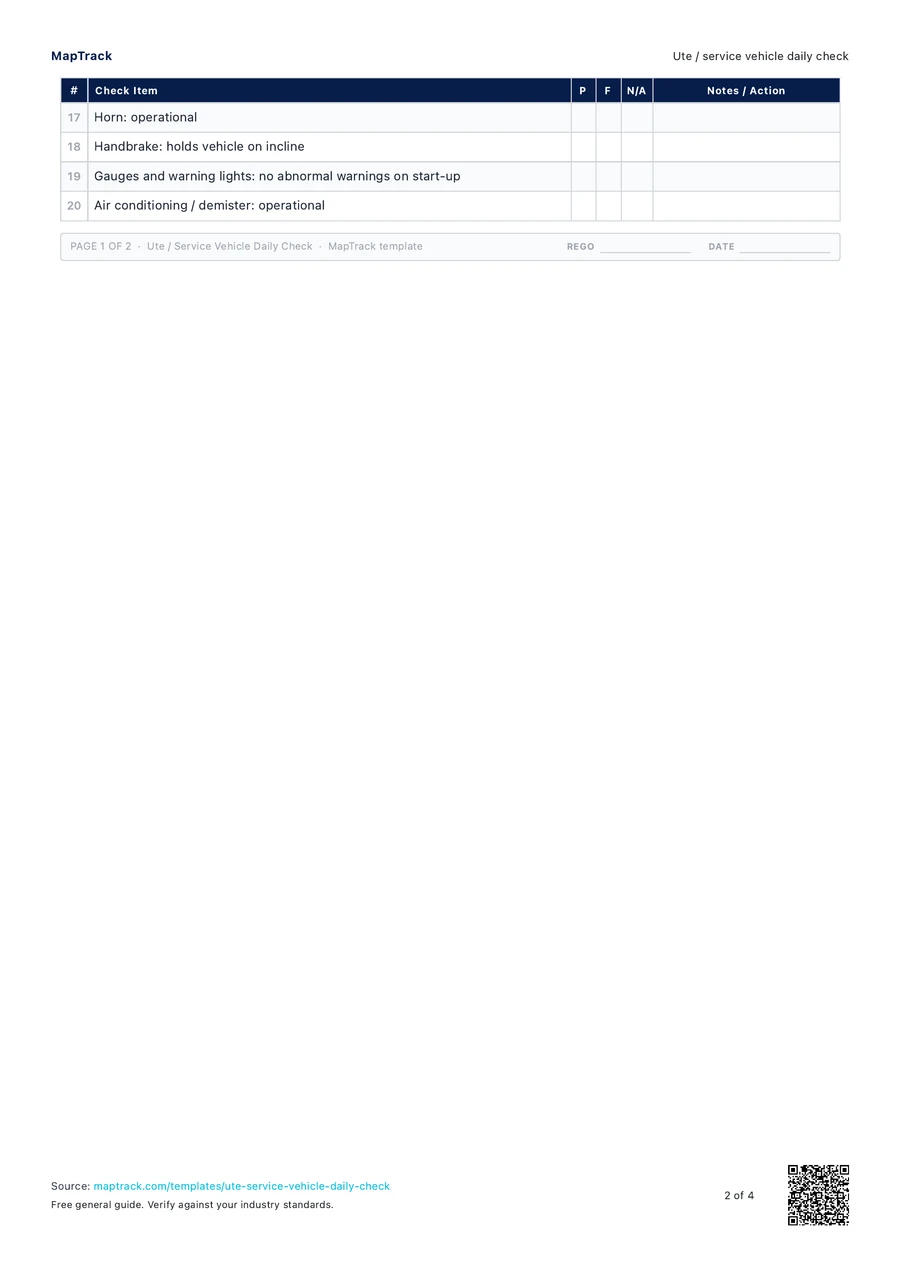
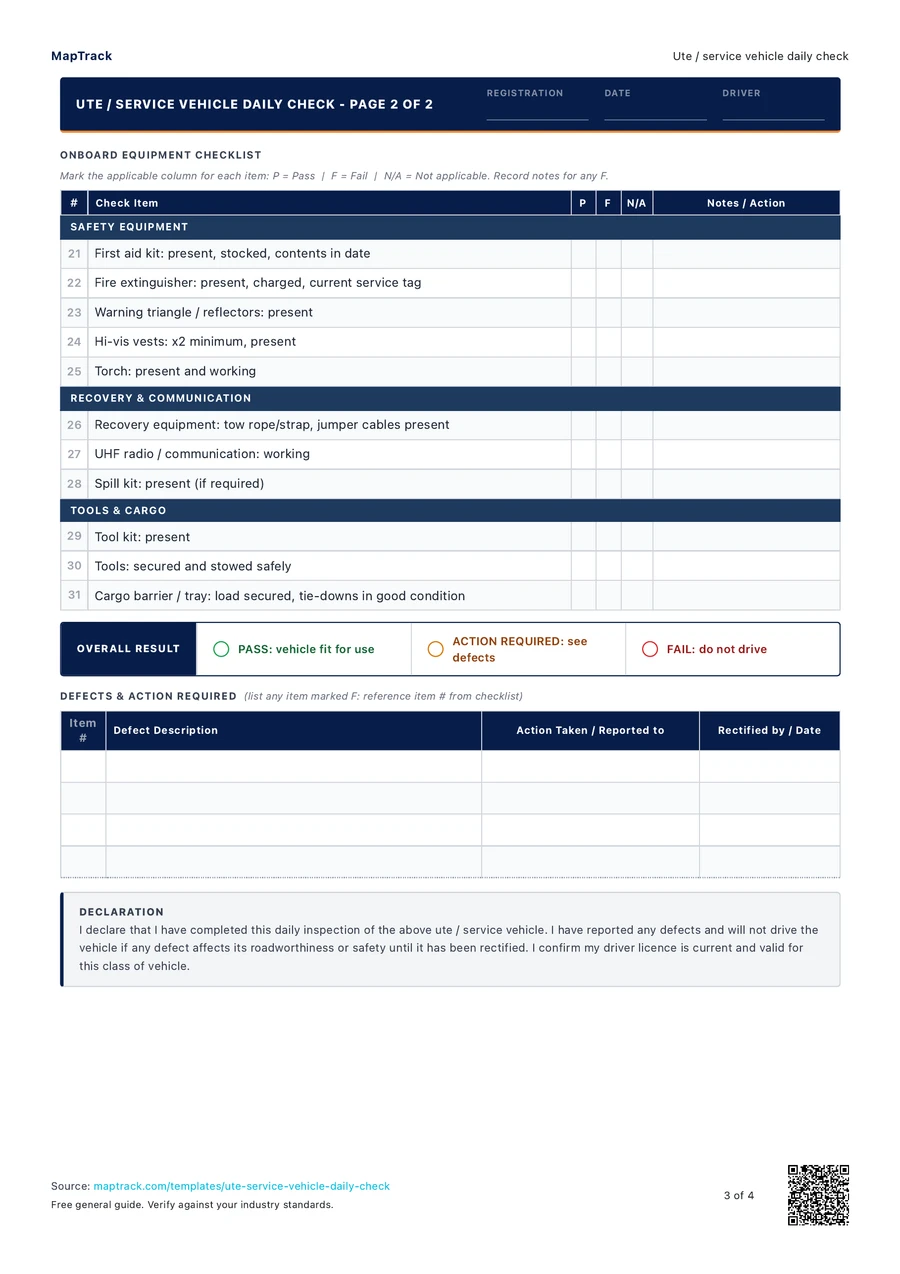

Read the form fields
31 checks · 6 sections · Sign-off
31 checks
The fields in the printable form, in a view that fits your screen.
- Registration
- Make / model
- Odometer (km)
- Fleet number
- Job / site
- Date
- Driver name
- Licence number
Exterior
Under Bonnet
Interior
Safety Equipment
Recovery & Communication
Tools & Cargo
(list any item marked F: reference item # from checklist)
Defects & Action Required
- Item #
- Defect Description
- Action Taken / Reported to
- Rectified by / Date
Declaration
I declare that I have completed this daily inspection of the above ute / service vehicle. I have reported any defects and will not drive the vehicle if any defect affects its roadworthiness or safety until it has been rectified. I confirm my driver licence is current and valid for this class of vehicle.
Driver Sign-off
Signature · Print name · Date & time
Supervisor Acknowledgement
Signature · Print name · Date
The MapTrack ute / service vehicle daily check contains 31 checks across 6 sections.

Make this form your own
Add your fields and logo. Give your team a form they can use on site.
Free 30-day trial. No credit card. Work email needed.
Customise & use this form now for free

“MapTrack beat them all in every aspect.”
 Vincent Stone · HSEQ Advisor, Concept Tanks
After signup: customise the template, then save and publish it for your team.
General guidance only. Check the form against your equipment manual, site procedures and local requirements before using it.
Key takeaways
- The MapTrack ute / service vehicle daily check contains 31 checks across 6 sections. Sections covered: Exterior, Under Bonnet, Interior, Safety Equipment, Recovery & Communication, Tools & Cargo.
- Vehicle details: registration, make/model, odometer, fleet number, job/site.
- Driver details: name, licence number, date.
- Exterior: tyres, lights, mirrors, windscreen, wipers, body condition, numberplates, tow bar/hitch if fitted.
What is a ute / service vehicle daily check?
A ute / service vehicle daily check is a structured inspection form completed by the driver before using a ute, van or light commercial vehicle for work purposes. It is a visual and functional walk-around that covers the vehicle exterior (tyres, lights, mirrors, windscreen, body condition), under the bonnet (oil, coolant, brake fluid, washer fluid, battery, belts), cabin controls (seatbelts, horn, handbrake, gauges, warning lights) and onboard equipment (first aid kit, fire extinguisher, warning triangle, hi-vis vests, torch, recovery gear, tools, cargo restraint, UHF radio and spill kit). The completed form provides a documented record that the vehicle and its safety equipment were inspected and any defects reported before driving.
Learn more about pre-start inspections in MapTrack.
Choose the format that fits your team
Download the PDF
Use the original printable form for a paper workflow. Check it against your equipment and site procedure before the job.
Keep completed copies in your own record system and arrange any follow-up through your normal process.
Download free PDFCustomise a form in MapTrack
Start a free trial, adjust the digital form to your workflow, then save and publish it for your team to use.
Your account uses the digital template. Sample answers on this page and completed PDF records aren't imported automatically.
Customise & use this form now for freeFree 30-day trial. No credit card. Work email needed.
Benefits of using this ute / service vehicle daily check
- Driver and crew safety: catch tyre, brake, light and fluid issues before they cause a breakdown or accident on the road.
- Tool and equipment accountability: confirm that essential tools, first aid kit, fire extinguisher and recovery gear are present and in working order before leaving the depot.
- WHS compliance: demonstrate that vehicles used for work are inspected regularly, supporting your duty of care under WHS legislation.
- Reduced downtime: early detection of minor issues prevents costly breakdowns and unplanned repairs in the field.
- Fleet visibility: a consistent daily check across all utes and service vehicles gives fleet managers visibility of vehicle condition and recurring defects.
- Audit trail: a signed daily form provides documented evidence for insurance claims, incident investigations and fleet audits.
What to include in a ute / service vehicle daily check
- Vehicle details: registration, make/model, odometer, fleet number, job/site.
- Driver details: name, licence number, date.
- Exterior: tyres, lights, mirrors, windscreen, wipers, body condition, numberplates, tow bar/hitch if fitted.
- Under bonnet: oil, coolant, brake fluid, washer fluid, battery, belts.
- Interior: seatbelts, horn, handbrake, gauges, warning lights, air conditioning.
- Safety equipment: first aid kit (present, stocked, in date), fire extinguisher (charged, current service tag), warning triangle/reflectors, hi-vis vests (x2 minimum), torch (working).
- Recovery and communication: tow rope/strap, jumper cables, UHF radio, spill kit (if required).
- Tools and cargo: tool kit present, tools secured, cargo barrier/tray, load secured, tie-downs.
- Overall result: Pass / Action Required / Fail.
- Defects table: defect description, action taken, rectified by.
- Driver and supervisor sign-off: signature, name, date and time.
How to use this ute / service vehicle daily check
Fill in the vehicle details (registration, make/model, odometer, fleet number, job/site) and driver details (name, licence, date) at the top of the form.
Record the vehicle registration, make, model, current odometer reading, fleet number and the job or site you are travelling to. Enter your name, licence number and the date. This information links the daily check to a specific vehicle and driver, supporting fleet compliance records, insurance documentation and WHS audit requirements.
Walk around the exterior. Check tyres for condition and pressure, inspect all lights, mirrors, windscreen, wipers, body panels, numberplates and tow bar if fitted. Mark Pass or Fail for each item.
Start at the front and work clockwise. Check each tyre for tread depth, cuts, bulges and correct inflation. Inspect all headlights, indicators, tail lights and brake lights for function. Confirm mirrors are secure and clean. Check the windscreen for cracks and wipers for blade condition. Look for body damage, loose panels or trim. Verify number plates are legible and securely attached. If a tow bar or hitch is fitted, check for cracks and confirm the pin or coupling is secure.
Open the bonnet. Check engine oil, coolant, brake fluid, washer fluid, battery terminals and belts. Mark Pass or Fail.
With the engine off, check the engine oil dipstick and top up if below the minimum mark. Inspect the coolant expansion tank level (never remove a hot radiator cap). Check the brake fluid reservoir is between the MIN and MAX marks. Fill the washer fluid if low. Inspect the battery terminals for corrosion and confirm connections are tight. Check drive belts for cracks, glazing or looseness. Look for any fluid leaks around hoses and gaskets.
Sit in the cabin. Check seatbelts, horn, handbrake, dashboard gauges, warning lights and air conditioning. Start the engine and confirm no warning lights remain on.
Fasten the seatbelt and give it a sharp tug to confirm the retractor locks. Sound the horn. Apply the handbrake and confirm it holds the vehicle. Turn the ignition to the accessory position and check that all warning lights illuminate during the self-test, then start the engine and confirm they extinguish. Test the air conditioning on both hot and cold settings. Check the fuel gauge and trip meter for the planned journey.
Check onboard safety equipment - first aid kit, fire extinguisher, warning triangle, hi-vis vests, torch, recovery gear, UHF radio, spill kit.
Open the first aid kit and verify it is stocked and all items are within their expiry date. Check the fire extinguisher gauge shows a full charge and the service tag is current. Confirm the warning triangle or reflectors are accessible. Count at least two hi-vis vests and check the torch has working batteries. Verify recovery gear (tow rope or strap, jumper cables) is present. Test the UHF radio if fitted. If a spill kit is required for your site or industry, check it is complete and stocked.
Confirm tools are present and secured, cargo barrier is in place and any load is restrained.
Check the tool kit is present and all required tools accounted for. Confirm tools are secured in a toolbox or tray and cannot become projectiles in a sudden stop. Verify the cargo barrier is in place between the cabin and the tray or load area. If carrying any load, confirm it is restrained with tie-downs or straps rated for the load weight and that the total weight does not exceed the vehicle GVM.
If any item fails, record it in the defects table with a description and action taken. Do not drive the vehicle if defects affect roadworthiness until they are rectified.
Write a clear description of each defect and the immediate action taken. Safety-critical defects such as brake failure, tyre blowout, non-functional headlights, non-functional brake lights or steering issues must prevent the vehicle from being driven. Notify your fleet manager or supervisor and arrange repair. For non-critical defects, log them for scheduled maintenance but proceed if the vehicle remains safe to drive.
Select the overall result (Pass / Action Required / Fail), sign and date the form. Save or print a copy for the fleet records.
Mark the overall result based on your findings. Sign and date the form, noting the time. If your company requires a supervisor countersignature, obtain it before departing. File the completed form in the vehicle glovebox logbook, upload to your fleet management system or submit digitally through MapTrack so the record is linked to the vehicle asset for compliance tracking.
How often should you complete this checklist?
Utes and service vehicles used for work purposes should receive a daily pre-use inspection before the first use of each day or shift. This visual and functional check takes 5–10 minutes and catches defects before they become a safety risk on the road. In addition to daily checks, vehicles should follow the manufacturer's scheduled service intervals - typically every 10,000–15,000 km or 6–12 months. Many organisations also require a more detailed weekly or monthly inspection that includes tyre tread measurements, fluid top-ups, tool inventory and fire extinguisher expiry dates. If a vehicle is used in harsh conditions (dust, gravel roads, heavy loads), increase the inspection frequency accordingly.
Make this form your own
From your template to your team.
Start with this template, adjust it for your equipment and site, then save and publish the digital form for your team.
- 01
Start your free trial
Use your work email to create your MapTrack account.
- 02
Customise, save and publish
Adjust the template fields and branding for your site.
- 03
Complete it on the job
Record checks, add photos and export a branded PDF.
Keep working offline
Load the form before you lose reception. Complete it offline and sync when you're back online.
Scan the asset. Open its form.
Use an asset's QR code to find and complete the forms that belong to it.
Show what you found
Capture photos and attach files so the next person has the details they need.
Take a branded PDF with you
Download completed forms as PDF reports with your company logo.
The trial uses a digital template. Completed paper records aren't imported automatically.
Frequently asked questions
Practical answers about the form, record keeping and using MapTrack.
A ute daily check should cover the exterior (tyres, lights, mirrors, windscreen, wipers, body condition, numberplates and tow bar/hitch if fitted), under the bonnet (oil, coolant, brake fluid, washer fluid, battery and belts), interior (seatbelts, horn, handbrake, gauges, warning lights and air conditioning), and onboard equipment (first aid kit, fire extinguisher, warning triangle, hi-vis vests, torch, recovery equipment, tools, cargo barrier/tray, UHF radio and spill kit if required). Complete the check before the first use of each day.
Link to this answerService vehicles used for work purposes should receive a daily pre-use inspection before the first use of each day or shift. This visual and functional check takes 5 to 10 minutes and catches defects before they become a safety risk on the road. In addition to daily checks, service vehicles should follow the manufacturer scheduled service intervals, typically every 10,000 to 15,000 km or 6 to 12 months. If the vehicle is used in harsh conditions (dust, gravel roads, heavy loads), increase the inspection frequency accordingly.
Link to this answerAt a minimum, a work ute should carry a first aid kit (stocked and in date), a fire extinguisher (charged with a current service tag), a warning triangle or reflectors, at least two hi-vis vests, a working torch, and recovery equipment such as a tow rope or strap and jumper cables. Depending on your industry and site requirements, you may also need a UHF radio, spill kit, tools and a cargo barrier. Check your company policy, site induction requirements and state or territory regulations for specific obligations.
Link to this answerYes. Download and use the template for free. Open the HTML file in any browser and use Print then Save as PDF to generate a printable copy. No MapTrack account is required. If you later want digital daily vehicle checks linked to each ute or service vehicle with automatic defect alerts, tool inventory tracking and fleet compliance dashboards, MapTrack can help. Book a demo to see how it works.
Link to this answerYes, this ute and service vehicle daily check template is completely free to download as a PDF. No account or signup is required. For teams wanting to move beyond paper forms, MapTrack offers a digital version that automates scheduling, sends overdue alerts, and stores completed records in the cloud for instant retrieval during audits.
Link to this answerApplicable regulatory standards
This form is a starting point. Check the current requirements that apply to your equipment, work and location. The form alone does not establish compliance.
- WHS Regulations 2017 (Part 5.1 Plant)
- WHS Act 2011 (Section 19 - Primary duty of care)
- AS 1851 (Routine service of fire protection equipment)
- Model WHS Regulations (Safe Work Australia)
- Model Work Health and Safety Act (Safe Work Australia)
- AS 1851-2012, Routine service of fire protection systems and equipment (Standards Australia)
MapTrack publishes this template. The linked authorities publish their own guidance; they haven't endorsed this form.
The numbers behind this ute / service vehicle daily check
Every figure below is sourced and dated, so you can quote it in a toolbox talk, a budget case or a board paper without having to chase the original report.
Cite this template
Writing about this topic? You’re welcome to quote this checklist. Here’s the wording to use so your readers can find the original.
The MapTrack ute / service vehicle daily check contains 31 checks across 6 sections.
- Short attribution
- MapTrack Ute / service vehicle daily check, https://www.maptrack.com/templates/ute-service-vehicle-daily-check
- Reference list
- MapTrack. (2026). Ute / service vehicle daily check [Checklist template]. Retrieved from https://www.maptrack.com/templates/ute-service-vehicle-daily-check
Free to reuse with credit under a Creative Commons Attribution 4.0 licence. If you’d rather link straight to it, the page is https://www.maptrack.com/templates/ute-service-vehicle-daily-check.
Embed this free template on your website
Run an industry blog, trade association site, or training resource? Drop a preview of this free ute / service vehicle daily check straight into your page. The snippet is self-contained, needs no scripts, and links readers back to the full free template.
<div style="max-width:480px;font-family:system-ui,-apple-system,'Segoe UI',Roboto,sans-serif;border:1px solid #E5E7EB;border-radius:12px;padding:20px;background:#ffffff;">
  <p style="font-size:12px;font-weight:700;letter-spacing:0.05em;text-transform:uppercase;color:#071D49;margin:0;">Free template</p>
  <p style="font-size:18px;font-weight:700;color:#071D49;margin:6px 0 0;">Ute / service vehicle daily check</p>
  <ul style="margin:12px 0 0;padding-left:18px;color:#374151;font-size:14px;line-height:1.6;">
    <li style="margin:4px 0;">Vehicle details: registration, make/model, odometer, fleet number, job/site.</li>
    <li style="margin:4px 0;">Driver details: name, licence number, date.</li>
    <li style="margin:4px 0;">Exterior: tyres, lights, mirrors, windscreen, wipers, body condition, numberplates, tow bar/hitch if fitted.</li>
    <li style="margin:4px 0;">Under bonnet: oil, coolant, brake fluid, washer fluid, battery, belts.</li>
    <li style="margin:4px 0;">Interior: seatbelts, horn, handbrake, gauges, warning lights, air conditioning.</li>
    <li style="margin:4px 0;">Safety equipment: first aid kit (present, stocked, in date), fire extinguisher (charged, current service tag), warning triangle/reflectors, hi-vis vests (x2 minimum), torch (working).</li>
  </ul>
  <p style="font-size:13px;color:#6B7280;margin:14px 0 0;padding-top:12px;border-top:1px solid #E5E7EB;">Free <a href="https://www.maptrack.com/templates/ute-service-vehicle-daily-check" style="color:#071D49;font-weight:600;text-decoration:none;">Ute / service vehicle daily check</a> by MapTrack</p>
</div>Free to reuse, including commercially. This template is published under a Creative Commons Attribution 4.0 licence. Copy it, adapt it, put it on your own site or in your own docs. All we ask is that you credit MapTrack with a link back to this page. The snippet above already includes that credit, so if you use it as-is you’re covered.
About the author

Commercial Director
Jarrod has spent over a decade in technology consulting and asset management, including roles at Accenture (mining and heavy industry) and CGI as an Asset Management Consultant. He joined MapTrack in 2018 and has spent the past 8+ years building and scaling the platform, conducting 300+ user research sessions with field teams to shape the product. His consulting background gives him deep insight into the operational and compliance challenges facing asset-intensive Australian businesses.
View LinkedIn profile →Ready for your next job?
Keep the PDF handy, or customise the digital form for your team.