
Free plumbing inspection checklist
Free plumbing inspection checklist (PDF-ready). Covers supply, drainage, backflow, hot water, gas and stormwater for buildings and pre-purchase audits.
Updated 18 May 2026
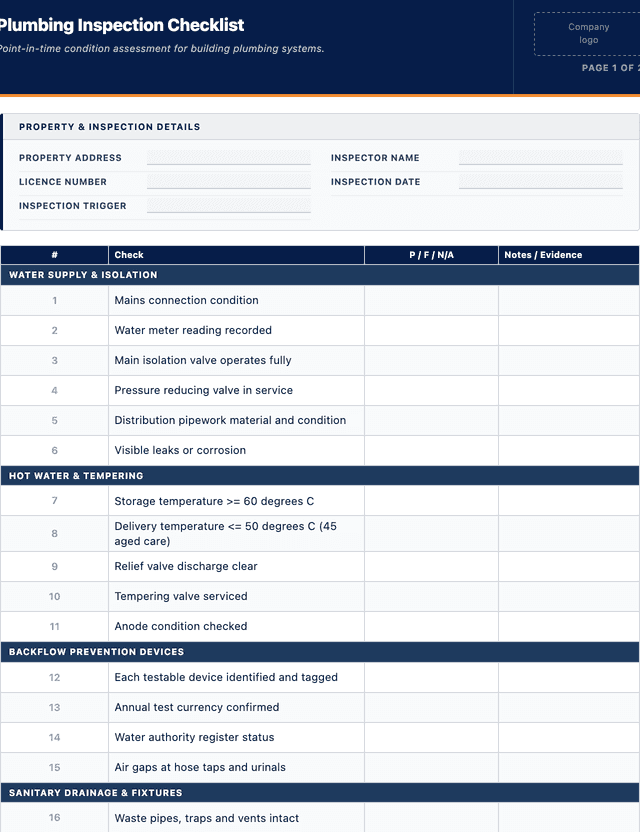
Plumbing Inspection Checklist
Point-in-time condition assessment for building plumbing systems.
Water supply & isolation
Hot water & tempering
Backflow prevention devices
Sanitary drainage & fixtures
Stormwater & gas
Defect classification
How to use: download the PDF, print or complete digitally on any device.
- PDF format, ready to print or fill on screen
- Use as-is or customise to suit your operation
- Go digital in MapTrack for photos, reminders and audit trails
Download free PDF template
Use in MapTrack →



Trusted by teams across Australia and New Zealand
We respect your privacy. Unsubscribe anytime.
Or set it up in MapTrack
- Fill it in on a phone, attach photos to any check
- Automatic reports and audit trails
- The same checks as the PDF, ready to configure
Free 30-day trial. No credit card. Personal email accepted.
Don't just download it - use it live. Start a free workspace with this plumbing inspection checklist already built, so your crew can run it from a phone.

Co-Founder & Commercial Director
Key takeaways
- The MapTrack plumbing inspection checklist contains 27 checks across 6 sections. Sections covered: Water supply & isolation, Hot water & tempering, Backflow prevention devices, Sanitary drainage & fixtures, Stormwater & gas, Defect classification.
Enter your email below to download this plumbing inspection checklist as a ready-to-use PDF.
Used by construction, mining and field service teams








What is a plumbing inspection checklist?
A plumbing inspection checklist is a point-in-time condition assessment form used by facilities managers, property managers, commercial plumbers and pre-purchase building inspectors to verify whether a property's plumbing systems meet code, are functioning correctly and pose no immediate risk to occupants. Unlike a recurring service log, this checklist records the observed state of supply pipework, drainage, fixtures, hot water units, backflow prevention devices, stormwater and gas plumbing on the day of inspection, with each item marked as compliant, defective, or requiring further investigation. Common triggers include pre-purchase property reports, lease handovers, insurance assessments, water authority audits and tenant complaint follow-ups.
In Australia the inspection is benchmarked against AS/NZS 3500 (Plumbing and Drainage) and the Plumbing Code of Australia (Volume 3 of the National Construction Code), with state-based licensing requiring that plumbing inspections be performed by or supervised by a licensed plumber. In the United Kingdom the Water Supply (Water Fittings) Regulations 1999 govern fittings compliance and backflow protection. In the United States EPA 40 CFR Part 141 covers cross-connection control under the Safe Drinking Water Act, with state plumbing codes (Uniform Plumbing Code, International Plumbing Code) governing fixture and pipework standards. A documented inspection provides the property owner with a defensible condition record at a specific date, supports insurance and finance due diligence, and gives building managers a prioritised defect list to feed into work orders.
Learn more about maintenance and work orders in MapTrack.
Benefits of using this plumbing inspection checklist
- Defensible condition record: a dated, photographed inspection captures the exact state of every plumbing system on the day of assessment, protecting owners during disputes, insurance claims and pre-purchase negotiations.
- Code benchmarking: every check is referenced against AS/NZS 3500, the Plumbing Code of Australia, UK Water Supply Regulations or relevant US plumbing codes so the report stands up to water authority and building surveyor scrutiny.
- Backflow audit support: documented inspection of testable and non-testable backflow prevention devices, with annual test currency confirmed, satisfies water authority reporting obligations and protects potable supply integrity.
- Pre-purchase due diligence: structured assessment of supply pipework, drainage, hot water units and gas plumbing surfaces hidden defects before settlement, which materially affects negotiation and contract conditions.
- Risk identification: visible leaks, deteriorated braided hoses, scalding-temperature hot water, gas leak indications and contaminated cross-connections are flagged for immediate action before they cause property damage or occupant harm.
- Prioritised defect register: every recorded defect becomes a work order with severity rating, recommended action and target close-out date, giving facilities managers a clear remediation programme rather than a list of observations.
- Audit-ready evidence: linked to building records in MapTrack, completed inspections build a defensible compliance history for water authority audits, insurance reviews and building certification renewals.
Benefits of digitising forms in MapTrack
When you digitise plumbing system checklists in MapTrack, you get:
- Field users can easily scan a QR code to complete a form on mobile. Unlimited users.
- Email the right people when a form is submitted, with an automation you set up.
- File every completed form against the asset, location or person it covers.
- Download any completed form as a PDF, with failed answers listed at the top.
- Fill in forms offline; they upload when the device is back online.
- Build conditional logic (show or hide questions based on answers).
- Take pictures or attach photos. Not possible with a paper-based form.
- Electronic signatures.
- Edit forms later without reprinting.
- Set who can view, fill in or edit forms with user roles.
- Upload a paper form (PDF, Word, Excel or a photo) and MapTrack's AI builds a digital version for you to check.
- Raise a work order from a submitted form with an automation you set up.
- Track service intervals by hours, kilometres or calendar date in one place.
- Attach supplier invoices and parts receipts to each maintenance record.
Book a demo to see how MapTrack handles plumbing system checklists.
Try MapTrack free for 30 days
Full access to every feature. No credit card required. Per-asset pricing so you scale as your fleet grows.
- No credit card required
- 30 days free trial
- Cancel anytime
1-2 days/week saved
“Bloody amazing! We used to spend 1-2 days a week tracking and managing our generators alone.”

Steve McAllister
Asset Coordinator, Saunders International
What to include in a plumbing inspection checklist
This plumbing inspection checklist covers 10 key areas:
- Property and inspection header: property address, building type, year of construction, inspector name and licence number, inspection date, weather conditions and the trigger for the inspection (pre-purchase, lease handover, audit, complaint).
- Water supply: condition of mains connection, water meter (record reading), main isolation valve operation, pressure reducing valve, distribution pipework material and condition, visible leaks and pipe insulation.
- Hot water systems: type and age of each unit, storage and delivery temperature measurements, relief valve and discharge condition, tempering valve operation, anode condition, electrical or gas isolation and visible corrosion.
- Backflow prevention: device type and location for each testable and non-testable device, annual test tag currency, water authority register status and air gap arrangements at hose taps, urinals and chemical dosing points.
- Sanitary plumbing and drainage: condition of accessible waste pipes, vents, traps, floor wastes, cleanout points and sewer connections, with trap seal integrity tested and odour or blockage indications noted.
- Fixtures and fittings: condition of taps, mixers, cisterns, urinals, basins, sinks, showers and drinking fountains, with leaks, dripping outlets, limescale, damaged seats and water-efficiency compliance recorded.
- Stormwater drainage: condition of roof drainage, downpipes, stormwater pits, on-site detention systems and overflow paths, with debris accumulation and capacity concerns noted against council requirements.
- Gas plumbing: condition of gas meter, regulator, pipework, appliance connections, flexible hoses and appliance ventilation, with leak test result, AS/NZS 5601 compliance and combustion air provision recorded.
- Cross-connections and contamination risk: identification of any direct or indirect cross-connections between potable and non-potable supplies, irrigation systems, fire services, chemical dosing equipment or rainwater tanks.
- Defect register and sign-off: every recorded defect with severity rating, photograph reference, recommended action, target close-out date, inspector signature, licence number and date.
How to use this plumbing inspection checklist
- Prepare the inspection by gathering building plans, previous reports and asset records: review hot water service history, backflow test register, water meter readings and any tenant complaints so you know which systems need closer attention.
- Inspect the water supply from mains connection through distribution pipework: locate and operate the main isolation valve, record the water meter reading, check pressure reducing valves and walk accessible pipe routes for leaks, corrosion and damaged insulation.
- Inspect every hot water unit and tempering arrangement: measure storage temperature (minimum 60 degrees Celsius for Legionella control) and delivered temperature at the furthest fixture (maximum 50 degrees Celsius via tempering valve, 45 degrees for aged care and early childhood).
- Inspect every backflow prevention device and check water authority register currency: confirm annual test tags are current, photograph each device with its tag, identify any non-testable devices and check for missing air gaps at hose taps, urinals and chemical dosing connections.
- Inspect sanitary drainage, fixtures, stormwater and gas plumbing systems: flush floor wastes to test trap seals, operate every accessible fixture, look for slow drains, deteriorated braided hoses, clear stormwater pits and leak-test gas pipework with approved leak detection solution.
- Record every defect with severity rating, photograph and recommended action: log critical defects (gas leaks, backflow failures, scalding temperatures) for immediate action, major defects (failed valves, significant leaks) for short-term remediation and minor defects for routine maintenance.
- Issue the signed inspection report and update the asset register: sign and date the report, attach photographs, lodge a copy with the water authority where required, and raise work orders in MapTrack for each defect with assigned owners and due dates.
In MapTrack, you can schedule and track maintenance digitally, by date or meter reading. Each submission is stored as a timestamped PDF against the asset record.
Get the free templateEnter your email above to download the full plumbing inspection checklist as a PDF.Back to download formHow often should you complete this checklist?
A standalone plumbing inspection is event-driven rather than scheduled. Pre-purchase building inspections, lease handovers, water authority audits, insurance assessments and significant tenant complaints all trigger a one-off inspection. Commercial properties typically commission an inspection every two to five years between water authority audit cycles, with higher-risk buildings (healthcare, aged care, hospitality, food preparation) inspected annually.
Independent of these one-off inspections, recurring maintenance activities continue: testable backflow prevention devices must be tested annually by a licensed backflow tester with results lodged with the water authority, hot water tempering valves should be serviced annually, anodes inspected every three to five years and Legionella temperature monitoring conducted at the frequency specified in the building's water risk management plan. Linking each completed inspection to the building asset record in MapTrack ensures these recurring activities continue to be tracked between point-in-time inspections.
Frequently asked questions
Applicable regulatory standards
This template is a starting point. Check the current requirements that apply to your equipment, work and location. The template alone does not establish compliance.
- AS/NZS 3500:2021
- Plumbing Code of Australia (NCC Volume 3)
- AS/NZS 5601:2013
- UK Water Supply (Water Fittings) Regulations 1999
- EPA 40 CFR Part 141
Plumbing inspection checklist preview
The numbers behind this plumbing inspection checklist
Every figure below is sourced and dated, so you can quote it in a toolbox talk, a budget case or a board paper without having to chase the original report.
Embed this free template on your website
Run an industry blog, trade association site, or training resource? Drop a preview of this free plumbing inspection checklist straight into your page. The snippet is self-contained, needs no scripts, and links readers back to the full free template.
<div style="max-width:480px;font-family:system-ui,-apple-system,'Segoe UI',Roboto,sans-serif;border:1px solid #E5E7EB;border-radius:12px;padding:20px;background:#ffffff;">
  <p style="font-size:12px;font-weight:700;letter-spacing:0.05em;text-transform:uppercase;color:#071D49;margin:0;">Free template</p>
  <p style="font-size:18px;font-weight:700;color:#071D49;margin:6px 0 0;">Plumbing inspection checklist</p>
  <ul style="margin:12px 0 0;padding-left:18px;color:#374151;font-size:14px;line-height:1.6;">
    <li style="margin:4px 0;">Property and inspection header: property address, building type, year of construction, inspector name and licence number, inspection date, weather conditions and the trigger for the inspection (pre-purchase, lease handover, audit, complaint).</li>
    <li style="margin:4px 0;">Water supply: condition of mains connection, water meter (record reading), main isolation valve operation, pressure reducing valve, distribution pipework material and condition, visible leaks and pipe insulation.</li>
    <li style="margin:4px 0;">Hot water systems: type and age of each unit, storage and delivery temperature measurements, relief valve and discharge condition, tempering valve operation, anode condition, electrical or gas isolation and visible corrosion.</li>
    <li style="margin:4px 0;">Backflow prevention: device type and location for each testable and non-testable device, annual test tag currency, water authority register status and air gap arrangements at hose taps, urinals and chemical dosing points.</li>
    <li style="margin:4px 0;">Sanitary plumbing and drainage: condition of accessible waste pipes, vents, traps, floor wastes, cleanout points and sewer connections, with trap seal integrity tested and odour or blockage indications noted.</li>
    <li style="margin:4px 0;">Fixtures and fittings: condition of taps, mixers, cisterns, urinals, basins, sinks, showers and drinking fountains, with leaks, dripping outlets, limescale, damaged seats and water-efficiency compliance recorded.</li>
  </ul>
  <p style="font-size:13px;color:#6B7280;margin:14px 0 0;padding-top:12px;border-top:1px solid #E5E7EB;">Free <a href="https://www.maptrack.com/templates/plumbing-inspection-checklist" style="color:#071D49;font-weight:600;text-decoration:none;">Plumbing inspection checklist</a> by MapTrack</p>
</div>Free to reuse, including commercially. This template is published under a Creative Commons Attribution 4.0 licence. Copy it, adapt it, put it on your own site or in your own docs. All we ask is that you credit MapTrack with a link back to this page. The snippet above already includes that credit, so if you use it as-is you’re covered.
Cite this template
Writing about this topic? You’re welcome to quote this checklist. Here’s the wording to use so your readers can find the original.
The MapTrack plumbing inspection checklist contains 27 checks across 6 sections.
- Short attribution
- MapTrack Plumbing inspection checklist, https://www.maptrack.com/templates/plumbing-inspection-checklist
- Reference list
- MapTrack. (2026). Plumbing inspection checklist [Checklist template]. Retrieved from https://www.maptrack.com/templates/plumbing-inspection-checklist
Free to reuse with credit under a Creative Commons Attribution 4.0 licence. If you’d rather link straight to it, the page is https://www.maptrack.com/templates/plumbing-inspection-checklist.
Need to schedule and track maintenance digitally, by date or meter reading?
Register every plumbing system in MapTrack, attach digital forms, and get a complete history of every inspection, service and compliance record.
Maintenance and work orders · All templates · Pricing · Book a demo