
Free irrigation system inspection checklist
Free irrigation system inspection checklist (PDF-ready). Backflow valves, controllers, pressure and station audit for councils, parks and turf. Download free.
Updated 18 May 2026
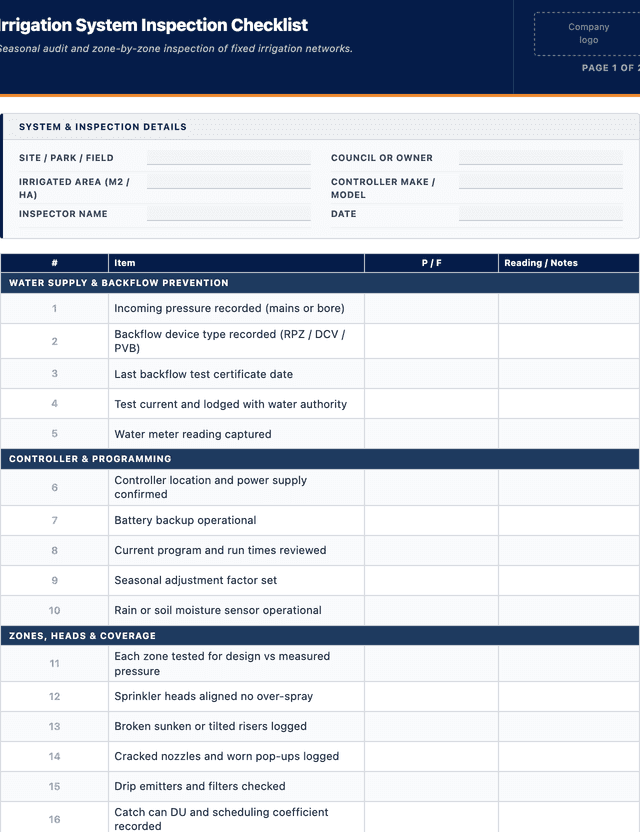
Irrigation System Inspection Checklist
Seasonal audit and zone-by-zone inspection of fixed irrigation networks.
Water supply & backflow prevention
Controller & programming
Zones, heads & coverage
Valves & valve boxes
How to use: download the PDF, print or complete digitally on any device.
- PDF format, ready to print or fill on screen
- Use as-is or customise to suit your operation
- Go digital in MapTrack for photos, reminders and audit trails
Two ways to use it
Use in MapTrack →Use it digitally instead
Unlimited usersUpload this PDF and MapTrack drafts the form for you.




- Scan the asset’s QR tag with any phone
- Submitted forms can trigger alerts
- Photos on fails, audit-ready records
- Export responses, PDF reports with your logo
Free trial. No credit card needed.
Trusted by teams across Australia and New Zealand
We respect your privacy. Unsubscribe anytime.
These templates are free general guides provided as-is. They do not constitute legal, safety or compliance advice. You are responsible for ensuring any form meets your specific workplace obligations, industry standards and applicable regulations.
Don't just download it - use it live. Start a free workspace, upload this irrigation system inspection checklist and MapTrack drafts it as a form your crew can run from a phone.

Co-Founder & Commercial Director
Key takeaways
- The MapTrack irrigation system inspection checklist contains 22 checks across 4 sections. Sections covered: Water supply & backflow prevention, Controller & programming, Zones, heads & coverage, Valves & valve boxes.
Enter your email below to download this irrigation system inspection checklist as a ready-to-use PDF.
Used by construction, mining and field service teams











What is an irrigation system inspection checklist?
An irrigation system inspection is a structured walk-around audit of a fixed irrigation network covering the water supply, backflow prevention device, controller, station valves, zones, sprinkler heads or drip emitters, pressure regulators and reticulated pipework. It is used by councils, parks teams, sports turf managers, agriculture irrigators and commercial landscape contractors to verify the system is delivering uniform application, reasonable pressure and compliant water use across the irrigated area, and to identify the leaks, blocked nozzles, broken risers, stuck valves and controller faults that drive water loss, labour and turf failure between major service intervals.
For Australian operators the inspection sits within the framework of AS/NZS 3500.1 (Plumbing and Drainage Water Services), AS 2845 (Water supply Backflow prevention devices) for testable backflow protection, state-based water efficiency labelling and standards (WELS), the Smart Approved WaterMark guidelines and the council or state water authority efficiency obligations attached to each meter. Sports turf managers also benchmark against Sports Turf Association irrigation audit practice (catch can distribution uniformity DU and scheduling coefficient SC). A documented inspection produces evidence of compliance with backflow testing obligations (annual in most states), provides defensible records for water authority audits and supports the irrigation efficiency reporting now required against many commercial supply agreements. Beyond compliance, a structured inspection routinely recovers 10 to 30 percent of irrigation water on neglected systems through stuck valves, leaking solenoids, mis-aimed sprinklers and unchecked controller schedules. The inspection runs system by system and zone by zone so any defect is mapped against the as-built drawing and triaged into immediate fix, scheduled repair or capital renewal.
Learn more about maintenance and work orders in MapTrack.
Benefits of using this irrigation system inspection checklist
- Water savings: structured zone-by-zone inspection routinely recovers 10 to 30 percent of irrigation water lost to stuck valves leaking solenoids mis-aimed heads and undetected controller schedules across council parks and turf networks.
- Backflow compliance: documented annual backflow device testing satisfies AS 2845 and the water authority obligation under AS/NZS 3500.1 with a signed record that the council water inspector or water authority auditor expects to see on file.
- Turf and crop performance: catch can audits and zone uniformity checks identify under-performing zones before grass canopy stress sports surface failure or crop yield loss reveal the problem to the asset owner or end user.
- Controller intelligence: confirming schedules are aligned to evapotranspiration soil moisture and seasonal demand cuts run times against the as-built design and surfaces controllers running on dead defaults from a previous season.
- Cost recovery and reporting: a zone-by-zone defect register backed by photographs and pressure readings supports water authority rebates council asset reporting and contractor payment milestones on grounds maintenance contracts.
- Pipework integrity: pressure testing and visual checks of mainlines laterals and risers catch the cracked joints air gulps and slow leaks that destroy turf hard surfaces and footpath sub-bases when left to run unobserved across an irrigation season.
Benefits of digitising forms in MapTrack
When you digitise irrigation system checklists in MapTrack, you get:
- Field users can easily scan a QR code to complete a form on mobile. Unlimited users.
- Email the right people when a form is submitted, with an automation you set up.
- File every completed form against the asset, location or person it covers.
- Download any completed form as a PDF, with failed answers listed at the top.
- Fill in forms offline; they upload when the device is back online.
- Build conditional logic (show or hide questions based on answers).
- Take pictures or attach photos. Not possible with a paper-based form.
- Electronic signatures.
- Edit forms later without reprinting.
- Set who can view, fill in or edit forms with user roles.
- Upload a paper form (PDF, Word, Excel or a photo) and MapTrack's AI builds a digital version for you to check.
- Raise a work order from a submitted form with an automation you set up.
- Track service intervals by hours, kilometres or calendar date in one place.
- Attach supplier invoices and parts receipts to each maintenance record.
Book a demo to see how MapTrack handles irrigation system checklists.
Try MapTrack free for 30 days
Full access to every feature. No credit card required. Per-asset pricing so you scale as your fleet grows.
- No credit card required
- 30 days free trial
- Cancel anytime
1-2 days/week saved
“Bloody amazing! We used to spend 1-2 days a week tracking and managing our generators alone.”

Steve McAllister
Asset Coordinator, Saunders International
What to include in an irrigation system inspection checklist
This irrigation system inspection checklist covers 10 key areas:
- Site identification: site name, park or sports field reference, council or owner, irrigated area (m2 or hectares), supply meter number, controller make and model and the inspector name and date.
- Water supply and backflow: incoming pressure, mains or bore source, backflow prevention device type (RPZ, DCV, pressure vacuum breaker), last test date, current test result and registration with the water authority.
- Controller and program: controller location, power supply, battery backup, current schedule, active programmes, total run minutes per zone and any seasonal adjustment factor.
- Station and zone audit: zone number, area covered, design pressure, measured pressure, number of heads or emitters, spray pattern coverage overlap and any over-spray onto paving or carriageway.
- Sprinkler and emitter condition: head type (rotor, spray, drip line), broken or sunken risers, tilted heads, cracked nozzles, blocked filters and excessive pop-up wear.
- Valve operation: solenoid manual operation, valve box condition, pressure regulation and any seeping or stuck valves identified.
- Pressure and uniformity: dynamic pressure at zone test point, catch can distribution uniformity (DU), scheduling coefficient (SC) and design pressure tolerance.
- Pipework and trenches: visible mains, lateral and riser condition, swing joints, fitting types, signs of subsidence and any leak point identified by surface wetting or water meter telemetry.
- Cross-connection and signage: hose taps in irrigated zones, tagged hose connections, cross-connection points identified and warning signage on non-potable irrigation supply.
- Defect register and sign-off: defect description, location, severity, recommended action, responsible person, target date and inspector and asset manager signatures.
How to use this irrigation system inspection checklist
- Confirm the asset and gather records: record the site, park or field reference, irrigated area, meter number, controller make, model and current programme, then review the as-built drawing, previous inspection report and any water authority correspondence including the last backflow test certificate.
- Walk the controller and station map: at the controller record battery backup, mains supply, current programme and run times, then walk every station zone with the manual run option open noting design pressure, measured dynamic pressure, number of heads or emitters and design tolerance against the original commissioning record.
- Audit zone uniformity and head performance: at each zone open the valve, check spray pattern overlap and head aim, run a catch can audit on representative zones to calculate distribution uniformity (DU) and scheduling coefficient (SC) and flag any tilted, blocked or broken heads, risers and nozzles for replacement.
- Inspect valves backflow device and pipework: pressure test the backflow prevention device against AS 2845 (or schedule the licensed test if due), operate every solenoid and manual valve, visually check valve boxes and remote bleed screws and walk the mainlines and laterals looking for surface wetting, subsidence or pressure loss between test points.
- Document defects raise corrective actions and sign off: log every defect with zone reference, photograph, severity and recommended action, set a target date and responsible person, update the as-built schematic if any changes are found and have the inspector and asset manager sign the report and the next inspection due date.
In MapTrack, you can schedule and track maintenance digitally, by date or meter reading. Each submission is stored as a timestamped PDF against the asset record.
Get the free templateEnter your email above to download the full irrigation system inspection checklist as a PDF.Back to download formHow often should you complete this checklist?
Irrigation inspections should follow a tiered cadence. A short visual walk at the controller and key zones should occur weekly during the active irrigation season (typically October through March in southern Australia and year-round in tropical regions) to catch broken heads, stuck valves and controller faults before they waste water or damage turf. A full system audit (controller programme review, zone-by-zone pressure and uniformity, catch can audit, valve operation and pipework walk) should be completed at start of season and at end of season as a minimum. Backflow prevention devices require an annual licensed test under AS 2845 and AS/NZS 3500.1, with the test result lodged with the water authority. Smart Approved WaterMark and sports turf management practice both expect this rhythm to be documented and signed. For agriculture, council and sports turf operators the inspection rhythm is also driven by contractor performance milestones and water authority audit windows, and MapTrack scheduling can run the weekly walk, monthly station audit, start and end of season audit and annual backflow test as recurring tasks against each irrigation asset.
Frequently asked questions
Applicable regulatory standards
This template is a starting point. Check the current requirements that apply to your equipment, work and location. The template alone does not establish compliance.
- AS/NZS 3500.1:2021 (Water services)
- AS 2845.1:2022 (Backflow prevention devices)
- WELS (Water Efficiency Labelling and Standards Act 2005)
- Smart Approved WaterMark guidelines 2021
- Sports Turf Association irrigation audit practice
Irrigation system inspection checklist preview
The numbers behind this irrigation system inspection checklist
Every figure below is sourced and dated, so you can quote it in a toolbox talk, a budget case or a board paper without having to chase the original report.
Embed this free template on your website
Run an industry blog, trade association site, or training resource? Drop a preview of this free irrigation system inspection checklist straight into your page. The snippet is self-contained, needs no scripts, and links readers back to the full free template.
<div style="max-width:480px;font-family:system-ui,-apple-system,'Segoe UI',Roboto,sans-serif;border:1px solid #E5E7EB;border-radius:12px;padding:20px;background:#ffffff;">
  <p style="font-size:12px;font-weight:700;letter-spacing:0.05em;text-transform:uppercase;color:#071D49;margin:0;">Free template</p>
  <p style="font-size:18px;font-weight:700;color:#071D49;margin:6px 0 0;">Irrigation system inspection checklist</p>
  <ul style="margin:12px 0 0;padding-left:18px;color:#374151;font-size:14px;line-height:1.6;">
    <li style="margin:4px 0;">Site identification: site name, park or sports field reference, council or owner, irrigated area (m2 or hectares), supply meter number, controller make and model and the inspector name and date.</li>
    <li style="margin:4px 0;">Water supply and backflow: incoming pressure, mains or bore source, backflow prevention device type (RPZ, DCV, pressure vacuum breaker), last test date, current test result and registration with the water authority.</li>
    <li style="margin:4px 0;">Controller and program: controller location, power supply, battery backup, current schedule, active programmes, total run minutes per zone and any seasonal adjustment factor.</li>
    <li style="margin:4px 0;">Station and zone audit: zone number, area covered, design pressure, measured pressure, number of heads or emitters, spray pattern coverage overlap and any over-spray onto paving or carriageway.</li>
    <li style="margin:4px 0;">Sprinkler and emitter condition: head type (rotor, spray, drip line), broken or sunken risers, tilted heads, cracked nozzles, blocked filters and excessive pop-up wear.</li>
    <li style="margin:4px 0;">Valve operation: solenoid manual operation, valve box condition, pressure regulation and any seeping or stuck valves identified.</li>
  </ul>
  <p style="font-size:13px;color:#6B7280;margin:14px 0 0;padding-top:12px;border-top:1px solid #E5E7EB;">Free <a href="https://www.maptrack.com/templates/irrigation-system-inspection-checklist" style="color:#071D49;font-weight:600;text-decoration:none;">Irrigation system inspection checklist</a> by MapTrack</p>
</div>Free to reuse, including commercially. This template is published under a Creative Commons Attribution 4.0 licence. Copy it, adapt it, put it on your own site or in your own docs. All we ask is that you credit MapTrack with a link back to this page. The snippet above already includes that credit, so if you use it as-is you’re covered.
Cite this template
Writing about this topic? You’re welcome to quote this checklist. Here’s the wording to use so your readers can find the original.
The MapTrack irrigation system inspection checklist contains 22 checks across 4 sections.
- Short attribution
- MapTrack Irrigation system inspection checklist, https://www.maptrack.com/templates/irrigation-system-inspection-checklist
- Reference list
- MapTrack. (2026). Irrigation system inspection checklist [Checklist template]. Retrieved from https://www.maptrack.com/templates/irrigation-system-inspection-checklist
Free to reuse with credit under a Creative Commons Attribution 4.0 licence. If you’d rather link straight to it, the page is https://www.maptrack.com/templates/irrigation-system-inspection-checklist.
Need to schedule and track maintenance digitally, by date or meter reading?
Register every irrigation system in MapTrack, attach digital forms, and get a complete history of every inspection, service and compliance record.
Maintenance and work orders · All templates · Pricing · Book a demo