
Free dump truck 1000-hour service checklist
Free dump truck 1000-hour service checklist (PDF-ready). Drivetrain, hydraulics, body hoist, brakes and structural inspections. Download free.
Updated 3 May 2026
Dump Truck 1000-Hour Service Procedure
Major service - rigid and articulated dump truck (all makes)
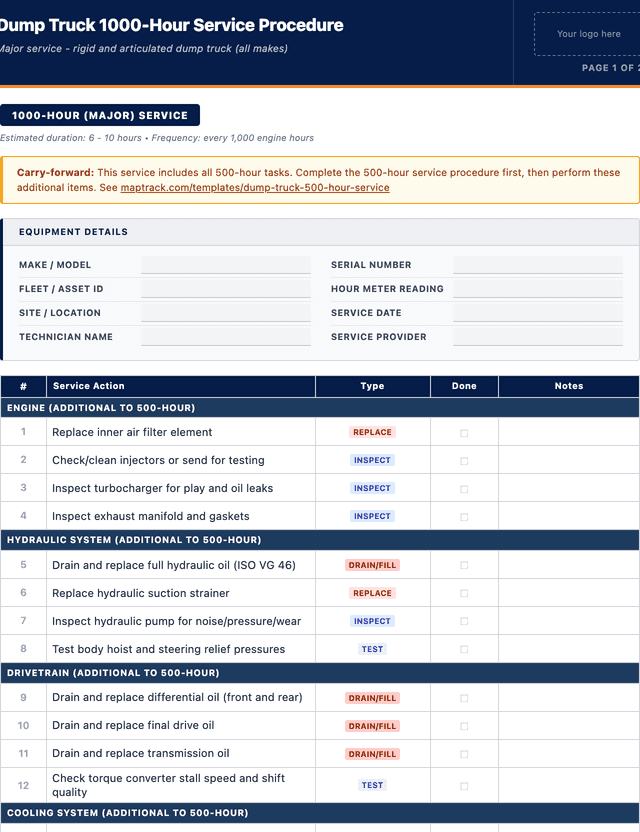
Engine (additional to 500-hour)
Hydraulic System (additional to 500-hour)
Drivetrain (additional to 500-hour)
Cooling System (additional to 500-hour)
Brakes (additional to 500-hour)
Body and Hoist (additional to 500-hour)
Structural and Tyres (additional to 500-hour)
How to use: download the PDF, print or complete digitally on any device.
- PDF format, ready to print or fill on screen
- Use as-is or customise to suit your operation
- Go digital in MapTrack for photos, reminders and audit trails
Download free PDF template
Use in MapTrack →



Trusted by teams across Australia and New Zealand
We respect your privacy. Unsubscribe anytime.
Or set it up in MapTrack
- Fill it in on a phone, attach photos to any check
- Automatic reports and audit trails
- The same checks as the PDF, ready to configure
Free 30-day trial. No credit card. Personal email accepted.
Don't just download it - use it live. Start a free workspace with this dump truck 1000-hour service checklist already built, so your crew can run it from a phone.

Co-Founder & Commercial Director
Key takeaways
- The MapTrack dump truck 1000-hour service checklist contains 25 checks across 7 sections. Sections covered: Engine (additional to 500-hour), Hydraulic System (additional to 500-hour), Drivetrain (additional to 500-hour), Cooling System (additional to 500-hour), Brakes (additional to 500-hour), Body and Hoist (additional to 500-hour), Structural and Tyres (additional to 500-hour).
Enter your email below to download this dump truck 1000-hour service checklist as a ready-to-use PDF.
Used by construction, mining and field service teams










What is a dump truck 1000-hour service checklist?
A 1,000-hour service is the third tier (major) of scheduled preventive maintenance for a rigid or articulated dump truck. It is performed every 1,000 engine hours, or approximately every 4 to 6 months of full-time operation. The 1,000-hour service carries forward all 500-hour tasks and adds the most significant fluid changes, structural assessments and wear measurements: draining and replacing the full hydraulic oil system, flushing and replacing the coolant, replacing differential and final drive oil, replacing transmission oil, inspecting the body hoist cylinders and pivot pins, performing a full brake system inspection including wet disc or dry disc brake measurement, inspecting all structural welds on the chassis, body and articulation joint, measuring tyre wear and checking wheel nut torque, and testing the retarder or exhaust brake system. This service typically takes 6 to 10 hours and is best performed in a workshop or hardstand due to the large fluid volumes and specialist testing equipment required.
Under Australian workplace health and safety legislation (WHS Act 2011, WHS Regulations 2011 Chapter 5), operators and owners of mobile plant have a duty to maintain equipment in a safe condition and to keep documented records of all maintenance activities. The 1,000-hour major service is a critical milestone that produces the evidence needed for compliance during audits and incident investigations. Dump trucks operate on haul roads with steep grades and heavy payloads, making brake system integrity, steering responsiveness and structural soundness especially critical. Without regular major services, drivetrain wear, hydraulic contamination, brake degradation and structural fatigue can go undetected, creating serious safety hazards and costly unplanned downtime.
Learn more about maintenance and work orders in MapTrack.
Benefits of using this dump truck 1000-hour service checklist
- Hydraulic system longevity: replacing the full hydraulic oil removes contamination, moisture and degraded additives that cause pump, valve and cylinder wear in the body hoist and steering circuits.
- Drivetrain protection: draining and replacing differential, final drive and transmission oil at 1,000 hours removes metal particles and degraded lubricant that accelerate gear, bearing and clutch pack wear.
- Brake system safety: a thorough brake inspection at the 1,000-hour major service verifies that wet disc or dry disc brakes, retarder and park brake are all within specification for safe operation on steep haul roads.
- Structural integrity: weld inspections on the chassis, body, A-frame and articulation joint detect fatigue cracking early, preventing failures that can occur under heavy payload and rough haul road conditions.
- Compliance with WHS legislation: documented 1,000-hour service records satisfy Chapter 5 plant maintenance obligations and demonstrate due diligence during audits and incident investigations.
- Resale value: a dump truck with documented 250, 500 and 1,000-hour service records commands a higher price at trade-in or sale, as buyers can verify the full maintenance history.
Benefits of digitising forms in MapTrack
When you digitise dump truck service procedures in MapTrack, you get:
- Field users can easily scan a QR code to complete a form on mobile. Unlimited users.
- Email the right people when a form is submitted, with an automation you set up.
- File every completed form against the asset, location or person it covers.
- Download any completed form as a PDF, with failed answers listed at the top.
- Fill in forms offline; they upload when the device is back online.
- Build conditional logic (show or hide questions based on answers).
- Take pictures or attach photos. Not possible with a paper-based form.
- Electronic signatures.
- Edit forms later without reprinting.
- Set who can view, fill in or edit forms with user roles.
- Upload a paper form (PDF, Word, Excel or a photo) and MapTrack's AI builds a digital version for you to check.
- Raise a work order from a submitted form with an automation you set up.
- Track service intervals by hours, kilometres or calendar date in one place.
- Attach supplier invoices and parts receipts to each maintenance record.
Book a demo to see how MapTrack handles dump truck service procedures.
Try MapTrack free for 30 days
Full access to every feature. No credit card required. Per-asset pricing so you scale as your fleet grows.
- No credit card required
- 30 days free trial
- Cancel anytime
1-2 days/week saved
“Bloody amazing! We used to spend 1-2 days a week tracking and managing our generators alone.”

Steve McAllister
Asset Coordinator, Saunders International
What to include in a dump truck 1000-hour service checklist
This dump truck 1000-hour service checklist covers 10 key areas:
- Engine: replace inner air filter element, check or send injectors for testing, inspect turbocharger for play and oil leaks, inspect exhaust manifold and gaskets.
- Hydraulic system: drain and replace full hydraulic oil (ISO VG 46 or manufacturer specification), replace hydraulic suction strainer, inspect hydraulic pump for noise, pressure and wear, test body hoist and steering relief pressures.
- Drivetrain: drain and replace differential oil (front and rear where applicable), drain and replace final drive oil, inspect drained oil for metal particles and discolouration.
- Transmission: drain and replace transmission oil, inspect torque converter for stall speed, check shift quality and clutch pack operation.
- Cooling system: drain, flush and replace coolant (50/50 ethylene glycol), pressure test the cooling system, replace thermostat if due per manufacturer schedule.
- Brakes: measure wet disc or dry disc brake wear, test service brake stopping performance, test retarder or exhaust brake operation, test park brake holding capacity on grade.
- Body and hoist: inspect body hoist cylinders for leaks and rod scoring, check hoist pivot pins and bushes for wear, inspect body floor and sidewall wear plates, check tailgate mechanism.
- Structural: visual inspection of chassis welds, A-frame welds, articulation joint (if articulated), body mounting bolts and brackets for cracking or looseness.
- Tyres and wheels: measure tyre tread depth and inspect for cuts, check wheel nut torque, inspect rims for cracks or damage.
- Electrical and safety: test all lights, indicators, beacon, reversing alarm and camera. Check battery terminals and alternator output.
How to use this dump truck 1000-hour service checklist
- Complete the full 500-hour service procedure first (which includes all 250-hour tasks). Use the 500-hour service checklist as the starting point.: Verify all 250-hour and 500-hour items are completed and defects documented before starting the 1,000-hour specific tasks. This ensures the cumulative service model is properly followed and no items are missed.
- Replace the inner air filter element. Check or send injectors for testing. Inspect the turbocharger for shaft play and oil leaks. Inspect the exhaust manifold and gaskets.: Handle the inner element carefully to prevent debris entering the intake manifold. Inspect injector nozzles for carbon buildup and check for visible fuel leaks. Check turbo shaft play by gripping the compressor wheel and testing for radial and axial movement. Inspect the exhaust manifold for heat-related cracks around stud holes.
- Drain the full hydraulic oil system. Replace the hydraulic suction strainer. Refill with fresh hydraulic oil per manufacturer specification. Test body hoist and steering relief pressures.: Dump truck hydraulic systems typically hold 100 to 250 litres depending on machine size. Drain the tank, cylinders and lines as thoroughly as possible. Clean the suction strainer housing before fitting the new element. After refilling, cycle the body hoist and steering through their full range at idle to bleed air. Test relief pressures against manufacturer specifications.
- Drain and replace differential oil, final drive oil and transmission oil. Inspect drained oil for metal particles or discolouration.: Position each drain plug at the lowest point before draining. Metal particles in the drained oil indicate gear, bearing or clutch pack wear and should be investigated before the truck returns to service. After refilling transmission oil, test shift quality through all gears and check torque converter stall speed if the manufacturer specifies a check at this interval.
- Drain, flush and replace the coolant. Pressure test the cooling system for leaks. Replace the thermostat if due per the manufacturer schedule.: Flush the system with clean water until the discharge runs clear. Refill with pre-mixed 50/50 coolant. Pressure test at the radiator cap rating (typically 100 to 110 kPa) and hold for 10 minutes to check for leaks. Inspect all hoses, clamps and the water pump weep hole.
- Perform a full brake system inspection. Measure wet disc or dry disc brake wear. Test service brake, retarder and park brake operation. Inspect body hoist cylinders, pivot pins and body wear plates.: Measure brake disc and pad wear against manufacturer minimum specifications. Test service brake stopping distance at a safe location. Verify retarder or exhaust brake operation on a grade if possible. Test park brake holding capacity. Inspect hoist cylinder rods for scoring and seals for leaks. Check pivot pin bushes for excessive play. Measure body floor wear plate thickness at high-wear points.
- Inspect structural welds on the chassis, A-frame, articulation joint and body mounting. Measure tyre wear and check wheel nut torque.: Focus on high-stress areas including chassis rail welds near the suspension mounts, A-frame pivot welds, articulation bearing housing (if articulated) and body mounting bracket welds. Use a strong light for visual inspection. Any suspected cracks should be verified by NDT before the truck returns to service. Measure tyre tread depth and inspect sidewalls for cuts. Torque wheel nuts to manufacturer specification.
- Start the engine and cycle all functions. Check for leaks, abnormal noises or warning lights. Record any defects and set the next service intervals.: Run the engine to full operating temperature and cycle the body hoist through its full range. Drive the truck a short distance testing steering, brakes and transmission. Walk around the machine checking for new fluid leaks. Confirm all gauges and indicators read within the normal range. Record next 250, 500 and 1,000-hour service due hours in MapTrack.
In MapTrack, you can schedule and track maintenance digitally, by date or meter reading. Each submission is stored as a timestamped PDF against the asset record.
Get the free templateEnter your email above to download the full dump truck 1000-hour service checklist as a PDF.Back to download formHow often should you complete this service procedure?
A 1,000-hour major service should be performed every 1,000 engine hours, which typically equates to every 4 to 6 months of full-time dump truck operation. This service carries forward all 250-hour and 500-hour tasks. For dump trucks operating on steep haul roads, carrying consistently heavy payloads or working in abrasive conditions, consider shortening the brake inspection interval and the hydraulic oil change interval. Always follow the manufacturer service schedule and WHS Regulations 2011 Chapter 5 requirements for your specific dump truck model. In MapTrack, set up meter-based maintenance schedules with automatic work order generation as each truck approaches its next service threshold.
Frequently asked questions
Applicable regulatory standards
This template is a starting point. Check the current requirements that apply to your equipment, work and location. The template alone does not establish compliance.
- WHS Act 2011
- WHS Regulations 2011 Chapter 5 (Plant and Structures)
- AS 4024 (Safety of Machinery)
- Safe Work Australia CoP: Managing Risks of Plant
- State Mining Safety Legislation (Qld, NSW, WA, etc.)
- Safe Work Australia Code of Practice: Managing Risks of Plant in the Workplace
Dump truck 1000-hour service checklist preview
The numbers behind this dump truck 1000-hour service checklist
Every figure below is sourced and dated, so you can quote it in a toolbox talk, a budget case or a board paper without having to chase the original report.
Embed this free template on your website
Run an industry blog, trade association site, or training resource? Drop a preview of this free dump truck 1000-hour service checklist straight into your page. The snippet is self-contained, needs no scripts, and links readers back to the full free template.
<div style="max-width:480px;font-family:system-ui,-apple-system,'Segoe UI',Roboto,sans-serif;border:1px solid #E5E7EB;border-radius:12px;padding:20px;background:#ffffff;">
  <p style="font-size:12px;font-weight:700;letter-spacing:0.05em;text-transform:uppercase;color:#071D49;margin:0;">Free template</p>
  <p style="font-size:18px;font-weight:700;color:#071D49;margin:6px 0 0;">Dump truck 1000-hour service checklist</p>
  <ul style="margin:12px 0 0;padding-left:18px;color:#374151;font-size:14px;line-height:1.6;">
    <li style="margin:4px 0;">Engine: replace inner air filter element, check or send injectors for testing, inspect turbocharger for play and oil leaks, inspect exhaust manifold and gaskets.</li>
    <li style="margin:4px 0;">Hydraulic system: drain and replace full hydraulic oil (ISO VG 46 or manufacturer specification), replace hydraulic suction strainer, inspect hydraulic pump for noise, pressure and wear, test body hoist and steering relief pressures.</li>
    <li style="margin:4px 0;">Drivetrain: drain and replace differential oil (front and rear where applicable), drain and replace final drive oil, inspect drained oil for metal particles and discolouration.</li>
    <li style="margin:4px 0;">Transmission: drain and replace transmission oil, inspect torque converter for stall speed, check shift quality and clutch pack operation.</li>
    <li style="margin:4px 0;">Cooling system: drain, flush and replace coolant (50/50 ethylene glycol), pressure test the cooling system, replace thermostat if due per manufacturer schedule.</li>
    <li style="margin:4px 0;">Brakes: measure wet disc or dry disc brake wear, test service brake stopping performance, test retarder or exhaust brake operation, test park brake holding capacity on grade.</li>
  </ul>
  <p style="font-size:13px;color:#6B7280;margin:14px 0 0;padding-top:12px;border-top:1px solid #E5E7EB;">Free <a href="https://www.maptrack.com/templates/dump-truck-1000-hour-service" style="color:#071D49;font-weight:600;text-decoration:none;">Dump truck 1000-hour service checklist</a> by MapTrack</p>
</div>Free to reuse, including commercially. This template is published under a Creative Commons Attribution 4.0 licence. Copy it, adapt it, put it on your own site or in your own docs. All we ask is that you credit MapTrack with a link back to this page. The snippet above already includes that credit, so if you use it as-is you’re covered.
Cite this template
Writing about this topic? You’re welcome to quote this checklist. Here’s the wording to use so your readers can find the original.
The MapTrack dump truck 1000-hour service checklist contains 25 checks across 7 sections.
- Short attribution
- MapTrack Dump truck 1000-hour service checklist, https://www.maptrack.com/templates/dump-truck-1000-hour-service
- Reference list
- MapTrack. (2026). Dump truck 1000-hour service checklist [Checklist template]. Retrieved from https://www.maptrack.com/templates/dump-truck-1000-hour-service
Free to reuse with credit under a Creative Commons Attribution 4.0 licence. If you’d rather link straight to it, the page is https://www.maptrack.com/templates/dump-truck-1000-hour-service.
Need to schedule and track maintenance digitally, by date or meter reading?
Register every dump truck in MapTrack, attach digital forms, and get a complete history of every inspection, service and compliance record.
Maintenance and work orders · All templates · Pricing · Book a demo