
Asset label material
Heavy-Duty Polyester Asset Labels Australia
Heavy-duty polyester gives teams an economical online label option for high-volume equipment identification where custom branding, QR scanning and waterproof durability matter.
Online checkout available from 200 labels per size, in steps of 100, using the same transparent size and volume tiers as standard QR labels. Current online label pricing is $1.50-$6.00 ex GST ($1.65-$6.60 inc GST) per label, with free AU shipping over $500.
Heavy-duty polyester
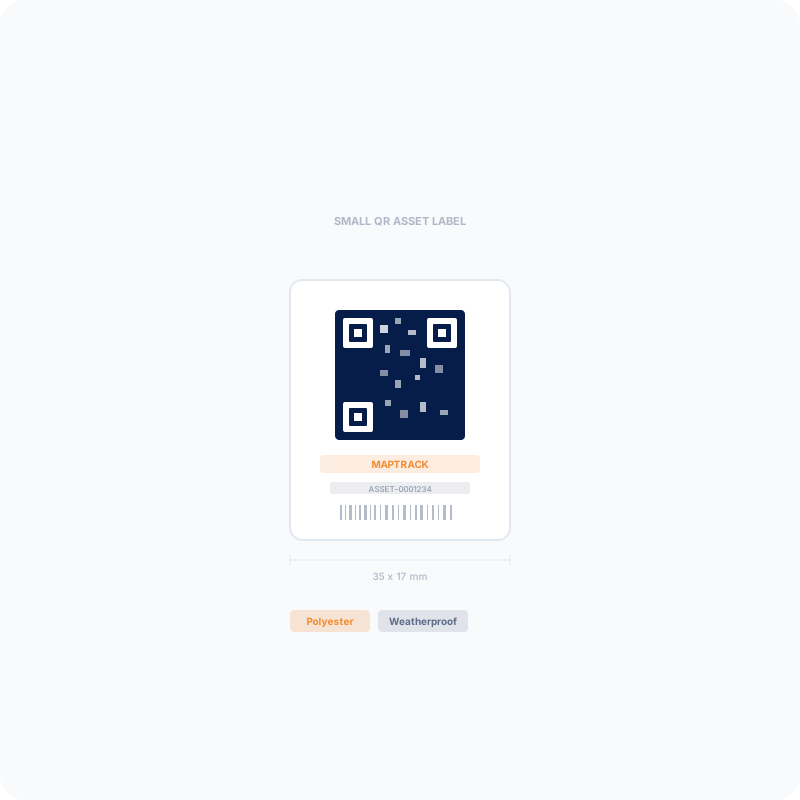
Small
35 × 17 mm
Medium
25 × 50 mm
Large
35 × 65 mm
Trusted by Australian teams tracking tools, plant and equipment








“Thanks to MapTrack we know exactly where our gear is, who has it and when it needs servicing.”
Best fit
- IT assets, workshop tools, stores equipment and indoor-outdoor plant.
- Bulk rollouts where price transparency and fast ordering matter.
- Assets that need a durable QR identity but not a rigid metal plate.
Quote or sample first when
- The asset faces repeated scraping, grinding or heavy impact.
- You need riveted or screwed metal plates.
- The surface cannot be cleaned before adhesive application.
Specifications
Material, code and mounting details
Every label order is proofed around the asset, scan distance and rollout plan. Standard QR labels can be paid online; metal, barcode and mechanical mounting combinations are confirmed before production.
Material
Laminated synthetic polyester label stock
Adhesive
3M industrial adhesive for clean surfaces
Code format
QR code online; barcode by proof
Custom print
Logo, colour, phone and asset prefix
Sizes
35 x 17 mm, 25 x 50 mm and 35 x 65 mm
Minimum order
200 labels per size, then steps of 100
Environment fit
Confirm the material against the real application
Stores, IT, workshops and indoor-outdoor gear
Polyester is a laminated synthetic label stock: waterproof, rated for outdoor use and able to take rain, mud, fuel, oil and pressure washing. It is the economical pick when you are labelling a lot of general equipment and do not need the tougher polycarbonate face.
- Use it for IT assets, workshop tools, stores equipment and indoor-outdoor plant.
- Pick it for bulk rollouts where a clear price and fast ordering matter most.
- Choose polycarbonate instead when the gear gets dragged, scraped or handled hard on site.
- Choose a metal tag when the asset needs rivets or screws, or faces corrosive washdown.
Sizes by material
Polyester label sizes for tools, plant and equipment
Use the smallest readable label that fits the surface. Larger assets and longer scan distances usually need a larger QR code or a quoted custom plate.
Polyester Small
35 × 17 mm polyester asset labels
Best for hand tools, power tools, it assets, small equipment. Configure this size online from 200 labels, in steps of 100.
Configure this sizePolyester Medium
25 × 50 mm polyester asset labels
Best for plant, machinery, fleet vehicles, site equipment. Configure this size online from 200 labels, in steps of 100.
Configure this sizePolyester Large
35 × 65 mm polyester asset labels
Best for excavators, heavy plant, containers, trailers. Configure this size online from 200 labels, in steps of 100.
Configure this sizeProofing and samples
Test the label on real equipment before a large rollout
A useful sample should prove more than material feel. MapTrack ties the label test to the scan workflow, asset record and rollout design.
Use the label designer for print-ready artwork or upload your logo during checkout.
MapTrack prepares the QR sequence and links labels to your account.
Use a sample pilot when surfaces are curved, flexible or frequently cleaned.
Fitting, ordering and returns
How to fit, order and return polyester labels
Fitting them so they last
- Pick a flat spot that is easy to reach with a phone and clear of edges, seams and impact zones. Curved surfaces can lift the edges.
- Make sure the surface is clean and dry. On oily or dusty gear, wipe it with isopropyl alcohol first.
- Press the label down firmly. The 3M industrial adhesive bonds to metal, plastic, painted and powder-coated surfaces and holds through vibration and temperature changes.
- On gear that's washed hard, don't point a label edge straight into the spray.
- For very rough, flexible or contaminated surfaces, or machines that run hot or get pressure-washed daily, test a sample on the real asset before labelling the whole fleet.
How ordering works
- 1Choose a size: small 35 × 17 mm, medium 25 × 50 mm or large 35 × 65 mm.
- 2Set the quantity: from 200 labels a size, in steps of 100, with the price per label stepping down at 300, 500, 1,000 and 2,000+.
- 3Add your logo, phone number and asset prefix, or use the free label designer. Rather we did it? Choose "Let us design it for you" and we'll send a proof within 1 business day, free.
- 4Enter your MapTrack account email, and our team links the QR codes to your account during fulfilment, so they're ready to scan when they arrive.
- 5Pay by card through Stripe. Labels take 3-5 business days to print and dispatch, then 2-5 business days within Australia. Orders over $500 ship free, with a $15 flat rate below that threshold.
Proofs, returns and refunds
- Custom-printed labels go into production straight away and can’t be cancelled once printing has begun.
- Custom-printed labels and tags carry your logo and asset numbers, so they aren't eligible for change-of-mind returns.
- If anything arrives faulty, damaged or not as ordered, contact us within 30 days of delivery for a full refund or replacement, with free return shipping.
- Approved refunds go back to your original payment method within 5 business days.
- Your rights under the Australian Consumer Law always apply on top of this.
Compare materials
Choose by environment, not just unit price
For a broader explainer, read the asset label material guide.
Material FAQ
Common questions
When should I choose polyester asset labels?
Can polyester labels carry a barcode instead of QR?
Labels plus tracking
The label is the entry point to the asset record
MapTrack labels do more than identify equipment. Scanning opens check-out, inspections, history, faults and optional GPS or Bluetooth location workflows.