
Free template · PDF
Free smoke detector inspection checklist
Free smoke detector inspection checklist (PDF-ready). Covers functional testing, sensitivity, battery condition and cleaning per AS 1851 and NFPA 72.
Loading PDF page...
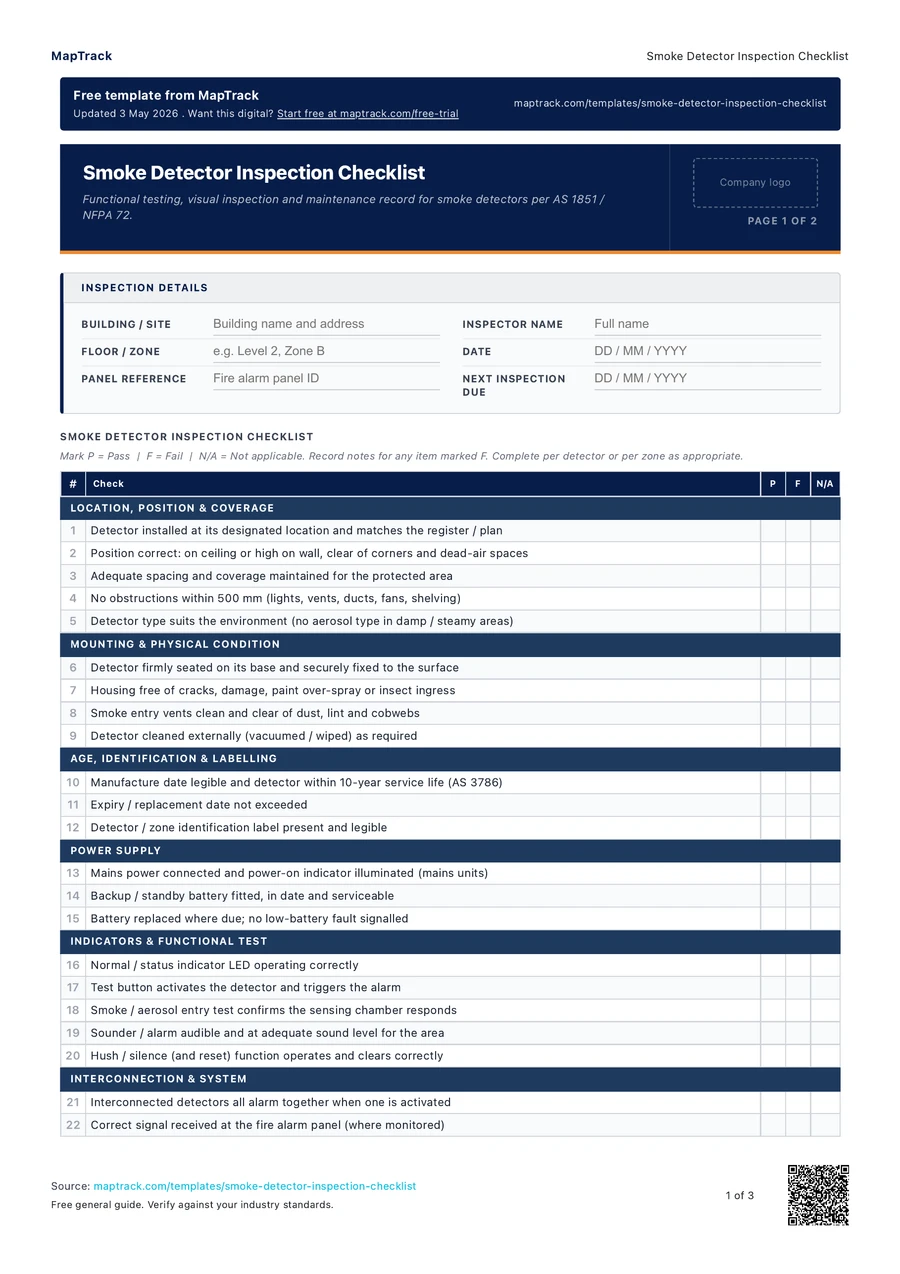


Read the form fields
24 checks · 6 sections · Sign-off
24 checks
The fields in the printable form, in a view that fits your screen.
- Building / site
- Inspector name
- Floor / zone
- Date
- Panel reference
- Next inspection due
- Total detectors
- Passed
- Failed
- Replaced
- Panel status after
- Batteries replaced
Location, Position & Coverage
Mounting & Physical Condition
Age, Identification & Labelling
Power Supply
Indicators & Functional Test
Interconnection & System
Declaration
I declare that I have inspected and tested the smoke detectors listed above in accordance with the applicable standard (AS 1851 / NFPA 72 / BS 5839). All detectors that passed are functioning correctly. Any detectors that failed or require replacement have been noted and reported to the building manager. The fire alarm system has been restored from test mode and is operating normally.
Inspector Sign-off
Signature · Print name · Licence / cert # · Date
Building Manager Acknowledgement
Signature · Print name · Date
The MapTrack smoke detector inspection checklist contains 24 checks across 6 sections.

Make this form your own
Add your fields and logo. Give your team a form they can use on site.
Free trial. No credit card. Work email needed.
Customise & use this form now for free



“MapTrack beat them all in every aspect.”
 Vincent Stone · HSEQ Advisor, Concept Tanks
After signup: customise the template, then save and publish it for your team.
General guidance only. Check the form against your equipment manual, site procedures and local requirements before using it.
Short answer
A smoke detector inspection checklist records each detector's location, type and serial number with its visual check, functional test, cleaning, battery status and pass or fail result. Fire contractors and facility managers complete it at each routine service. In Australia, Section 6 of AS 1851-2012 covers routine service of fire detection and alarm systems; in the US, NFPA 72 Chapter 14 sets inspection and testing frequencies.
Checked against AS 1851-2012 (incl. Amd 1:2016) on by the MapTrack templates team. How we check templates
Key takeaways
- The MapTrack smoke detector inspection checklist contains 24 checks across 6 sections. Sections covered: Location, Position & Coverage, Mounting & Physical Condition, Age, Identification & Labelling, Power Supply, Indicators & Functional Test, Interconnection & System.
- AS 1851-2012 Section 6 covers routine service of fire detection and alarm systems; clause 1.11 sets service intervals and the tolerance around each due date.
- AS 1851 clause 1.16 covers the service record: logbooks, tags and labels, summary records and how long records are kept.
- Report a failed detector as a defect under AS 1851 clause 1.17, and test it for correct function after repair under clause 1.15.
- NFPA 72 Chapter 14 sets US inspection and test frequencies; check which edition your authority having jurisdiction enforces.
- BS 5839-1:2025 applies to UK non-domestic premises only; the 2017 edition was withdrawn on 29 April 2025.
What is a smoke detector inspection checklist?
A smoke detector inspection checklist is a structured document used to record the systematic testing, inspection and maintenance of smoke detectors (also called smoke alarms) in a building or facility. The checklist covers visual inspection of each detector for physical damage, contamination and correct mounting, functional testing by activating the test button or applying test aerosol, verification that the detector triggers the fire alarm panel and any connected notification devices, battery condition and replacement status, detector sensitivity testing where applicable, cleaning to remove dust and debris that can cause false alarms or reduced sensitivity, and recording of the detector location, type, serial number, installation date and service history.
Smoke detectors are a critical first line of defence in fire safety. They provide early warning of a developing fire, giving occupants time to evacuate and emergency services time to respond. However, a smoke detector that is dirty, has a flat battery, is painted over, has been disconnected or has drifted out of sensitivity range provides no protection at all. Regular documented inspections are the only way to confirm that every detector in the building will function as intended when it matters most. In Australia, AS 1851 sets out the routine service requirements for fire protection systems, including smoke detection. In the United States, NFPA 72 governs inspection, testing and maintenance of fire alarm systems. In the United Kingdom, BS 5839 provides the equivalent requirements. Regardless of jurisdiction, a documented inspection programme is essential for compliance, insurance and duty of care.
Learn more about compliance and inspections in MapTrack.
Testing detectors floor by floor? See fire equipment inspection and tagging for keeping each detector's results on the building's register.
Choose the format that fits your team
Download the PDF
Use the original printable form for a paper workflow. Check it against your equipment and site procedure before the job.
Keep completed copies in your own record system and arrange any follow-up through your normal process.
Download free PDFCustomise a form in MapTrack
Start a free trial, adjust the digital form to your workflow, then save and publish it for your team to use.
Your account uses the digital template. Sample answers on this page and completed PDF records aren't imported automatically.
Customise & use this form now for freeFree trial. No credit card. Work email needed.
Benefits of using this smoke detector inspection checklist
- Life safety assurance: confirm that every smoke detector in the building will detect smoke and trigger an alarm, providing early warning to occupants in the event of a fire.
- Regulatory compliance: meet the routine service and testing requirements of AS 1851 (Australia), NFPA 72 (United States) and BS 5839 (United Kingdom) for fire detection systems.
- False alarm reduction: regular cleaning and sensitivity testing identifies detectors that are contaminated with dust, grease or insects, which are a leading cause of nuisance false alarms.
- Insurance compliance: many commercial insurance policies require documented evidence of regular fire detection system testing to maintain coverage and avoid premium increases.
- Battery management: systematic inspection catches flat, corroded or missing batteries before they cause a detector to fail when needed.
- Asset lifecycle tracking: recording the installation date, service history and test results for each detector supports replacement planning when detectors reach end of life, typically 10 years.
What to include in a smoke detector inspection checklist
- Building and inspection details: building name or address, floor or zone, inspector name, date of inspection, fire alarm panel reference, next scheduled inspection date.
- Detector identification: location or zone identifier, detector type (ionisation, photoelectric, combination, aspirating), make and model, serial number, installation date.
- Visual inspection: detector physically present and correctly mounted, no paint or coverings, no visible damage or discolouration, indicator LED visible, no obstructions within required clearance zone.
- Functional test: test button pressed or approved test method applied (aerosol, magnet), detector responded (alarm activated), fire alarm panel received signal, notification devices activated (sounders, strobes, monitoring centre).
- Battery condition (battery-powered detectors): battery present, correct type, voltage tested (if applicable), battery replaced (yes / no / N/A for hardwired detectors), replacement date recorded.
- Sensitivity test (where applicable): detector sensitivity within manufacturer specified range, drift compensation status, sensitivity reading recorded.
- Cleaning: detector head cleaned or vacuumed to remove dust, insects and debris, detector chamber inspected for contamination.
- Test result: pass (detector functions correctly), fail (detector failed to respond or is outside parameters), or replace (detector damaged, expired or unserviceable).
- Notes and actions: space for recording follow-up actions such as detector replacement, panel fault clearance or referral to fire protection contractor.
How to use this smoke detector inspection checklist
Record the building details, floor or zone, inspector name and date. Obtain the site fire alarm panel status and confirm no existing faults before starting the inspection.
Check the fire alarm panel for any pre-existing faults, isolations or disabled zones. Record the panel status at the start of the inspection. If faults exist, note them and advise the building manager. Place the fire alarm system into test mode or notify the monitoring centre before conducting functional tests to avoid false alarm callouts.
For each detector, record the location, type, serial number and installation date. Conduct a visual inspection for physical damage, contamination, paint, obstructions and correct mounting.
Visually inspect each detector from the ground or access platform. Check that the detector is securely mounted, the indicator LED is visible and functioning, no paint or coverings have been applied, no physical damage or discolouration is present, and no obstructions such as shelving, equipment or stored materials are within the required clearance zone specified by the manufacturer and relevant standard.
Conduct a functional test by pressing the test button or applying an approved test method. Confirm the detector triggers the fire alarm panel and any notification devices.
Press the test button on each detector and confirm the alarm activates locally, the fire alarm panel receives the signal and displays the correct zone and detector address, and any connected notification devices (sounders, strobes, auto-diallers) activate. For aspirating smoke detection systems, use the manufacturer specified test method. Record the response time and panel indication for each detector.
Check battery condition for battery-powered detectors. Replace batteries that are flat, corroded or approaching end of life.
For battery-powered detectors, remove the battery and inspect for corrosion or leakage. Test battery voltage with a multimeter if required. Replace batteries that fail the test, show corrosion or are past the manufacturer recommended replacement interval, typically 12 months for alkaline or up to 10 years for sealed lithium batteries. Record the battery type and replacement date.
Clean each detector head by vacuuming or wiping to remove dust, insects and debris. Inspect the sensing chamber for contamination.
Use a soft brush attachment on a vacuum cleaner to gently remove dust and debris from the detector housing and sensing openings. Do not use compressed air, as this can push contaminants further into the sensing chamber. For detectors in environments prone to contamination (kitchens, workshops, dusty environments), more frequent cleaning may be required to prevent false alarms.
Record the test result for each detector (pass, fail or replace), note any follow-up actions and sign the completed checklist.
Mark each detector as pass, fail or replace. For any detector that fails the functional test or visual inspection, record the defect and the corrective action required, such as replacement, cleaning, re-mounting or panel fault clearance. Sign and date the checklist, restore the fire alarm system from test mode, and file the record. Provide a copy to the building manager or facilities team.
Try MapTrack free
Full access to every feature. No credit card required. Per-asset pricing so you scale as your fleet grows.
- No credit card required
How often should you complete this checklist?
Under AS 1851, smoke detectors in commercial and residential buildings must be tested at defined intervals depending on the system type and occupancy classification. Monthly checks typically cover fire alarm panel status and visual walkthrough. Six-monthly testing covers functional testing of all detectors. Annual maintenance includes sensitivity testing, battery replacement (where applicable) and detailed inspection. NFPA 72 requires visual inspection semi-annually and functional testing annually, with sensitivity testing as required by the manufacturer. BS 5839 recommends weekly visual checks, monthly functional tests of a proportion of the system and annual testing of all detectors. Regardless of the standard, any detector that fails a test must be repaired or replaced promptly. Detectors should be replaced at the manufacturer recommended end-of-life interval, typically 10 years from the date of manufacture.
Make this form your own
From your template to your team.
Start with this template, adjust it for your equipment and site, then save and publish the digital form for your team.
- 01
Start your free trial
Use your work email to create your MapTrack account.
- 02
Customise, save and publish
Adjust the template fields and branding for your site.
- 03
Complete it on the job
Record checks, add photos and export a branded PDF.
Keep working offline
Load the form before you lose reception. Complete it offline and sync when you're back online.
Scan the asset. Open its form.
Use an asset's QR code to find and complete the forms that belong to it.
Show what you found
Capture photos and attach files so the next person has the details they need.
Take a branded PDF with you
Download completed forms as PDF reports with your company logo.
The trial uses a digital template. Completed paper records aren't imported automatically.
Frequently asked questions
Practical answers about the form, record keeping and using MapTrack.
A smoke detector inspection checklist is a document used to record the systematic testing, visual inspection, battery check, cleaning and functional test of each smoke detector in a building. It captures the detector location, type, serial number, installation date, test method, result (pass, fail or replace) and any follow-up actions required. The checklist provides documented evidence that the fire detection system has been inspected and tested in accordance with the applicable standard, such as AS 1851, NFPA 72 or BS 5839.
Link to this answerTesting frequency depends on the applicable standard and the building type. Under AS 1851, functional testing of smoke detectors is typically required every six months, with annual sensitivity testing and detailed maintenance. NFPA 72 requires annual functional testing and sensitivity testing per the manufacturer schedule. BS 5839 recommends monthly functional tests of a proportion of the system. In residential properties, Australian state and territory legislation generally requires annual testing by the property owner or manager. The fire alarm panel should be checked monthly for faults and isolations.
Link to this answerAS 1851 (Routine Service of Fire Protection Systems and Equipment) is the primary standard governing the inspection, testing and maintenance of fire detection systems in Australia. It sets out the frequency and method for testing smoke detectors, checking batteries, conducting sensitivity tests and maintaining the fire alarm panel. State and territory building codes and fire safety legislation reference AS 1851 for compliance. Each state also has specific legislation governing smoke alarm requirements in residential properties.
Link to this answerA smoke alarm is a self-contained device with a built-in sounder that detects smoke and produces an audible alarm at the unit itself. It is commonly used in residential properties. A smoke detector is a sensing device that is connected to a central fire alarm panel as part of a larger fire detection system. When the detector senses smoke, it sends a signal to the panel, which then activates sounders, strobes and notification systems throughout the building. Both require regular inspection, testing and maintenance to function correctly.
Link to this answerYes. Digital smoke detector inspection on a tablet or mobile device lets you scan a QR code on each detector, complete the checklist, attach photos, record pass or fail results, and store the record against the asset in your system. MapTrack supports fire safety equipment tracking with automated inspection reminders, digital forms and a complete audit trail linked to each detector asset. This replaces paper checklists and ensures no detector is missed. Book a demo to see how it works.
Link to this answerApplicable regulatory standards
This form is a starting point. Check the current requirements that apply to your equipment, work and location. The form alone does not establish compliance.
| Standard | Edition | Clauses this template relies on | Source |
|---|---|---|---|
| Routine service of fire protection systems and equipmentRoutine service of fire detection and alarm systems: service intervals and tolerances, post-repair testing, records and defect reporting. | AS 1851-2012 (incl. Amd 1:2016) |
| Standards AustraliaSold by the publisher |
| National Fire Alarm and Signaling CodeUS inspection, testing and maintenance frequencies and records. Check the edition your authority having jurisdiction enforces. | NFPA 72, 2025 edition |
| National Fire Protection Association (NFPA)Sold by the publisher |
| Fire detection and fire alarm systems for buildings - Design, installation, commissioning and maintenance of systems in non-domestic premises. Code of practiceUK code of practice for fire detection and alarm systems in non-domestic premises, 2025 edition; the 2017 edition was withdrawn. | BS 5839-1:2025 | Whole instrument | BSI (British Standards Institution)Sold by the publisher |
Routine service of fire protection systems and equipment
Edition: AS 1851-2012 (incl. Amd 1:2016)
Routine service of fire detection and alarm systems: service intervals and tolerances, post-repair testing, records and defect reporting.
- Section 6: Routine service of fire detection and alarm systems.
- 1.11: Frequency of routine service intervals, allowed tolerances and changes to scheduled dates.
- 1.15: Testing the system or component for correct function after defect rectification.
- 1.16: Routine service records: logbooks, tags and labels, summary records and record retention.
- 1.17: Reporting defects, non-conformances and service activities outside timing tolerances, plus yearly condition reports.
Standards AustraliaSold by the publisher
National Fire Alarm and Signaling Code
Edition: NFPA 72, 2025 edition
US inspection, testing and maintenance frequencies and records. Check the edition your authority having jurisdiction enforces.
- Chapter 14: Inspection, testing and maintenance of fire alarm and signalling systems, including test methods, frequencies and records.
National Fire Protection Association (NFPA)Sold by the publisher
Fire detection and fire alarm systems for buildings - Design, installation, commissioning and maintenance of systems in non-domestic premises. Code of practice
Edition: BS 5839-1:2025
UK code of practice for fire detection and alarm systems in non-domestic premises, 2025 edition; the 2017 edition was withdrawn.
BSI (British Standards Institution)Sold by the publisher
Each source was read at its publisher and the page checked on 26 October 2026. The publisher's current text is the authority.
MapTrack publishes this template. The linked authorities publish their own guidance; they haven't endorsed this form.
The numbers behind this smoke detector inspection checklist
The pages below gather the figures behind this kind of check. Each figure on them carries its source and date, so you can quote it in a toolbox talk, a budget case or a board paper without chasing the original report.
Get the free template
Enter your email above to download the full smoke detector inspection checklist as a PDF.
Cite this template
Writing about this topic? You’re welcome to quote this checklist. Here’s the wording to use so your readers can find the original.
The MapTrack smoke detector inspection checklist contains 24 checks across 6 sections.
- Short attribution
- MapTrack Smoke Detector Inspection Checklist, https://www.maptrack.com/templates/smoke-detector-inspection-checklist
- Reference list
- MapTrack. (2026). Smoke Detector Inspection Checklist [Checklist template]. Retrieved from https://www.maptrack.com/templates/smoke-detector-inspection-checklist
Free to reuse with credit under a Creative Commons Attribution 4.0 licence. If you’d rather link straight to it, the page is https://www.maptrack.com/templates/smoke-detector-inspection-checklist.
Embed this free template on your website
Run an industry blog, trade association site, or training resource? Drop a preview of this free smoke detector inspection checklist straight into your page. The snippet is self-contained, needs no scripts, and links readers back to the full free template.
<div style="max-width:480px;font-family:system-ui,-apple-system,'Segoe UI',Roboto,sans-serif;border:1px solid #E5E7EB;border-radius:12px;padding:20px;background:#ffffff;">
  <p style="font-size:12px;font-weight:700;letter-spacing:0.05em;text-transform:uppercase;color:#071D49;margin:0;">Free template</p>
  <p style="font-size:18px;font-weight:700;color:#071D49;margin:6px 0 0;">Smoke Detector Inspection Checklist</p>
  <ul style="margin:12px 0 0;padding-left:18px;color:#374151;font-size:14px;line-height:1.6;">
    <li style="margin:4px 0;">Building and inspection details: building name or address, floor or zone, inspector name, date of inspection, fire alarm panel reference, next scheduled inspection date.</li>
    <li style="margin:4px 0;">Detector identification: location or zone identifier, detector type (ionisation, photoelectric, combination, aspirating), make and model, serial number, installation date.</li>
    <li style="margin:4px 0;">Visual inspection: detector physically present and correctly mounted, no paint or coverings, no visible damage or discolouration, indicator LED visible, no obstructions within required clearance zone.</li>
    <li style="margin:4px 0;">Functional test: test button pressed or approved test method applied (aerosol, magnet), detector responded (alarm activated), fire alarm panel received signal, notification devices activated (sounders, strobes, monitoring centre).</li>
    <li style="margin:4px 0;">Battery condition (battery-powered detectors): battery present, correct type, voltage tested (if applicable), battery replaced (yes / no / N/A for hardwired detectors), replacement date recorded.</li>
    <li style="margin:4px 0;">Sensitivity test (where applicable): detector sensitivity within manufacturer specified range, drift compensation status, sensitivity reading recorded.</li>
  </ul>
  <p style="font-size:13px;color:#6B7280;margin:14px 0 0;padding-top:12px;border-top:1px solid #E5E7EB;">Free <a href="https://www.maptrack.com/templates/smoke-detector-inspection-checklist" style="color:#071D49;font-weight:600;text-decoration:none;">Smoke Detector Inspection Checklist</a> by MapTrack</p>
</div>Free to reuse, including commercially. This template is published under a Creative Commons Attribution 4.0 licence. Copy it, adapt it, put it on your own site or in your own docs. All we ask is that you credit MapTrack with a link back to this page. The snippet above already includes that credit, so if you use it as-is you’re covered.
About the author

Co-Founder & Commercial Director
Jarrod has spent over a decade in technology consulting and asset management, including roles at Accenture (mining and heavy industry) and CGI as an Asset Management Consultant. He co-founded MapTrack and built and scaled its original platform, then rebuilt it with Lachlan and Alex from thousands of customer conversations and 300+ user research sessions with field teams. His consulting background gives him deep insight into the operational and compliance challenges facing asset-intensive Australian businesses.
View LinkedIn profile →Ready for your next job?
Keep the PDF handy, or customise the digital form for your team.